Key Takeaways
- Myelination is activity-dependent: oligodendrocytes selectively wrap axons that fire repeatedly, not axons that sit idle.
- Oligodendrocyte production rises within hours of focused practice; white-matter changes appear within roughly two weeks
- Effortful execution becomes automaticity through gradual insulation of skill circuits, not a psychological state
- Adult brains generate myelinating cells lifelong: skill acquisition at fifty and twenty-five uses identical hardware
- Practice that maximizes myelin recruitment is circuit-specific, sufficiently repeated, progressively challenging, and adequately spaced.
Myelination is the brain’s hardware mechanism for skill durability. When you repeatedly fire a circuit through deliberate practice, oligodendrocytes detect the activation pattern and wrap those axons with insulating myelin, accelerating signal transmission and converting effortful execution into automatic professional performance.
This article belongs to our research hub on learning agility and skill acquisition, where the mechanics of getting better are mapped.
How Does Myelin Affect Learning and Skill Development?
Myelin affects learning by physically rewiring the speed of professional skill circuits. Each repetition of a deliberate practice activates specific axons; oligodendrocytes recognize the pattern and selectively wrap those axons in myelin, increasing transmission velocity and signal precision until the circuit fires faster than conscious effort can match.
The mechanism is activity-dependent myelination: oligodendrocyte precursor cells distributed throughout the white matter sense the firing pattern of nearby axons, and the cells that successfully integrate signals from active fibers go on to mature into myelinating oligodendrocytes. Idle circuits are not insulated. Frequently fired circuits are.
This is why two professionals with identical formal training can perform at strikingly different speeds. The neuroscience of how the brain learns and thinks reveals that the difference is not motivation or talent in the loose sense: it is the cumulative wrapping of the specific circuits the work demands. Skill is the long shadow of repeated activation, written in white matter. A landmark Science paper showed that when researchers blocked the formation of new oligodendrocytes in mice, the animals could initiate a complex motor task but could not master it (McKenzie et al., 2014). The behavioral attempt was preserved; the consolidation of the skill was not.
Myelination is not a metaphor for learning. It is a substrate of learning, one of three core mechanisms behind Real-Time Neuroplasticity™, alongside synaptic strengthening and circuit pruning. For complex professional skills, it is the substrate that determines durability.
Does Learning Activate the Production of Myelin?
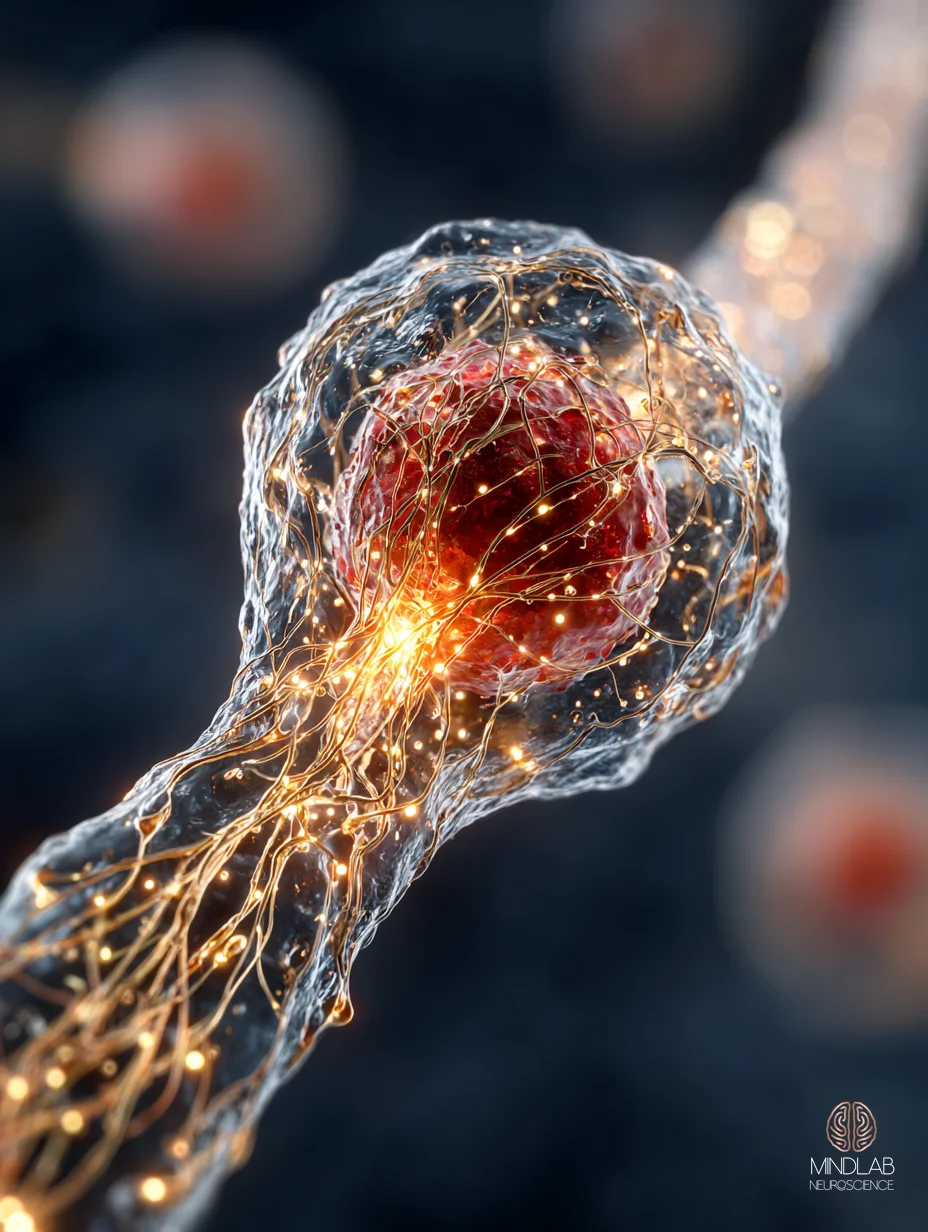
Yes. Learning directly activates myelin production. Repeated firing of a circuit signals oligodendrocyte precursor cells to differentiate, mature, and wrap surrounding axons. Studies in mice show that motor learning drives the formation of new oligodendrocytes within days, while blocking that formation prevents skill mastery from consolidating.
It sits within the broader work on peak performance systems that frames how skill and output are built.
The signaling cascade runs from action potential to oligodendrocyte. When an axon fires, it releases neurotransmitters along its length; nearby precursor cells detect those signals through specialized receptors and respond by surviving, dividing, and beginning the wrapping process. The more often the axon fires within a relevant window, the more strongly those precursor cells are recruited.
A 2022 study of motor-learning mice found that practice produced intermittent patterns of new myelin specifically on the axons activated during the training task, not on neighboring inactive axons (Bacmeister et al., 2022). The myelination was selective, targeted, and tied directly to which circuits the animal had actually used. This is the experimental signature of activity-dependent wrapping.
The implication for professional practice is uncomfortable but clarifying: cognitive effort that does not actually fire the target circuit produces little myelination. Reading about a skill, watching it performed, or thinking about it in the abstract activates different circuits than executing it. The hardware change requires activation of the specific fibers the skill relies on. Other learning mechanisms exist alongside this one, see our overview of neuroplasticity, memory, and learning, but myelination is the one that converts repetition into durability.

How Should Professionals Structure Practice to Build Myelin?
Professionals build myelin most efficiently through structured practice that combines high circuit-specificity, sufficient repetition, and progressive challenge. The protocol pattern: isolate the precise skill circuit, repeat it under accurate conditions, increase difficulty just past current capacity, and space sessions to allow oligodendrocyte recruitment between bouts of activation.
The memory side of durable learning is detailed in how memory consolidation works.
Four conditions consistently emerge from the experimental literature on activity-dependent myelination and the human white-matter studies of skilled performers.
Specificity. Practice must fire the target circuit, not a circuit that resembles it. Reading about negotiation does not myelinate negotiation. Watching a senior partner does not myelinate your own delivery. Only execution under realistic conditions does.
Repetition. Below a threshold of activation, oligodendrocyte recruitment is not triggered. The work has to be done often enough, within a relevant window, for precursor cells to detect a sustained firing pattern. Sporadic effort produces sporadic insulation.
Progressive challenge. Practice that stays inside current capacity activates already-myelinated circuits without recruiting new ones. The pattern must reach just past the current edge so that adjacent, less-insulated fibers are firing too.
For the wider method, read our guide to brain-based learning.
Spacing. The build happens between sessions. Continuous high-intensity practice without recovery windows leaves no time for the days-long oligodendrocyte response. Spaced repetition is not a memory trick: it is a hardware-recruitment schedule.
“A practice session is not the build. The practice session is the trigger; the build happens in the days that follow, when oligodendrocyte precursor cells respond to the firing patterns you laid down.”
This is consistent with the broader brain-based learning principles that govern any deliberate skill-acquisition program. The framework also extends to skill-rehearsal modalities: see our analysis of the neuroscience of visualization for how mental rehearsal interacts with these same circuits. None of this requires extraordinary willpower. It requires correct conditions, applied consistently, for long enough.
References
- Sampaio-Baptista, C., Khrapitchev, A. A., Foxley, S., Schlagheck, T., Scholz, J., et al. (2013). Motor skill learning induces changes in white matter microstructure and myelination. Journal of Neuroscience. https://doi.org/10.1523/jneurosci.3048-13.2013
- Monje, M. (2018). Myelin plasticity and nervous system function. Annual Review of Neuroscience. https://doi.org/10.1146/annurev-neuro-080317-061853
- Osso, L. A., & Hughes, E. G. (2024). Dynamics of mature myelin. Nature Neuroscience. https://doi.org/10.1038/s41593-024-01642-2
- Pan, S., Mayoral, S. R., Choi, H. S., Chan, J. R., & Kheirbek, M. A. (2020). Preservation of a remote fear memory requires new myelin formation. Nature Neuroscience. https://doi.org/10.1038/s41593-019-0582-1
What the First Conversation Looks Like
When someone reaches out to MindLAB Neuroscience about a skill they cannot seem to make automatic, the first conversation is not about discipline or effort. It is about which circuits are firing, how often, and under what conditions. I want to understand the actual practice, not the practice as imagined. We map what is being done now, isolate where the activation is sparse or too generic to recruit new myelin, and rebuild the schedule around the four conditions the literature identifies. NeuroSync™ assessment tools and the NeuroConcierge™ engagement structure exist for exactly this kind of precision work, turning effortful repetition into hardware-level skill. The work is specific. The mechanism is specific. The result is durable.
Is myelination the same as neuroplasticity?
Myelination is one form of neuroplasticity, not a synonym for the whole concept. Neuroplasticity covers any adaptive change in the nervous system, including synaptic strengthening, pruning, and circuit reorganization. Myelination specifically refers to the wrapping of axons by oligodendrocytes, which alters signal speed and timing. For durable professional skill, myelination is the form of plasticity that turns repeated activation into durable hardware.
Can you lose myelin from a skill you no longer practice?
Yes. Myelin remodels in both directions. Circuits that go unused over long periods undergo gradual demyelination as the wrapping is not maintained, while circuits that continue to fire retain their insulation. This is why elite skills rust without practice. The hardware is dynamic, not fixed. Maintenance practice is not redundant; it is the mechanism by which existing skill circuits remain insulated against the slow loss of unused wrapping over time.
Does myelination explain why some skills feel impossible to relearn?
Partly. Adult oligodendrocyte precursor cells respond more slowly to activation signals than they did in adolescence, and the brain has more competing circuits demanding wrapping. This raises the practice volume needed to fire a skill into automaticity at fifty compared with at twenty-five. The capability is preserved; the substrate simply takes longer to recruit. With correct conditions, the wrapping does still occur, the timeline is the variable, not the outcome.
How is myelin different from synaptic plasticity?
Synaptic plasticity changes the strength of connections between neurons; myelination changes the speed of signals along axons that connect them. Both are genuine forms of learning hardware, and both fire during deliberate practice. Synaptic changes happen quickly, within minutes to hours, while myelination unfolds over days to months. For automaticity, both are needed: synaptic strengthening to encode the pattern and myelination to make it fast enough to run without conscious oversight.
How much practice is enough to trigger new myelin?
There is no single number, but the experimental signal is clear: scattered, occasional effort below a threshold of activation does not recruit oligodendrocyte differentiation. The threshold appears to require sustained, frequent firing of the target circuit within days of each session, repeated over weeks. For professional skills, that translates to short, accurate, near-daily sessions that progressively challenge the circuit, rather than long, infrequent practice that lets the activation signal fade between bouts.