
Key Takeaways
- The brain does not think in errors, but in patterns automated as once-useful shortcuts.
- Cognitive distortions are Hebbian reinforcements: neural pathways activated repeatedly until they became the default route.
- The prefrontal cortex overrides automated thinking only when undepleted and when the override is practiced.
- Prediction error, fired when reality misses expectation, is the primary neurochemical trigger for cognitive change.
- Insight alone does not rewire: repeated, neuroplasticity-compatible experiences must disprove the pattern at circuit level.
Most people try to change their lives by adjusting their schedules, habits, or goals. Almost no one asks the deeper question that actually drives lasting change:
What, exactly, is my brain learning every single day?
That is what brain learning is: the way your brain rewires itself in response to repeated thoughts, emotions, and behaviors. Once you understand how your brain learns, you can finally see why certain mental patterns feel so stubborn, and what it actually takes to replace them.
Old, painful thinking does not stick around because you are weak. It sticks around because your brain has turned those thoughts into fast, efficient mental shortcuts. Many of those shortcuts show up as cognitive distortions and biases. They are not random, and they are not simply “negative thinking.” They are the predictable output of how the brain learns, shaped by millions of years of evolution.
In this article, we will explore brain learning in a clear, practical way: what cognitive distortions are, how they form in the brain, ten of the most common ones, and exactly how to use neuroscience-based tools to build new neural pathways that lead to more accurate, more helpful thinking.
You do not need to be a scientist. You only need curiosity and a willingness to practice. Your brain will do the rest.
A Personal Note from Dr. Sydney Ceruto
I am not writing about brain learning from a distance. I have had to use these tools inside my own life, inside my own nervous system, the very same way I am asking you to use them now.
For years, my brain carried a quiet, painful script: if I was left alone, it meant I was being abandoned. An unanswered text, a delayed reply, a quiet evening by myself, none of it felt neutral. My brain had learned to read those moments as rejection and ran the same old pathway: “You are being left. You do not matter.” Those were not facts. They were patterns my brain had wired through repetition and emotion, fusing “alone” with “abandoned” until that fusion shaped how I thought, felt, and behaved for a long time.
The work I describe here is the same work I had to do for myself. I learned to notice the pattern in real time, name it for what it was, and gently offer my brain a different option: “Someone stepping away does not mean I am being left. I am still safe. I am still worthy.” I practiced it in the small, everyday moments that used to trigger the old story, and slowly my nervous system learned something new. I have watched the same shift happen in hundreds of clients, bright and capable people who arrived convinced that “I always mess things up” or “I am never enough” was simply the truth about who they are. There is nothing wrong with your brain. It has been doing exactly what it was built to do, even when the results were painful. Brain learning is not your enemy. It is the very process we are going to use to change how you think, one practiced pathway at a time.
What Is Brain Learning?
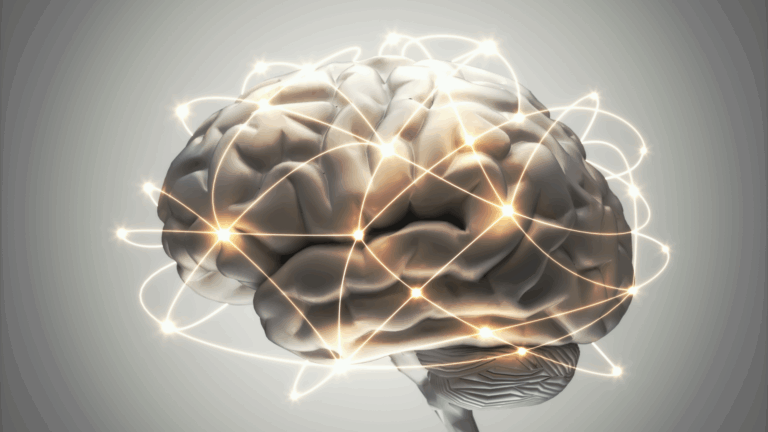
Brain learning is the ongoing process by which your nervous system turns experience into wiring. It has nothing to do with school or textbooks. It is how your brain silently learns from what you repeat and what feels important. Every time you think, feel, or act a certain way, groups of neurons fire together, and when that pattern repeats, the connections between those neurons strengthen so the pattern runs faster and more automatically next time.
In simple terms, neurons that fire together wire together. Repeated activation deepens those connections until the pattern becomes automatic. Because the brain stays plastic throughout life, even long-established mental habits remain changeable when new pathways get consistent, emotionally engaged practice over time.
If you repeatedly think “I always mess things up,” your brain treats that as a useful shortcut. It does not judge whether the thought is fair or kind. It notices repetition and emotional intensity, and “I always mess things up” becomes the fast lane in your mind.
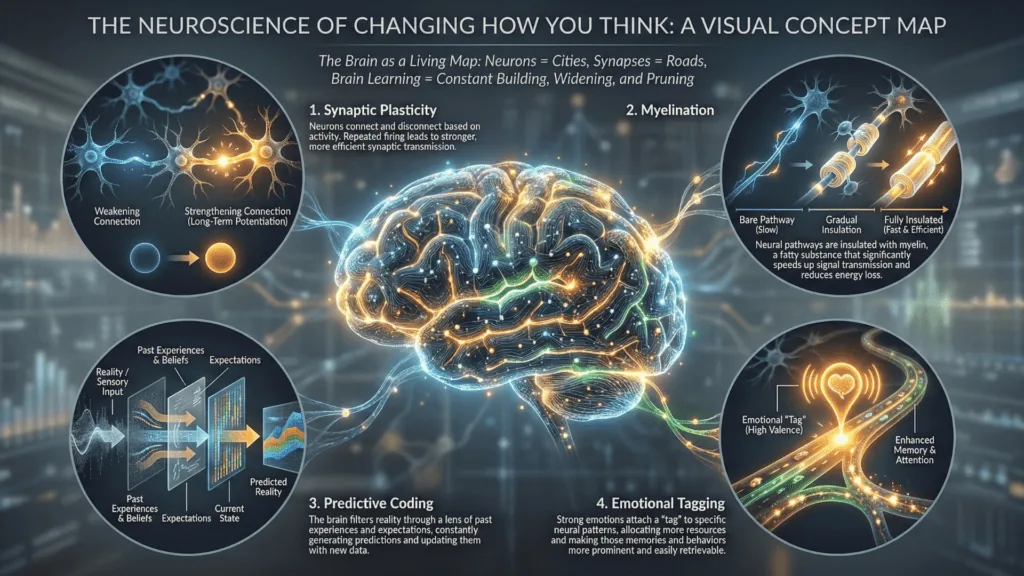
Changing how you think starts with respecting one basic fact: your brain is constantly optimizing for speed and efficiency. Picture it as a living, adaptive map. Neurons are the cities, synapses (the connections between neurons) are the roads, and brain learning is the constant building, widening, and pruning of those roads. When you think in a particular way often enough, your brain paves a highway for it. Signals travel faster, the supporting chemistry releases more efficiently, and eventually the route runs almost automatically. Real change is about building new roads and slowly diverting traffic away from the old ones, through a few key processes.
- Synaptic plasticity. The strength of a connection between neurons can rise or fall. Repeated activation strengthens a synapse; disuse weakens it. The brain leans on this rule constantly as it learns.
- Myelination. With repetition, some pathways get insulated with myelin, a fatty sheath that speeds signal transmission. That is why certain thoughts feel instant: brain learning has literally made those routes more efficient.
- Predictive coding. Your brain does not just react, it predicts. It uses past learning to forecast what will happen and what something means, then filters reality through that forecast. Distorted predictions produce distorted thinking.
- Emotional tagging. When an experience carries a strong emotional charge, your brain stamps it as “important” and allocates more resources to that pattern. Many cognitive distortions are built on highly emotional memories tagged this way.
The takeaway is simple: your mind is not merely “thinking.” It is running predictions and shortcuts based on prior learning. When those shortcuts are distorted, the work is to train your brain to build better ones.

Why Your Brain Builds Distorted Shortcuts
Evolution shaped the brain to prioritize speed over accuracy, building a system that converts repeated experience into automatic shortcuts. That stress-response architecture once served survival, but it frequently misfires in modern environments that reward nuanced social and emotional judgment rather than rapid threat detection.
So the brain developed a bias toward shortcuts. Better to assume a rustle in the grass is a threat than to weigh the options slowly. Better to over-associate danger with intensity than to miss a real one. Better to see patterns, even false ones, than to overlook the patterns that matter. Those instincts were useful for survival, but they also set the stage for cognitive distortions. Brain learning took those ancient priorities and applied them to modern life, so instead of rustling bushes you now face emails, texts, meetings, and difficult conversations, all run through the same quick, biased system.
That is why so many distortions lean in the same directions: exaggerating risk, overvaluing negative information, jumping to conclusions, and oversimplifying a complex reality. Understanding this context matters, because it shows that distorted thinking is not a moral failure. Your ancient brain is simply running outdated programming in a modern world.
Cognitive distortions and cognitive biases are close cousins. Distortions tend to be personal and subjective; biases are the more general mental shortcuts that all human brains share to some degree. Both grow out of brain learning and evolutionary pressure. Confirmation bias leads your brain to favor information that confirms what it already believes, which feeds overgeneralization and mental filtering. Negativity bias gives more weight to negative input, which fuels catastrophizing and discounting the positive. Availability bias makes you overestimate whatever is easy to recall. The work is to notice how brain learning has braided these biases together with your personal distortions into automatic routines, then train more accurate patterns in their place.
The Most Common Cognitive Distortions
Cognitive distortions are patterned ways of thinking that systematically misrepresent reality. They are not random negative thoughts; they are structured biases your brain has learned over time. They feel “true” for three reasons: they fire quickly and automatically, they arrive with intense bodily sensations, and they have usually been rehearsed many times. Recognizing them is the first move toward replacing them with more accurate, flexible pathways.
Below are ten of the most common distortions. For each one, notice what it looks like and how brain learning and evolution keep it in place.
- All-or-Nothing Thinking
All-or-nothing thinking shows up as binary judgments. Something is either a total success or a complete failure, and there is no gray area. Evolution favored clear categories: “safe” versus “dangerous” needed to feel like two separate buckets so you could act fast. When small mistakes repeatedly felt huge, the brain wired a pathway of slight error leading to a big internal alarm and harsh self-judgment, and the prefrontal cortex (which handles nuance) gets overridden by older circuits that prefer simple, absolute rules.
- Catastrophizing
Catastrophizing is the tendency to jump straight to the worst possible outcome, even when the situation is uncertain or minor. A delay becomes a disaster; a small problem becomes a total collapse. Your ancestors survived by over-predicting danger, and brain learning inherited that bias. In modern life it reinforces repeated panic thoughts like “this will be terrible” or “this will ruin everything,” and emotional arousal teaches your nervous system that those predictions are essential, until catastrophe becomes the default forecast.
- Overgeneralization
Overgeneralization takes one event and turns it into a sweeping rule. One failed attempt becomes “I always fail”; one awkward moment becomes “I am bad with people.” You can see real examples of overgeneralization thinking patterns everywhere, because the brain’s pattern-seeking nature wants to convert single experiences into broad rules to conserve energy. If we do not update painful events with new, more nuanced experiences, the brain keeps operating on outdated rules, filling the mental world with “always” and “never” statements that do not match real data.
- Mental Filter
A mental filter is when you focus almost exclusively on the negative and ignore the neutral or positive. One criticism blocks out ten compliments; one tiny error defines an entire project. Your survival system evolved to highlight potential threats, so the brain naturally weights negative signals more heavily than positive ones. If you review your day by replaying only what went wrong, brain learning builds a filter that shows you mostly flaws and risks, like looking through dark glasses that dim everything except problems.

- Discounting the Positive
Discounting the positive means noticing good things but quickly dismissing them. Compliments “do not count” because the person was just being kind; wins are “not a big deal”; progress is “still not enough.” From a survival standpoint, dwelling on the positive added little protection, so the system stayed tuned to “what still might hurt me.” If you consistently downplay your successes in your internal narrative, the brain adopts that as the correct script, leaving the pathways for appreciation and satisfaction weak while self-criticism grows stronger.
- Mind Reading
Mind reading is assuming you know exactly what others are thinking without clear evidence, and it usually leans negative: “they think I am incompetent,” “they are bored with me,” “they are judging me.” Humans evolved in groups where social standing mattered, so anticipating others’ reactions helped avoid conflict and exclusion, and the brain became skilled at simulating other minds. When those simulations are repeatedly skewed toward rejection, the biased version becomes the default, fusing “uncertainty” with “negative prediction” so the brain stops checking for better information.
- Fortune Telling
Fortune telling is making negative predictions about the future and treating them as established fact: “this will not work,” “they will say no,” “the outcome is already bad.” Your brain is a prediction machine, constantly building internal models and testing them against reality. If your model has been trained mostly with fearful or pessimistic expectations, it will forecast failure by default. The fix is to feed that prediction system new data, so brain learning can update its internal models instead of recycling the same distorted forecasts.
- Emotional Reasoning
Emotional reasoning is using your feelings as proof that a thought is true: “I feel like a fraud, so I must be one,” “I feel unsafe, so this must be dangerous.” Feelings evolved as rapid, global signals that something may need attention; they were never meant to be precise maps of reality. When you repeatedly pair a certain feeling with a certain story, the brain links them tightly until emotional signals fuse with specific distorted beliefs. Changing this requires gently separating feeling from fact through new neural pairings.
- Personalization
Personalization is taking excessive responsibility for events outside your control, or assuming neutral events are secretly about you: “they are quiet, so I must have done something wrong.” Because humans evolved in tight-knit groups, it was safer to wonder “is this about me?” than to miss an important social signal. If brain learning is trained by environments where you felt overly responsible or had to scan for subtle shifts in others, it builds a bias toward self-blame, over-attributing causality to the self even when other factors clearly matter.
- Labeling and Identity Fusion
Labeling and identity fusion happen when you define yourself with a harsh, global label based on specific events: “I am a failure,” “I am broken,” “I am incapable.” The brain likes stable identities because they simplify prediction, but when labels form during intense experiences and get repeated internally, brain learning carves them deeply into your self-concept. Neurons that encode specific memories become tightly linked with neurons that encode your sense of self, producing a rigid identity that does not flex with new evidence.
Once these patterns exist, brain learning works behind the scenes to keep them in place through three levers. The first is repetition: every time you run a distorted thought, you fire the same neurons in the same sequence and the synapses strengthen, so the pattern grows faster and more automatic. The second is emotion: distorted thinking usually carries strong emotional energy, which acts like a highlighter that flags the pattern as meaningful and easy to retrieve. The third is attention: when you fixate on certain thoughts and ignore others, you train your attention networks to keep noticing whatever fits the distortion. To change a distortion, you work through those same three levers deliberately, in reverse.
Changing the Story You Tell Yourself
Most people assume their inner story is simply “who they are.” In reality, that story is the product of years of brain learning. Saying “I am the one who always screws things up” or “I am the one who has to hold everything together” is not stating a fact; it is rehearsing a line your brain has already begun to memorize. Neurons that encode your memories, your feelings, and your sense of identity fire together and, through repetition, wire into a stable self-story.
This is where real change happens. Compare two internal lines: “I failed, so I am a failure” versus “I failed at this task, and I am learning to do it better.” The first fuses a single event to your identity; the second keeps them separate. Brain learning notices which one you repeat more often and quietly builds it into your self-concept. So you recall an old, emotionally loaded story, spot the distortion inside it (overgeneralization, say, or labeling), offer a more accurate and flexible version, and repeat that version until your brain starts to prefer it. Each time you revisit a memory through a new lens, it becomes slightly less fixed and its emotional charge can soften. Over time “I am broken” can genuinely become “I am someone who has been through hard things and is still capable of growth,” not as a slogan but as a pathway your brain actually believes.
There is one more layer most people miss. You can understand your patterns perfectly when you are calm and still get hijacked in high-stakes moments. When the stakes feel high, sensory input, old emotional memories, and fast survival pathways all light up at once, and your brain reaches for whatever pattern it has practiced most in that state, not for what you wrote in your journal last week. If you have spent years pairing tension with catastrophizing, or conflict with all-or-nothing thinking, those are the tracks it grabs first. That is why you can have insight on the couch and still feel stuck in the boardroom: calm insight and high-arousal performance are not stored as the same experience. To change the pattern, you have to train your brain in the same states where you want the new response to show up.
Practically, that means using brain learning in small, real-time ways. In the first thirty seconds of a hard conversation, notice the urge to mind-read and ask a simple question instead. In the moment before you send an email written in all-or-nothing thinking, pause, breathe once, and rewrite a single sentence in more balanced language. These tiny moments carry real neurological weight: you take a situation your brain has tagged as danger, let the old distortion start to fire, and then interrupt the script. Brain learning records that interruption as new data, proof that another response is possible. Repeat it often enough and your default response in those same situations begins to shift. The old highway still exists, but the new pathway starts to feel more available, and eventually more natural.

Neuroscience-Based Ways to Change Distorted Thinking
Changing distorted thinking is not about forcing yourself to “think positive.” It is about using brain learning deliberately to build new, durable pathways. Here are the core principles that help you create them.
- Train awareness as a neural skill. Before you can change a distortion, you have to see it in action. Each time you pause and notice a thought pattern, you strengthen the prefrontal networks that monitor inner experience, which makes it easier to catch distortions earlier. For one week, pick a single distortion and let your only goal be to notice when it appears and name it. You are not fixing it yet; you are building the circuitry that lets you see it clearly.
- Slow down the automatic pathway. Distorted thoughts are fast and run on well-insulated highways. To change them, you need to slow the signal just enough for the conscious brain to step in. One or two slower breaths, relaxing your jaw and shoulders, or pausing before you reply shifts activation away from pure survival circuits and gives the prefrontal cortex a chance to engage. Brain learning then begins to link the trigger with a pause instead of an instant distortion.
- Create specific neural alternatives. The goal is not “do not think that.” It is giving your brain a concrete, repeatable replacement that is more accurate, still emotionally believable, and stated in simple language. For all-or-nothing thinking, “if this is not perfect, it is worthless” becomes “this can be imperfect and still be valuable.” For catastrophizing, “if this goes wrong, everything falls apart” becomes “if this goes wrong, it will be uncomfortable, and I will still have options.” For overgeneralization, “I failed once, so I always fail” becomes “I failed this time; that is data, not destiny.” Each time the distortion appears, you gently insert the alternative, and brain learning slowly builds a new pathway that can compete with the old one.
- Pair new thoughts with new actions. Purely intellectual change often does not stick, because brain learning responds strongly to behavior. When you notice mind reading, ask one clarifying question instead of staying silent. When you catch emotional reasoning, write down three pieces of observable evidence before acting. When you spot discounting the positive, pause to note one thing that did go well. The combination of thought plus action gives the brain stronger evidence that the new pattern matters.
- Use emotion to strengthen new pathways. Distortions are often held in place by strong emotion, and you can use that same lever for healthier patterns. When you practice an alternative thought, take a moment to notice any small sense of relief, freedom, or possibility, and let yourself acknowledge even small wins with quiet satisfaction. Because brain learning pays close attention to emotionally charged experiences, pairing balanced thinking with subtle positive emotion stamps the new pathway as important.
- Engage in repeated, spaced practice. One new thought will not erase years of brain learning; what changes the brain is repeated activation of the new pathway over time. Spaced practice works better than an all-at-once effort. It is far more effective to catch and shift a distortion many times across several weeks than to analyze it once in depth. Think of each repetition as a single rep in strength training: small on its own, but over time the nervous system thickens and stabilizes the new neural “muscle.”
- Use reflection to support memory reconsolidation. When you review a situation afterward and see that a distortion did not match reality, you guide your brain through an update process called reconsolidation. Describe what you predicted using the distorted thought, describe what actually happened, and gently highlight the gap between the two. Each time you do this, the brain adjusts its internal models slightly, using that gap to weaken old predictions and strengthen more accurate ones.

The patterns described here were built through thousands of neural repetitions, and they need targeted intervention to rewire. Real-Time Neuroplasticity™ provides the mechanism: intervening during the live moments when a pattern activates, building new neural evidence that a different response is architecturally possible. The table below maps how that plays out across several common distortions.
| Cognitive Distortion | Neural Automation | Prefrontal Override | Neuroplasticity Approach |
|---|---|---|---|
| All-or-nothing thinking | Binary pattern matching in amygdala | PFC introduces nuance and gradients | Practice finding the third option |
| Catastrophizing | Threat pathway amplification | PFC evaluates statistical probability | Evidence log: outcomes vs predictions |
| Mind reading | Social prediction model overconfidence | PFC requests actual data before concluding | Test predictions explicitly, update model |
| Personalization | Attribution circuit linking events to self | PFC evaluates external causal factors | Causal attribution widening exercises |
| Overgeneralization | Pattern completion from minimal data | PFC requires sample size before rule | Counter-example tracking |
| Filtering (negative magnification) | Negativity bias circuit prioritization | PFC balances threat signals with neutral data | Deliberate positive-evidence logging |
“Cognitive distortions are not thinking errors. They are efficiency shortcuts the brain automated because they once served a purpose. Changing them is not a matter of trying harder. It is a matter of giving the brain better data, repeatedly enough to update the circuit.”
A Practical Protocol to Rewire One Distortion
Here is a simple, neuroscience-based protocol you can use with any single cognitive distortion. It puts brain learning to work deliberately.
Step 1: Select one specific distortion. Do not try to correct all ten at once. Choose the one that shows up most often or causes the most trouble.
Step 2: Write down three real examples. Capture brief notes from recent situations where the distortion appeared. This makes the pattern concrete for your brain.
Step 3: Design one alternative thought. Craft a short, believable alternative you can remember without notes. Keep it simple and specific.
Step 4: Choose one small behavioral shift. Decide on a single action to take when you notice the distortion: ask a question, pause, write something down, or change your posture.
Step 5: Practice in real time for two weeks. Your whole job is to notice the distortion, name it, insert the new thought, and take the new action. Do it even if you only catch the pattern after the moment has passed; brain learning still notices.
Step 6: Reflect once a week. Spend a few minutes reviewing how often you noticed the distortion, how it felt to try the new pattern, and any small differences in outcomes. This reflection helps solidify the new neural pattern.
Step 7: Decide whether to repeat or move on. After two weeks, keep working with the same distortion or choose a new one. The goal is not perfection; it is steady brain learning over time.
A 30-Day Structure
If you want a structured month, here is a 30-day arc built on the same principles.
Days 1 to 7, awareness and mapping. Choose two distortions that feel most familiar and spend the week simply noticing each one, jotting down the situation, the thought, and its label. You are building the neural observer that can see patterns.
Days 8 to 14, alternatives and behavior. For each distortion, create one alternative thought and pair it with one behavior shift. Practice catching, naming, and shifting the thought plus the action, so brain learning starts to connect the old trigger with the new response.
Days 15 to 21, emotion and embedding. Each time you use the new pattern, pause for ten to twenty seconds, feel any sense of relief or possibility, and acknowledge your brain for doing something different. You are adding emotional weight to the new pathway.
Days 22 to 30, reconsolidation and expansion. Once a day, reflect on one moment where you used the new pattern or caught the old one, compare what the distortion predicted to what actually happened, and decide whether to add a third distortion or go deeper on the first two.
By the end of 30 days, brain learning will have had dozens of chances to practice in real time. The patterns will not be perfect, but the new pathways will be real and growing.

How the brain learns its thinking shortcuts is the throughline of our hub on cognitive flexibility and thought patterns.
What is brain learning in simple terms?
Brain learning is the way your brain turns repeated thoughts, feelings, and actions into wiring. Each time you think a certain thought or react a certain way, groups of neurons fire together, and when that pattern repeats, those neurons wire together more strongly, so the path becomes easier and faster to travel. That is why some ways of thinking feel automatic: your brain has decided they are efficient and important. Changing how you think means giving your brain new patterns to repeat so it can build different, more accurate pathways.
Can I really change long-standing distorted thinking as an adult?
Yes. Your brain remains plastic for your entire life. Neuroplasticity does not stop when you leave school or reach a certain age; it keeps reshaping your neural pathways in response to what you practice, pay attention to, and react to emotionally. Deep distortions feel fixed because they have been rehearsed for years and sit on strong, well-reinforced pathways. But when you start activating new, more realistic thoughts with enough repetition and emotional engagement, those new pathways can grow strong enough to compete with and eventually replace the old ones.
Why do new, healthier thoughts feel fake at first?
New thoughts feel fake because your brain has not yet had time to wire them in. The old distortion runs on a fast, well-insulated highway, while the new pattern is more like a small trail you just started to walk, so it feels unfamiliar and effortful. That fake feeling is actually a sign you are doing real work: you are stepping off the automatic route your brain knows and asking it to use a pathway that is not yet fully built. Keep repeating the new thought in real situations and brain learning will gradually strengthen that pathway until it feels natural.
What is the difference between a cognitive distortion and a cognitive bias?
A cognitive distortion is a personal, often emotionally loaded pattern of inaccurate thinking, such as all-or-nothing thinking, catastrophizing, or labeling yourself in harsh global terms. Distortions usually grow out of specific experiences and stories that brain learning has linked together over time. A cognitive bias is a more general shortcut that almost all human brains share, such as negativity bias or confirmation bias, rooted in evolution to help the brain save energy by guessing quickly. Changing how you think involves noticing how your own brain learning has combined general biases with your personal distortions, then training more flexible, accurate interpretations.
How long does cognitive change actually take?
There is no single number, because every distortion has a different history and emotional weight. The timeline depends on how deeply the pattern is encoded, how often you encounter the triggering situation, and the quality of your practice. Mildly entrenched patterns can shift meaningfully in roughly 8 to 12 weeks of consistent work. Deeply wired patterns, particularly those formed early in life under stress, typically take 6 to 18 months of neuroplasticity-compatible practice. The key variables are always repetition, emotional relevance, and consistency.
Why does insight alone rarely produce lasting change?
Insight, knowing that a pattern is distorted, engages the prefrontal cortex. But the distortion lives in subcortical circuits that predate and outrun conscious awareness, so by the time insight arrives, the emotional reaction has usually already happened. Lasting change requires working at the level where the pattern actually fires, which means creating new experiences and repetitions, not just new understandings. That is why concrete, repeated prediction-and-correction cycles change the circuit while vague positive thinking does not.
References
- Ochsner, K. N. and Gross, J. J. (2005). The cognitive control of emotion. Trends in Cognitive Sciences, 9(5), 242–249.
- Doidge, N. (2007). The Brain That Changes Itself: Stories of Personal Triumph from the Frontiers of Brain Science. Viking.
- LeDoux, J. E. and Daw, N. D. (2018). Surviving threats: neural circuit and computational implications of a new taxonomy of defensive behaviour. Nature Reviews Neuroscience, 19(5), 269–282.
- Draganski, B., Gaser, C., Busch, V., Schuierer, G., Bogdahn, U. and May, A. (2004). Neuroplasticity: changes in grey matter induced by training. Nature, 427(6972), 311–312.
- Sapolsky, R. M. (2023). Determined: A Science of Life Without Free Will. Penguin Press.
From Reading to Rewiring
Understand the neuroscience. Apply it to your life. Work directly with Dr. Sydney Ceruto to build a personalized strategy.
One hour with Dr. Ceruto