Key Takeaways
- The adult brain rewires throughout life. Neuroplasticity is a physical process: connections you use are strengthened, and connections you stop using are pruned, so a pattern that was learned can be replaced.
- Knowing why you do something does not rewire it. Insight and rewiring are two different processes. The pattern was carved in by repetition, not by understanding, and it can only be carved out the same way.
- Timing is the decisive variable. A pathway is malleable only in the live moment it fires; a pattern that has been reactivated briefly reopens and then re-stabilizes, which is the window most methods never reach.
- Age does not close the door. Plasticity is highest in the early critical periods and slower afterward, but it persists for life. The brain still rewires at 40, 50, and 60.
- Real-Time Neuroplasticity™ is the practice of intervening in that live window, so a new response strengthens and the old one weakens through the brain’s own long-term potentiation and synaptic pruning. The principle is precision of timing over volume of effort.
By Dr. Sydney Ceruto, Neuroscientist & Author
You have tried to change the pattern. You understand it completely: where it came from, what it costs you, the exact moment it fires. You have read the books and done the reflecting, and perhaps the work in a therapist’s office too. And still, the next time the trigger arrives, you watch yourself do the thing you swore you would not. The problem was never insight. It was timing.
If conventional talk therapy has left the underlying pattern intact, this is an alternative to therapy that reaches the source of the behavior rather than its narrative.
Executives in the Pacific Northwest who want this work applied to leadership performance can meet with an executive coach in Seattle.
Yes, the adult brain can be rewired. It does it constantly, through a physical process called neuroplasticity: the circuits you use grow stronger, and the ones you stop using are pruned away. The catch is not whether change is possible but when it is possible. A neural pattern is only soft enough to rewire in the brief window it is actually firing, the live moment between a trigger and your response. A change made inside that window holds. A change rehearsed later, in the calm of reflection, usually does not. The method built around that window has a name, Real-Time Neuroplasticity™, and it is the difference between understanding a pattern and being free of it.
Can you actually rewire your brain?
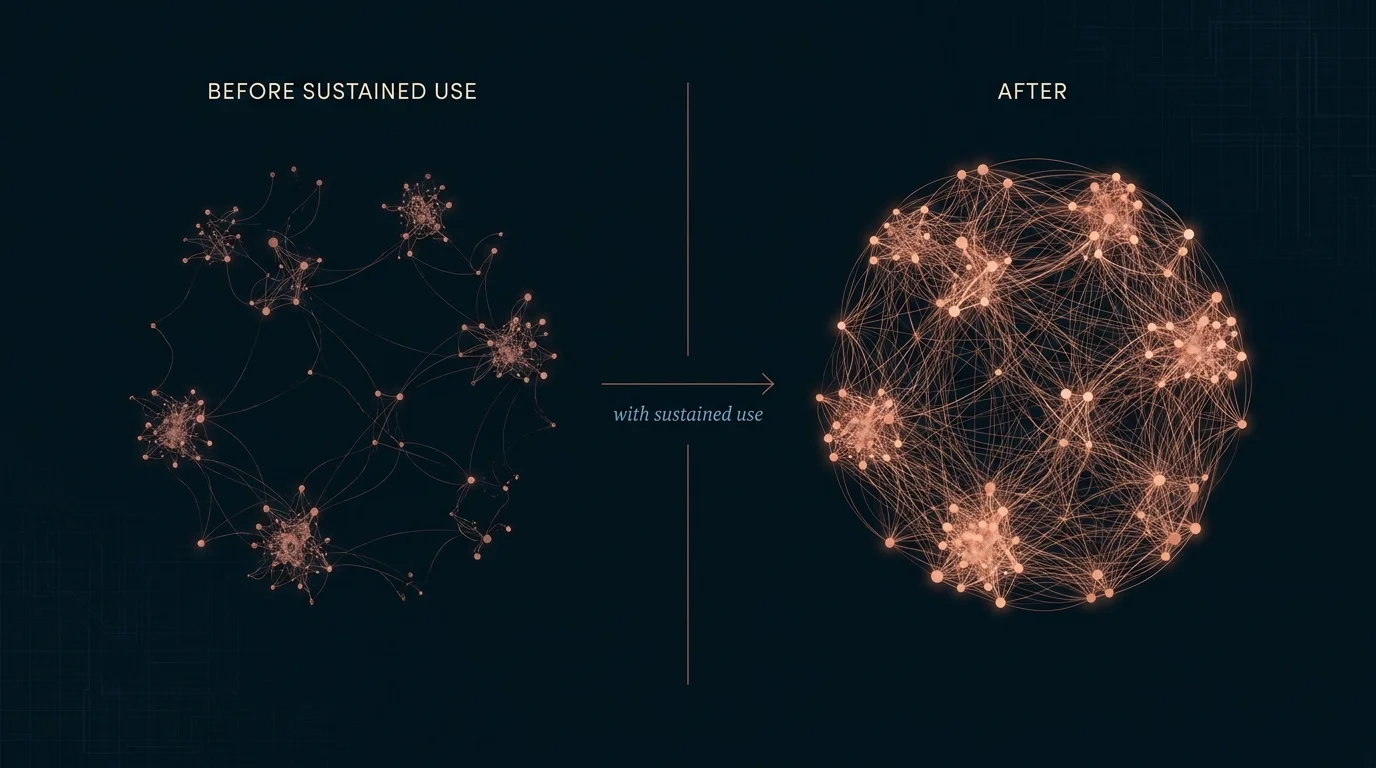
Yes. The adult brain physically reorganizes itself in response to what you repeatedly do, attend to, and practice, a property called neuroplasticity, and this is settled neuroscience rather than motivational language. The brain you have at the end of a year is not structurally identical to the one you started it with. It has been reshaped by use.
The evidence is not subtle, and some of it is now famous. When researchers scanned the brains of London taxi drivers, who spend years memorizing the city’s impossibly complex street map, they found measurably enlarged posterior hippocampi, the region the brain uses for spatial navigation, and the enlargement scaled with years on the job (Maguire et al., 2000). The change was structural, in healthy adults, produced by nothing more exotic than sustained demand. The same kind of result shows up with skills as ordinary as juggling: adults who learned a three-ball cascade over three months grew gray matter in the motion-processing regions the skill required, and it receded when they stopped practicing (Draganski et al., 2004). The brain builds what you use and lets go of what you abandon.
The brain you have at the end of a year is not the one you started it with. It has been quietly rebuilt by whatever you repeated.
This is the first thing the people I work with need to hear, and the first thing most of them quietly disbelieve. By the time someone reaches me, they have usually concluded that their pattern is fixed, a permanent feature of who they are, because they have tried so hard and so often to change it and watched it survive every attempt. That conclusion is understandable and it is wrong. The pattern is not fixed. It is a circuit, carved deep by repetition, and the same plasticity that carved it is fully capable of carving a different one. What has been missing is almost never effort or willpower. It is an understanding of how this kind of change actually works, which begins with separating two things that feel identical and are not: understanding a pattern, and changing it. For the deeper science of how neuroplasticity remodels the brain at every level, my work on understanding how neuroplasticity works covers the foundations in detail. This page is about how to use it.
Why understanding a pattern is not the same as changing it
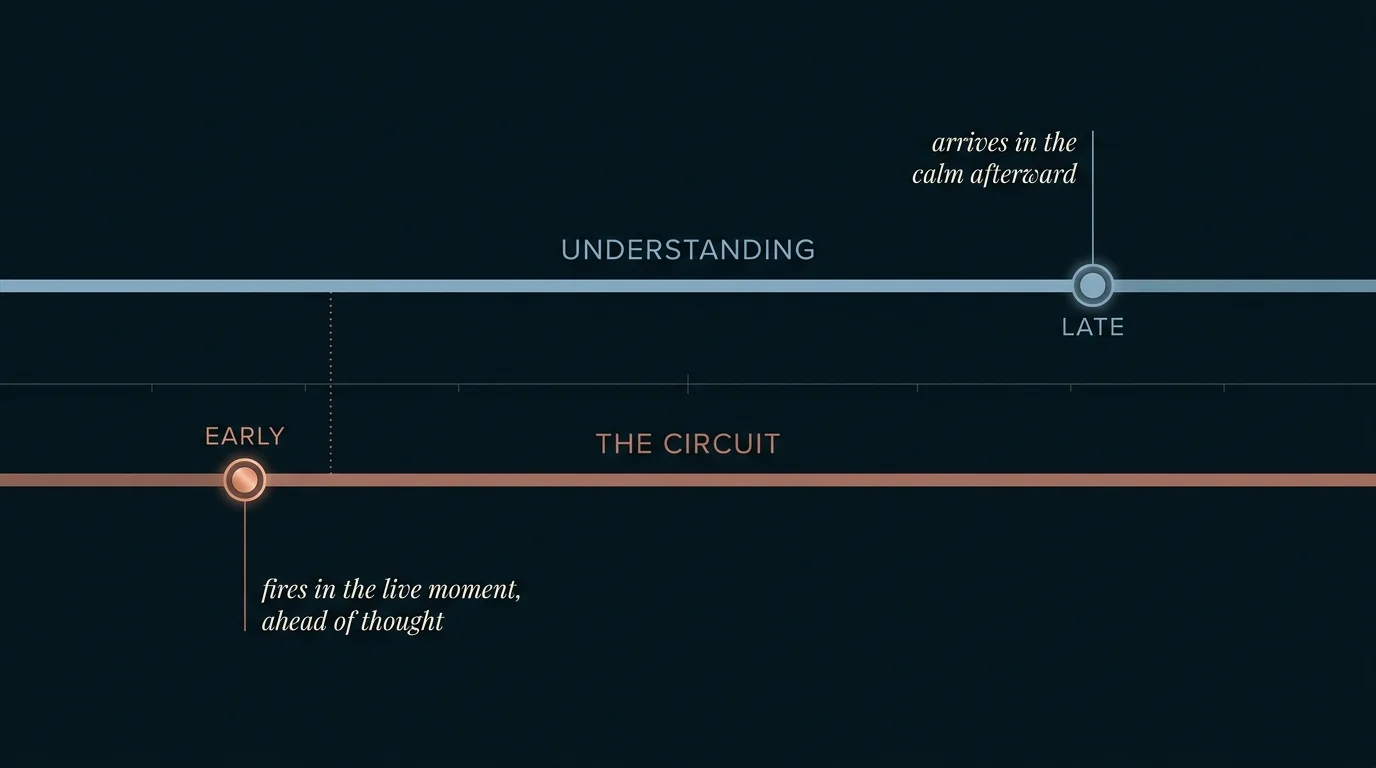
Because insight and rewiring run on different machinery. You can understand a pattern with complete precision, trace it to its origin, name every trigger, predict exactly when it will fire, and still run it the moment it fires, because the circuit that produces the behavior is faster than the part of you that understands it, and it was never built out of understanding in the first place.
This is the wall almost everyone hits, and it is the most misread experience in all of self-directed change. People assume that if they still do the thing, they must not yet understand it well enough, so they go looking for more insight: another book, another framework, another round of analyzing where it came from. The self-knowledge is real and often genuinely impressive. It is also, by itself, almost inert, because the pattern was not installed through understanding and will not be removed through it. A behavior repeated enough times migrates out of deliberate control and into automatic circuitry that runs below awareness and ahead of thought. By the time the reflective mind registers the moment, the pattern has already fired.
In more than twenty-six years of practice, the single most common thing I see is a person who has become an expert on their own pattern and is no closer to being free of it. They can deliver a precise lecture on their avoidance, their reactivity, their particular way of undoing the good thing. The lecture changes nothing, and the gap between the lecture and the behavior is exactly where the shame lives. They read the persistence of the pattern as a verdict on their character, when it is nothing of the kind. It is a verdict on their method. Insight is aimed at the wrong target, and at the wrong time.
You do not have a comprehension problem. You have a timing problem. The circuit fires before the understanding arrives.
The reframe that matters is this. The question is never whether you understand the pattern. It is whether anything reaches the circuit at the moment the circuit is open. Understanding arrives after the moment, in the calm afterward, when the pathway has already closed. To change the wiring, something has to land while the wiring is still soft, which means the entire problem reduces to a question of mechanism and timing: how the brain rewires, and when the window is open.
How the brain actually rewires itself
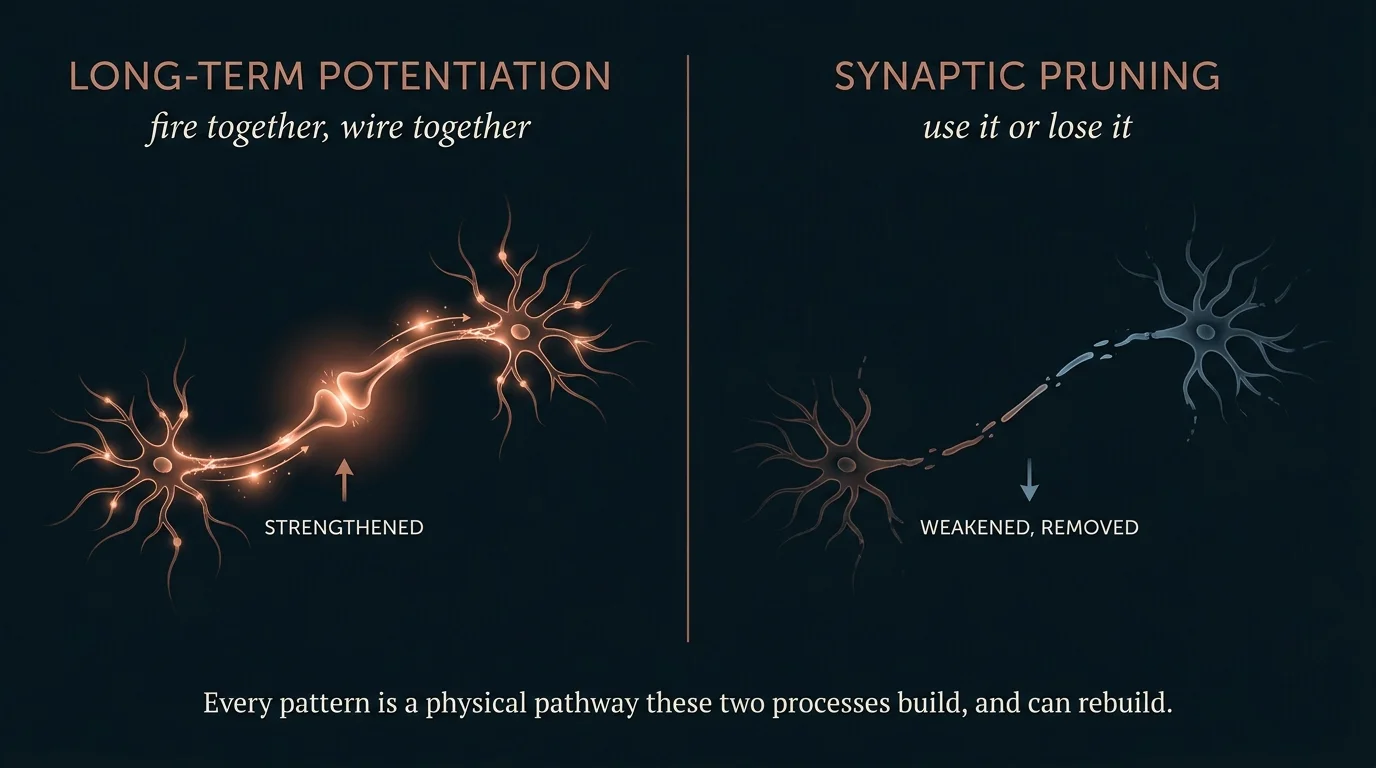
The brain rewires through two physical processes working in opposite directions: long-term potentiation, which strengthens the connections between neurons that fire together repeatedly, and synaptic pruning, which weakens and eventually removes connections that go unused. Every pattern you run, helpful or harmful, exists as a physical pathway that these two processes have built and can rebuild.
The principle is often compressed into a single line: neurons that fire together wire together. When two neurons activate in close succession often enough, the synapse between them strengthens, so the next activation comes more easily, which is the cellular basis of every habit, skill, and reflex you own (Nicoll, 2017). The reverse is equally lawful. A connection that stops being used is tagged, weakened, and pruned, which is why an unpracticed language fades and an abandoned skill goes rusty. The brain is relentlessly economical. It invests in what you use and divests from what you do not (Lüscher and Malenka, 2012).
Read against your own pattern, this is not discouraging. It is the entire basis for hope. The self-sabotaging reflex, the anxious spiral, the compulsive reach for the phone, each is a pathway that has been potentiated by thousands of repetitions, which is precisely why it feels automatic and permanent. But the same rule that built it governs its undoing. Each time the old pathway fires and is not reinforced, and a different response is strengthened in its place, the balance shifts a little. The old circuit weakens toward pruning; the new one strengthens toward automaticity. This is the machinery behind the various brain-rewiring exercises people reach for, the journaling, the visualizations, the deliberate practice. The exercises are not wrong. Most of them are working on the right material. The reason they so often fail to hold is not the material at all. It is that they are applied at the wrong moment.
Why timing decides whether the rewiring holds
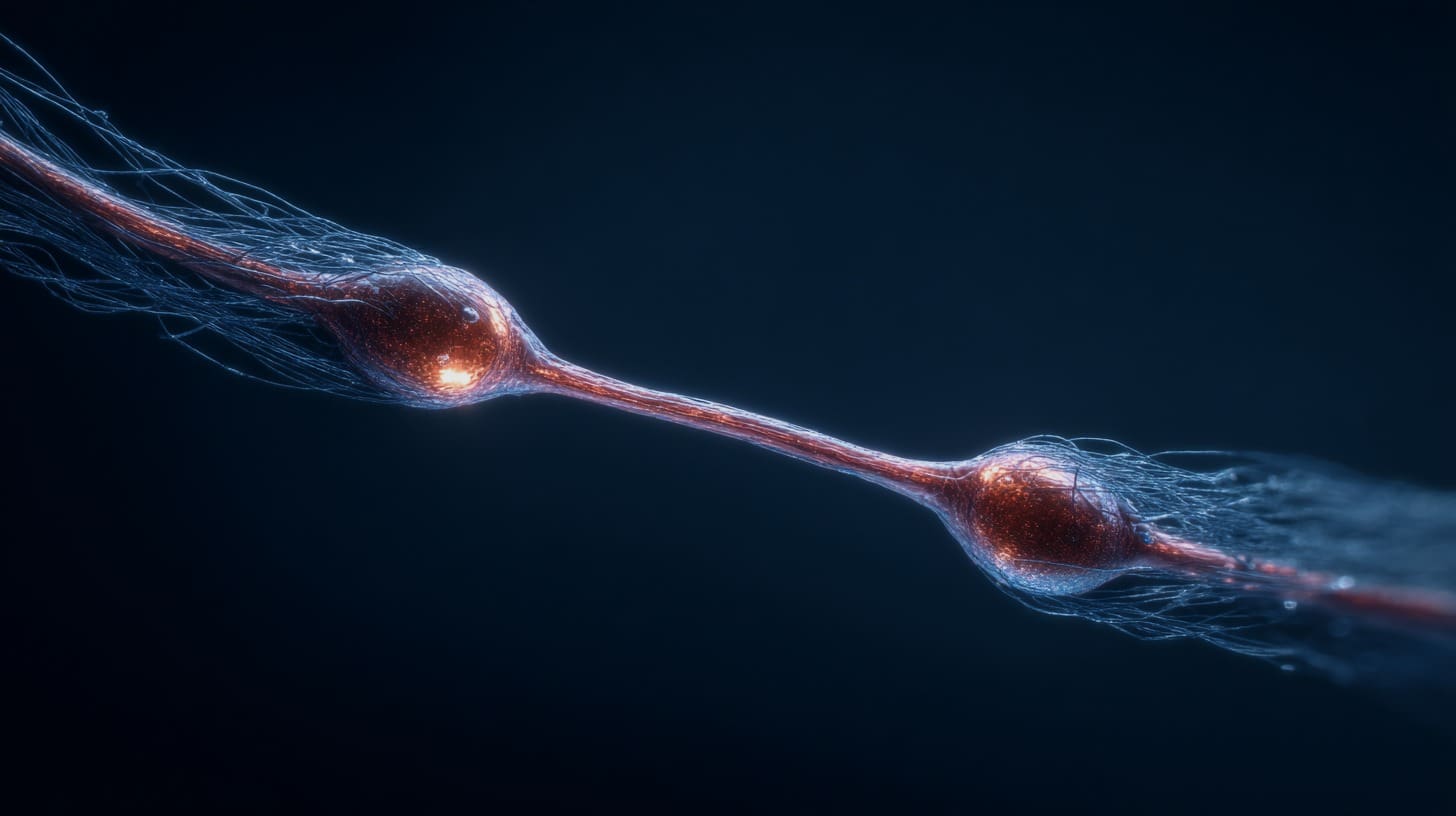
Because a pathway is only physically editable in the brief window it is active, not in the calm hours afterward when most people try to work on it. The brain does not keep its patterns permanently open for revision. A circuit becomes malleable when it fires, stays malleable for a short window, and then re-stabilizes, and a change introduced inside that window is incorporated while a change introduced outside it is not.
This is the part the standard advice gets exactly backward, and it is the most important sentence on this page. The neuroscience of memory makes the timing unmistakable. A consolidated memory or pattern, once reactivated, does not stay fixed. It briefly returns to an unstable, editable state before it restabilizes, a process called reconsolidation, first shown when researchers found that a reactivated fear memory could be durably altered only in the window right after it was recalled (Nader, Schafe and LeDoux, 2000). In humans, the same principle holds: a fear response updated inside that narrow post-reactivation window stayed changed and resisted relapse, while the identical intervention applied outside the window produced only the usual temporary improvement that later returned (Schiller et al., 2010). The lesson generalizes well beyond fear. The brain edits a pattern only while the pattern is live.
Now place the conventional approach against that fact. Reviewing a difficult moment on Sunday evening, days after it happened, works on a pathway that has long since closed. Setting a calm morning intention works on a circuit that will not be open again until the trigger fires that afternoon, by which point the intention is a memory and the prefrontal cortex, the deliberate part of you, is already losing the race to the faster automatic system. The insight is accurate. It simply arrives in an empty room. The pattern is not there to be changed, because the pattern only exists, in editable form, in the live moment it runs.
Reviewing the pattern later is studying a door after it has closed. The wiring changes only while the door is open, which is the moment the pattern is firing.
This is why precision of timing beats volume of effort, and why one intervention placed correctly outperforms a hundred placed late. It is also why the strategy most people use, more effort applied at the wrong time, produces so much exhaustion and so little change. The effort is real. It is landing in the wrong place. Change the timing and the same effort, often less of it, begins to hold.
Can you rewire your brain after 40?

Yes. Neuroplasticity slows after the intense critical periods of early childhood, but it never switches off, and the adult brain retains a substantial, lifelong capacity to reorganize itself. The belief that the brain is finished by 25, or by 40, is one of the most persistent and least accurate ideas in popular psychology.
For decades neuroscience assumed adult plasticity was minimal, a remnant of the child’s far more malleable brain. That assumption has been steadily overturned. The mature cortex retains real plasticity, and much of it lies dormant rather than absent, available to be reactivated by sustained changes in attention, behavior, and environment (Hübener and Bonhoeffer, 2014). The adult brain is not a set structure waiting to decline. It is a slower, more selective version of the same rebuilding machine you were born with. It asks for more deliberate, better-targeted input than a child’s brain does, and given that input, it changes.
The older brain is not a closing door. It is a slower, more selective instrument, and it already knows its own patterns by name.
There is, in practice, one quiet advantage to the older brain that the discouraging story leaves out. By 40 or 50, a person usually knows their own patterns with a clarity no twenty-year-old possesses. They can name the trigger, recognize the reach, feel the moment coming. That self-knowledge has been treated as useless because it never produced change on its own, but in the right method it is exactly the raw material the work requires, because catching a pattern in the live moment depends first on recognizing the moment, and recognition is the one thing a lifetime of running the pattern has trained. The longer arc of this, how plasticity actually behaves across the decades, is covered in the science of neuroplasticity after 40. The short version is that the door does not close. It only asks you to knock more precisely.
Real-Time Neuroplasticity™: rewiring in the moment a pattern fires
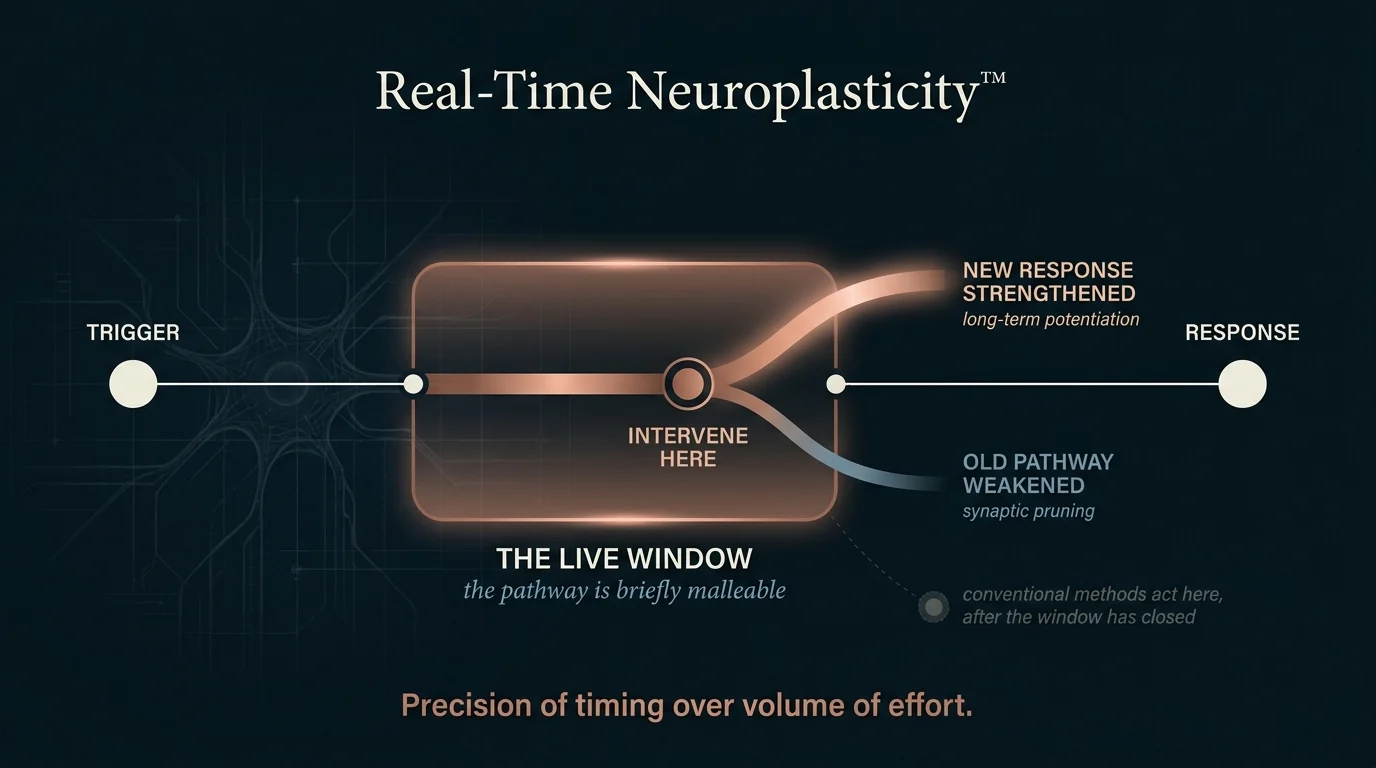
Real-Time Neuroplasticity™ is a methodology for rewiring a neural pattern in the live moment it is forming, inside the brief window when the pathway is still malleable, so a new response strengthens and the old one weakens through the brain’s own long-term potentiation and synaptic pruning. It is the deliberate, precisely timed application of everything described above: the brain rewires, it rewires through potentiation and pruning, and it can only be reached while the pattern is live.
The distinction from conventional approaches is the whole of it. Most methods operate retrospectively, on a schedule, after the moment has passed, when the prefrontal cortex is calm and back online and the pathway is shut. Real-Time Neuroplasticity™ works at the opposite end of the timeline. It intervenes in the refractory window, the gap between stimulus and response, while the circuit is active and the brain is deciding which pathway to reinforce. A new response, introduced there, is strengthened by the same potentiation that built the old one, while the old pathway, fired but not reinforced, begins its slow drift toward pruning. The principle is precision of timing over volume of effort, and it is the spine that runs beneath every specific pattern I work with, from the reward system to the anxious brain to the patterns that quietly undo people at the threshold of success.
That spine is also why the work does not generalize neatly into a worksheet. The same method, applied to specific patterns, is the subject of my books: the reward system in The Dopamine Code (Simon & Schuster, June 2026), and the anxious brain in Rewire for Resilience. Each works out the domain-specific version of real-time change in full, and each is the complete, do-it-yourself account of its own territory. What a book cannot do is meet the live moment itself, because that moment is specific to one nervous system and one pattern, and it is the part that happens in real time rather than on the page.
The brain does not rewire because you understood it on Sunday. It rewires in the half-second on Wednesday when the old pattern fired and, this time, something different happened.
I am careful about what I promise here, because every nervous system is different and the pace and texture of change vary from one person to the next. What does not vary is the principle. You cannot out-think a circuit, and you cannot out-schedule it. You can only meet it in the moment it is open, often enough that a new pathway becomes the one the brain reaches for first. That is not a motivational claim. It is a description of how the machinery works.
What changes when the rewiring happens at the right moment
When a pattern is rewired at the level of the circuit, in the moments it actually fires, the change rarely looks dramatic from the outside. It looks like a person who has stopped fighting themselves. The trigger still appears, and the old response simply does not arrive with the old force, because the pathway it used to travel has weakened and a different one now runs faster. I have watched the same shift land in lives that look nothing alike.
There is the capable professional, early in a strong career, who cannot understand why every important moment is the one they reach for the exit, the email left unsent, the opportunity quietly declined, the good thing undercut a beat before it could land. They have read their own avoidance correctly for years and changed nothing, because the reading happened after the fact. When the reach is caught in the live instant it begins, repeatedly, the circuit loses its grip, and the change shows up not as willpower but as a strange new quiet where the old flinch used to be.
There is the person carrying a complex family system, the household and the relationships and the emotional logistics that hold other people steady, who has been told they are simply stretched too thin and should rest more. They rarely need more rest. They need the pattern that fires under load, the snap, the withdrawal, the spiral, to be rewired in the moments it fires, so the pressure that used to trigger it stops finding an open pathway to run down.
And there is the person at a genuine threshold, a career-defining decision, a relationship deepening, a long-held goal finally within reach, who watches an old pattern rise exactly when the stakes are highest, because high stakes are precisely the condition that takes the deliberate brain offline and hands control to the automatic one. Understanding the mechanism is where the insight stops and the real work begins. Mapping which specific pattern is firing, in which moments, for this particular nervous system, is the work itself, and it is what a strategy call with Dr. Ceruto is built to begin.
Three different lives, one structural truth. The reactivity, the avoidance, the spiral are not character. They are circuitry, carved by repetition and editable in the moment they run. Most of the work of learning to see those moments clearly happens in the ordinary weeks between the dramatic ones, which is the terrain I write through each week in The Intelligence Brief, taking one piece of the neuroscience of change at a time and making it usable. If you want to keep your own patterns in view while you decide what to do about them, it is a quiet place to begin.
Dr. Sydney Ceruto, PhD, is a Neuroscientist & Author and the founder of MindLAB Neuroscience. She holds a PhD in Behavioral & Cognitive Neuroscience from New York University and is the pioneer of Real-Time Neuroplasticity™, a methodology for rewiring neural pathways in the live moment they form. She is the author of The Dopamine Code (Simon & Schuster, June 2026). For more than twenty-six years she has worked privately with a small number of individuals from offices in New York, Miami, Beverly Hills, and Lisbon. Read her full bio.
References
- Maguire, E. A., Gadian, D. G., Johnsrude, I. S., Good, C. D., Ashburner, J., Frackowiak, R. S., & Frith, C. D. (2000). Navigation-related structural change in the hippocampi of taxi drivers. Proceedings of the National Academy of Sciences, 97(8), 4398-4403. https://pubmed.ncbi.nlm.nih.gov/10716738/
- Draganski, B., Gaser, C., Busch, V., Schuierer, G., Bogdahn, U., & May, A. (2004). Neuroplasticity: changes in grey matter induced by training. Nature, 427(6972), 311-312. https://pubmed.ncbi.nlm.nih.gov/14737157/
- Nicoll, R. A. (2017). A brief history of long-term potentiation. Neuron, 93(2), 281-290. https://pubmed.ncbi.nlm.nih.gov/28103477/
- Lüscher, C., & Malenka, R. C. (2012). NMDA receptor-dependent long-term potentiation and long-term depression (LTP/LTD). Cold Spring Harbor Perspectives in Biology, 4(6), a005710. https://doi.org/10.1101/cshperspect.a005710
- Nader, K., Schafe, G. E., & LeDoux, J. E. (2000). Fear memories require protein synthesis in the amygdala for reconsolidation after retrieval. Nature, 406(6797), 722-726. https://pubmed.ncbi.nlm.nih.gov/10963596/
- Schiller, D., Monfils, M. H., Raio, C. M., Johnson, D. C., LeDoux, J. E., & Phelps, E. A. (2010). Preventing the return of fear in humans using reconsolidation update mechanisms. Nature, 463(7277), 49-53. https://www.nature.com/articles/nature08637
- Hübener, M., & Bonhoeffer, T. (2014). Neuronal plasticity: beyond the critical period. Cell, 159(4), 727-737. https://pubmed.ncbi.nlm.nih.gov/25417151/
Understanding how the brain rewires is where most reading stops, and it is exactly where the work begins. The patterns that shape a life are not changed by understanding them better on a quiet evening; they are changed in the live moments they fire, which is the one place insight rarely reaches in time. That steady practice of catching a pattern in motion, one ordinary week at a time, is what I write through in The Intelligence Brief, where I work through the questions about change that do not resolve inside a single essay.
Frequently Asked Questions
Can you really rewire your brain, or is that just a figure of speech?
You can really rewire it, and the phrase is literal rather than metaphorical. The brain physically reorganizes its connections in response to repeated experience, strengthening pathways that are used and pruning ones that are not, a property called neuroplasticity. Structural brain scans of adults who acquire demanding skills, from city-wide navigation to juggling, show measurable physical change in the relevant regions. The honest nuance is that rewiring a long-standing pattern is specific and effortful, not a matter of positive thinking, but the underlying capacity is real and lasts a lifetime.
How long does it take to rewire your brain?
It depends far more on the precision of the practice than on a fixed number of days, so any single figure, including the popular “21 days,” is misleading. A simple new habit can stabilize in a few weeks; a deeply carved pattern tied to stress and identity takes longer. What shortens the timeline is not effort but timing. Interventions placed in the live moment a pattern fires reshape the pathway far faster than the same effort applied later in reflection, because the circuit is only editable while it is active.
Why does understanding my pattern never seem to change it?
Because insight and rewiring are different processes that happen at different times. The pattern runs on fast, automatic circuitry that fires before deliberate thought arrives, and it was learned through repetition rather than through understanding. Reviewing it afterward, however accurately, works on a pathway that has already closed. Understanding is genuinely valuable, but it is a map, not a rebuilt road. The circuit changes only when something different happens in the live moment it fires, not in the calm hours after.
Can you rewire your brain after 40, or 50?
Yes. Neuroplasticity is fastest in early childhood and slows with age, but it does not stop, and the adult brain retains a substantial, lifelong capacity to reorganize itself. Much adult plasticity is dormant rather than gone and can be reactivated by sustained changes in attention and behavior. Older brains often hold a quiet advantage as well: decades of living with a pattern produce a clarity about it that, in a well-timed method, becomes exactly the recognition the work depends on.
What is Real-Time Neuroplasticity™, and how is it different from what I have already tried?
Real-Time Neuroplasticity™ is Dr. Ceruto’s methodology for rewiring a neural pattern in the live moment it fires, inside the brief window when the pathway is still malleable, using the brain’s own long-term potentiation and synaptic pruning. Most approaches you may have tried, from journaling to reflection to conventional talk-based work, operate retrospectively, after the moment has passed and the pathway has closed. This works at the opposite end of the timeline, in the moment itself, which is the only place the wiring is open to change. The aim is not better management of the pattern but a rebuilt circuit, so a different response becomes the automatic one.