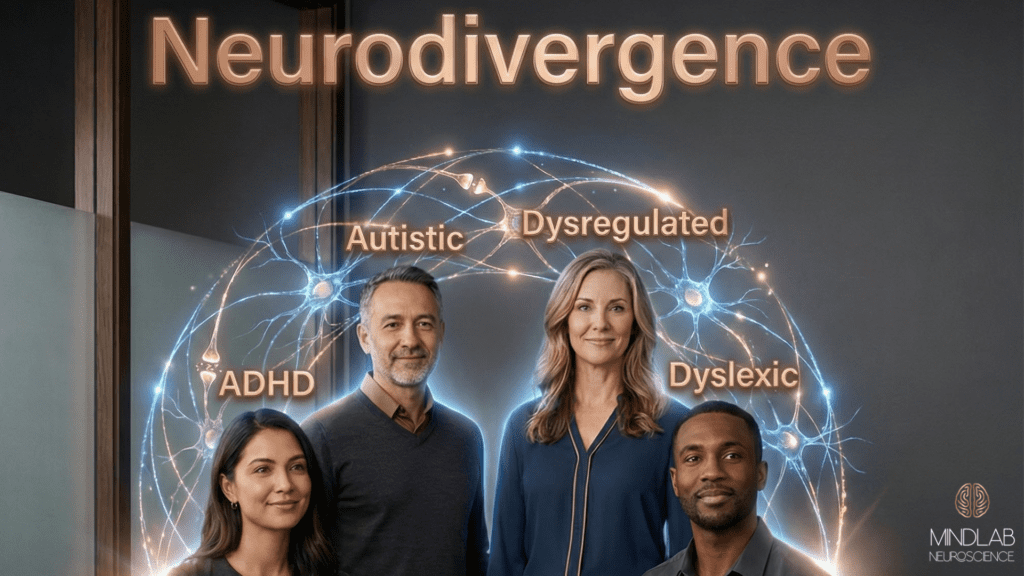
Why Neurodivergent Practice is Effective When Other Methods Have Failed
You’ve probably spent years feeling like something was wrong with you. You were told you needed more discipline. More structure. More willpower. Maybe you went through therapy. Maybe you got on medication. Perhaps you tried every productivity system on the market. And maybe, just maybe, nothing actually worked because the real problem was that nobody was addressing how your brain actually functions.
Nineteen percent of Americans identify as neurodivergent. You’re one of 60 million people whose brains process information differently from the neurotypical norm. ADHD, autism, dyslexia, dyspraxia, and other neurodivergent conditions aren’t defects. They’re different operating systems. And if every support system you’ve tried was designed for a different operating system, of course, you haven’t succeeded.
That’s precisely why Real-Time Neuroplasticity Practice™ exists. This isn’t traditional therapy. It isn’t generic practice. It’s a personalized, neuroscience-based approach specifically designed for how your neurodivergent brain actually works.
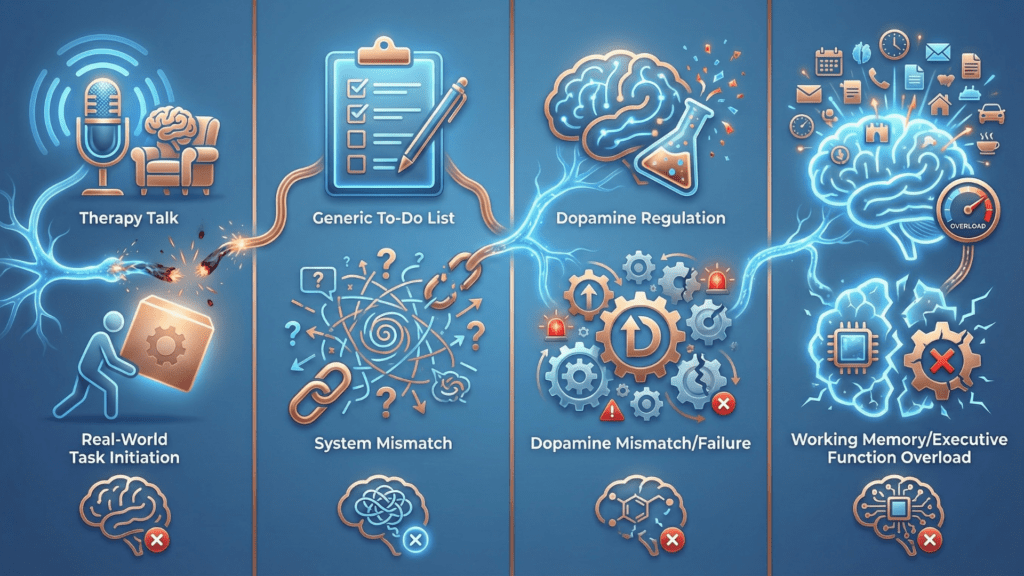
Why Traditional Approaches Fail Neurodivergent Practice Clients
Here’s what you’ve probably experienced. You go to therapy and talk about your feelings for an hour. It feels good in the moment. Then you walk out into the real world, where you still can’t initiate tasks, manage your time, or regulate your emotions. Traditional therapy focuses on what you’re thinking, not how your brain actually functions.
Or you tried practice with a neurotypical practitioner who recommends the same systems that don’t work for anyone like you. Better to-do lists. Morning routines. Accountability partners. None of it sticks because it’s all built for a brain type that isn’t yours.
The fundamental issue is this: your neurodivergent brain doesn’t have motivation problems. It has dopamine regulation problems. It doesn’t have organizational issues. It has working memory challenges. It doesn’t have social difficulties. It has sensory processing and communication differences. Traditional approaches try to force your brain to work differently, rather than working with how it’s actually wired.
Real-Time Neuroplasticity Practice™ does something revolutionary. It stops trying to make you neurotypical and instead optimizes the extraordinary brain you already have.
What Real-Time Neuroplasticity Practice™ Actually Is
Real-Time Neuroplasticity Practice™ is a specialized, personalized approach that combines three powerful elements: advanced neuroscience understanding, real-time practice in the moments you need support, and proven neuroplasticity techniques that create lasting brain change.
Neurodivergent practice meets you where you are right now, unlike therapy, which focuses on the past, or generic practice, which provides one-size-fits-all strategies, especially when you’re struggling to start a project or when your emotions feel overwhelming. When you’re in a difficult conversation. Your practitioner helps you think when you’re about to decide.
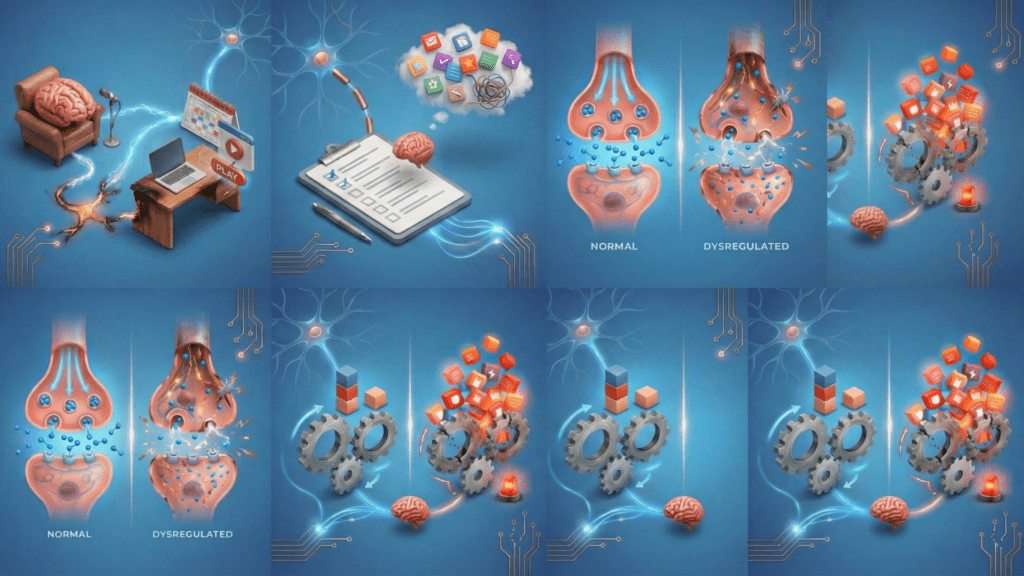
The real-time component is transformative. Instead of learning techniques in an office and trying to apply them later, you’re learning and practicing them in the moment. Your practitioner isn’t just telling you what to do. They’re actively helping you rewire your brain’s response patterns as they happen. That’s neuroplasticity in action.
Every person’s neurodivergent brain is uniquely wired. Your ADHD might manifest as hyperfocus and impulsivity, but not time blindness. Someone else’s ADHD shows up as rejection sensitivity and executive dysfunction. Neurodivergent practice is tailored specifically to your brain, your challenges, and your strengths. Not a template. Not a generic program. A personalized protocol built for you.
The Neuroscience Behind Why Neurodivergent Practice Works
Your brain isn’t fixed. It’s plastic, meaning it’s constantly rewiring itself through experience. This fundamental property of the brain is called neuroplasticity, and it’s the most powerful tool for lasting change you have access to.
Traditional approaches rarely leverage neuroplasticity effectively. They assume your brain’s patterns are fixed and focus on behavioral workarounds. Neurodivergent practice does the opposite. It actively targets the neural pathways underlying your challenges and helps create new, more effective pathways.
Here’s how it works at the brain level. When you have ADHD and you struggle with task initiation, your dopamine system isn’t functioning optimally. Instead of telling you to start, neurodivergent practice helps you understand your dopamine triggers and redesign your environment to activate dopamine naturally. Over time, repeated engagement with dopamine-optimized strategies creates new neural pathways. Your brain literally rewires itself to initiate more easily.
Research demonstrates this works. Studies show that integrated approaches combining therapeutic concepts with practical skill-building produce superior outcomes compared to either intervention alone. When neurodivergent practice specifically targets how your brain functions, the results are transformative. Task completion improves. Time management becomes possible. Emotional regulation stabilizes. Decision-making gets clearer.
Research on ADHD practice alone shows that 17 out of 19 studies found improvements in symptoms. Six studies demonstrated improved well-being. Six reported high satisfaction with practice, and three reported that improvements persisted beyond the work period.

What Actually Changes With Neurodivergent Practice
You Finally Understand Your Brain
Most neurodivergent adults have spent years thinking they were lazy, broken, or not trying hard enough. The first shift in neurodivergent practice creates understanding, not as a concept, but as a lived experience. You learn how your dopamine system actually works. Why do you hyperfocus on some things and can’t initiate others? Why do your emotions feel more intense? Why do you process information differently?
That understanding is simultaneously relieving and empowering. You’re not defective. Your brain works differently, and once you understand how it operates, you can work with it rather than against it.
Your Executive Function Actually Improves
Executive dysfunction is the biggest quality-of-life challenge most neurodivergent adults face. Time blindness. Working memory gaps are a common symptom of executive dysfunction. Difficulty initiating tasks. Emotional dysregulation. Planning paralysis. These aren’t motivational issues. They have brain function issues.
Neurodivergent practice tackles executive function differently than traditional practice. Instead of generic time management systems, your practitioner helps you build workflows aligned with how your brain actually processes information. Instead of fighting your energy patterns, you schedule tasks around them. Instead of expecting neurotypical consistency, you build flexibility into your systems.
These approaches actually work. Clients report better task completion, reduced procrastination, more apparent prioritization, and, fundamentally, less shame about how their brains function. Your executive function doesn’t just improve on paper. It improves in your actual life.
You Build Emotional Resilience
Neurodivergent brains often experience emotions more intensely. ADHD creates rapid emotional swings. Autism can involve emotional shutdowns after overstimulation. Dyspraxia usually comes with shame about coordination. This intensity creates a painful feedback loop: big emotions lead to dysregulation, which leads to shame, which makes the next emotion even bigger.
Neurodivergent practice breaks this cycle through brain-based emotional regulation techniques. Your practitioner teaches you to recognize your nervous system states, understand your sensory triggers, and build recovery protocols specific to your neurodivergence. When you know that your emotional intensity isn’t instability but your brain’s actual wiring, shame begins to dissolve.
Over time, with real-time practice, your brain develops new pathways for processing emotions. You don’t become emotionally flat. You become emotionally intelligent. Your intensity becomes a strength rather than a liability.
You Discover Your Actual Strengths
Most neurodivergent adults grew up being told what was wrong with them. Deficits. Disabilities. Disorders. By adulthood, many have lost sight of their genuine superpowers.
Neurodivergent practice starts with a strengths assessment that can help identify your hyperfocus, the patterns you recognize that others might miss, and the areas where your creativity flourishes. For individuals with ADHD, this might involve crisis management and rapid problem-solving. For those on the autism spectrum, it could be pattern recognition and systematic thinking. It frequently involves strategic visualization and spatial reasoning for people with dyslexia. This might be crisis management and rapid problem-solving. For autistic individuals, pattern recognition and systematic thinking are key strengths. Dyslexic individuals often struggle with spatial reasoning and strategic visualization.
Once you understand your actual strengths, neurodivergent practice helps you build your entire life around leveraging them. You’re not trying to become neurotypical. You’re optimizing the uniquely powerful brain you already have.
Neurodivergent Practice vs. Traditional Therapy
This is an important distinction. Traditional therapy is powerful for processing trauma, addressing mental health conditions, and addressing emotional wounds. It’s not optimized for skill-building, performance enhancement, or working with how your neurodivergent brain functions.
Neurodivergent practice is designed explicitly for neurodivergent adults who are emotionally stable but need personalized strategies, real-world skill-building, and practical support working with their neurodivergent operating system. You’re not seeking to recover from trauma. You’re seeking to optimize your functioning.
Many clients do both simultaneously. They work with a practitioner to process emotional issues while engaging in neurodivergent practice to build practical skills and transform how they function. The practice accelerates therapy outcomes by providing the real-world skill-building that therapy addresses conceptually.

Who Neurodivergent Practice is Perfect For
You’re a great fit if you’re ADHD, autistic, or dyslexic, and you recognize that traditional approaches haven’t worked. You’ve tried therapy. You’ve been attempting practice. You’ve tried systems and strategies. But nothing actually stuck because nothing was designed for how your brain actually works.
You’re also a fit if you’re high-performing but exhausted. You’ve built success through sheer willpower and masking, and you’re burning out. You need to shift from survival mode to sustainable functioning. Neurodivergent practice helps you succeed without the burnout.
You’re a fit if you’re newly identified and you finally have language for what’s been happening your whole life, but you don’t know how to move forward. You are also a good fit if you suspect you are neurodivergent but have not sought a formal identification and prefer to receive support immediately instead of waiting for evaluation appointments.
You’re a fit if you want something different from traditional mental healthcare. Something that honors how your brain works rather than trying to fix it. Something personalized rather than generic. Something real-time and practical rather than theoretical.
The Transformation Timeline
Neurodivergent practice creates real, measurable change. But it’s not overnight magic. Neuroplasticity takes time. Your brain has built neural pathways through years of functioning a certain way. Creating new pathways requires consistent practice with real-time feedback.
Most clients report noticeable improvements within four to six weeks. Task completion improves. Energy becomes more available. Decision-making gets clearer. Emotional regulation stabilizes. Over several months, the changes compound. You’re not just functioning better. You’re functioning in a fundamentally different way.
What’s revolutionary about the real-time component is that because you’re practicing these new pathways during actual life moments, not in an office, the changes transfer directly to your real world. You’re not learning strategies that you try to apply later. You’re practicing new brain functioning as it happens.
What Makes Neurodivergent Practice Different
Neurodivergent practice isn’t just terminology. It’s a complete philosophy and methodology.
It starts with the recognition that your neurodivergent brain is your actual self, not something broken that needs fixing. It combines advanced neuroscience understanding with practical practice during the exact moments you need support. It leverages neuroplasticity to create actual brain change, not just behavioral workarounds. And it’s deeply, personally customized to your unique brain, your specific challenges, and your individual strengths.
You’re not following a program designed for somebody else. You’re building a personalized protocol tailored to you.
Getting Started With Neurodivergent Practice
The first step is a a comprehensive look at how neuroplasticity enables rewiring strategy call to assess your specific situation, challenges, and goals. You’ll talk about what hasn’t worked, what you’ve tried, and what transformation would actually look like for you.
From there, your personalized protocol develops. This might include weekly or twice-weekly sessions, depending on your needs. It involves real-time practice during challenging moments, between-session assignments designed to build neuroplastic change, and consistent monitoring of your progress against objectives that matter to you.
You’ll notice improvements in executive function, emotional regulation, clarity of thought, and sense of agency. You’ll discover strengths you didn’t know you had. Most importantly, you’ll experience transformation because your support is finally aligned with how your brain actually works.

The Real Impact
Beneath all the neuroscience and strategy is a fundamental truth: you deserve support that honors how your brain works. Not support that tries to make you neurotypical. You should not rely on generic strategies. Not treatment that pathologizes your neurodivergence. You deserve practice that acknowledges your neurodivergence and optimizes your life around it.
Real-Time Neuroplasticity Practice™ delivers precisely that. It’s the alternative to traditional therapy that actually works for neurodivergent brains. It’s personal. It’s scientific. It’s practical. And it creates the kind of transformation that changes everything.
Closing Thoughts
In my opinion, everyone has some degree of neurodivergence; otherwise, we would all be the same. I have been practice neurodivergent clients for well over two decades. If you’re neurodivergent and have been waiting for a method tailored to your brain, that time is now. Real-Time Neuroplasticity Practice™ combines advanced neuroscience, real-time practice in the moments you need support, and personalized strategies tailored to you.
You don’t need to become neurotypical. You need to optimize the extraordinary brain you have. You don’t need generic strategies. You need personalized protocols. You don’t need to process the past. You need to build a different future.
Real-Time Neuroplasticity Practice™ makes that possible. Reach out today to explore how personalized, neuroscience-based practice explicitly designed for your neurodivergent brain can transform your executive function, emotional regulation, and quality of life.
Your neurodivergent brain doesn’t need fixing. It needs understanding. It requires the proper support. It needs Real-Time Neuroplasticity Practice™.
Frequently Asked Questions
u003cstrongu003eHow is Real-Time Neuroplasticity Practice™ different from traditional therapy?u003c/strongu003e
Traditional therapy processes past experiences and addresses emotional wounds. Real-Time Neuroplasticity Practice™ focuses on skill-building, performance optimization, and real-time support when you’re struggling. u003cbru003eu003cbru003eMany clients benefit from both simultaneously. You can work with a practitioner to process emotional issues while engaging in neurodivergent practice to build practical, real-world skills specific to your neurodivergent brain. The practice accelerates therapy outcomes by providing the real-world skill-building that therapy addresses conceptually.
u003cstrongu003eDo I need a formal identification to work with neurodivergent practice?u003c/strongu003e
No. Many individuals have neurodivergent traits without a formal identification and benefit tremendously from practice designed for neurodivergent brains. If traditional strategies haven’t worked for you, your brain likely processes information differently, and neurodivergent practice can help you work with that unique wiring. Many clients come to practice before pursuing a formal evaluation and use the results of this work as part of their evaluation journey.
u003cstrongu003eHow quickly will I see improvements with neurodivergent practice?u003c/strongu003e
Most clients report noticeable improvements in task completion, emotional regulation, and clarity within 4 to 6 weeks. Significant transformation typically occurs over several months as neuroplasticity creates actual brain change. u003cbru003eu003cbru003eBecause practice is real-time, changes happen during your actual life rather than in an office, so improvements transfer directly to what matters most to you. Improvements in executive function, emotional resilience, and goal achievement occur at different rates depending on your starting point and specific challenges.
u003cstrongu003eWhat if I also have multiple neurodivergences like ADHD and autism?u003c/strongu003e
Real-Time Neuroplasticity Practice™ is specifically designed to address the unique ways your individual brain works. Many clients have multiple neurodivergences, including ADHD, autism, dyslexia, and anxiety. Your personalized neurodivergent practice protocol accounts for how all your neurodivergences interact, providing tailored strategies for your specific combination of strengths and challenges. u003cbru003eu003cbru003eThis intersection of neurodivergences makes neurodivergent practice even more valuable, because generic approaches miss how these conditions interact in your brain.
u003cstrongu003eCan neurodivergent practice help with burnout?u003c/strongu003e
Absolutely. Many high-performing neurodivergent adults build success through masking and sheer willpower, then hit a burnout wall. Neurodivergent practice addresses burnout by shifting you from survival mode to sustainable functioning. u003cbru003eu003cbru003eInstead of forcing yourself to work harder, neurodivergent practice helps you work differently, aligning your strategies with how your brain actually functions. This reduces the exhaustion that comes from constantly fighting your neurodivergence and creates genuine, sustainable success.
u003cstrongu003eHow does neurodivergent practice handle emotional dysregulation?u003c/strongu003e
Neurodivergent practice addresses emotional dysregulation through brain-based techniques specific to how neurodivergent brains process emotions. Your practitioner teaches you to recognize your nervous system states, understand your sensory triggers, identify emotional shutdown patterns, and build recovery protocols tailored to your neurodivergence. Real-time practice means you’re learning these techniques during actual emotional moments, not just in sessions. u003cbru003eu003cbru003eOver time, your brain develops new pathways for processing intense emotions, building genuine emotional resilience rather than just coping strategies.
u003cstrongu003eIs neurodivergent practice covered by insurance?u003c/strongu003e
Most health insurance doesn’t cover neurodivergent practice because it’s classified as a performance and skill-building service rather than therapy or medical treatment. However, many clients find that the investment in neurodivergent practice pays dividends through increased productivity, career advancement, relationship improvements, and reduced burnout. Some employers offer practice as an employee wellness benefit. It’s always worth checking with your insurance provider about potential coverage or reimbursement options.
u003cstrongu003eWhat makes Real-Time Neuroplasticity Practice™ different from other neurodivergent approaches?u003c/strongu003e
Real-Time Neuroplasticity Practice™ includes three important parts that many other neurodivergent practice methods don’t have: a deep understanding of how your brain works, practice support while you’re dealing with challenges, and effective techniques that actually change your brain instead of just helping you cope. u003cbru003eu003cbru003eThe real-time component is transformative because you’re not learning strategies to apply later. You’re practicing new brain functioning as it happens, which creates faster, more lasting neural change and ensures improvements transfer directly to your real life.
The patterns described in this article were built through thousands of neural repetitions — and they require targeted intervention to rewire. Real-Time Neuroplasticity™ provides the mechanism: intervening during the live moments when the pattern activates, building new neural evidence that a different response is architecturally possible.
Key Takeaways
- Neurodivergent brains are not deficient versions of neurotypical brains — they are architecturally different, with distinct processing patterns, attentional profiles, and neurochemical signatures.
- ADHD involves variable dopamine signaling in the prefrontal cortex, producing inconsistent executive function rather than absent capability.
- Standard behavioral advice frequently fails neurodivergent individuals because it was designed for a neurotypical baseline that many neurodivergent people do not have.
- Neuroplasticity does not normalize a neurodivergent brain — it calibrates its existing architecture to work more effectively in the environments the individual actually inhabits.
- The goal is not to become less neurodivergent. It is to build a life that uses the architecture you have rather than fighting it.
| Framework | View of Neurodivergence | Goal of Intervention | Likely Outcome |
|---|---|---|---|
| Deficit model | Brain is missing or broken | Normalize toward neurotypical baseline | Chronic self-comparison, exhaustion from masking |
| Architectural model | Brain runs a different operating system | Calibrate the existing architecture | Reduced friction, improved self-understanding |
| Standard behavioral strategies | Applies same rules to all brain types | Modify behavior through discipline | Short-term compliance, high cognitive cost |
| Neuroplasticity-based approach | Works with how the brain actually processes | Build circuits that work for this brain type | Sustainable patterns that match architecture |
| Masking / suppression | Neurodivergent traits are liabilities | Hide or suppress divergent patterns | Burnout, identity disconnection, high stress load |
“The neurodivergent brain is not broken. It is running a different operating system that most environments were not designed for. The question is not how to fix the brain — it is how to build the life the brain can actually run.”
What does “neurodivergent” actually mean neurologically?
Neurodivergence refers to brain development and processing patterns that differ meaningfully from the statistical majority. ADHD, autism spectrum profiles, dyslexia, and related conditions involve specific neurological differences: variable dopamine regulation in ADHD, atypical sensory processing in autism, and distinct phonological processing in dyslexia, among others. These are not deficits relative to an objective standard — they are differences relative to the neurotypical majority. Many neurodivergent individuals have significant processing advantages in specific domains precisely because of how their nervous system is wired.
Why do standard productivity and focus strategies often fail for ADHD brains?
ADHD involves atypical dopamine signaling in the prefrontal cortex. The dopamine system that drives task engagement, sustained attention, and working memory in neurotypical individuals operates on a different schedule and intensity in ADHD. Standard strategies — prioritized to-do lists, time-blocking, accountability systems — assume a neurotypical reward-and-attention architecture. For ADHD, these strategies may produce short-term compliance but frequently fail under increased cognitive load because they do not address the underlying dopamine variability driving the executive function pattern.
Can neuroplasticity actually help ADHD and autism, or does it just apply to neurotypical brains?
Neuroplasticity applies to all brains. The capacity for neural circuit change is not gated by neurodivergence status — all brains reorganize in response to repeated experience. The difference is that effective neuroplasticity work for neurodivergent individuals requires strategies calibrated to their specific processing architecture rather than strategies designed for a neurotypical baseline. This means accounting for dopamine variability, sensory processing differences, and executive function patterns that operate differently — not worse, differently.
What is “masking” and why does it cause burnout?
Masking is the sustained effort to suppress or hide neurodivergent traits in order to appear neurotypical in social and professional settings. It is neurologically expensive: it requires continuous prefrontal override of automatic processing patterns, sustained self-monitoring, and real-time behavioral adjustment. Research documents that chronic masking produces significant burnout — a state of neurological depletion characterized by executive function collapse, emotional dysregulation, and withdrawal. Many neurodivergent individuals report that burnout from masking is more disabling than the underlying neurodivergence itself.
How is a neuroplasticity-based approach different from standard behavioral support?
Standard behavioral support typically targets outputs: behaviors to increase, behaviors to decrease, systems to implement. Neuroplasticity-based work targets the neural circuits producing those behaviors. For neurodivergent individuals, this means identifying the specific processing patterns driving difficulties — dopamine timing, sensory thresholds, working memory load — and building strategies designed for that architecture rather than against it. The goal is not to produce neurotypical behavior through effortful discipline. It is to build neural pathways that make effective functioning feel more natural for the brain that actually exists.
Overthinking & Mental Clarity — MindLAB Locations
References
- Barkley, R.A. (1997). “Behavioral inhibition, sustained attention, and executive functions: constructing a unifying theory of ADHD.” Psychological Bulletin, 121(1), 65-94. DOI: 10.1037/0033-2909.121.1.65
- Shaw, P., Eckstrand, K., Sharp, W., Blumenthal, J., Lerch, J.P., Greenstein, D., … Rapoport, J.L. (2007). “Attention-deficit/hyperactivity disorder is characterized by a delay in cortical maturation.” PNAS, 104(49), 19649-19654. DOI: 10.1073/pnas.0707741104
- Doidge, N. (2007). The Brain That Changes Itself: Stories of Personal Triumph from the Frontiers of Brain Science. Viking.
At MindLAB Neuroscience, Dr. Ceruto applies Real-Time Neuroplasticity™ (RTN™) with neurodivergent clients using an architecture-first approach. Rather than requiring the client to adapt to a neurotypical framework, RTN™ begins with a precise mapping of how this brain actually processes — identifying where the friction is and what the existing architecture is capable of — then builds strategies that work with those processing patterns rather than fighting them.
If this pattern has persisted despite your understanding of it, the neural architecture sustaining it is identifiable and addressable. A strategy call with Dr. Ceruto maps the specific circuits driving the cycle and identifies whether it can be interrupted at its neurological source rather than managed from its surface.
This article is part of our Cognitive Flexibility & Thought Patterns collection. Explore the full series for deeper insights into cognitive flexibility & thought patterns.