- The 10-Minute Career Clarity Scan
Once a week, take ten minutes and ask yourself three questions:
• What gave me energy at work this week?
• What drained me the most?
• When did I feel most like my authentic self?
Write short, honest answers. Over a month or two, patterns will appear. You will see which tasks light up your reward system and which situations overstimulate your threat system. That information is gold for your career development plan. - The nervous system resets before big moments.
Before a high-stakes meeting, interview, or conversation, your nervous system may already be on high alert. Spend two to three minutes doing a simple reset. Inhale slowly through your nose, then exhale slightly longer than you inhaled. Drop your shoulders. Feel your feet on the floor. Focus on one point in the room. - Decision Sprints Instead of Endless Debating
If you struggle with career indecision, try a decision sprint. Choose one specific decision related to your career development. Set a timer for fifteen minutes. During that time, write down your options, the real risks, and the real upside of each choice. When the timer ends, choose a small, concrete next step you will take within seventy-two hours. You are not deciding your entire future; you are training your brain to move instead of freeze. - Weekly Career Experiments
Treat your career development as a series of experiments rather than a single irreversible choice. Once a week, run one experiment: reach out to someone in a field you are curious about, volunteer for a project that stretches you, or spend time doing work that fits a future direction you are considering. After each experiment, ask your brain, “What did I learn about what feels right for me?” - The “Evidence of Progress” Log
Your brain tends to remember failures more than wins, especially if you struggle with perfectionism. Keep a simple log where you record three small wins at the end of each workday. They can be as simple as sending a tough email, asking one clarifying question, or setting a small boundary. This trains your brain to notice that your career development is already happening, which builds motivation and confidence.
Case Snapshots: How Neuroscience Practice Shifts Careers
Every client’s story is unique, but there are patterns I see again and again when people apply neuroscience to their career development. Here are a few simplified examples, with details changed for privacy.
One client was a mid-level manager who had been “thinking” about a career move for five years. He bounced between job boards and advanced degrees but never made a clear decision. Together, we mapped out his threat triggers: fear of disappointing his family, fear of losing status, and fear of being a beginner again.
We practiced real-time neuroplasticity around small risks, like initiating conversations with leaders in a new field and speaking more boldly in his current role. Within a year, he had made a confident, strategic move into a role that matched his strengths and values, and his nervous system had learned that growth did not equal danger.
Another client was a physician who felt profoundly stagnant. On paper, she had everything: status, stability, and respect. Inside, she felt trapped. We worked on her reward system, exploring where she actually felt meaning and joy in her work.
Over time, we adjusted her career development plan to focus more on teaching, mentoring, and program building. She did not have to abandon her field. Instead, she restructured her role to align with her genuine strengths. The result was not just a better job but a regulated nervous system that no longer dreaded Mondays.
A third client was a young finance professional who felt invisible. He kept his head down, did excellent work, and waited to be noticed. When promotions passed him by, he assumed he was not talented enough. We learned during practice that his nervous system connected visibility to danger.
We used graded exposure to help him take up more space: sharing his wins, asking better questions in meetings, and building relationships with decision-makers. His career development took off not because his skills changed overnight, but because his brain finally allowed him to be seen.
How Neuroscience Practice Creates Measurable Results
It is important to say this clearly: neuroscience practice is not magic. It is effective because it works with how the brain naturally learns and changes. When you apply these principles to your career development, the results are often tangible and measurable.
Clients report more transparent decision-making, less time stuck in mental loops, and more strategic risk-taking. They describe feeling calmer before high-stakes moments and more confident speaking about their strengths and ambitions. Many achieve concrete outcomes: promotions, successful career pivots, new businesses, or redesigned roles that align with their true identity.
Underneath those outcomes, something else has shifted. Their relationship to fear, uncertainty, and visibility has changed. Their nervous system no longer perceives every step forward as a threat. Their reward system is calibrated toward meaningful progress rather than external approval alone.
Once those changes are in place, future career development becomes easier because their brain is now wired to support growth rather than block it.
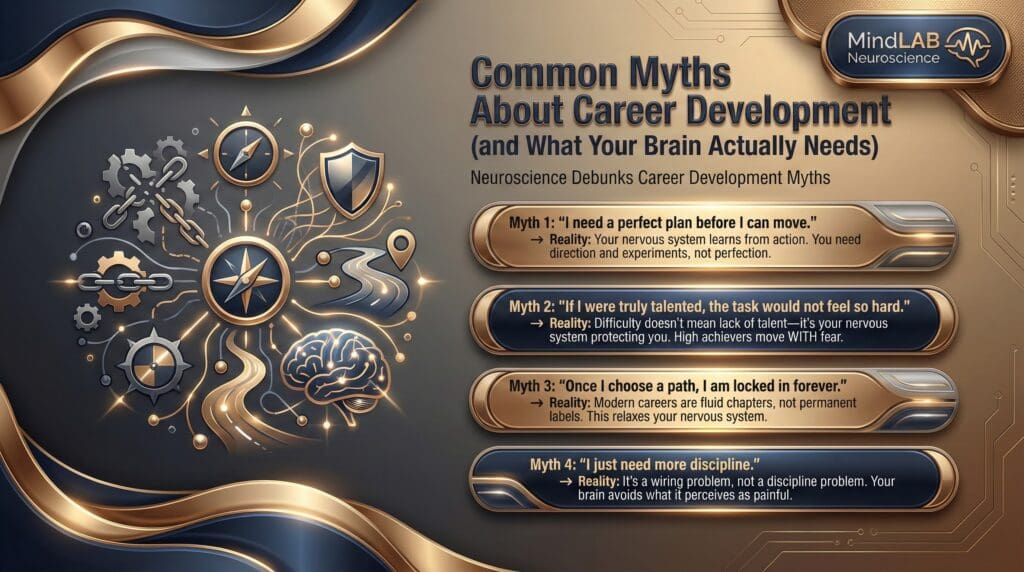
Common Myths About Career Development (and What Your Brain Actually Needs)
Several myths about career development quietly keep people stuck. Neuroscience helps us see why these myths do not hold up.
Myth 1: “I need a perfect plan before I can move.”
Your brain loves certainty, so it waits for a perfect plan that does not exist. In reality, your nervous system learns from action. You need a clear direction and a set of experiments, not a flawless script.
Myth 2: “If I were truly talented, the task would not feel so hard.”
Difficulty does not mean lack of talent. It often means your nervous system is trying to protect you from risk. High achievers feel fear and doubt, too. The difference is that they have learned how to move with those feelings, not wait for them to disappear.
Myth 3: “Once I choose a path, I am locked in forever.”
This belief keeps your threat system on high alert. In reality, modern careers are fluid. When you view your path as a series of chapters rather than a single, permanent label, your nervous system relaxes. That makes better decisions possible.
Myth 4: “I just need more discipline.”
If you are constantly fighting yourself, it is not a discipline problem. It is a wiring problem. Your brain is trying to avoid something it perceives as painful. Neuroscience practice helps you understand what that is so you can change it instead of shaming yourself.
Designing Your Personal Career Development Roadmap
Your career development roadmap does not need to look like anyone else’s. It should align with your nervous system, values, and long-term vision. Here is a simple way to begin designing one.
Step 1: Define your “north star” feeling
Instead of starting with a job title, start with how you want your work life to feel. Do you want more creativity, influence, autonomy, stability, impact, or learning? Your brain organizes information around feeling states. This north star becomes the emotional anchor for your decisions.
Step 2: Identify your current chapter
Be honest about where you are today. Are you in a chapter of skill-building, survival, experimentation, or consolidation? Each chapter has a different purpose. When your actions match the chapter you are in, your nervous system feels less confused and more focused.
Step 3: Choose three key growth targets
Select three specific areas for your career development over the next six to twelve months. For instance, you could focus on enhancing your visibility, developing your leadership skills, branching out into a new specialty, or venturing into a new field. These targets give your brain coordinates to work with.
Step 4: Design small, repeatable actions
For each target, choose one or two actions you will repeat weekly. They should be challenging enough to stretch you but not so extreme that your nervous system shuts down. This is where neuroplasticity thrives: repeated, meaningful action just beyond your comfort zone.
Step 5: Review and update monthly
Your brain needs feedback. Once a month, review your experiments. What felt aligned? What triggered too much stress? Where did you surprise yourself? Update your roadmap based on what your nervous system is telling you. This keeps your career development dynamic and responsive instead of rigid.

When to Consider Neuroscience Practice for Career Development
Neuroscience practice is not necessary for everyone, but it can be especially powerful if any of the following feel true for you:
• You know you are capable of more, but you cannot seem to get yourself to take the steps you already understand.
• You feel stuck in career indecision and cannot tell if your hesitation is wisdom or fear.
• You are successful on paper but feel bored, disconnected, or strangely empty in your work.
• You keep repeating the same patterns at work: over-pleasing, overworking, staying silent, or avoiding conflict.
• You have made significant career changes in the past, but they did not resolve the underlying dissatisfaction.
• You want a career development plan that honors both your ambition and your nervous system, instead of forcing you into someone else’s version of success.
If you recognize yourself in any of these, neuroscience practice can help you move forward more clearly and calmly. It gives you both the map and the tools to change your patterns in real time, rather than only understanding them in theory.
How do I work with clients on career development?
In my practice, I work with founders, executives, professionals, and high-potential individuals who are ready for next-level career development but feel blocked by invisible forces. We start with a deep assessment of your brain patterns, not just your résumé. We explore your story through the lens of neuroplasticity: how did your nervous system learn to respond this way, and what do we want it to know instead?
From there, we design a personalized plan. That plan includes strategic career moves, but it also includes emotional and neurological work. We practice difficult conversations before they happen. We rehearse new behaviors in low-stakes settings before you bring them into high-stakes situations. We track your progress in both external results and internal shifts, like reduced anxiety, clearer thinking, and a stronger sense of self at work.
Career development becomes a partnership between your goals and your brain. You are no longer trying to bully yourself into change. You are learning how to leverage your biology, so growth feels challenging but achievable, not terrifying or impossible.
Final Thoughts: Your Career Is Your Brain’s Most Important Project
Your career is not just a series of jobs. It’s the story your mind tells about your identity, abilities, and how you fit into the world. Fear, habit, or other people’s expectations can drive that story, leading to feelings of indecision, stagnation, or quiet unhappiness.
Next-level career development asks a different question: How can I shape my brain to support the life I actually want? Neuroscience practice answers that question with practical, evidence-based tools. It helps you understand why certain moves feel so hard, even when they look simple on paper. It gives you a way to retrain your nervous system so that clarity, courage, and consistent action become your new default.
You are not behind. You are not broken. Your brain has been doing its best to protect you with the wiring it has. If you are reading this, wiring has brought you as far as it can. The next level of your career development will not come from more pressure or more self-criticism. It will come from learning how your brain actually works and choosing, step by step, to rewire it in your favor.
That is the work I have devoted my life to: helping people change not just their careers, but the neural patterns that drive them. When you do that, your career stops feeling like something that is happening to you and starts feeling like something you are actively and intelligently creating.
Most people think career development is about polishing a résumé, networking more, or collecting new skills. Those pieces matter, but they are not what actually determines whether you stay stuck in the same role for years or step into a career that feels alive, aligned, and truly your own. Under every promotion, pivot, or leap in your professional life, there is one thing at work: your brain.
In more than twenty-five years as a neuroscience-based practitioner, I have watched incredibly bright, accomplished people stay trapped in roles that drain them. They read the career development books, listen to the podcasts, and take another online course, yet still feel indecisive, stagnant, or afraid to make a move. They tell themselves they “should” be grateful.
They convince themselves it is safer to wait. But their nervous system is doing something very specific: it is choosing certainty over growth.
Career development does not fail because you are lazy or confused. It fails when the plan you are following does not align with how the brain actually changes. Real progress at work comes from rewiring how you think, decide, and act in the moments that matter. That is precisely what neuroscience practice is designed to do. It turns career development from a vague idea into a brain-based process you can actually follow and repeat.
In this article, I will show you how. You will learn why traditional career development often stalls, what is happening in your brain when you face career indecision or stagnation, and how neuroscience practice can help you build a career that fits who you truly are. You will gain practical tools and a deeper comprehension of your brain’s reaction to high-stakes situations.
My goal is simple: to help you stop fighting your brain and start using it as your most substantial advantage in career development.
What Traditional Career and Professional Development Get Wrong
Most career advice focuses on what you do, not how your brain works while doing it. They advise you to set goals, work harder, exercise more discipline, and venture beyond your comfort zone. On paper, it sounds right. In real life, it often collapses the moment stress, uncertainty, or self-doubt shows up.
There are three common patterns I see in my practice. The first is career indecision. These are clients who have ten browser tabs open with job postings, graduate programs, or business ideas, yet make no clear move. They analyze every option until they feel paralyzed. They are not indecisive by nature; their brain is flooded with threat signals that make every choice feel dangerous.
The second pattern is career stagnation. These clients are usually successful on the surface. They have stable titles, adequate salaries, and a reputation for being reliable. Inside, they feel bored, numb, or quietly resentful. They tell themselves they will make a change “next year,” but next year keeps moving. Deep habit loops around safety and predictability have been ingrained in their brain, making any change feel daunting.
The third pattern is overachievement without alignment. These individuals are the epitome of career development. They keep climbing, taking on more, hitting targets, and chasing bigger roles. But they feel disconnected from their life. Their nervous system is wired to chase external approval instead of internal meaning, and eventually that gap shows up as burnout, emptiness, or impulsive decisions.
All three patterns have something in common. They view career development as a purely logical exercise. In reality, your career is a high-stakes emotional and neurological process. Until you understand what your brain is doing underneath your goals, you will keep bumping into the same invisible walls.
The Neuroscience Behind Career Development
At its core, career development is your brain learning which actions feel safe, rewarding, and possible for you. Every time you make a decision, speak up in a meeting, ask for feedback, or avoid a risk, your brain is updating a map of “who I am at work” and “what is safe for me.” That map lives in your neural pathways.
Neural pathways are the tracks your thoughts and behaviors follow. The more often you repeat a pattern, the stronger those tracks become. If you have spent years telling yourself that you are poor at speaking up, your brain has reinforced that pathway. The same is true if you have spent years saying yes to everyone, avoiding conflict, or choosing roles that match what other people expect from you.
Two key systems shape your career development every day. The first is your threat system. This mechanism is the part of your nervous system that scans for risk: rejection, failure, embarrassment, or loss of status. The second is your reward system. This system responds to factors such as meaning, progress, recognition, learning, and contribution. When these systems are not in balance, you either play too small or chase rewards that do not actually feel satisfying.
Your prefrontal cortex, the part of your brain behind your forehead, is responsible for planning, decision-making, and self-control. It is the region you need for smart career decisions. Under high stress or chronic uncertainty, your brain starts to favor older survival circuits instead. That is when you freeze, avoid, over-please, or procrastinate.
Your conscious goals say, “I want next-level career development.” Your nervous system quietly says, “Let’s not rock the boat.”
Neuroscience works by understanding these systems and helping you change them in real time. Instead of asking, “What should you do with your career?” It also asks, “What is your brain doing, and how can we change that pattern so the next decision feels possible instead of terrifying?”
What Is Neuroscience-Based Career Advisory?
Neuroscience-based career advisory is not about generic advice or motivational slogans. It is a structured process that uses what we know about the brain to help you make better career decisions and sustain new behavior.
When I work with clients on career development, I am not only listening to the story of their résumé. I am listening to their wiring. How do they respond under pressure? Where do they freeze? What triggers shame, self-doubt, or anger? Where do they come alive? Which tasks give them energy instead of draining it? How do they talk to themselves when something goes wrong?
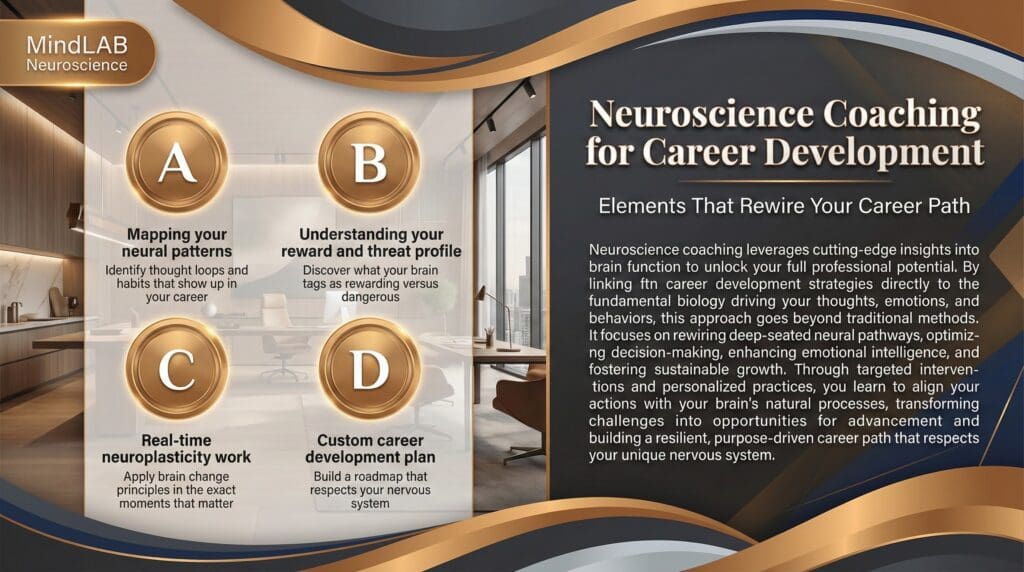
Neuroscience practice for career development usually includes several elements:
- Mapping your current neural patterns
We identify the specific thought loops, emotional reactions, and habits that show up in your career. For example, do you always downplay your ideas in front of authority figures? Do you go blank when you have to talk about your strengths? Do you keep saying yes to projects you do not want because conflict makes your nervous system panic? - Understanding your reward and threat profile
We look at what your brain currently tags as “rewarding” and “dangerous.” Many people are wired to feel rewarded by approval or perfection but feel threatened by visibility, uncertainty, or asking for what they want. This profile explains why your career development has felt harder than it should. - Real-Time Neuroplasticity™ work
Neuroplasticity is your brain’s ability to change itself. Real-time neuroplasticity means we apply those principles in the exact moments you would usually repeat an old pattern before the big conversation with your boss, after a conflict, during a stressful presentation, or while you are deciding whether to apply for a role. We do not just talk about change; we rehearse and implement it in real life. - A custom career development plan that fits your brain
Instead of handing you a one-size-fits-all plan, we build a roadmap that respects your nervous system. We break change into steps your brain can handle, while still moving you toward real growth. That is why neuroscience practice is so effective: it links your career development strategy to the biology that drives your behavior.

How Career Indecision Looks Inside the Brain
Career indecision can feel like you are simply missing information. If you had the correct data, the right mentor, or the right moment, the path to career decision-making would become clear.. In reality, your brain already knows that several of your options could work. The issue is that your threat response system is more dominant than your decision-making system..
When you imagine choosing a new path, your brain runs mental simulations. It pictures the worst-case scenarios: failing in a new role, disappointing your family, earning less for a while, or looking foolish. These simulations trigger the same stress circuits that light up when you face actual danger.
Your heart rate increases, your muscles tense, and your prefrontal cortex becomes less effective. Suddenly, everything feels fuzzy and overwhelming.
To protect you, your brain quietly chooses the “safest” option: delay. You do more research. You talk to one more person. You wait for a sign. On the outside, it looks like you are being thoughtful. Inside, your nervous system has made a clear choice: better the devil you know than the uncertainty you do not.
Neuroscience practice interrupts this loop. Instead of trying to push you into a decision with willpower, we work directly with your nervous system. We train your brain to tolerate uncertainty in smaller steps, so your prefrontal cortex stays online. You learn to view career development not as a single, big leap, but as a series of controlled experiments. That shift alone reduces fear and enables action.
Career Stagnation: When Your Brain Gets Too Comfortable
Career stagnation often begins as relief. You land the role you wanted, hit a certain income level, or finally escape a toxic environment. Your brain, which has been working hard to keep you safe, relaxes. Predictability feels good. Your routine becomes familiar. You know what is expected.
Over time, though, a different feeling shows up. Boredom. Restlessness. Irritation. There is a subtle awareness that your potential extends beyond your daily activities. You may start asking, “Is this worth it?” That feeling is not selfish or ungrateful. It is your brain’s reward system telling you that your more profound needs for growth, meaning, and contribution are not being met.
The problem is that your threat and reward systems are now at odds with each other. One part of your brain is telling you to “Stay. It is safe here.” Another part is saying, “Grow. You are underusing your potential.” When you ignore that tension, it often turns into burnout, chronic fatigue, or resentment toward your job, even if nothing on the outside looks wrong.
In neuroscience practice, we regard career stagnation as a signal, not a failure. Your nervous system is asking for a new chapter, but it needs guidance to update its definition of “safe.” We build career development steps that introduce challenge and novelty in a way your brain can handle, so you do not burn everything down to get relief.
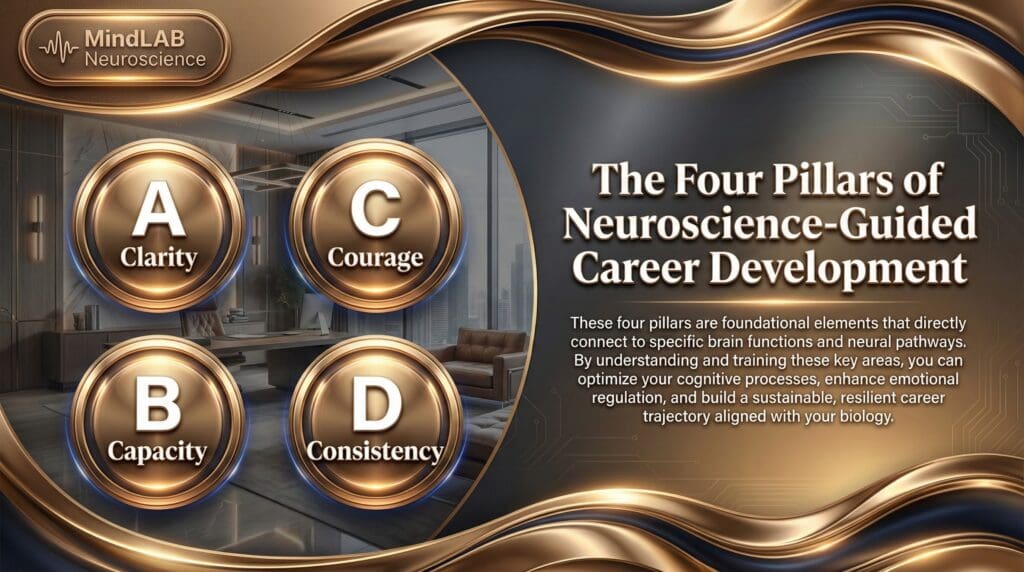
The Four Pillars of Neuroscience-Guided Career Development
Effective career development in my practice usually rests on four core pillars: clarity, capacity, courage, and consistency. Each pillar connects to specific brain functions, and each one can be trained.
Clarity—Teaching Your Brain What to Aim For
Your brain is a prediction machine. It likes clear targets. When your career goals are vague, like “be more fulfilled” or “find my purpose,” your nervous system has nothing concrete to work with. Clarity means turning your values, strengths, and interests into specific, observable targets.
In neuroscience practice, we ask detailed questions: When do you feel most mentally alive? What kind of problems do you enjoy solving? What type of environment helps your brain perform at its best? Which tasks give you energy, even when they are hard?
As we answer these, your brain starts to build a sharper picture of what actual career development looks like for you, not for anyone else.
Capacity—Regulating Your Nervous System for High Stakes
No matter how clear your goals are, you will not move toward them if your nervous system is constantly overwhelmed. Capacity is your ability to stay grounded and focused when the stakes feel high. It includes your sleep, energy, emotional regulation, and cognitive bandwidth.
Neuroscience practice for career development always includes capacity work. You learn simple, science-based tools to bring your nervous system back into balance before big moments: performance reviews, presentations, negotiations, or difficult conversations. When your brain is regulated, your prefrontal cortex can do its job. That is when you make better decisions, communicate clearly, and show up as the version of yourself you want your career to reflect.
Courage—Expanding What Feels “Safe Enough”
Courage is not the absence of fear. It is the ability to act while your nervous system feels uncertain. From a brain perspective, courage is about expanding your window of tolerance for risk, visibility, and change.
We build courage through graded exposure. Instead of forcing you to make a giant leap, we design smaller, controlled challenges that stretch your comfort zone without overwhelming it. Speak up once in a meeting. Ask for feedback from one person you trust. Apply for a role that feels slightly out of reach, not impossible.
Each time you do this and survive, your brain updates its prediction: “This is challenging, but I can handle it.” Over time, that is how your career development becomes bolder and more aligned.
Consistency—Turning New Patterns into Default Settings
A single brave action does not build a new career. Repeated, aligned actions do. Consistency is where neuroplasticity becomes visible in your daily life. Each time you choose the new pattern instead of the old one, you reinforce a new neural pathway.
In practice, we choose a few key behaviors that will have the most significant impact on your career development. It could be sending one targeted networking email each week, blocking time for deep work, setting a boundary with your time, or tracking your wins so your brain sees evidence of progress. Consistency makes the new pattern feel natural instead of forced. That is when your brain starts to say, “This is just who I am now.
Real-Time Neuroplasticity™: Changing Your Career in the Moments That Matter
Most people perceive career development as something they think about only when they are updating their résumé or facing a big decision. Real-time neuroplasticity: Every day at work is a training ground for your brain. The moments that used to trigger your worst habits become the exact places where you rewire them.
Imagine you are in a meeting. You have a valuable idea, but your heart starts racing. Your threat system lights up, telling you to stay quiet. In the past, you would have obeyed that signal and stayed silent. With real-time neuroplasticity, we have prepared for this moment. You recognize the physical signs, use a simple grounding tool to settle your nervous system, and share the idea anyway.
In that instant, your brain has done something new. It faced a perceived threat, remained regulated, and aligned with your career goals. That single act may seem small, but it is a powerful signal to your nervous system: “It is safe to be visible. It is safe to contribute.”
When these moments are repeated over time, they contribute to significant career development.
This is why neuroscience practice is so effective. It does not just give you insight. It gives you a step-by-step process to practice new responses in real time, while the stakes are real and your nervous system is activated. That is how neural pathways change in a way that actually shows up in your career.
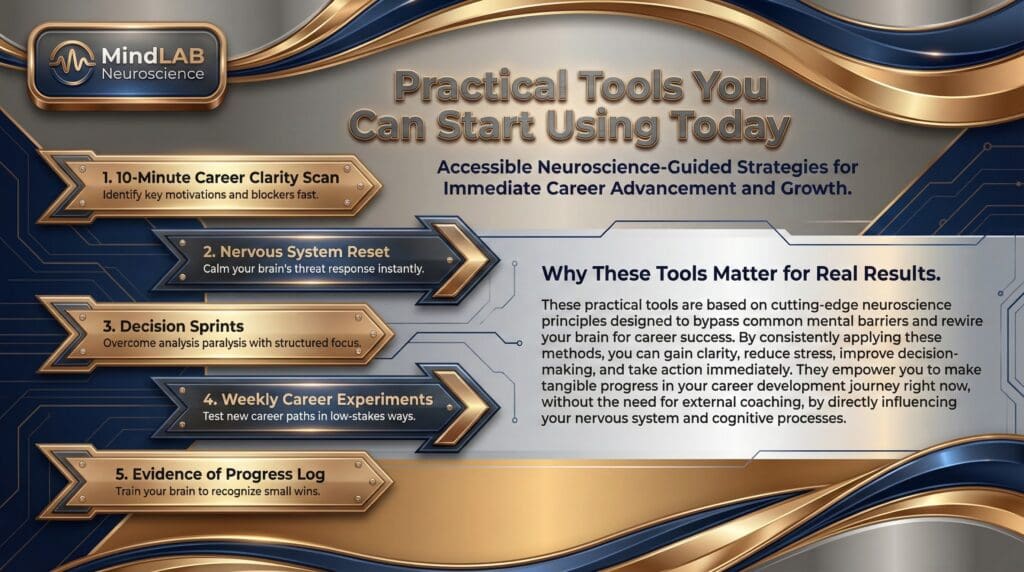
Practical Tools You Can Start Using Today
You do not have to wait to work with a practitioner to start applying neuroscience to your career development. Here are several tools you can begin using now.
- The 10-Minute Career Clarity Scan
Once a week, take ten minutes and ask yourself three questions:
• What gave me energy at work this week?
• What drained me the most?
• When did I feel most like my authentic self?
Write short, honest answers. Over a month or two, patterns will appear. You will see which tasks light up your reward system and which situations overstimulate your threat system. That information is gold for your career development plan. - The nervous system resets before big moments.
Before a high-stakes meeting, interview, or conversation, your nervous system may already be on high alert. Spend two to three minutes doing a simple reset. Inhale slowly through your nose, then exhale slightly longer than you inhaled. Drop your shoulders. Feel your feet on the floor. Focus on one point in the room. - Decision Sprints Instead of Endless Debating
If you struggle with career indecision, try a decision sprint. Choose one specific decision related to your career development. Set a timer for fifteen minutes. During that time, write down your options, the real risks, and the real upside of each choice. When the timer ends, choose a small, concrete next step you will take within seventy-two hours. You are not deciding your entire future; you are training your brain to move instead of freeze. - Weekly Career Experiments
Treat your career development as a series of experiments rather than a single irreversible choice. Once a week, run one experiment: reach out to someone in a field you are curious about, volunteer for a project that stretches you, or spend time doing work that fits a future direction you are considering. After each experiment, ask your brain, “What did I learn about what feels right for me?” - The “Evidence of Progress” Log
Your brain tends to remember failures more than wins, especially if you struggle with perfectionism. Keep a simple log where you record three small wins at the end of each workday. They can be as simple as sending a tough email, asking one clarifying question, or setting a small boundary. This trains your brain to notice that your career development is already happening, which builds motivation and confidence.
Case Snapshots: How Neuroscience Practice Shifts Careers
Every client’s story is unique, but there are patterns I see again and again when people apply neuroscience to their career development. Here are a few simplified examples, with details changed for privacy.
One client was a mid-level manager who had been “thinking” about a career move for five years. He bounced between job boards and advanced degrees but never made a clear decision. Together, we mapped out his threat triggers: fear of disappointing his family, fear of losing status, and fear of being a beginner again.
We practiced real-time neuroplasticity around small risks, like initiating conversations with leaders in a new field and speaking more boldly in his current role. Within a year, he had made a confident, strategic move into a role that matched his strengths and values, and his nervous system had learned that growth did not equal danger.
Another client was a physician who felt profoundly stagnant. On paper, she had everything: status, stability, and respect. Inside, she felt trapped. We worked on her reward system, exploring where she actually felt meaning and joy in her work.
Over time, we adjusted her career development plan to focus more on teaching, mentoring, and program building. She did not have to abandon her field. Instead, she restructured her role to align with her genuine strengths. The result was not just a better job but a regulated nervous system that no longer dreaded Mondays.
A third client was a young finance professional who felt invisible. He kept his head down, did excellent work, and waited to be noticed. When promotions passed him by, he assumed he was not talented enough. We learned during practice that his nervous system connected visibility to danger.
We used graded exposure to help him take up more space: sharing his wins, asking better questions in meetings, and building relationships with decision-makers. His career development took off not because his skills changed overnight, but because his brain finally allowed him to be seen.
How Neuroscience Practice Creates Measurable Results
It is important to say this clearly: neuroscience practice is not magic. It is effective because it works with how the brain naturally learns and changes. When you apply these principles to your career development, the results are often tangible and measurable.
Clients report more transparent decision-making, less time stuck in mental loops, and more strategic risk-taking. They describe feeling calmer before high-stakes moments and more confident speaking about their strengths and ambitions. Many achieve concrete outcomes: promotions, successful career pivots, new businesses, or redesigned roles that align with their true identity.
Underneath those outcomes, something else has shifted. Their relationship to fear, uncertainty, and visibility has changed. Their nervous system no longer perceives every step forward as a threat. Their reward system is calibrated toward meaningful progress rather than external approval alone.
Once those changes are in place, future career development becomes easier because their brain is now wired to support growth rather than block it.
Common Myths About Career Development (and What Your Brain Actually Needs)
Several myths about career development quietly keep people stuck. Neuroscience helps us see why these myths do not hold up.
Myth 1: “I need a perfect plan before I can move.”
Your brain loves certainty, so it waits for a perfect plan that does not exist. In reality, your nervous system learns from action. You need a clear direction and a set of experiments, not a flawless script.
Myth 2: “If I were truly talented, the task would not feel so hard.”
Difficulty does not mean lack of talent. It often means your nervous system is trying to protect you from risk. High achievers feel fear and doubt, too. The difference is that they have learned how to move with those feelings, not wait for them to disappear.
Myth 3: “Once I choose a path, I am locked in forever.”
This belief keeps your threat system on high alert. In reality, modern careers are fluid. When you view your path as a series of chapters rather than a single, permanent label, your nervous system relaxes. That makes better decisions possible.
Myth 4: “I just need more discipline.”
If you are constantly fighting yourself, it is not a discipline problem. It is a wiring problem. Your brain is trying to avoid something it perceives as painful. Neuroscience practice helps you understand what that is so you can change it instead of shaming yourself.
Designing Your Personal Career Development Roadmap
Your career development roadmap does not need to look like anyone else’s. It should align with your nervous system, values, and long-term vision. Here is a simple way to begin designing one.
Step 1: Define your “north star” feeling
Instead of starting with a job title, start with how you want your work life to feel. Do you want more creativity, influence, autonomy, stability, impact, or learning? Your brain organizes information around feeling states. This north star becomes the emotional anchor for your decisions.
Step 2: Identify your current chapter
Be honest about where you are today. Are you in a chapter of skill-building, survival, experimentation, or consolidation? Each chapter has a different purpose. When your actions match the chapter you are in, your nervous system feels less confused and more focused.
Step 3: Choose three key growth targets
Select three specific areas for your career development over the next six to twelve months. For instance, you could focus on enhancing your visibility, developing your leadership skills, branching out into a new specialty, or venturing into a new field. These targets give your brain coordinates to work with.
Step 4: Design small, repeatable actions
For each target, choose one or two actions you will repeat weekly. They should be challenging enough to stretch you but not so extreme that your nervous system shuts down. This is where neuroplasticity thrives: repeated, meaningful action just beyond your comfort zone.
Step 5: Review and update monthly
Your brain needs feedback. Once a month, review your experiments. What felt aligned? What triggered too much stress? Where did you surprise yourself? Update your roadmap based on what your nervous system is telling you. This keeps your career development dynamic and responsive instead of rigid.
When to Consider Neuroscience Practice for Career Development
Neuroscience practice is not necessary for everyone, but it can be especially powerful if any of the following feel true for you:
• You know you are capable of more, but you cannot seem to get yourself to take the steps you already understand.
• You feel stuck in career indecision and cannot tell if your hesitation is wisdom or fear.
• You are successful on paper but feel bored, disconnected, or strangely empty in your work.
• You keep repeating the same patterns at work: over-pleasing, overworking, staying silent, or avoiding conflict.
• You have made significant career changes in the past, but they did not resolve the underlying dissatisfaction.
• You want a career development plan that honors both your ambition and your nervous system, instead of forcing you into someone else’s version of success.
If you recognize yourself in any of these, neuroscience practice can help you move forward more clearly and calmly. It gives you both the map and the tools to change your patterns in real time, rather than only understanding them in theory.
How do I work with clients on career development?
In my practice, I work with founders, executives, professionals, and high-potential individuals who are ready for next-level career development but feel blocked by invisible forces. We start with a deep assessment of your brain patterns, not just your résumé. We explore your story through the lens of neuroplasticity: how did your nervous system learn to respond this way, and what do we want it to know instead?
From there, we design a personalized plan. That plan includes strategic career moves, but it also includes emotional and neurological work. We practice difficult conversations before they happen. We rehearse new behaviors in low-stakes settings before you bring them into high-stakes situations. We track your progress in both external results and internal shifts, like reduced anxiety, clearer thinking, and a stronger sense of self at work.
Career development becomes a partnership between your goals and your brain. You are no longer trying to bully yourself into change. You are learning how to leverage your biology, so growth feels challenging but achievable, not terrifying or impossible.
Final Thoughts: Your Career Is Your Brain’s Most Important Project
Your career is not just a series of jobs. It’s the story your mind tells about your identity, abilities, and how you fit into the world. Fear, habit, or other people’s expectations can drive that story, leading to feelings of indecision, stagnation, or quiet unhappiness.
Next-level career development asks a different question: How can I shape my brain to support the life I actually want? Neuroscience practice answers that question with practical, evidence-based tools. It helps you understand why certain moves feel so hard, even when they look simple on paper. It gives you a way to retrain your nervous system so that clarity, courage, and consistent action become your new default.
You are not behind. You are not broken. Your brain has been doing its best to protect you with the wiring it has. If you are reading this, wiring has brought you as far as it can. The next level of your career development will not come from more pressure or more self-criticism. It will come from learning how your brain actually works and choosing, step by step, to rewire it in your favor.
That is the work I have devoted my life to: helping people change not just their careers, but the neural patterns that drive them. When you do that, your career stops feeling like something that is happening to you and starts feeling like something you are actively and intelligently creating.
This article is part of our Strategic Career Architecture collection. Explore the full series for deeper insights into strategic career architecture.