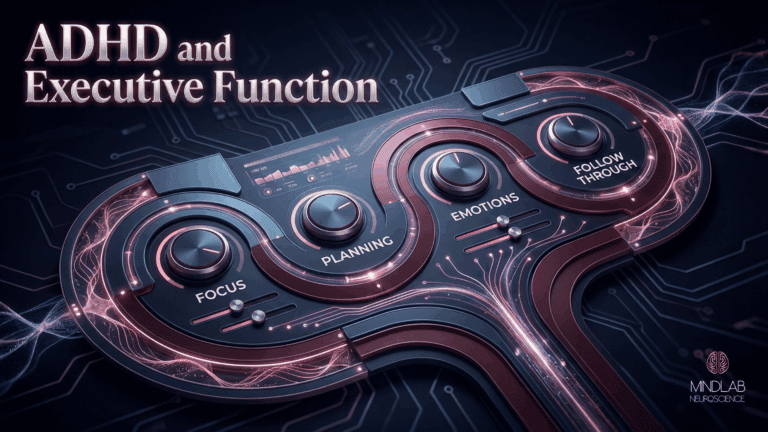
The Cognitive Edge: Redefining Executive Function
You may be searching for ADHD & Executive Function therapy, but traditional talk therapy often fails high-performers. You need Neuro-Optimization.
Let’s be direct: You did not get to the C-suite, build your enterprise, or amass your portfolio by having a “normal” brain. You succeeded because your neural architecture is distinct. In the world of high-performance, standard “coping mechanisms” are a regression to the mean. You are not looking to regress; you are looking to leverage.
Traditional psychology addresses your neurodivergence as a deficit to be managed. I view it as a high-volatility asset to be mastered. We are not here to fix a disorder; we are here to upgrade the operating system of a Formula 1 engine that has been forced to drive in school zones.
The Neuroscience of Your Competitive Advantage
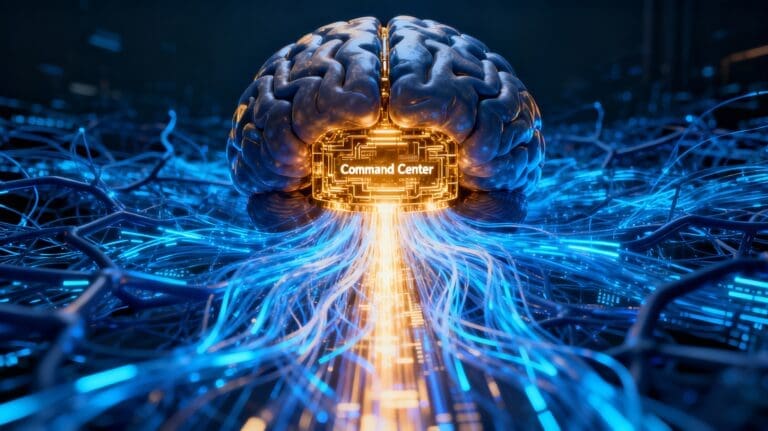
To understand why you oscillate between brilliance and boredom, we must look at the Prefrontal Cortex (PFC) through the lens of what I call the “CEO Paradox.”
Imagine your brain is a Fortune 500 company. In a neurotypical brain, the CEO (the PFC) is a steady, risk-averse administrator who files paperwork on time and keeps the office quiet. In your brain, the CEO is a visionary disruptor. When the stakes are high and the dopamine is flowing, this CEO enters a state of Hyperfocus—a flow state where time vanishes and productivity becomes exponential. This is your biological competitive advantage.
However, when the environment is mundane, your internal CEO leaves the building to chase new mergers, leaving the interns (your executive functions) unsupervised. This isn’t a lack of attention; it is an abundance of processing power seeking a worthy target. We don’t want to sedate the CEO; we want to build a better boardroom to support their vision.
This is the shift from “symptom management” to Cognitive Architecture. We are going to harness your wiring to ensure that your executive function matches your intellectual horsepower.
The Neurobiology of Elite Cognitive Wiring
To optimize your performance, we must move beyond the vague notion of “willpower” and examine the hardware running your system. Your brain is not broken; it is specialized. The neurobiological signature of the high-functioning ADHD mind—what I term the Divergent High-Performance Phenotype—is characterized by distinct variations in neural connectivity and neurotransmitter availability. We are dealing with a difference in physics, not a deficit in character.
The Dopaminergic Supply Chain: Tonic vs. Phasic Firing
The primary driver of your unique cognitive profile lies in the transmission of dopamine and norepinephrine. In the neurotypical brain, dopamine is released in a steady, baseline drip (tonic firing), allowing for sustained attention on mundane tasks. Your brain, however, operates on a Phasic system.
Think of this as the difference between a commercial sedan and a high-performance jet. A sedan runs efficiently on standard fuel at 45 miles per hour. Your brain is a jet engine; it creates insufficient lift at low speeds (low stimulation), causing it to stall. However, when engaged by high-stakes challenges, novelty, or urgency, your brain releases a massive, phasic spike of dopamine. This is not a malfunction; it is a fuel injection system designed for velocity. You struggle with the mundane because your biology demands high-octane environments to function at peak capacity.
Network Connectivity: The DMN-TPN Toggle
Neuroscience identifies two primary networks relevant to executive function: the Task Positive Network (TPN), used for focused execution, and the Default Mode Network (DMN), responsible for imagination, future planning, and creativity. In a standard brain, these networks operate like a seesaw—when one goes up, the other goes down.
In the neurodivergent high-performer, this “toggle switch” is often resistant. You may find it metabolically expensive to disengage the DMN (the visionary, creative mode) to engage the TPN for administrative details. However, once the TPN is fully engaged—usually triggered by that phasic dopamine spike—the DMN is suppressed so completely that you enter Hyperfocus. This is a state of pure neural efficiency where the cost of task-switching vanishes, and output becomes nonlinear.
Evolutionary Anomalies: The Hunter’s Scan
Why does this wiring exist? Evolutionary psychology suggests that this is not a mutation, but a preservation of the “Hunter” gene pool. While the “Farmer” brain is wired for repetitive, linear crop maintenance, the “Hunter” brain is wired for scanning and sprinting.
What is often labeled as “distractibility” is actually Hyper-Awareness. Your brain does not filter out sensory input; it absorbs it to scan for threats or opportunities. In the C-suite, this translates to an uncanny ability to read a room, detect shifts in market sentiment before the data confirms them, and pivot strategies instantly. Your biology is optimized for crisis management and rapid innovation, not maintenance.
The Metabolic Cost of Executive Control
It is crucial to understand that forcing a “Hunter” brain to perform “Farmer” tasks imposes a heavy metabolic tax. The Prefrontal Cortex (PFC)—the CEO of the brain—requires significantly more glucose and oxygen to regulate attention on low-stimulation tasks for the neurodivergent mind. This explains the phenomenon of “decision fatigue” or sudden exhaustion after a day of administrative work, despite your high intellect. We are not looking to force efficiency in low-value areas; we are looking to align your daily operations with your metabolic strengths.
Why Standard Interventions Fail the High-Performance Mind
If you are reading this, you have likely already exhausted the standard menu of clinical interventions. You have sat on leather couches discussing your childhood, and perhaps you have experimented with pharmacology. Yet, the friction remains. This is not a failure of your effort; it is a failure of the model. Standard care is designed to bring the dysfunctional up to “average.” It is wholly unequipped to take the exceptional to the optimal.
The Fallacy of “Top-Down” Talk Therapy
Traditional psychotherapy, particularly Cognitive Behavioral Therapy (CBT), operates on a “Top-Down” mechanism. It assumes that if you can rationally analyze a behavior with your Prefrontal Cortex (PFC), you can change it.
For the neurodivergent high-performer, this is a fundamental architectural error. We know that under stress or high cognitive load, your PFC—the logic center—temporarily decouples from the limbic system. Trying to “talk” your way out of executive dysfunction is like trying to update a computer’s software while the hardware is overheating. You cannot use logic to override a neurobiological event. Talk therapy addresses the symptom (the behavior) while ignoring the source (the neural firing pattern). You do not need more insight; you have plenty of insight. You need neural regulation.
The Cost of Chemical Blunting
The other standard lever is medication. While useful for some, for the creative entrepreneur or the visionary executive, reliance on stimulants often comes with an unacceptable “tax.”
Medication is a blunt instrument designed to increase tonic dopamine levels, effectively forcing the “Hunter” brain to tolerate the “Farmer’s” routine. The trade-off is often a phenomenon I call Cognitive Flattening. While you may gain the ability to sit through a three-hour compliance meeting, you often lose the lateral thinking, the rapid-fire association, and the intuitive leaps that define your genius. We are not interested in sedating the visionary to save the administrator. To blunt your neurodivergence is to blunt your competitive edge.
The Mismatch of Scale
Most ADHD coaching is built for the general population—focusing on basic life skills like remembering keys or paying bills. Your challenges are not pedestrian; they are systemic and high-stakes. You are managing mergers, navigating volatility, and leading teams.
You do not need a cheerleader to tell you to use a planner. You need a neuro-associative approach that aligns your biological rhythms with your professional demands. We must bypass the conscious mind’s resistance and work directly on the neural pathways, moving from a model of “coping with a disorder” to engineering a bespoke cognitive environment. We are not here to make you normal. We are here to make you efficient.
Protocols for Executive Optimization
We cannot wait for the world to become less stimulating, nor can we rely on willpower, which is a finite metabolic resource. Instead, we must deploy Bottom-Up Cognitive Restructuring. These are not “tips”; they are neuro-hacks designed to manually override the Default Mode Network and force the Task Positive Network into engagement. We are bypassing the “mind” to hack the “machine.”
Protocol 1: The Phasic Sprint (Overcoming Inertia)
The Mechanism: The neurodivergent brain creates high friction against starting mundane tasks because the anticipated dopamine reward is too low to trigger action. Your brain remains in a low-energy, tonic state. To engage the engine, we must artificially induce a phasic dopamine spike.
The Execution: Do not commit to “working on the project.” That is too abstract for your amygdala. Instead, set a timer for exactly 12 minutes. This creates a “micro-deadline”—an artificial crisis that mimics the urgency your brain thrives on. Tell yourself, “I am not finishing this; I am merely engaging for 12 minutes.” This lowers the barrier to entry. Once the timer starts, the urgency triggers norepinephrine release. By minute 10, the Task Positive Network is typically fully vascularized and online, and you will likely bypass the alarm and continue in a state of flow. We use the sprint to trick the system into ignition.
Protocol 2: Visual Gating (Eliminating Cognitive Noise)
The Mechanism: Your brain is an indiscriminate data sponge. It processes the movement in your peripheral vision with the same priority as the spreadsheet in front of you. This creates a “processing bottleneck” in the Prefrontal Cortex, leading to rapid fatigue.
The Execution: We must mechanically restrict sensory input to force focus. This is Visual Gating. When deep work is required, physically narrow your visual field. Use a hood, dim the ambient lights, or use “tunnel vision” blocking glasses. By obscuring peripheral visual data, you reduce the metabolic load on your brain’s filtering mechanisms. When the brain has less data to filter out, it has more bandwidth to pour into the singular task at hand. You are effectively putting blinders on a racehorse to ensure it runs in a straight line.
Protocol 3: Interoceptive Grounding (The Circuit Breaker)
The Mechanism: High-performers often experience “Amygdala Hijack”—a sudden surge of frustration or impulsivity when a plan goes off-track. This disconnects the rational PFC. Trying to “think” your way calm in this state is impossible because the logic center is offline.
The Execution: You must intervene via the body (bottom-up). When you feel the “spin” of overwhelm or reactivity, execute a Physiological Sigh: two sharp inhales through the nose (to fully inflate the alveoli) followed by one long, extended exhale through the mouth. This is not meditation; it is mechanics. This specific breathing pattern mechanically offloads carbon dioxide and triggers a baroreflex that forces the heart rate to slow. It sends a direct signal to the vagus nerve to disengage the sympathetic nervous system (fight/flight) and re-engage the frontal lobes. Do this three times to reboot your executive control immediately.
Frequently Asked Questions
“I have never been formally identified with ADHD. Is this program relevant to me?”
Absolute assessment is less relevant than functional reality. In high-performance neuroscience, we look at the phenotype—the observable characteristics of your neural wiring. If you experience the oscillation between hyperfocus and paralysis, the craving for high-stakes stimulation, and the struggle with linear administration, you possess the Divergent High-Performance Phenotype. We address the architecture, not the label. You do not need a medical tag to optimize a machine that is clearly built for speed rather than comfort.
“Will optimizing my executive function kill my creativity or ‘edge’?”
This is the most common fear among the elite. There is a pervasive myth that chaos is a prerequisite for genius. It is not. Chaos is simply the tax you are currently paying to access your genius. By strengthening your executive functions—specifically the “brakes” and “steering” of your Prefrontal Cortex—we do not dampen the engine; we simply ensure you don’t crash on the corners. Structure does not kill flow; it creates a container for it to exist without burnout.
“I don’t have time for weekly therapy sessions. How is this efficient?”
Standard therapy is a “soft” intervention that requires years of conversation to yield behavioral shifts. Neuro-Optimization is a “hard” skill acquisition model. We are not here to discuss your feelings about the past; we are here to install protocols for the present. This is akin to working with a performance coach for your brain. The focus is on rapid implementation of cognitive strategies that yield immediate ROI. We respect your time by focusing strictly on the mechanics of output.
“Is this a permanent fix, or will I always need these protocols?”
The goal of Neuro-Optimization is Self-Directed Neuroplasticity. Initially, you use these protocols as external scaffolding—manual overrides for your automatic systems. However, the brain follows the principle of “What fires together, wires together.” By repeatedly forcing the Task Positive Network to engage through these bottom-up drills, you are physically thickening the neural pathways in the PFC. Over time, what requires conscious effort today becomes unconscious competence tomorrow.
The Executive Conclusion
For too long, you have likely viewed your mind as a liability to be managed—a wild horse that constantly threatens to buck you off. It is time to invert that narrative.
The global economy is shifting. The “Farmer” brain—steady, repetitive, risk-averse—is being replaced by automation and algorithms. The future belongs to the “Hunter.” It belongs to the mind that can synthesize disparate information instantly, the mind that thrives in volatility, and the mind that can hyperfocus on a vision until it manifests in reality.
Your ADHD is not a disorder; it is a high-volatility asset class. It comes with higher risk, yes, but it also offers an exponentially higher yield. By mastering the neurobiology of your executive function, you stop fighting your nature and start leveraging it. You are not broken. You are simply a Formula 1 car that has finally stopped trying to drive off-road.
About Dr. Sydney Ceruto
Dr. Sydney Ceruto is a Neuroscientist and Brain Performance Strategist specializing in neurological re-engineering for elite individuals navigating high-stakes environments. As the founder of MindLAB Neuroscience and the pioneer of Real-Time Neuroplasticity™, she translates clinical neurobiology into decisive competitive advantages for tech innovators, professional athletes, entertainers, and private families worldwide. Dr. Ceruto holds dual PhDs in Behavioral & Cognitive Neuroscience from New York University and dual Master’s degrees in Clinical Psychology and Business Psychology from Yale University. She is the author of The Dopamine Code, published by Simon & Schuster.