
Key Takeaways
- Time blindness is striatal timing-circuit miscalibration, not laziness: the internal clock diverges from external time.
- Time optimism expresses time blindness: underestimating task duration (the planning fallacy) despite accurate personal history.
- The mechanism is dopaminergic: dopamine sets the internal pacemaker, and ADHD dysregulation accelerates time perception.
- External time anchors beat internal monitoring: the striatal deficit is tracking, not responding to signals.
- Time calibration is learnable: the striatal timing circuit recalibrates by pairing estimates with measured outcomes.
You were sure you had time. You were calm, even a little proud of staying relaxed. Then reality hits: the meeting starts in five minutes, you are not ready, and your laptop is still asleep.
If that happens once in a while, that is life. If it keeps happening even though you are capable and motivated, it is not laziness. It is time optimism: your brain sincerely forecasts that the future will run smoother than it usually does. Paired with time blindness, a weak internal sense of passing minutes, it quietly erodes trust at work. The fix is not more pressure. It is better calibration, and it is trainable. This pattern is examined in the brain science of compartmentalization for a thriving life.
I have worked with high performers for more than 26 years: founders, attorneys, surgeons, traders, creatives. They are capable, driven, and self-aware. Yet many of them chronically underestimate time. This work sits within our ADHD and executive function focus, and the pattern is rooted in how the brain resists action rather than in any lack of discipline. The dopamine timing circuits behind it are explored in The Dopamine Code.
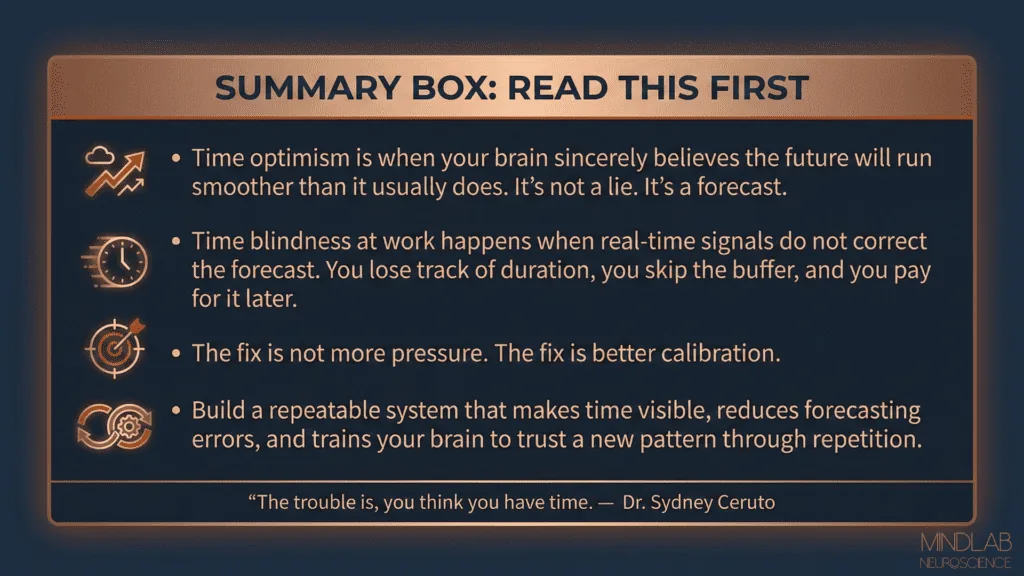
The trouble is, you think you have time.
Dr. Sydney Ceruto
What time optimism really is
Time optimism is the tendency to estimate time from the best-case story in your head rather than from the whole pattern of your real life. The brain builds a smooth, frictionless simulation of the future and treats that simulation as a reliable forecast, even when your own history consistently shows a different result. Forecasting bias feels like confidence. It can even feel like hope.
You think: I can do this in twenty minutes. I have done it before. Nothing will interrupt me. Then your phone rings, a client messages, the login fails, the file is missing. Your brain did not account for the interruptions because it was running a clean, uninterrupted scenario. In Sweden the word for this has gone viral: tidsoptimist, a person who believes they can fit more into the day than time allows. People laugh because it is painfully familiar, until the cost stops being funny.
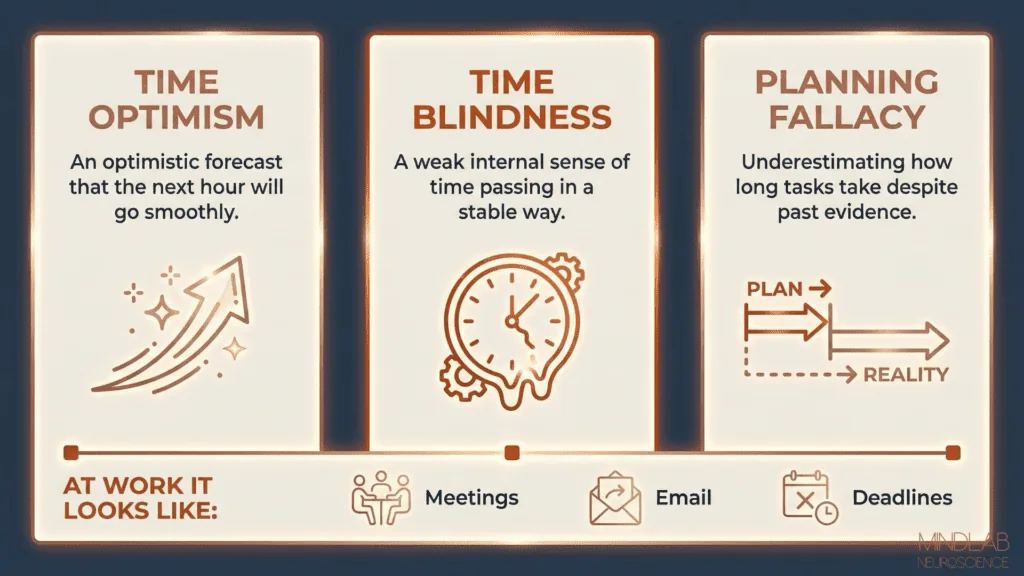
Three terms get used interchangeably, but they are not the same:
- Time optimism is the optimistic forecast: the belief that the next hour will cooperate.
- Time blindness is the internal tracking problem: the failure to feel time passing in a stable way. Minutes stretch, shrink, or disappear depending on attention.
- The planning fallacy is the classic pattern of underestimating how long tasks take, even with past evidence. You remember your intention more than your data.
At work these stack. You start with an optimistic forecast, lose time in the middle to time blindness, then double down on the planning fallacy by assuming the next task will be faster. That is how you end the day with five unfinished promises and a heavy nervous system.
Why smart people get stuck in it
High performers do not fail because they lack ability. They fail because a strength becomes a blind spot. If you have solved problems fast before, your brain remembers that, so you estimate time as the person you are on your best day. The belief that you can push through is not wrong, just incomplete. It is a brain shortcut, your nervous system saving effort with a simple rule: I can handle it. In a focused environment that shortcut keeps you moving. In a modern workday full of interruptions, it becomes expensive.
The confidence trap deepens it. People used to accomplishing a great deal in a short time build schedules assuming they will always run at peak capacity. The brain, though, is a living system with peaks and dips, not a machine. It gets hungry, overloaded, and emotionally pulled off task. Time optimism loves the confidence trap, because confidence makes the forecast feel true.

The neuroscience of why time disappears
Time is not a single clock in the brain. It is constructed from attention, working memory, and prediction, which is why a careful review of the timing literature treats duration as something the brain builds rather than reads. Picture your brain as a newsroom. Attention is the editor. Working memory is the desk where the key facts sit. Prediction is the headline you expect to publish next. When attention locks onto one thing, the editor stops watching the hallway and time stops being updated. When the desk gets overloaded, you lose the thread and time slips. When the headline stays too clean, you do not prepare for delays.
Two ways your brain tracks time
Two timing systems run in parallel. One is like a stopwatch: your sense of duration, how long has it been. The other is like a calendar: your sense of sequence, what happened first, second, third. When you are stressed or absorbed, the stopwatch becomes unreliable, so two hours can feel like twenty minutes. When you are overwhelmed, the calendar becomes unreliable, so you forget where you left off and restarting costs more than it should. This is why time blindness at work can look like procrastination even when it is not. You are not avoiding the work. You are losing the thread.
Dopamine and the pull of urgency
Dopamine is not just pleasure. It is a signal about what matters and what is worth chasing. When something feels urgent or exciting, dopamine sharpens focus at work. That narrowing makes you productive, but it also makes you time-blind. The brain’s SEEKING system, driven by dopamine, compresses subjective time during goal pursuit, which is why urgency-driven sprints feel shorter than they are and leave the nervous system progressively depleted. So you get stuck in a sprint style: you wait until pressure hits, your system locks on, and you power through. Urgency works until it costs you sleep, relationships, and your sense of control. Deep focus is a gift that can quietly distort time, because you remember the flow, not the clock.
Time optimism is not carelessness. It is dopaminergic, because dopamine sets the speed of the brain’s internal pacemaker, and a fast clock collapses the felt sense of duration.
Why time warps at work even when you are sharp
Work is built to distort time. At home, time is more predictable and there are fewer forced switches. At work, your brain bounces between short bursts and deep focus all day, and every bounce changes how time feels. Your brain does not measure time like a wall clock; it estimates time using attention and change. When attention is steady, it stops checking the clock, so an hour can feel like fifteen minutes. When attention is chopped up, it starts over again and again, and each restart has a hidden cost: rereading the thread, reopening the file, rebuilding the mental map. That cost rarely shows up in your estimate, so time optimism keeps winning.
In practice, a handful of workplace triggers reliably amplify the pattern:
- Task switching. Every switch has a restart cost while your brain reloads context.
- Meetings. Most start late and run long. Plan as if every one behaves and your calendar becomes a fantasy.
- Hidden steps. The two-minute email becomes a chain. The quick document needs a login, a missing attachment, then a conversation.
- Emotional friction. A hard call can take the wind out of you for an hour while your brain keeps replaying it.
When you do not budget for these, you are not making a plan. You are making a wish. The fix begins when you stop treating time as motivation and start treating it as a signal: make it visible, protect transitions, and give the brain repeated, calm, specific feedback. The goal is not to become rigid. It is to become accurate.
The time optimism loop
Time optimism follows a predictable loop. Once you see it, you can interrupt it:
- The clean forecast. You picture the task going smoothly. You do not picture friction.
- The attentional lock. You start, attention narrows, and time passes without registration.
- The surprise signal. Reality hits. The meeting is in ten minutes. The deadline is today.
- The adrenaline sprint. You rush, cut corners, and skip breaks. Repeated stress activation in this state wears down prefrontal function over time.
- The aftertaste. You feel embarrassed and drained, promise to do better, then repeat, because the brain never learned a new forecast.
Time optimism is not corrected by guilt. Data and repetition correct it.
A quick self-check
Read these and notice your first honest answer:
- Do you plan your day in back-to-back blocks with no gaps at all?
- Do you believe you can do a task fast if you focus, even after being wrong before?
- Are you shocked by how long routine tasks take, like email, admin, or prep?
- Do you start getting ready only when it is already time to leave?
- Do you show up on time only when you feel pressure or fear?
If you said yes to two or more, time optimism is part of your pattern. If you also lose track of time while you work, time blindness is likely part of it too.
The fix: build time realism, not rigidity
Most people try to fix time optimism with more discipline. They tell themselves to be better. That does not work in the long term, because the brain does not respond to moral lectures. It responds to how time is encoded. The goal is time realism: estimates grounded in your actual pattern, not your intention. Time realism does not make you boring or kill creativity. It reduces panic. When you have buffers and clean transitions, your brain has more room for insight, and you become trustworthy to yourself.
The Temporal Recalibration Architecture™
The strategies I use in practice are not productivity hacks. They are a structured way to recalibrate the striatal timing circuit, the brain system that determines how duration feels, how forecasts form, and whether your internal clock can be trusted. I call this framework the Temporal Recalibration Architecture™. It operates in five phases, each targeting a specific point in the loop where the brain’s miscalibration takes hold. The goal is not discipline. It is a new neural default that makes accurate time perception feel automatic.
Phase 1: Externalize, remove the internal clock from judgment
The first move is structural, not motivational. Stop relying on your internal sense of passing time and replace it with one visible signal. Not five apps, not a mental countdown: a single, dedicated timer that depletes in real time so your brain can see duration rather than feel it. This matters because the striatal timing circuit, the internal pacemaker, is the miscalibrated instrument. You cannot fix a broken instrument by trying harder with it. External time anchors engage visual processing rather than temporal processing. That is not a workaround. It is the architecturally correct tool for this specific circuit problem.
Phase 2: Anchor, make the forecast explicit before the clock starts
Before any task, state your estimate in a full sentence out loud: this report will take me forty minutes; getting to the office will take thirty. This is not a ritual, it is a neurological commitment. Language externalizes the forecast and makes it testable. Time optimism thrives in vague, unspoken expectations, the clean story the brain tells itself without accountability. The moment you name the estimate, you have created a data point, so when the actual time differs your brain gets specific, correctable feedback instead of diffuse shame. In my practice, clients who resist this step are usually protecting the vagueness, which feels like optimism but is really insulating the miscalibration from correction.
Phase 3: Friction-load, build your real nervous system into every estimate
Take your estimate from Phase 2 and add thirty percent. Said forty minutes, plan for fifty-two. Said thirty, plan for thirty-nine. This is not pessimism, it is accuracy. Dopamine-driven attentional narrowing, the same mechanism that makes deep focus feel effortless, accelerates subjective time, so your brain compresses duration when attention is captured. The friction factor compensates for that compression structurally. You are no longer planning for your best-case neurological state in a frictionless environment; you are planning for the actual nervous system you have, one that gets interrupted, hits hidden steps, and pays restart costs on every switch. For clients with ADHD the initial friction factor is usually larger, because the circuit runs faster and the correction has to match the real error rate.
Phase 4: Interrupt, break the attentional lock before the surprise hits
Most people set an alarm for the end of a block. By then the damage is done: the attentional lock has already compressed an hour into what felt like fifteen minutes, and the nervous system floods with adrenaline. Place the interrupt at the midpoint instead. If you planned sixty minutes, the alarm fires at thirty. This is not a break, it is a recalibration window. The midpoint alarm activates the prefrontal cortex while adjustment is still possible. You look at the clock, assess where you are, and decide whether the estimate holds. The clock surprise becomes a clock check. This single change reduces time blindness at work faster than almost anything else I implement, because the circuit does not need an overhaul. It needs more data points, and the midpoint alarm provides them.
Phase 5: Review, give the circuit the corrective feedback it needs
Once a week, ten minutes, one question: where did my estimates break down? Not a self-attack, not a performance review, a data scan. Look for the specific patterns: the tasks you consistently underestimate, the transitions that always cost more than planned, the recovery time after hard conversations that never appears on your calendar. When you find a recurring gap, you do not need a new personality. You need a new default: a standing buffer, a different estimate rule, an earlier start cue. This is the phase that makes the architecture self-correcting, because the striatal timing circuit recalibrates through the repeated pairing of estimates against measured actuals. Clients who skip this phase plateau. Clients who sustain it for six to eight weeks consistently report that their forecasting has shifted in ways that feel organic rather than forced. That shift is not willpower. It is neuroplasticity, applied at the circuit level where time perception is actually built.

The 30-day time optimism reset
Time optimism does not change because you understand it. It changes because you practice a new pattern long enough for your brain to trust it. Here is a simple thirty-day progression I give clients who want fast relief without turning their life into a spreadsheet.
Week 1: make time visible and stop guessing in your head
For seven days, your only job is to externalize time. Pick one timer and use it for your work blocks. Do not build the perfect system. Every time you begin a task, say your estimate out loud, then start the timer. At the end, do not judge yourself. Just write down the real time in one line. This week is about honesty, not performance. Time optimism thrives on vague thinking, and data breaks the spell.
Week 2: install the friction factor as your default
Now add a friction factor to every estimate. Plan like a person with a real nervous system, not a robot. Think a task takes thirty minutes, plan for forty. Think a call takes fifteen, plan for twenty. You are not being pessimistic, you are building accuracy. The goal of Week 2 is for your brain to start expecting friction. Once it does, time optimism stops surprising you.
Week 3: protect transitions so the day does not bleed
This is the week high performers feel the biggest shift. Create small transition blocks between tasks, just enough to close one loop and open the next. Before you end a block, do a two-minute closing ritual: save the work, write the next step, set up the next starting point. Then take a short transition: water, stand up, breathe, verify the next commitment. These cut the hidden restart costs that time optimism ignores. Week 3 is where clients start saying their day feels calmer, and that calm is part of the fix, not a bonus.
Week 4: stress-test your calibration in real conditions
Now practice accuracy when the day gets messy. Pick two days and plan them with wider buffers than you think you need, then watch where the real leaks are. Most people find one main leak: meetings, travel, email spirals, or recovery time after hard conversations. Once you identify it, you do not need a new personality. You need a new default that structures your schedule around that leak, the way you would design a bridge to withstand wind. At the end of thirty days you will not be perfect. You will be calibrated, and that is the win.

What this looks like in practice
A founder came to me years ago, respected and growing a company, with a calm presence and a sharp mind, but always late by five to ten minutes. That small gap was enough to cost him: investors noticed, his team noticed, his partner noticed. The issue was not effort. He estimated his morning based on his fastest self, a quick shower, a quick email check, a quick drive, and never planned for the real nervous system: a slow elevator, a missed turn, a call from his COO, a moment of indecision over what to wear. We retrained his forecasting and taught him to externalize time. His lateness dropped within weeks, and the bigger win was relief. He stopped living in constant micro-panic.
An operations director kept missing internal deadlines by a day or two and could not explain why. She handled real crises well, but time optimism showed up in two places. First, she underestimated hidden steps, planning for the main task but not the prep, the data requests, the approvals, so the work was a chain, not one block. Second, she lost time in transitions, finishing one thing and jumping straight to the next with no closing ritual and no midpoint check. Her fix was calibration: name the estimate aloud, add the friction factor, set midpoint alarms, and plan every deliverable as a chain with a first and last step. Within weeks she stopped living in apology mode, and she stopped feeling as if her brain were betraying her. That is the deeper repair. Time optimism is not just about the calendar. It is about trust in yourself.
| Time Management Strategy | Works for Accurate Time Perceivers | Why It Fails for Time-Blind Brains | Calibrated Alternative |
|---|---|---|---|
| Task time estimates | Internal estimate is reasonably accurate; planning works | Internal pacemaker runs fast, so estimates are systematically low by 2-4x | Use historical data: how long similar tasks actually took, not intuitive guesses |
| Calendar blocking | Blocks reflect actual time needs; the schedule holds | Blocks are too short; the schedule collapses by mid-morning | Double calendar blocks from historical data; treat as a minimum, not an estimate |
| One more thing before leaving | Reasonable estimation; punctuality maintained | The last task expands; the late-arrival pattern is consistent | Use a hard external trigger (alarm, departure timer), not internal judgment |
| Deadline-based urgency | Builds appropriate runway; steady progress | No urgency until very close; pressure produces errors | Set artificial early deadlines with external accountability |
| Mental to-do list | Working memory tracks tasks reasonably | List complexity is underestimated; quick tasks expand | Use a written task list with time allocations; external rather than internal tracking |

Recognizing time blindness, and handling the clock surprise
Others often misread time blindness at work. Your boss may think you are slow, your partner may think you do not care, your team may think you are unreliable. Inside, you may feel the opposite, like you are always trying to catch up. Here are the signs I listen for:
- You start tasks later than you intend, even when you care.
- You lose time during transitions, like switching from email to deep work.
- You underestimate how long small admin tasks will take.
- You are surprised by the clock more often than guided by it.
When you catch it late, your body floods with adrenaline and you feel the urge to speed up or skip the basics. Here is a fast reset simple enough to use in a hallway. First, stop moving for ten seconds; stillness breaks the panic loop. Second, look at one clock and name the real time; your brain needs a clean signal. Third, pick the next-smallest action you can finish in two minutes; that gives your brain a win that reduces threat. Then make one honest call: if you are going to be late, say it early. Speak in data, not self-attack: I am running ten minutes behind, I will be there at 2:10. A clean repair protects relationships and reduces shame, which reduces future avoidance. Repairs build trust faster than perfection.
If you have ADHD, this is not just a preference
Many adults with ADHD struggle with time perception, working memory, and task initiation, and that combination is a perfect setup for time optimism. Time can feel like either now or not now. You may underestimate how long transitions take, or start getting ready when you are already late, not because you do not care but because the cue did not land. The fix is still calibration, but you may need more external structure at first: external timers, a visual schedule, shorter blocks, clearer start cues, and bigger buffers. You are not trying to become rigid. You are trying to become safe. When your brain trusts the system, it relaxes.
For leaders: reducing chronic underestimation across a team
If you lead a team, you can reduce chronic underestimation without micromanaging. Start by changing the environment: build default buffers into meeting schedules, normalize clear start and end times, stop rewarding last-minute hero work as the only path to value, and end meetings with one clear next step and one honest time estimate. Then model reality-based updates. If you, as a leader, pretend everything will fit, your team will copy that. They do not just copy what you say. They copy what your calendar shows.
Why this runs deeper than minutes
Time optimism is not just about minutes. It is about identity. Many high performers attach self-worth to competence, so when they are late or behind they do not just feel inconvenienced, they feel flawed. Hear this clearly: time optimism does not mean you are irresponsible. It means your brain is running a best-case forecast and editing out friction. That is changeable.
Time optimism is not a flaw in your character. It is a feature of your neurology. The brain cannot report accurately on a measurement system running at the wrong speed. Calibrating time means moving the measurement outside the brain that is miscalibrated, not trying harder with the same broken instrument.
Your next step
If you have lived with time optimism for years, you may have built a quiet story about yourself: I am always late, I cannot follow through, I have no discipline. Those stories hurt because they are not true. They are incomplete. You do not need to become a different person. Start with one day, one task, one estimate, one buffer. Then repeat. That repetition is what teaches your brain a new forecast, and that is neuroplasticity applied in real life. The dopamine timing circuits behind the whole pattern are explored in depth in The Dopamine Code.
Is time optimism the same as being an optimist?
Not exactly. Time optimism is not a personality trait, it is a forecasting habit rooted in how the brain builds predictions. You can hold a generally cautious worldview and still be systematically overoptimistic about your schedule, because the brain generates best-case simulations by default. That is why even self-aware, careful people fall into the pattern without noticing.
Why do I only finish things when I am under pressure?
Deadline pressure triggers a surge in arousal and dopamine signaling that narrows attention and produces focused effort. Many people have trained their nervous system to wait for that urgency signal before starting deep work. The problem is that repeated stress activation wears down prefrontal function over time, so the pressure-dependent approach becomes less sustainable the longer you rely on it.
How do I stop underestimating travel time?
Track your real travel average across two weeks instead of estimating from memory, because your brain recalls the best-case trip, not the statistical norm. Set your default departure time from that data, then add a standing buffer of fifteen to twenty percent for the variability time optimism ignores: traffic, parking, and the small delays that always appear.
Is time blindness always ADHD?
No. ADHD strongly increases the risk because dopamine system differences alter the striatal timing circuit, but time blindness also shows up in people without ADHD. Chronic stress, burnout, and high cognitive load all disrupt internal time tracking, which is why high-demand work environments can produce time blindness on their own.
How long does it take to rewire this pattern?
Most people notice meaningful relief within the first two weeks of using external time anchors and midpoint alarms. Deeper forecasting shifts, where estimates become reliably accurate without effort, usually build over six to eight weeks of consistent repetition. Neuroplastic change depends on sustained practice rather than occasional effort, which is why the weekly review step matters so much.
What is the fastest place to start?
Start with one visible timer and one midpoint alarm set at the halfway point of your first work block. These two changes break the most expensive loop, losing time without noticing, by replacing internal guesswork with external signals. Most people feel an immediate improvement in time awareness on the first day, before any deeper recalibration has begun.
References
- Meck, W. H., and Benson, S. W. (2002). Dissecting the brain’s internal clock: How frontal-striatal circuitry keeps time and shifts attention. Brain and Cognition, 48(1), 195-211. https://doi.org/10.1006/brcg.2001.1313
- Grondin, S. (2010). Timing and time perception: A review of recent behavioral and neuroscience findings and theoretical directions. Attention, Perception, and Psychophysics, 72(3), 561-582. https://doi.org/10.3758/APP.72.3.561
- Arnsten, A. F. T. (2009). Stress signalling pathways that impair prefrontal cortex structure and function. Nature Reviews Neuroscience, 10(6), 410-422. https://doi.org/10.1038/nrn2648
- Kleim, J. A., and Jones, T. A. (2008). Principles of experience-dependent neural plasticity: Implications for rehabilitation after brain damage. Journal of Speech, Language, and Hearing Research, 51(1), S225-S239. https://doi.org/10.1044/1092-4388(2008/018)
- Barkley, R. A. (2011). The important role of executive functioning and self-regulation in ADHD. russellbarkley.org
From Reading to Rewiring
The pattern was built through thousands of neural repetitions, and it rewires the same way: by intervening in the live moments when it activates. Work directly with Dr. Sydney Ceruto to map the circuits driving the cycle and build a personalized strategy.
One hour with Dr. Ceruto