Key Takeaways
- Scarcity cues fire threat (amygdala) and reward anticipation (dopamine) together, pushing the prefrontal cortex offline.
- High performers are more vulnerable, not less: dopamine wiring reads scarcity as opportunity, chronic stress primes the amygdala.
- Each refresh, cart addition, and countdown delivers a dopamine hit that trains speed over thought.
- Willpower fails: scarcity takes prefrontal cortex offline; change requires nervous system regulation and identity clarity.
- A brief pause and one identity question reactivate the prefrontal cortex and quiet the amygdala.
A countdown timer does not persuade you: it hijacks you. The instant you see “only 3 left in stock,” your amygdala fires a threat signal while your dopamine system fires a reward signal, and that double activation pulls the prefrontal cortex, the part of you that weighs long-term consequences, partly offline. What feels like a decision is mostly a nervous-system reflex. Understanding the neural architecture behind impulsive decisions is the first step to interrupting that reflex before it drives a purchase. Understanding the mechanism is the first step to taking your decisions back.
After more than 26 years of neuroscience practice, I have worked with hundreds of executives and founders who came to me frustrated by the same paradox: they make brilliant, calculated decisions all day at work, then come home during a sale and spend a fortune on things they do not need. The answer is not weak discipline. It is neurobiology, and once you understand how it works, you can change it.
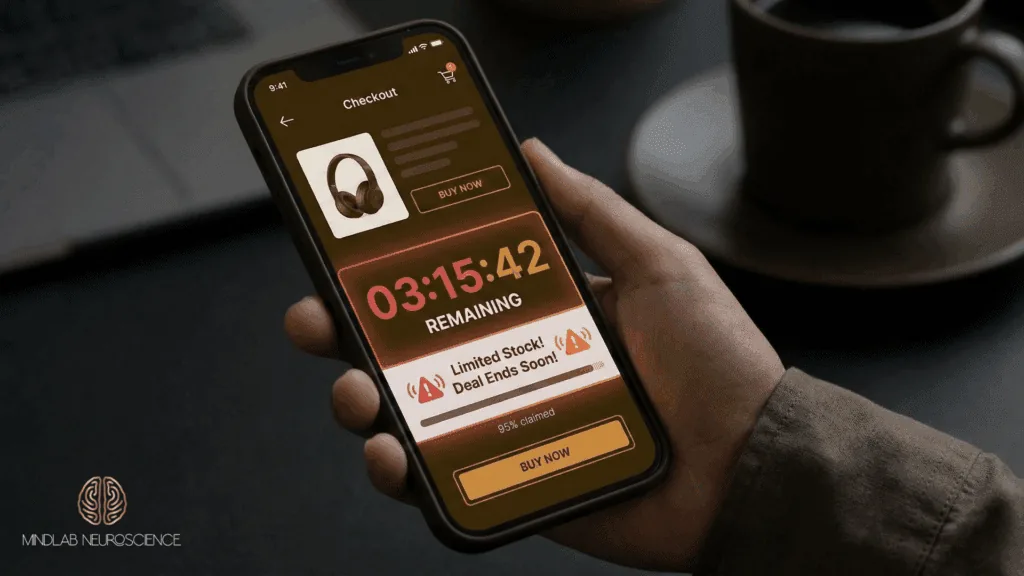
A countdown timer does not persuade you. It hijacks you, firing a threat signal in the amygdala the instant scarcity appears, while willpower goes offline.
What happens inside your brain during a Black Friday sale
Your brain runs ancient systems built to protect you. When you encounter scarcity, your amygdala, the alarm bell of the nervous system, fires, triggering the fight-flight-freeze response and flooding your body with adrenaline and cortisol, often before your conscious mind has finished reading the marketing copy. But scarcity cues do not only signal threat. They also trigger reward anticipation: “limited time offer” activates the dopamine system, which is not about pleasure but about pursuit, the neurochemistry of the chase. Your brain loves the hunt more than it loves owning the thing.
This is exactly why countdown timers work so well. They create a double activation: the threat response because time is running out, and the reward response because you might “win” the deal. Together they generate an urgency that is nearly irresistible, and your prefrontal cortex, responsible for planning and weighing consequences, starts to go quiet. That is not a character weakness; it is biology. I worked with a tech executive I will call James, who earned seven figures making careful decisions forty hours a week, yet during a sale would buy things that fit neither his values nor his life. When we mapped his nervous system, the cause was clear: years of high-stakes work had left his threat-detection system primed and reactive, and scarcity marketing hit it like a pressure cooker.
The stress-dopamine loop behind countdown timers
When you meet a countdown timer, it is not one signal but a cascade. First, you perceive the timer as a threat: your amygdala registers “loss is possible,” stress chemistry floods in, your breathing quickens. Simultaneously, your ventral tegmental area, the dopamine factory, fires in anticipation of potential gain, and merely imagining the purchase is itself a dopamine hit. These two systems feed each other: the stress makes you crave relief through action, and the dopamine makes the action feel good before you have bought anything. Caught between a push and a pull, your prefrontal cortex, the part that would normally ask “is this actually a good idea?”, loses the contest.
Every refresh of the page delivers another small dopamine hit; every item added to the cart, another spike; every tick of the timer, another wave of urgency. Your brain is being systematically trained, in real time, to move faster and think less. This is not merely marketing psychology, it is applied neuroscience that the world’s largest companies have learned to weaponize. The same plasticity that lets the loop form also lets it be unlearned.
Why high performers are most vulnerable to scarcity traps
The common assumption is that successful, disciplined people are immune to marketing tricks. The brain says otherwise, and the vulnerability comes from the exact wiring that makes them successful. High performers tend to run higher on dopamine; they are built for pursuit, spot opportunities fast, and act rather than freeze. That is superb for building a career, and a liability during a sale, because a dopamine-forward brain is extra sensitive to words like “exclusive,” “insider,” and “today only.” Those words do not just sound appealing; they register as opportunity, the very signal that drives high achievers forward, and the brain cannot easily tell manufactured urgency from a genuine time-sensitive advantage.
On top of that, high performers carry chronic background stress from managing teams, clients, and responsibility, which keeps the amygdala primed and threat-detection extra sensitive. Add a layer of identity-level fear of missing out, not just “I might miss a deal” but “I might fall behind, lose my edge, while everyone else upgrades”, and a sale becomes a perfect storm. I worked with a founder, David, who called himself a man with a “collector’s brain”: a garage of unused equipment, dozens of software subscriptions. What we discovered was that his buying was never about the things. Buying generated a sense of progress and control in a life that felt chaotic, and during a sale that signal screamed at him from hundreds of items at once. Naming the real need, not the object, was what finally loosened its grip.
The protocol: regulate, clarify identity, orient to your future self
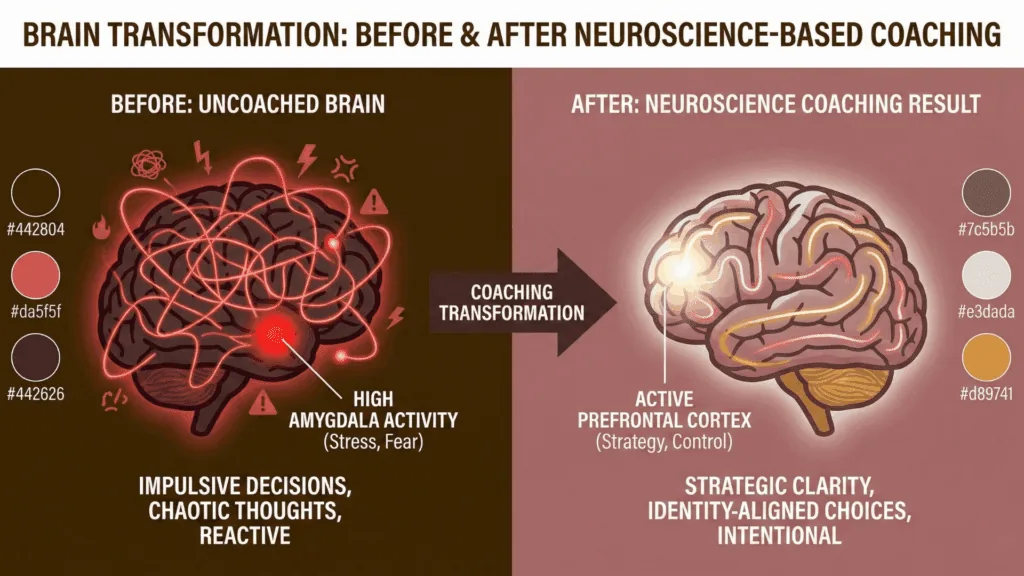
What I teach high performers is that your spending is an external expression of your internal values and your nervous-system state. If you want to change the spending, you change the state and the alignment underneath it. This is why generic willpower advice fails, you cannot white-knuckle different behavior while your nervous system is dysregulated and your identity is unclear. Shift both, and the behavior changes almost on its own. The work has three parts.
First, nervous-system regulation. Address the background stress that makes you vulnerable in the first place, build rituals that activate the parasympathetic system regularly, protect sleep (deprivation makes the amygdala more reactive and the prefrontal cortex less available), and manage dopamine, because a chronically overstimulated brain reads scarcity as relief rather than threat. Second, identity clarity. Know who you are building yourself to become, not your title or your achievements, but your actual values and your vision at one, five, and ten years. With that clarity, every purchase becomes a simple question of whether it serves who you are becoming. Third, future-self orientation: a deliberate practice of asking “what would the person I’m becoming choose right now?” When you think from your future self, the prefrontal cortex naturally re-engages, you think long-term, and the reactive pull loses its grip, you are operating from vision instead of urgency.

The one question that changes everything
After a brief micro-pause, name the urge, breathe, ground, you ask yourself one question, slowly, and let it land: “Is this purchase feeding my future identity or just my current nervous system?” That single question moves you from “what do I want right now?” to “who am I building myself to become?”, a completely different evaluation. Neurologically, it engages the prefrontal cortex in long-term thinking, and because the prefrontal cortex and amygdala compete for resources, asking a prefrontal question literally quiets the alarm.
The question works best followed by three sub-questions. What am I actually buying? Often it is not the object: it is relief, status, a feeling of progress, or the story of being someone who gets deals. How long will that feeling actually last? Usually far shorter than you expect; the nervous system adapts to the new normal within hours. Is there a higher-ROI way to get the same outcome? Higher ROI rarely means cheaper, it means a better return on money, time, and attention: one program you will actually implement instead of six discounted ones you will not; better sleep and steadier regulation instead of a third subscription. I worked with a serial entrepreneur, Robert, a self-described “deal junkie.” When he started running purchases through those three questions, what surfaced was that buying deals made him feel smart and resourceful, a real need that does not vanish when you see through the trick. So instead of fighting it, we redirected it: he channeled the same energy into one high-quality investment in his next business move, bought at full price, with dramatically higher ROI because he actually used it. The question does not stop you from wanting. It redirects wanting toward what serves you.
When your Black Friday brain is actually right
Sometimes the urgency is real and the deal is genuinely worth it, and you need a way to tell the difference. The filter I teach is not about saying no: it is about saying yes strategically. After the three sub-questions, you have clear information. If the honest answers are “I’m buying ten minutes of dopamine,” “it will feel good for less than a day,” and “yes, there is a better way,” you are not resisting an urge: you are seeing clearly, and saying no is effortless. But if the answers are “this aligns with who I am becoming,” “the benefit compounds,” and “this is the cleanest way to get this outcome,” then buy it, without guilt. That is not impulse; it is strategy. The point is that white-knuckling burns willpower, which depletes, while clarity does not deplete, it energizes. When you can see the difference, you do not need willpower. You need clarity and clean prioritization.
Build the practice into your life
This is not a one-time insight; it is a practice, and the nervous system learns through repetition. One good decision during a sale does not rewire anything, but a series of conscious ones will. For the next thirty days, every time you feel the urge to buy something outside your investment lanes, pause, run the micro-pause, ask the three sub-questions, and write the answers down. You are not trying to be perfect or resist every urge, you are building the prefrontal override through reps until it becomes automatic. Most people find that after thirty days the urges are less intense, easier to observe, and less commanding.
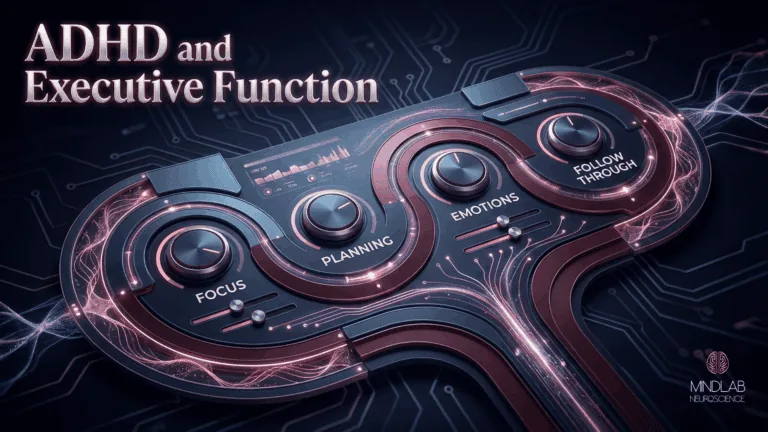
Make it concrete by tracking your leaks. Over a week, notice what you want to buy, run each through the three sub-questions, and tally what you chose not to buy, for many high performers that “impulse leak” is surprisingly large. Then identify one or two future-identity investment lanes, leadership, resilience, a specific skill, and make those your only categories for major spends. Everything else becomes “no unless it is clearly right”; everything in your lanes becomes “yes if it aligns.” The money and attention you were leaking gets redirected toward what compounds. One executive I worked with, Sophie, tracked a meaningful sum in impulse purchases over a year, then redirected that same energy and budget into sustained work on her nervous-system regulation and decision-making, an investment that paid back many times what she had been leaking, because it changed every decision downstream, not just one. That is the real power of understanding this wiring: not resisting the next sale, but changing how your nervous system responds to all of them, the same way strengthening the brain’s executive-function and impulse-control systems compounds over time.
Why do I feel out of control during sales even though I’m disciplined everywhere else?
It is not a failure of discipline; it is neurobiology. High performers are often more vulnerable because the same dopamine-driven wiring that makes you excellent at spotting real opportunities also makes you hypersensitive to urgency signals, and chronic work stress keeps your nervous system primed. What you are experiencing is your ancient threat-and-reward systems being hijacked by modern marketing. With practice, you learn to recognize that activation and interrupt the impulse before it becomes a purchase, giving your prefrontal cortex the chance to choose.
How does scarcity marketing trigger impulse buying in the brain?
Scarcity signals such as ‘limited time’ and ‘only 3 left’ activate the amygdala’s threat-detection system, triggering a fear-of-loss response that bypasses rational prefrontal evaluation. This shifts the brain into a reactive, survival-oriented mode where the perceived cost of missing out overrides logical cost-benefit analysis. At the same time, the dopamine system fires in anticipation of the ‘win,’ and the combined urgency compresses decision time and increases impulsive purchasing.
What role does dopamine play in impulse purchases during sales?
Dopamine surges during sales are driven by anticipation of the reward, the perceived win of securing a deal, rather than the actual value of the product. This anticipatory spike in the reward pathway creates a strong motivational drive that can override the prefrontal cortex’s more measured assessment of need versus want. Notably, the dopamine reward often drops sharply after purchase, which is why buyer’s remorse is so common.
Can I really rewire my brain’s response to scarcity, or am I stuck with this pattern?
You are not stuck. Neuroplasticity means your nervous system forms new patterns through repeated experience and conscious practice. Years of exposure taught your brain that scarcity signals mean opportunity and demand fast action, but that learning can be replaced. Practicing the pause, the grounding, and the three sub-questions consistently over about thirty days strengthens the prefrontal cortex’s ability to step in before the impulse takes over, measurable rewiring driven by repetition.
Why is willpower alone not enough to resist a good sale?
Willpower depends on the prefrontal cortex, which is exactly the system that goes partly offline when scarcity floods you with stress chemistry, and it is a limited resource that depletes under pressure. Trying to overpower the urge pits a depleted resource against a fast, automatic loop. The reliable alternative is to regulate the nervous system and clarify identity so the intentional choice becomes the easy one, which removes the need for willpower in the moment.
How do I tell a genuine good investment from manufactured urgency?
Run it through the three sub-questions. What am I actually buying, relief, status, progress, or the item itself? How long will that feeling last? And is there a higher-ROI way to reach the same outcome? If the answers show a short-lived dopamine hit with a better path available, you have your answer. But if the purchase genuinely aligns with who you are becoming, the benefit compounds, and it is the cleanest route to the outcome, buy it without guilt. The point is clarity, not blanket restraint.
References
- Tom, S. M., Fox, C. R., Trepel, C., and Poldrack, R. A. (2007). The neural basis of loss aversion in decision-making under risk. Science, 315(5811), 515-518. https://doi.org/10.1126/science.1134239
- Knutson, B., Rick, S., Wimmer, G. E., Prelec, D., and Loewenstein, G. (2007). Neural predictors of purchases. Neuron, 53(1), 147-156. https://doi.org/10.1016/j.neuron.2006.11.010
- Schultz, W., Dayan, P., and Montague, P. R. (1997). A neural substrate of prediction and reward. Science, 275(5306), 1593-1599. https://doi.org/10.1126/science.275.5306.1593
- Berridge, K. C., and Robinson, T. E. (1998). What is the role of dopamine in reward: Hedonic impact, reward learning, or incentive salience? Brain Research Reviews, 28(3), 309-369. https://doi.org/10.1016/S0165-0173(98)00019-8
From Reactive Buying to Strategic Choice
Impulse purchasing is a nervous-system response, not a character flaw, and a regulated nervous system makes intentional choice automatic. Dr. Sydney Ceruto works with high performers to regulate the stress response and align decisions with identity. Schedule a strategy call to begin.
One hour with Dr. Ceruto