
When most people hear the phrase “cognitive enhancement,” they picture brain hacks, extreme routines, or a stack of supplements that promise instant results. In my world, cognitive enhancement means something entirely unique. It is the practical, science-based way to help your brain work with you, not against you, in the moments that actually matter.
For more than two decades as a neuroscience-based practitioner, I have watched very bright, very driven people struggle with the same problems over and over. They know they are capable of more, yet their mind feels scattered, foggy, or stuck. They try productivity apps, new planners, or another podcast, but nothing creates lasting change in how they think and perform. The reason is simple. Their plan is not built on how the brain truly changes.
Real change in how you think is not magic. It is the result of neuroplasticity, your brain’s built-in ability to rewire itself in response to what you do, feel, and pay attention to. When you understand how neuroplasticity works, and when you learn to apply it in real time through real-time neuroplasticity practice, you can change the way you think, focus, and decide in a way that lasts. That is the heart of true cognitive enhancement.
What Is Cognitive Enhancement Really About
At its core, cognitive enhancement is about improving how you use your mind to meet the demands of your life. It is not about becoming superhuman. It is about having the mental clarity, focus, and emotional steadiness to do what matters most, even when pressure is high.
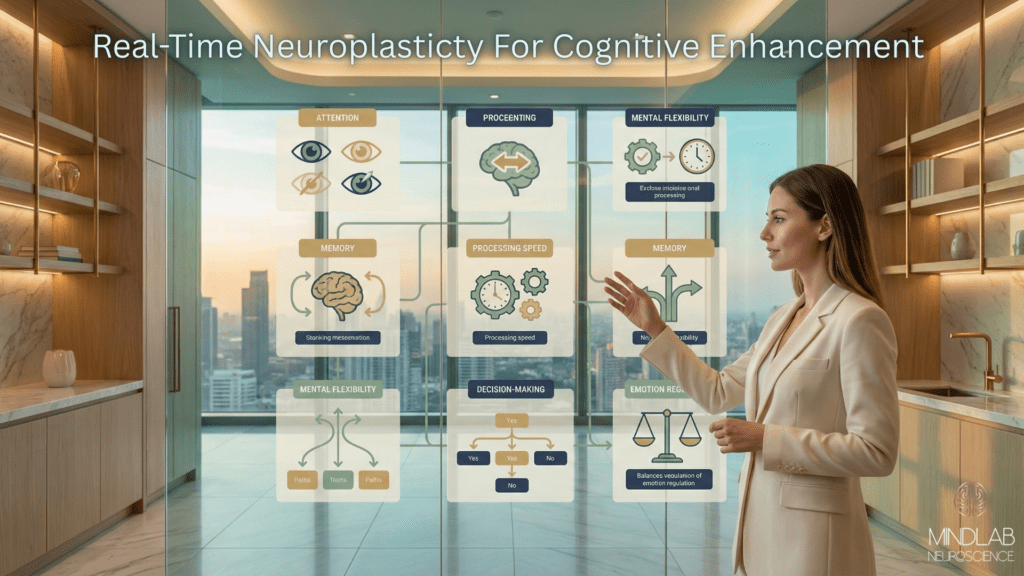
Cognitive enhancement touches many parts of mental performance. It includes attention and focus, memory, processing speed, mental flexibility, and decision-making. It also includes the way you manage emotion, stress, and energy, because all of these states directly shape how well your brain can perform. You cannot separate cognitive enhancement from the way you live, sleep, move, and relate to other people.
Most people try to pursue better thinking from the outside. They add stimulants, cram more work into the day, or try to force their brain through sheer willpower. This strategy may work briefly, but it does not create deep change. The only lasting path to cognitive enhancement lies in the brain’s own wiring, which means understanding neuroplasticity.
A Simple Guide To Neuroplasticity
Neuroplasticity is your brain’s ability to change its structure and function in response to experience. Every time you learn a new skill, practice a new habit, or attend to a certain pattern of thought, you are shaping the physical connections between your brain cells.
Neurons communicate through tiny gaps called synapses. When certain neurons fire together again and again, the connection between them becomes stronger and faster. You can think of neuroplasticity like building a trail in a forest. The more often you walk the same path, the clearer and easier it becomes to navigate. Cognitive enhancement depends on choosing which mental paths you walk most often.
There are two key parts of neuroplasticity. One is strengthening helpful circuits. The other is pruning or quieting unhelpful ones. When you invest attention and effort into a new way of thinking or responding, your brain builds stronger wiring to support it. When you stop feeding old habits, those circuits weaken over time. This is why cognitive enhancement is not about a single breakthrough moment. It is about repeated experiences that tell your brain, “This is the new normal.”
Your brain is not equally plastic all the time. It changes the most when three conditions come together. First, there is focused attention. Second, there is emotion or meaning, a sense that something important is at stake. Third, there is repetition over time. When you combine these, neuroplasticity becomes the engine of lasting mental upgrades.
The Brain Chemicals That Support Change
Neuroplasticity is not only about wiring. It is also about chemistry. Your brain uses special messenger chemicals, often called neuromodulators, to decide what to pay attention to and what to remember. A few of these play a big role in how your thinking improves over time.
Dopamine helps signal what is rewarding or important. When you take a small step toward a meaningful goal and notice that progress, dopamine gives your brain a gentle “yes, do more of this” message. When you chase constant novelty or short-term hits, dopamine spikes and crashes can leave you feeling scattered instead of sharp. Thoughtful practice turns dopamine into an ally that nudges your brain toward more helpful patterns and supports steady cognitive enhancement.
Norepinephrine is tied to alertness. It rises when something feels urgent or risky. A healthy level helps you wake up, focus, and respond quickly. Too much, for too long, can make your mind feel jumpy and anxious. Too little can leave you foggy. Part of this work is learning how to move your arousal level up or down so that your brain is in the best zone for learning.
Acetylcholine supports focused attention. It helps your brain zoom in on what matters and filter out noise. When you choose even a short block of deep work, you are training the systems that release acetylcholine. Over time, your brain becomes better at entering that clear, “locked in” state when you need it, which directly supports cognitive enhancement.
Another important player is a growth-supporting protein often described as “fertilizer for neurons.” Your brain makes more of it when you sleep well, move your body, and challenge yourself in manageable ways. This protein helps new connections grow stronger and more stable. It is one of the reasons lifestyle choices matter so much for how you think and feel.
The key idea is simple. Your daily choices shift these brain chemicals toward balance or toward chaos. You do not need to memorize their names. What you need is a set of habits and supports that keep your brain in a range where learning and growth are possible. When you feel steady, curious, and engaged, the biology of change is on your side, and cognitive enhancement becomes much easier.
Real-Time Neuroplasticity™ Practice And Why Moments Matter
Most practice and self-help focus on what you understand in a calm moment. You read a book, listen to a talk, or walk out of a session feeling clear and motivated. Then your real life shows up. The market fluctuates, your email overwhelms you, a relationship challenges you, or your team urgently requires a response. Under pressure, your brain isn’t concerned about what you meant to do. It runs the fastest and most familiar pattern it knows.
Real-time neuroplasticity practice is about working directly inside those moments, not around them. It means using the real conditions of your life as the “lab” for cognitive enhancement. Instead of waiting until later to reflect on what happened, you learn to notice and shift your mental patterns while they are firing.
For example, imagine you are a trader who tightens up and hesitates whenever a setup appears that fits your plan. Your body floods with adrenaline, your thinking narrows, and you either freeze or chase late. In real-time neuroplasticity practice, we do not just talk about confidence in general. We slow down that exact pattern, map the chain of thoughts, body cues, and beliefs, and then build a new response that you practice live.
The same process applies if you are an executive who spirals into overthinking before a major decision, a physician who gets mentally flooded before hard conversations, or a founder who jumps between tasks all day and never feels finished. Real-time neuroplasticity practice combines insight with in-the-moment experiments. This phase is where cognitive enhancement becomes more than an idea and becomes a lived change in how your brain performs.
The Pillars Of Cognitive Enhancement
This work is not a single skill. It is a set of pillars that support how your brain functions under stress and over time. When you intentionally construct these pillars, neuroplasticity takes the lead, leading to cognitive enhancement.
Attention And Focus
Your attention serves as the gateway to improved thinking. What you focus on, and how you focus, literally shapes your brain. Modern life pulls your attention in every direction, which is why so many people feel wired but tired, busy but not productive.
Training attention does not require hours of focused stillness, although intentional awareness can help. It starts with short, clear periods of single-task focus. Choose one important task, remove obvious distractions, and set a short timer. When your mind wanders, notice it without judgment and bring it back. Each time you do this, you are telling your brain that sustained focus is worth wiring for. Over weeks and months, this creates measurable cognitive enhancement in how quickly you can enter a focused state and how long you can stay there.
Working Memory And Mental Flexibility
Working memory is your ability to hold and use information in your mind for a short period. Your ability to shift perspectives, adapt to new information, and switch between tasks without getting stuck is called mental flexibility. These are core targets in cognitive enhancement, especially in complex, high-stakes environments.
Neuroplasticity supports these skills when you push your brain slightly past its comfort zone in a structured way. Puzzles, strategy games, learning a new language, or playing an instrument can all be helpful. So can specific practice exercises that ask you to generate multiple options, challenge automatic assumptions, and deliberately consider different time frames before making a choice. When you intentionally stretch your working memory and flexibility, you engage the very circuits that cognitive enhancement aims to upgrade.

Emotional Regulation And Cognitive Enhancement
Many people consider cognitive enhancement purely mental, but emotion plays a huge role in how your brain performs. When your nervous system is locked in chronic threat mode, your frontal cortex, the part of the brain responsible for planning, reasoning, and self-control, has less access to energy. You end up more reactive, less creative, and more likely to fall back into old patterns.
Building emotional regulation is, therefore, a direct path to cognitive enhancement. This does not mean suppressing feelings. It means learning to notice early signals in your body, using breathing and grounding tools to settle your system, and reframing situations so they feel more workable. Over time, your brain learns that intense moments are not automatic emergencies, and it keeps your higher thinking online. This is neuroplasticity at work in the emotional layer of this work.
Energy, Sleep, And The Brain’s Physical Needs
Your brain is a living organ, and cognitive enhancement depends on its basic physical health. Sleep, movement, and daily energy rhythms are not side topics. They are the soil in which neuroplasticity grows.
During deep sleep, your brain cleans out waste products, consolidates memory, and resets many of the chemicals that support clear thinking. When sleep is cut short or pushed to odd hours, every form of cognitive enhancement becomes harder. Focus feels slippery, recall slows, and emotional control takes more effort.
Movement also feeds cognitive enhancement. Even moderate physical activity increases blood flow to the brain and supports the growth of new neural connections. Short walks, stretching, or strength work sprinkled into your day are not just beneficial for your body. They are signals that tell your brain it is safe, supplied, and ready to learn.

Layers Of Change In Everyday Life
It can be helpful to contemplate three layers of change. Each layer uses neuroplasticity in a slightly different way, and together they shape how your mind works.
The first layer consists of microshifts that occur within a single moment. This might be catching yourself before you open another tab, feeling your shoulders tense before a hard call, or hearing the start of an old critical thought in your mind. When you notice these tiny signals sooner, you create a small space to choose a different response. Over time, these micro shifts add up and support more significant changes in how you think and act.
The second layer is daily structure. This is how you shape your schedule, your environment, and your habits so that better thinking becomes the default, not the exception. Clear start and stop times for work, planned breaks, a device-free wind-down, and simple checklists can all serve this middle layer. When your days are designed with your brain in mind, you rely less on willpower and more on smart designs that support cognitive enhancement without constant effort.
The third layer is identity-level change. This is the story you hold about who you are. If you secretly believe “I am scattered,” “I always choke under pressure,” or “I am just not a focused person,” your brain will keep looking for proof of that story. Real growth often shows up when you begin to see yourself differently. You might start to view yourself as deliberate, someone who can learn difficult things, or someone who can stay grounded in the middle of chaos.
All three layers are connected. Micro shifts give you evidence that change is possible. A daily structure makes it easier for your brain to reinforce those shifts. Over time, the story you tell yourself begins to update. The result is identity-level neuroplasticity, one of the most powerful drivers of long-term cognitive enhancement.
In my work with clients, we rarely chase perfection at any one layer. Instead, we look for the smallest change in each layer that would make life easier. Maybe that means learning a simple body scan you can use before big decisions, adjusting your calendar so that your hardest task sits in your best focus window, and catching the old story that says, “I always mess my brain up,” before it takes over. These layered adjustments are practical and kind, and they are the soil in which new wiring grows.
Designing Your Personal Dopamine Enhancement Plan
Cognitive enhancement becomes powerful when you turn it into a personal, realistic plan. This plan does not have to be perfect. It has to be specific and doable enough that your brain can trust you will stick with it.
Step one is clarity. Write down where you most want cognitive enhancement. Maybe you want to think more clearly under time pressure, recover faster from mistakes, maintain deep focus for longer stretches, or make decisions without endless second-guessing. Pick two or three concrete goals instead of a vague wish to “optimize everything.”
Step two is an honest audit. Notice how you are using your brain now. How often are you multitasking? When does your focus crumble? How much sleep are you actually getting? Where does emotion hijack your thinking? This audit is not about judgment. It is about understanding the current wiring that your cognitive enhancement plan will rewrite.

Step three is choosing a few high-leverage practices. These might include a daily block of distraction-free work, a short planning ritual to clear mental clutter, a simple wind-down routine before bed, or a brief reflection after high-stakes events, during which you notice what happened in your body and mind. Each of these practices becomes a repeated “vote” for the kind of cognitive enhancement you want.
Step four is feedback. Neuroplasticity loves feedback. Track simple metrics like how many focused blocks you completed, how often you caught yourself before spiraling into worry, or how long it took to recover after a setback. Even little progress reinforces your belief that cognitive enhancement is working, keeping you engaged in the process.
Simple Practices You Can Start This Week
You do not need a perfect system to begin. You only need a few clear actions that you can repeat often. Here are some simple practices I often use with clients who want to sharpen their thinking and decision-making.
One practice is a daily focus warm-up. Before you open your inbox or messages, spend ten to fifteen minutes on a single, meaningful task. This might be outlining a key project, reviewing your plan for the day, or thinking through an important decision on paper. The goal is not to finish the task. The goal is to tell your brain, “We start the day in a clear, intentional way.” Over time, this technique strengthens the circuits that support deep work and cognitive enhancement.
A second practice is a short recovery ritual. Choose one or two small actions that help your nervous system reset after stress. This practice might look like a brief walk without your phone, a few slow breaths by a window, or writing down the three main feelings you notice in your body. When you repeat this process after hard meetings, losses, or conflicts, your brain learns that intensity does not have to equal overwhelm. This practice frees up more mental energy for problem-solving.
A third practice is an end-of-day shutdown. Take 5 minutes to list what you have completed, what remains important for tomorrow, and what you can set aside for now. Then choose a small, physical cue that signals to your brain that the workday is over. You might close your laptop and place it in a drawer, change clothes, or step outside. This kind of boundary protects sleep, reduces rumination, and gives your brain the reset it needs to keep learning.
You can also add small cognitive drills to your week. For example, once a day, you might practice explaining a complex idea in simple terms, as if you were talking to a teenager. This trains clarity. You might choose a normal decision, like where to have dinner, and challenge yourself to generate three options and three possible outcomes for each. This trains flexible thinking. You might set a timer and see how many creative uses you can find for a common object like a paper clip. This technique trains divergent thinking.
None of these drills are about perfection or speed. They are about stretching your mind in playful, low-stakes ways. When combined with real-world practice in your job and relationships, they support the more significant changes you are making through neuroplasticity and contribute to steady cognitive enhancement.
As you try these practices, notice which ones give you the most value for the effort required. Your brain is more likely to keep firing new patterns when the process feels meaningful and, at times, even enjoyable. Start small, track what helps, and build from there. This is how a handful of simple actions turn into a steady upgrade in how your mind works.

Real-Time Neuroplasticity™ Practice: What It Looks Like
Real-time neuroplasticity practice is a methodology I pioneered and trademarked to take neuroscience principles and ground them directly in your actual life. Instead of abstract advice, we look at real situations where your current wiring is getting in the way of your focus, attention, and ability to sustain deep work.
This could entail analyzing how you move through your workday, the exact moments when your attention fractures, when you reach for your phone, or when you slip into reactive mode instead of staying with intentional focus. We notice the physical signs: your posture shift, the thoughts that flash by, and the story you tell yourself about urgency and control. Then we design a new micro-response, such as a brief reset breath, a protective boundary with notifications, or a small change in how you structure your focus blocks. You practice this in your next work session, and we refine it based on what actually happens in real time.
With another client, cognitive enhancement may center on how they lead meetings or make strategic decisions under pressure. We might script new ways to open a meeting that set a calmer, more focused tone, rehearse questions that elicit clarity rather than reactive answers, or create a simple ritual that signals to your brain it is time to settle into deep thinking. Each repetition in the real world feeds neuroplasticity and makes the new pattern more automatic until focused attention becomes your natural default.
With high-performing athletes or executives, we might work directly with how pressure shapes your nervous system during critical moments. We identify the exact physiological and cognitive shifts that occur when stakes feel high, then build in micro-practices that keep your prefrontal cortex online rather than slipping into threat response. This transforms how you show up when it matters most.
Real-time neuroplasticity practice is intense but efficient. Instead of trying to change everything at once, we target the few attention patterns that drive most of your results, the ones that touch your work, your relationships, and your ability to sustain the thinking your career demands. This is cognitive enhancement at the systems level, not just at the level of isolated skills. We are not teaching you to focus better in a lab. We are rewiring how your brain works in the actual moments that define your life and your performance.
Examples Of Change In The Real World
To make this more concrete, consider how these ideas play out in everyday life.
Consider a portfolio manager who keeps cutting winning trades too early. On paper, they know their system is sound, but in the moment, they feel a strong urge to “lock in” gains. Together, we map the sequence. A position moves into profit, their body tightens, and an old fear of loss surges. Instead of lecturing themselves, they learn a short pause routine, a sentence they say out loud, and a clear rule about when to move a stop versus when to let the trade run. Over weeks of practice, their brain learns that staying with the plan is safe enough. The new pattern becomes more automatic, and results follow.
Now imagine a senior executive who struggles with mental clutter. Their calendar is packed, their team needs constant input, and they fall asleep scrolling on their phone. Their first impulse is to buy a new productivity tool. Instead, we simplify. They create a single daily planning ritual, a handful of standard meeting structures, and a defined shutdown routine. At first, these changes feel almost too small. Yet within a month they notice clearer mornings, shorter decision cycles, and fewer dropped balls. Their confidence grows as their brain begins to expect order rather than chaos.
Consider a physician who dreads delivering difficult news. Before each conversation, their heart accelerates and their thoughts disperse. They worry about saying the wrong thing. In our work, we rehearse the opening lines, practice breathing techniques, and build a short reflection ritual to process emotions afterward. Slowly, their nervous system stops perceiving every hard conversation like an emergency. They do not enjoy these moments, but they feel more grounded and present. Their clients feel the difference too.
None of these people became someone else overnight. They used repeated experiences to send their brains a new message about who they are under stress. They moved from “I always panic here” to “I can meet this moment with more steadiness and clarity most of the time.” This is the heart of applied neuroplasticity. It is not distant theory. Real cognitive enhancement is based on the kind of change you can feel in the real situations that shape your work and life.
Common Myths About Cognitive Enhancement
There are many myths that keep people from pursuing real cognitive enhancement.
One myth is that cognitive enhancement is only for people with obvious problems. In reality, some of the most successful people I work with are already performing at a high level. They use cognitive enhancement to reduce friction, protect their energy, and extend their peak years.
Another myth is that cognitive enhancement requires a complete life overhaul. In truth, the brain changes most reliably in response to small, consistent shifts that it can actually sustain. Ten minutes of true focus practiced daily can be more powerful than a once-a-month marathon effort.
A third myth is that cognitive enhancement has to be driven by fear, pressure, or self-criticism. This is not only untrue, but it is also counterproductive. Brains change best in an atmosphere of safety and curiosity, not shame. When you develop a kinder internal tone, you make it easier for neuroplasticity to support cognitive enhancement.
A fourth myth is that cognitive enhancement is the same thing as taking a pill or stacking supplements. While some medical or nutritional support can be useful, they are not a substitute for changing how you think and behave. Sometimes, pills can create an opportunity for growth. Only your daily patterns, guided by neuroplasticity, can build new wiring.

Sustaining Cognitive Enhancement Over Time
The goal is not a brief spike in performance. The goal is durable cognitive enhancement that carries you through different seasons of your life and career. This means accepting that your brain is a moving target. Stress levels, health, and personal circumstances all influence how your cognitive system works.
To sustain gains, you regard your cognitive enhancement plan as something you revisit and refine. You check in with yourself every few months. Are your original goals still relevant? Have new demands emerged? Which practices remain relevant, and which have become outdated? You adjust, not because you failed, but because you and your life have evolved.
It also helps to build support around you. This might be a practitioner, a practitioner, a peer group, or a trusted partner who understands that your cognitive enhancement work matters. When the people around you respect your focus blocks, your sleep, and your emotional boundaries, it becomes much easier to keep honoring them yourself.
Finally, you remember why you started. Cognitive enhancement is not about winning some invisible contest. It is about thinking and feeling in a way that lets you be the person you want to be, with the people and projects that matter most. When you keep that deeper reason close, the daily work feels less like a chore and more like an act of self-respect.
Frequently Asked Questions About Cognitive Enhancement and Real-Time Neuroplasticity™ Practice
How long does cognitive enhancement take to be noticed?
Many people begin to feel small shifts in clarity, focus, or emotional steadiness within a few weeks of consistent practice. Deeper changes, like a new way of responding under pressure, often take a few months. Neuroplasticity is always working, yet it needs time and repetition to support lasting cognitive enhancement.
Can cognitive enhancement help if I already perform at a high level?
Yes. Cognitive enhancement is not only for people who are struggling. High performers often gain a lot by reducing internal friction, shortening recovery time after mistakes, and learning to access deep focus without burning out. In these cases, cognitive enhancement becomes more about refinement and sustainability than repair.
Do I need special apps or devices for cognitive enhancement?
You do not. Some tools can be helpful for tracking or practice, but the core drivers of cognitive enhancement are still attention, emotion, repetition, and meaning. A simple notebook, a timer, and a clear plan can be enough to start rewiring your brain through neuroplasticity.
Is cognitive enhancement possible without medication?
For many people, yes. There are cases where medication is an important part of care, and that is a decision to make with a qualified medical professional. At the same time, lifestyle changes, structured mental training, emotional regulation work, and real-time neuroplasticity practice can all create meaningful cognitive enhancement on their own.
How do I know if my cognitive enhancement plan is working?
Search for patterns, not perfection. Are you entering focused states a bit faster? Are you recovering from distractions more quickly? Do you catch yourself before spiraling into old reactions? Do difficult conversations feel slightly more manageable? These small signals are often the first proof that cognitive enhancement is taking root in your daily life.
What makes practice for cognitive enhancement different from generic self-help?
Generic self-help often gives you more information without changing your real-world patterns. Practice for cognitive enhancement, especially when it uses real-time neuroplasticity methods, is about building new responses in the exact situations where your brain usually gets hijacked. This approach transforms theoretical concepts into practical applications, leading to the formation of new neural connections.
Is it ever too late to improve how my brain works?
No. Your brain keeps the ability to change throughout your life. The pace and style of learning may shift as you age, but neuroplasticity does not suddenly switch off. Older adults can still gain sharper focus, better memory strategies, and calmer decision-making when they follow a thoughtful plan. The key is to match the level of challenge with your current energy and health so that your system feels stretched but not overwhelmed.
What should I do if u003ca href=u0022/conquer-burnout-boost-vitality-neuroscience-hacks/?utm_source=chatgpt.comu0022u003eI feel burned u003c/au003eout while trying to improve my thinking?
If you feel exhausted, the answer is not to push harder. Burnout indicates that your nervous system has been operating at maximum capacity for an extended period without sufficient recuperation. Start by simplifying your plan. Protect sleep, reduce unnecessary commitments for a season, and choose one or two gentle practices that help you feel a bit more grounded. Once your baseline energy improves, you can slowly reintroduce more demanding training. Growth is much easier when your brain feels safe, rested, and supported.
Moving Forward With Cognitive Enhancement
If you are ready to experience this level of mental upgrade in a way that is grounded in science and tailored to your actual life, you do not have to do it alone. With the right plan, support, and a willingness to experiment, your brain can become your greatest ally rather than your greatest obstacle.
You do not need to overhaul your life tomorrow. You can begin with one or two experiments that respect your schedule and nervous system. Maybe that looks like protecting a short window of quiet work, reshaping how you prepare for key conversations, or finally giving your sleep the priority it deserves. Each small win is more than a wonderful moment. It is proof that your brain can learn new patterns, even after years of doing things a certain way.
If you choose to work with a practitioner, make sure they can translate complex science into clear, human language and are willing to step into the real pressures you face every day. The right partnership should leave you feeling both challenged and deeply supported. Over time, the combination of solid neuroscience and real-world practice can help you build a mind that feels steady, agile, and fully engaged with the life you are creating.
The patterns described in this article were built through thousands of neural repetitions — and they require targeted intervention to rewire. Real-Time Neuroplasticity™ provides the mechanism: intervening during the live moments when the pattern activates, building new neural evidence that a different response is architecturally possible.
Key Takeaways
- Cognitive enhancement through neuroplasticity is not about performing better on brain games — it is about identifying the specific neural circuits limiting performance and building new synaptic pathways in those exact circuits under the conditions that reveal them.
- The three cognitive domains most reliably enhanced through targeted neuroplasticity work are: working memory capacity, attentional control (the ability to direct and sustain focus deliberately), and emotional regulation speed (how quickly the prefrontal cortex can restore function after amygdala activation).
- Real-Time Neuroplasticity™ differs from general cognitive enhancement approaches in specificity: it targets the circuit showing the actual performance constraint, not a generalized “brain fitness” protocol that may have no relationship to the person’s specific limitation.
- Cognitive enhancement is not linear — the circuits with the longest consolidation histories require the most targeted intervention, while more recently formed limitations often show rapid change when the right circuit is addressed at the right moment.
- The most overlooked cognitive enhancement lever is emotional regulation: the prefrontal cortex’s availability for complex thinking, creative problem-solving, and strategic planning is directly limited by the emotional activation load it is simultaneously managing.
| Cognitive Target | What Limits It | RTN™ Intervention Point | Observable Change |
|---|---|---|---|
| Working memory | Emotional interference; attentional fragmentation; unresolved cognitive loops | During tasks requiring sustained information-holding under mild pressure | Reduced cognitive load under complexity; fewer held-thought losses |
| Attentional control | Compulsive distraction patterns; anxiety about output; dopamine seeking | During the impulse to switch tasks or seek distraction | Longer sustained focus windows; reduced compulsive checking |
| Emotional regulation speed | Slow prefrontal recovery after amygdala activation; deep reactivity consolidation | During the activation itself — in the reactive moment | Faster return to prefrontal function after emotional events |
| Creative flexibility | Perfectionism blocking idea generation; threat-mode narrowing creative range | During the activation of perfectionism or self-censorship | More generative ideation; reduced internal censorship during exploration |
| Decision quality under pressure | Amygdala hijack compressing decision bandwidth; time pressure activating worst heuristics | During high-stakes, high-pressure decision activation | Access to full option range; reduced regret about reactive decisions |
The ceiling on your cognitive performance is not a fixed capacity — it is a specific neural bottleneck. Identify the bottleneck, address the circuit that creates it, and the ceiling moves. The question is not “how smart am I?” but “which circuit is limiting me right now, and can it be retrained?”
Frequently Asked Questions
What is cognitive enhancement through neuroplasticity?
Cognitive enhancement through neuroplasticity is the deliberate strengthening of specific neural circuits that govern performance, attention, memory, and emotional regulation — using the brain’s capacity for synaptic modification to build new or stronger pathways in the precise areas limiting function. It is distinct from pharmacological enhancement (which modifies neurochemistry) and general mental fitness practices (which improve broad brain health without targeting specific limitations). The neuroplastic approach requires identifying the specific circuit creating the performance constraint, then intervening during the conditions that activate that circuit to build the competing pathway under actual performance conditions.
How does Real-Time Neuroplasticity™ enhance cognitive performance?
Real-Time Neuroplasticity™ enhances cognitive performance by targeting the specific neural bottleneck during its active state. Most cognitive enhancement approaches work when the limiting circuit is not engaged — brain games train cognitive skills in neutral conditions, and the transfer to real-world performance is often limited because real-world performance happens in emotionally activated, pressured states that low-activation training does not replicate. RTN™ addresses the circuit while it is actively limiting performance: during the reactive episode, the distraction impulse, the creative block, or the decision-compression moment. This produces change that transfers to the actual conditions where cognitive enhancement matters most.
What are the most reliable targets for cognitive enhancement?
The most reliable and high-leverage cognitive enhancement targets are: emotional regulation speed (which unlocks prefrontal capacity currently consumed by emotional management), attentional control (which determines how much cognitive resource reaches deep work), and working memory under pressure (which governs performance specifically in the complex, high-stakes situations that matter most). These three interact: faster emotional regulation reduces the attentional and working memory burden; stronger attentional control provides more resource for all other cognitive functions; and improved working memory under pressure directly improves decision quality in the situations where decisions have the most consequence.
Are the results of neuroplasticity-based cognitive enhancement permanent?
Neuroplastic changes are durable but not unconditional. Like any acquired skill, the circuits built through deliberate practice maintain their strength through use and can weaken through prolonged disuse — though they do not fully revert to baseline. The practical implication is that cognitive enhancement is an investment with ongoing returns rather than a one-time fix: the circuit built through concentrated work continues to perform, and brief maintenance practice preserves the gains. People who do sustained neuroplasticity-based cognitive enhancement work often report that the changes feel structural rather than effortful — the new response becomes automatic, which is exactly what synaptic consolidation predicts.
How is this different from general brain health practices?
General brain health practices — exercise, sleep optimization, nutrition, social connection — support the physiological substrate that makes cognitive performance possible. They are necessary conditions, not sufficient ones. They raise the ceiling on available capacity but do not determine which specific circuits develop within that capacity. Targeted neuroplasticity-based cognitive enhancement addresses specific performance bottlenecks by building the exact circuits that create those bottlenecks — which is a different intervention at a different level of specificity. Both matter: general brain health provides the platform; targeted circuit work addresses the specific limitation. The highest-performing approach combines both.
Overthinking & Mental Clarity — MindLAB Locations
References
- Merzenich, M. M. (2013). Soft-Wired: How the New Science of Brain Plasticity Can Change Your Life. Parnassus Publishing.
- Arnsten, A. F. T. (2009). Stress signalling pathways that impair prefrontal cortex structure and function. Nature Reviews Neuroscience, 10(6), 410-422. DOI
- Diamond, A. (2013). Executive functions. Annual Review of Psychology, 64, 135-168. DOI
If this pattern has persisted despite your understanding of it, the neural architecture sustaining it is identifiable and addressable. A strategy call with Dr. Ceruto maps the specific circuits driving the cycle and identifies whether it can be interrupted at its neurological source rather than managed from its surface.
This article is part of our Cognitive Flexibility & Thought Patterns collection. Explore the full series for deeper insights into cognitive flexibility & thought patterns.