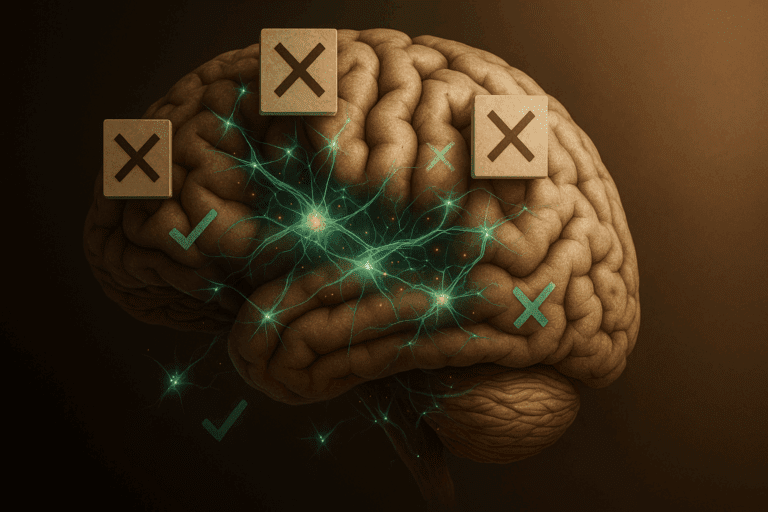
A limiting belief is not a thought. It is a neural prediction. The brain does not passively receive experience and then form opinions about it. It actively generates predictions based on consolidated prior learning, and those predictions shape what a person perceives, feels, and does before conscious evaluation has a chance to intervene. When the prefrontal cortex, hippocampus, and amygdala have consolidated a predictive model — “I will be rejected,” “success is not available to me,” “my contributions are insufficient” — that model operates as a perceptual filter. It biases attention toward confirming evidence and away from disconfirming evidence. It generates emotional responses (anxiety, shame, withdrawal) that function as behavioral brakes. And it does all of this automatically, at processing speeds that outpace the reflective cognition needed to challenge it. This is why a person can intellectually understand that a belief is irrational, articulate exactly why it is wrong, and yet continue to act as though it were true. The belief is not stored in the system that reasons about it. It is stored in the predictive architecture that operates beneath reasoning.
Beck’s cognitive model originally framed limiting beliefs as “core schemas” — deep cognitive structures that organize experience around rigid assumptions formed in early development. Subsequent neuroscience research has validated and extended this framework. Disner and colleagues’ neuroimaging meta-analysis demonstrated that negative self-schemas are associated with increased amygdala reactivity and reduced dorsolateral prefrontal engagement during self-referential processing — the brain is literally less able to apply executive evaluation to information that touches on the belief’s domain. Nader’s groundbreaking research on memory reconsolidation showed that retrieved memories enter a labile, modifiable state — opening a narrow window during which the synaptic connections encoding the memory (and the belief it supports) can be updated. This finding transformed the understanding of belief change: it is not that the person needs to build a new belief strong enough to override the old one; rather, the old consolidation itself can be destabilized and rewritten under the right neurochemical conditions. Grawe’s neuropsychotherapy framework further established that schemas are maintained by approach and avoidance motivational circuits, and that lasting change requires activation of the problematic schema simultaneously with corrective experience — a principle known as “concurrent activation.”
Conventional belief-change work — affirmations, visualization, cognitive reframing exercises, journaling — operates almost entirely at the declarative, conscious level. A person writes “I am worthy of success” while the predictive circuitry that generates their actual behavioral responses has not been touched. The problem is not that these tools are conceptually wrong. The problem is that they target the cortical narration system while leaving the subcortical and hippocampal consolidation that generates the belief’s behavioral effects fully intact. Repeating a new belief does not overwrite an old one. The original schema was not formed through repetition of words — it was formed through emotionally significant experience that consolidated specific synaptic connections. Overwriting it requires not more words but the right kind of neural activation under the right conditions.
Dr. Sydney Ceruto’s clinical approach at MindLAB Neuroscience works at the level of schema reconsolidation. Through Real-Time Neuroplasticity™, she identifies the specific predictive models that are generating a client’s self-limiting behavioral patterns — not by discussing beliefs retrospectively but by observing them activate in real-time decision contexts where the schema is producing its effects. During these moments of activation, when the neural encoding is in its most labile state, corrective intervention can reach the consolidation itself rather than layering over it. This is the mechanism through which beliefs that have governed behavior for decades can shift — not gradually through accumulated counter-evidence but through targeted disruption of the encoding that maintains them. A strategy call begins the process of identifying which predictive models are running your behavior from beneath conscious awareness. The articles below examine the neuroscience of cognitive schemas, self-limiting patterns, and the reconsolidation mechanisms that determine whether beliefs are permanent or programmable.