Key Takeaways
- The 80/20 rule reflects how the brain allocates attentional and energetic resources across competing demands
- Prefrontal cortex bandwidth is limited (~4-7 items), making the vital 20% the only compatible focus
- Most people optimize the low-value 80% because those tasks produce more frequent dopamine rewards
- Identifying your personal 20% requires mapping which activities produce disproportionate results
- A brain directing limited prefrontal resources toward highest-leverage activities outperforms one distributing evenly
Understanding 80/20 Rule Neuroscience: How Your Brain Prioritizes
The 80/20 rule aligns with how our brains naturally optimize performance and conserve energy, but not in the way most people assume. The brain consumes approximately 20% of the body’s total energy despite representing only 2% of its mass. Within that energy budget, the prefrontal cortex (the region responsible for strategic thinking, planning, and complex decision-making) is the most metabolically expensive neural system to operate. It fatigues faster than any other brain region, and its working memory capacity is limited to approximately four to seven items at any given moment.
This biological constraint is precisely why the 80/20 principle works. The brain cannot give equal, sustained attention to everything. When we attempt to distribute cognitive resources evenly across all tasks, the prefrontal cortex enters a state of chronic partial engagement: processing many things superficially rather than a few things deeply. Research on prefrontal cortex executive functions confirms that deep, focused processing of high-priority tasks produces qualitatively different neural activation patterns than surface-level multitasking. The neural pathways strengthened during focused engagement are denser, more interconnected, and more readily accessible for future use.
What I explain to my clients is that the 80/20 rule is not a productivity trick. Research by Koch confirmed that asymmetric input-output distributions appear across virtually every measurable domain, and it is the only strategy that is genuinely compatible with how the brain is architecturally designed to process information. Working against that architecture, by spreading attention thin, does not demonstrate dedication. It demonstrates a misunderstanding of the hardware you are working with.
| Domain | The 80% (Low Return) | The 20% (High Return) | Neural Bias |
|---|---|---|---|
| Career | Emails, meetings, busywork | Deep work, key relationships | Busywork = frequent micro-dopamine |
| Health | Supplements, tracking apps | Sleep, movement, stress regulation | Optimization feels productive |
| Relationships | Surface interactions | Deep conversations, vulnerability | Surface = lower-threat |
| Learning | Consuming content passively | Deliberate practice, teaching | Consumption feels like learning |
| Finance | Daily expense tracking | Income growth, investment | Small savings = immediate satisfaction |
Why Your Brain Resists the Pareto Principle: Focusing on the High-Value 20%
If the 80/20 principle is so effective, why do most people default to distributing effort evenly, or worse, concentrating on the low-return 80%? The answer is dopamine architecture. The brain’s reward system does not optimize for long-term results. It optimizes for frequent reward signals. Checking email produces a small dopamine pulse every time a new message appears. Responding to a text creates an immediate sense of completion. Reorganizing a spreadsheet offers the satisfaction of visible progress. None of these activities move the needle on outcomes, but all of them deliver the kind of rapid, predictable reward that the dopamine system is wired to pursue.
High-value activities (strategic planning, creative work, relationship building, skill development) deliver delayed, uncertain rewards. The dopamine system evaluates them as less immediately compelling precisely because their payoff is deferred. This is the fundamental conflict: the activities that produce 80% of your results feel less rewarding in the moment than the activities that produce almost nothing. Your brain is not broken for preferring email to deep work. It is doing exactly what the dopamine prediction error system was designed to do: favoring the predictable, frequent signal over the uncertain, delayed one.
What I work on with clients is not willpower to override this preference. Willpower is a prefrontal cortex function, and the prefrontal cortex is the resource you are already depleting by trying to do everything. The intervention is architectural: restructuring the environment so that dopamine optimization serves high-value activities rather than competing with them. This means designing work blocks where the high-value 20% comes first, before the prefrontal cortex has been depleted by low-return tasks. It means removing the cue architecture that triggers compulsive engagement with the 80%. And it means building feedback mechanisms that make progress on high-value work visible and emotionally salient, so the dopamine system begins to associate deep work with reward rather than deprivation.
Harnessing Neuroplasticity and Executive Function to Identify High-Impact Inputs
Neuroplasticity, the brain’s ability to reorganize itself by forming new neural connections throughout life, is the mechanism through which the 80/20 principle moves from concept to embodied habit. When you consistently direct attention toward high-value activities, the neural pathways supporting those activities become physically stronger. The myelin sheath around those circuits thickens, increasing signal speed. The synaptic connections become more numerous and more efficient. What initially requires intense deliberate effort gradually becomes the brain’s default mode of operation.
I guide my clients through a structured process to identify their personal 20%. It begins with a one-week activity audit, tracking every significant activity against two metrics: energy invested and results produced. What consistently emerges is that clients are spending 70-80% of their cognitive energy on activities that produce minimal impact, while the activities that drive their most important outcomes receive leftover bandwidth in the final hours when the prefrontal cortex is already depleted.
The pattern is remarkably consistent across domains. One client, a senior executive who came to me feeling overwhelmed by the volume of demands on her time, discovered through the audit that three activities accounted for nearly all of her career advancement and organizational impact: one-on-one conversations with key stakeholders, strategic document creation, and decisions about resource allocation. Everything else (the dozens of meetings, hundreds of emails, and constant context-switching that consumed her days) produced almost nothing measurable. By restructuring her schedule to protect two uninterrupted hours each morning for these three activities, she reported not only dramatically improved outcomes but a paradoxical reduction in total work hours. The brain that focuses deeply on what matters accomplishes more in less time than the brain that distributes effort everywhere.
The Cognitive Load Trap: Why Working Memory Limits Mean Doing Less Produces More
Decision fatigue is one of the most well-documented phenomena in cognitive science, and it explains why the 80/20 rule is neurologically essential, not merely convenient. Every decision you make, regardless of its significance, draws from the same limited pool of prefrontal cortex resources. The brain does not distinguish between choosing which email to answer and choosing which strategic initiative to prioritize. Both consume glucose, both deplete executive function capacity, and both contribute to the progressive erosion of judgment quality across the day.
Research by Roy Baumeister and colleagues demonstrated that the quality of decisions degrades measurably as the number of prior decisions increases: a phenomenon they termed ego depletion. What the 80/20 framework provides is a structural solution: by eliminating or automating 80% of low-impact decisions, you preserve prefrontal bandwidth for the 20% of decisions that produce disproportionate outcomes.
I see the cognitive load trap operate in my clients’ lives with striking predictability. The entrepreneur who makes fifty minor operational decisions before noon, then faces their most important strategic decision with a depleted prefrontal cortex. The parent who manages a cascade of household logistics all morning, then wonders why they have no patience or creativity left for their children by evening. The professional who answers emails for two hours before attempting deep work, then cannot sustain focus for more than twenty minutes. In every case, the problem is not ability, motivation, or time. The problem is that the brain’s highest-performance system has been spent on low-return activities before the high-return work even begins.
The solution is not to try harder. It is to restructure the sequence. High-value work first, when prefrontal resources are fresh. Low-value tasks later, when the brain’s capacity for deep thought has naturally diminished. This is not a scheduling preference. It is a neurological imperative.
Leveraging the 80/20 Principle for Skill Development and Learning
The 80/20 rule becomes particularly powerful when applied to skill development, because the brain’s learning systems follow the same asymmetric distribution. Not all practice is equal. Deliberate practice, focused repetition of specific subskills at the edge of current ability with immediate feedback, produces dramatically more neuroplastic change than general exposure or passive repetition.
In every domain I have observed, approximately 20% of the subskills account for 80% of performance. The public speaker who masters narrative structure and emotional pacing outperforms the one who practices every aspect of presentation equally. The musician who focuses on the passages that are genuinely difficult rather than playing through entire pieces improves faster. The professional who identifies and drills the specific cognitive skills that differentiate top performance from adequate performance (pattern recognition, rapid synthesis, strategic framing) develops expertise in a fraction of the time that distributed practice would require.
What makes this neurologically significant is that focused practice on high-leverage subskills does not just improve those subskills. It builds transferable neural architecture. The executive attention networks strengthened during deliberate practice carry over into every domain of cognition. Research by Newport established that the brain which has learned to sustain deep focus on one difficult task can sustain deep focus on any difficult task. The 20% investment produces returns that extend far beyond the specific skill being practiced.
Rewiring Habits Using the Pareto Principle and 80/20 Rule Neuroscience
Habit formation is a key area where the 80/20 rule creates profound changes. The brain’s basal ganglia, the neural system responsible for converting deliberate actions into automatic routines, does not weight all habits equally. Some habits serve as keystone habits: behaviors that, once established, create cascading positive effects across multiple domains. Identifying the 20% of habits that function as keystones is the neurological equivalent of finding the leverage point in a complex system.
In my practice, I consistently find that three categories of habits produce disproportionate cognitive and emotional returns: sleep architecture (specifically, consistent sleep-wake timing and adequate duration), physical movement (which increases BDNF, brain-derived neurotrophic factor, the protein most directly responsible for neuroplasticity), and emotional regulation practices that reduce chronic stress cortisol. A client who masters these three habits does not need to optimize twenty other behaviors. The neurochemical environment created by quality sleep, regular movement, and regulated stress response makes every other behavior easier to establish and sustain.
One client who came to me feeling overwhelmed by the number of changes she believed she needed to make discovered that focusing exclusively on two keystone habits, a consistent 10:30 p.m. lights-out and a 30-minute morning walk, produced cascading effects across every domain within six weeks. Her energy levels stabilized, her focus during work hours improved measurably, her emotional reactivity decreased, and her capacity for the kind of deep, strategic thinking that drove her career forward expanded dramatically. She had tried to change a dozen habits simultaneously for years with minimal success. Focusing on the 20% that drove 80% of outcomes transformed the trajectory.
Enhancing Emotional Intelligence with the 80/20 Framework
Emotional intelligence is another domain where the asymmetric distribution is strikingly consistent. In my work with leaders, managers, and individuals seeking to improve their relational effectiveness, I have identified that two competencies account for approximately 80% of interpersonal impact: the ability to accurately read emotional states in others (which relies on the mirror neuron system and the right temporoparietal junction) and the ability to regulate one’s own emotional responses under pressure (which relies on prefrontal-amygdala connectivity).
Many clients arrive with a list of twelve emotional intelligence skills they believe they need to develop. What I show them, consistently supported by the outcomes I observe, is that mastering these two foundational competencies makes the other ten easier or, in some cases, unnecessary. The leader who can accurately read the emotional temperature of a room and regulate their own response to it navigates nearly every interpersonal challenge more effectively than the leader who has practiced active listening, empathy, assertiveness, and eight other discrete skills without developing the foundational two.
This is not a shortcut. It is neurological efficiency: directing plasticity-building effort toward the circuits that produce the broadest downstream impact. The cognitive biases that create communication barriers become far more manageable when the underlying emotional regulation architecture is strong. The 80/20 framework applied to emotional intelligence means building the neural foundation first, not decorating the surface.

Applying the 80/20 Architecture to Your Life
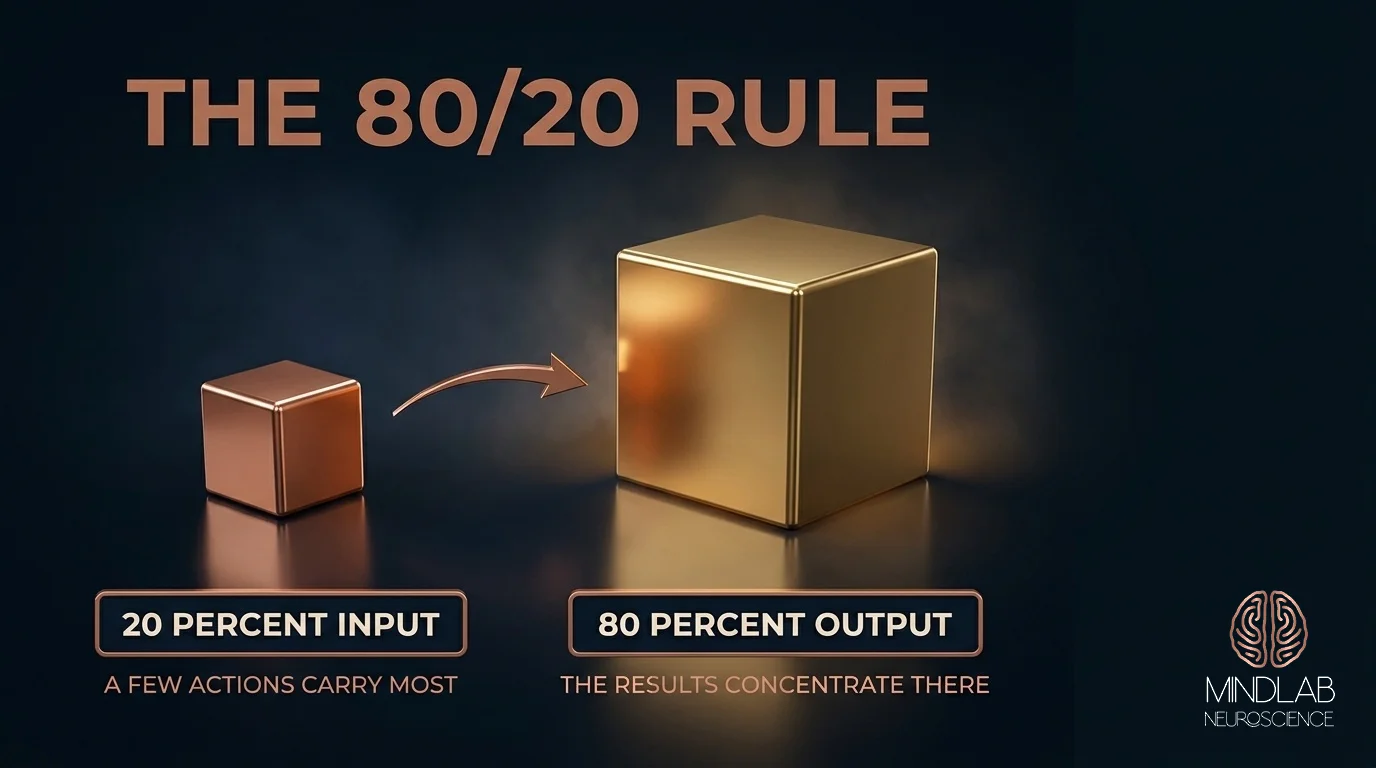
The path to extraordinary achievement does not always require extraordinary effort. What it requires is architectural precision: the ability to identify which 20% of inputs produce disproportionate outputs, and the discipline to protect those inputs from dilution by the 80% that produces almost nothing.
The brain that focuses on the vital 20% does not work harder. It works on the right neural circuits. Every hour invested in high-leverage activities strengthens the pathways associated with strategic thinking, creative problem-solving, and sustained focus. Every hour spent on low-return busywork strengthens the pathways associated with reactive processing and shallow engagement. Over time, these architectural differences compound. The person who spends five years directing prefrontal bandwidth toward their highest-value activities develops a qualitatively different brain than the person who spends five years distributing effort evenly.
What I tell every client who asks where to start: audit first, then restructure. Track your activities for one week. Identify the 20% that produce disproportionate results. Then redesign your environment, schedule, and decision architecture to protect those activities from encroachment. The brain will follow the architecture you build for it. Build the right one, and the 80/20 principle stops being a concept you know about and becomes the operating system your cognition runs on. The 80/20 principle is one part of the neuroscience of peak performance and flow.
Focusing prefrontal cortex resources on the highest-impact 20% of tasks produces roughly 80% of measurable outcomes, a ratio Vilfredo Pareto first documented in 1896. Neuroscience confirms that selective attention conserves limited prefrontal bandwidth by suppressing low-priority neural circuits, allowing deliberate effort to generate disproportionate cognitive and behavioral results without increasing overall mental workload. That same leverage is what the neuroscience of peak performance is built on.
How do I identify my personal 20%?
Track your activities for one week. Rate each on results produced versus energy invested. The activities with disproportionate results relative to energy are your 20%. Most people discover that three to five core activities drive nearly all meaningful outcomes across career, health, and relationships.
Why is it hard to focus on high-value tasks?
High-value tasks are harder, more ambiguous, and produce delayed rewards. The dopamine circuit prefers easy wins that deliver immediate, predictable signals. This is not a discipline failure, it is the reward system operating as designed. The solution is environmental restructuring that makes high-value work the path of least resistance, not willpower.
Does the 80/20 rule apply to relationships?
Yes, approximately 20% of your relationships account for 80% of your emotional support and personal growth. The brain’s bonding system activates most powerfully in deep, reciprocal relationships. Investing energy in surface-level social maintenance at the expense of deep relationships produces a measurably weaker oxytocin-vasopressin bonding response.
Can the 80/20 rule help with decision fatigue?
Directly. Eliminating or automating 80% of low-impact decisions preserves prefrontal bandwidth for the 20% that drive disproportionate outcomes. This is not optional optimization, the prefrontal cortex has a finite daily capacity, and every low-value decision depletes the same resource pool used for high-value strategic thinking.
Is the 80/20 ratio exact?
No, it is a heuristic. The actual distribution varies by domain and individual. In some areas the concentration is even more extreme, 90/10 or 95/5. The principle is that input-output distributions are consistently uneven, and the brain benefits enormously from identifying and prioritizing the high-leverage minority rather than distributing effort equally.
If this pattern has persisted despite your understanding of it, if you know the vital 20% but cannot sustain focus on it, the neural architecture sustaining the distraction is identifiable and addressable. A strategy call with Dr. Sydney Ceruto maps the specific circuits driving the cycle.
References
- Koch, R. (1998). The 80/20 Principle. Currency/Doubleday.
- Baumeister, R. F., & Tierney, J. (2011). Willpower: Rediscovering the Greatest Human Strength. Penguin Press.
- Newport, C. (2016). Deep Work: Rules for Focused Success in a Distracted World. Grand Central Publishing.
From Reading to Rewiring
Track your activities for one week. Rate each on results produced versus energy invested. The activities with disproportionate results relative to energy are your 20%. Most people discover that three to five core activities drive nearly all meaningful outcomes across career, health, and relationships. The prefrontal cortex’s opportunity cost computation can only serve you accurately when you have mapped this ratio explicitly.
One hour with Dr. Ceruto