Key Takeaways
- Holiday burnout is autonomic dysregulation, not tiredness: sustained social performance mode activates work-sprint stress circuits.
- The HPA axis accumulates allostatic load: each social performance demand adds to compounding cortisol debt.
- Vagal tone withdraws under sustained social performance pressure, reducing the body’s ability to downregulate arousal.
- Rest alone does not resolve burnout: the nervous system needs a shutdown sequence, not inactivity.
- Recovery within 48 hours is possible when the reset targets the parasympathetic system directly.
When the season feels like a test
If you have been snapping at people you love, forgetting simple things, or feeling like you are behind before the day even starts, you are not lazy. You are not broken. You may be running on a nervous system that has been pushed past its bandwidth. That state has a name: holiday burnout.
Seasonal burnout is not only about having too much to do. It is what happens when your brain reads the season as a long chain of demands, social threats, money pressures, and disrupted routines. Your system stays in high alert, even when nothing is technically wrong at the moment. Seasonal burnout makes small tasks feel heavy, and everyday conversations feel loaded.
In my work as a neuroscientist and practitioner, I see holiday burnout among high performers every year. The counterintuitive part is this: the people who look the most together often carry the deepest depletion. They are skilled at powering through, which means they usually miss the early warning signs.
This guide will show you what holiday burnout is, why it happens, and exactly how to reset your state fast. You will also get a simple 7-day plan you can use to protect your brain through the rest of the season. It sits within the broader brain science of stress and nervous system regulation.
What holiday burnout really is
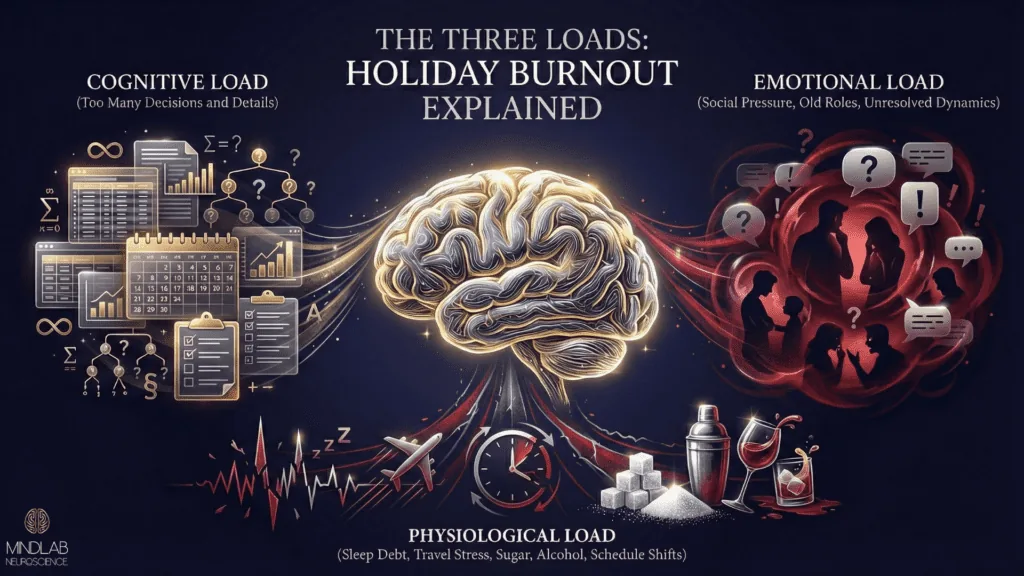
Seasonal overload is a state of overload that blends three things:
- cognitive load (too many decisions and details)
- emotional load (social pressure, old roles, and unresolved dynamics)
- physiological load (sleep debt, travel stress, sugar, alcohol, and schedule shifts)
When these loads stack, your brain does not interpret it as a busy month. It interprets it as a threat. The threat might be subtle, like a fear of disappointing someone, of conflict, or of being judged. But your nervous system responds the same way it would to a real danger. This pattern is examined in the brain science of resilience operating system.
Holiday burnout can look like:
- irritability and a short fuse
- brain fog and forgetfulness
- constant urgency, even when you have time
- feeling numb, checked out, or flat
- overeating, overspending, or scrolling more than usual
- trouble sleeping, waking early, or restless sleep
If you recognize yourself in that list, you are not alone. Seasonal burnout is common because the season is designed to overload the same systems you rely on for patience, focus, and self-control.
Why the holidays hit the brain so hard
The holiday season targets the brain’s prediction system. The brain continuously generates predictions about upcoming experiences, and any disruption to expected patterns triggers a threat response that draws heavily on the same neural resources needed for patience and self-regulation.
Your brain is always trying to predict what will happen next. Prediction saves energy. It also keeps you safe. The holidays disrupt prediction in two ways:
- your schedule changes (travel, events, late nights)
- your social environment changes (family systems, crowds, expectations)
When prediction fails, your brain increases alertness. That alertness can be helpful for a short period. But when it becomes the default, it turns into holiday burnout.

Decision fatigue
Every choice costs your brain energy. In December, choices multiply: What are we eating? What are we buying? Who is driving? Who is invited? What time do we leave? What is the gift budget? Decision fatigue is not a personality flaw. It emerges from a biological limit on how many choices the brain can process before cognitive resources become depleted.
When you hit that limit, your brain moves toward shortcuts. You become more reactive. You crave fast comfort. You avoid tasks that require planning. That is a classic depletion pattern.
Social threat and role reversion
Confident adults can walk into a family gathering and suddenly feel like younger, less resourced versions of themselves. This happens because the brain stores social templates from early relational experiences: the old roles, old power dynamics, and old survival strategies tied to specific people and places. When you return to those environments, your nervous system retrieves the old template automatically.
Right-brain attachment patterns, encoded early in life, activate automatically in familiar relational contexts, bypassing conscious reasoning and pulling behavior back toward historically established roles.
That can make holiday burnout feel confusing because you think, Why am I acting like this?
You are not failing. Your nervous system is running an old program.
Money pressure and shame loops
Even if you are financially stable, holiday spending can trigger scarcity signals: the fear of not doing enough, the fear of being judged, and the fear of regret. Scarcity narrows the brain’s focus. It reduces flexibility. It increases impulsivity. That is why seasonal overload often comes with overspending, then guilt, then more stress.
Sleep and rhythm disruption
Your brain runs on rhythm. Sleep is the main reset. But the holidays disrupt sleep with travel, events, alcohol, and late nights. When sleep quality drops, your prefrontal cortex has less fuel. Reduced sleep means less patience, less inhibition, and more threat sensitivity.
In plain terms, less sleep makes holiday burnout stronger. Chronic sleep disruption elevates baseline cortisol and reduces prefrontal inhibitory control, creating a biological environment where emotional reactivity becomes the default rather than the exception.
Holiday burnout versus anxiety, depression, and just being tired
One reason seasonal burnout feels scary is that it can mimic other mental health patterns. You might wonder, Is something wrong with me? The better question is, what is my system doing, and why?
Here is a simple way to tell the difference.
Holiday burnout is usually tied to the season’s load. It rises when demand rises and eases when the load reduces. You might feel okay on a quiet morning, then crash after errands, emails, and social plans stack up.
Anxiety is more about persistent threat expectation. Your body feels braced even when the calendar is calm. You may notice worry moving from one topic to the next, like your brain is scanning for the next problem to solve.

Depression is often marked by low drive, low pleasure, and a heavy sense of nothing matters. With holiday burnout, you can still feel joy in moments. You cannot access it reliably because your nervous system is overloaded.
Usually, a couple of nights of solid sleep alleviates the tiredness. With holiday burnout, sleep helps, but it does not entirely resolve the issue because the load keeps returning the next day.
If you have indicators that feel intense, persistent, or unsafe, seek professional support. For most people, seasonal overload is a solvable state-shift problem, not a life sentence.
What is happening in your brain and body during holiday burnout
To understand holiday burnout, think of your brain as having two jobs all day:
- keep you safe
- help you perform
When life is predictable, those jobs work together. During the holidays, predictability drops. Your brain shifts more resources into safety mode, leaving fewer for patience, focus, and self-control.
The threat system
Your amygdala is part of your threat detection network. It does not decide with logic. It flags risk fast. When your schedule is unstable, your sleep is short, and your social world feels tense, your threat system becomes jumpy. That jumpiness is why you may feel irritated, startled, or emotionally raw.
The brake system
Your prefrontal cortex helps you plan, pause, reframe, and choose your response. It is also one of the first systems to fail when you are sleep-deprived or overloaded. That is why you can be calm in October and then reactive in late December. Your brakes are not gone. They are under-fueled.
The stress hormone loop
Your HPA axis helps regulate cortisol. Cortisol is not detrimental. It is a mobilizer. But when cortisol stays elevated for too long, your body can feel wired and tired at the same time. You may crave sugar, salt, or quick comfort. You may also feel emotionally fragile. That is a common signature of seasonal burnout.

The vagus nerve and recovery capacity
Your vagus nerve helps your body shift into a state of recovery. When you feel safe, you digest, sleep, and connect more easily. When you feel threatened, those systems downshift. The goal is not to eliminate stress. The goal is to improve your ability to return to baseline.
The prediction system
Your brain is a prediction machine. It wants stable patterns. The holiday season introduces new patterns, plus old family patterns, plus pressure to make it work. As prediction error rises, your brain responds by increasing control attempts. You plan more. You think more. You reply more.
When you see this clearly, the shame drops. This overload is not you being weak. It is your brain doing its best in a high-load environment.
The three-signal checklist: how to know you’re slipping into holiday burnout
Holiday burnout usually shows up in three channels. Check all three.
Body signals
- tight chest, jaw clenching, shallow breathing
- headaches or stomach tension
- feeling wired but tired
- low-grade nausea before social events
Thought signals
- racing thoughts, I’m behind, I can’t handle this
- mind-reading, they’re judging me
- catastrophizing: “This is going to be a disaster
- rumination after events, replaying what you said
Behavior signals
- procrastinating on simple tasks
- snapping, withdrawing, or people-pleasing
- doomscrolling or rage scrolling
- sugar, alcohol, or shopping as relief
If two of these channels are active, you are in early-stage depletion. If all three are active, you are in full holiday burnout. You can interrupt it quickly once you know what to do.
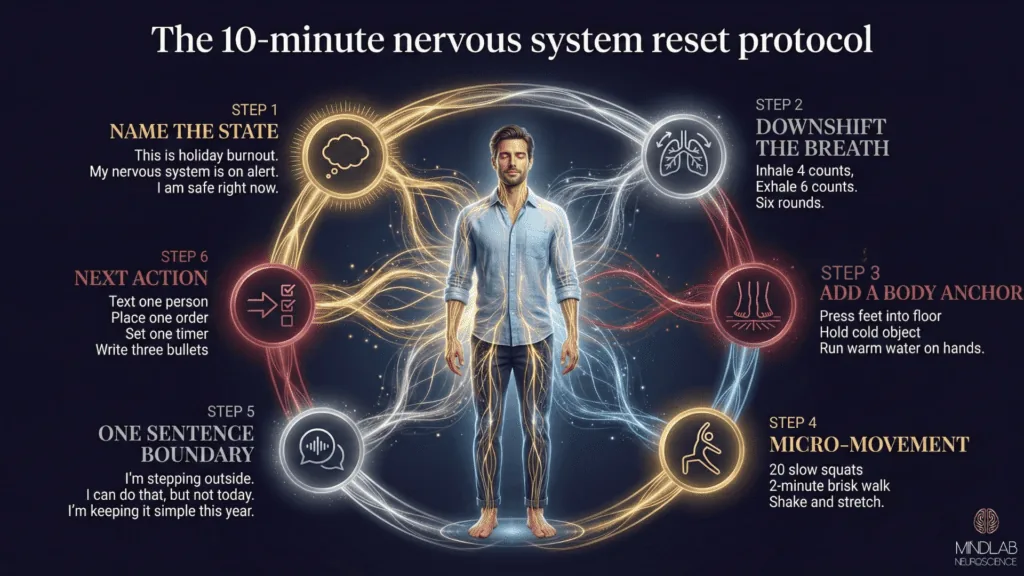
The 10-minute nervous system reset protocol
This is the protocol I teach when clients feel their state sliding into seasonal overload. It is not complicated. It works because it targets physiology first, then attention, then meaning.
Step 1: Name the state out loud (20 seconds)
Say: This is holiday burnout. My nervous system is on alert. I am safe right now.
Step 2: Downshift the breath (2 minutes)
Do this for six rounds:
- Inhale through the nose for 4
- exhale through the mouth for 6
Keep the exhale longer than the inhale.
Step 3: Add a body anchor (2 minutes)
Choose one:
- press your feet into the floor and feel the pressure for 30 seconds
- run warm water over your hands for 30 seconds
- hold something cold for 20 seconds, then rest
Step 4: Micro-movement to complete the stress loop (2 minutes)
Pick one:
- 20 slow squats
- a brisk 2-minute walk
- shake out your arms for 60 seconds, then stretch
Step 5: One sentence boundary (2 minutes)
Choose a script:
- I’m going to step outside for a minute and come back.
- I can do that, but not today.
- I’m keeping it simple this year.
Step 6: Next action (1 minute)
Pick the smallest following action that creates relief:
- text one person
- place one online order
- set one timer and pack one bag
- write three bullets for tomorrow
If you do this once, you will feel better. If you do it consistently, you will build a buffer so seasonal burnout stops running your day.

Joy pressure: the hidden stressor no one names
Joy pressure is the demand to feel happy on command. It shows up as:
- You should be grateful.
- This is supposed to be magical.
- Don’t ruin it.
- Smile.
Your brain cannot force emotion. When you try, it creates internal conflict. That conflict is exhausting. It makes holiday burnout worse because you are spending energy fighting your own state.
A healthier approach is emotional realism:
I can care about people and still feel overwhelmed.
I can love the season and still need quiet.
I can show up without pretending.
When you permit yourself to be human, the burnout loosens its grip.
How to handle family triggers without losing yourself
Family gatherings can be beautiful. They can also be intense because they push on identity.
Rule 1: Preload your nervous system
Do not arrive at a high-stimulation event already depleted. If possible, protect your sleep, eat protein, and take 10 minutes of quiet before you go. Preloading reduces depletion before it starts.
Rule 2: Use micro-exits
Most people wait until they explode or shut down. Instead, build micro-exits:
- bathroom break
- step outside
- offer to refill drinks
- take a short walk
Micro-exits prevent holiday burnout from hitting crisis level.

Rule 3: Avoid the debate trap
When the nervous system is activated, debate is rarely productive. If you feel your state rising, use a simple redirect:
- That’s interesting. Tell me how your week has been.
- I hear you. I’m focusing on keeping things peaceful today.
You are not being weak. You are being strategic.
Work stress: the end-of-year pressure cooker
A significant driver of seasonal overload is the overlap of two worlds:
- work deadlines and performance reviews
- social events and family logistics
This creates a double load: you never fully rest or entirely focus.
Strategy 1: The two lists reset
Make two lists:
- must do this week (3 items)
- can wait until January (everything else)
Your brain relaxes when it sees containment. Holiday burnout thrives on ambiguity.
Strategy 2: Time-block one recovery window daily
Pick one 20–30 minute recovery block. Put it on your calendar. Guard it. No phone. No multitasking. Recovery is not optional when you are addressing seasonal burnout.
Strategy 3: Stop catching up at night
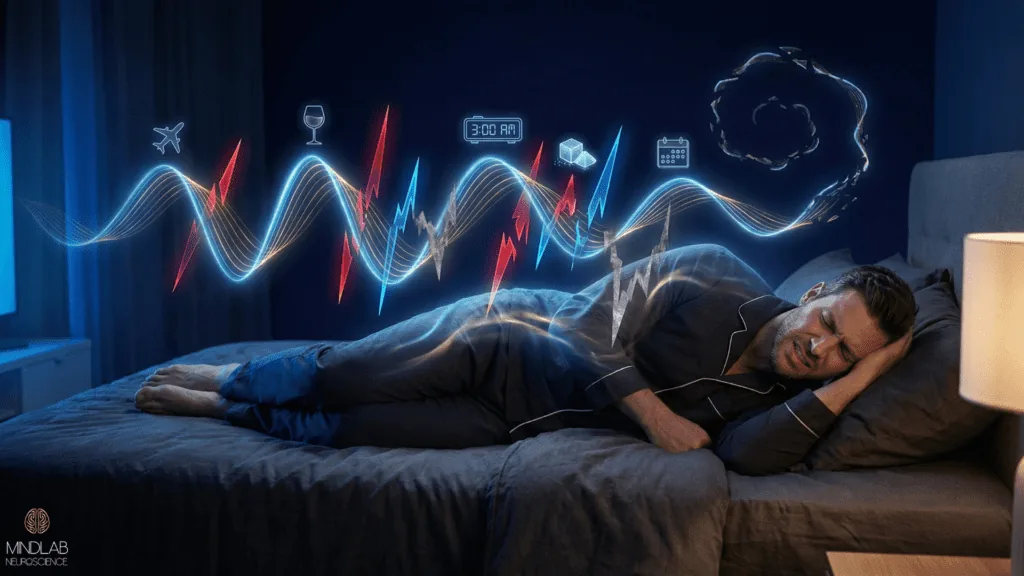
Late-night work steals sleep. Sleep is the primary regulator of emotional control. If you want less holiday burnout, prioritize bedtime like a non-negotiable meeting.
Money stress: a simple brain-safe budget move
Burnout often spikes when money feels unclear.
Try this three-number method:
- a gift number (total amount you will spend)
- a social number (meals, drinks, travel)
- a self-care number (one supportive thing for you)
Clarity reduces fear. Fear drives impulsivity. This one step can reduce holiday burnout more than another productivity hack.
The holiday dopamine trap: shopping, sugar, and scrolling
When you are overloaded, your brain looks for quick relief. Not because you are undisciplined, but because relief is a survival strategy. In a high-load season, the easiest relief usually comes from quick rewards, quick purchases, and quick hits of information.
Sugar and ultra-processed snacks
Sugar is not evil. But when your sleep is shorter and your stress is higher, sugar becomes a fast mood lever. It can briefly lift your energy and soften discomfort, then drop you. That drop often feels like irritability, fog, and craving. If you notice you are snacking all day, that may be your nervous system trying to self-medicate with a predictable reward.
A simple shift is protein first. Eat protein and fiber early in the day. It stabilizes energy and makes your brain less reactive later. You do not need a perfect diet. You need fewer spikes.
Shopping and the relief illusion
Buying something creates a momentary sense of progress. Your brain gets a small reward signal: I did it. The problem is that the relief is short. Then the next task arrives. This is why overspending often feels like stress relief in the moment and shame later.
Try a two-step pause:
- Put it in the cart.
- Wait 20 minutes before checkout.
If you still want it after 20 minutes, buy it within your budget. If you do not, you just saved money and stress.
Scrolling and emotional contagion
When you scroll, you are not only consuming information. You are absorbing states. If you are already tense, the content you consume can push you further into threat mode. That can look like doomscrolling, rage bait, or compulsive comparison.
One helpful rule is to state “check” before you open an app:
Ask, Am I looking for relief, or am I looking for information?
If you are looking for relief, choose a tool that actually calms your body, such as a walk, music, a shower, or a short breathing practice.
Travel, crowds, and sensory overload
Travel can be joyful, but it can also be sensory overload. Airports, traffic, crowds, and loud environments increase stimulation. Stimulation is not harmful, but it increases the work your nervous system has to do to stay regulated.

If you are sensitive to sensory load, approach travel days like performance days:
- hydrate early
- eat before you get hungry
- carry a simple snack
- use noise reduction if needed
- build quiet pockets into the day
These are not luxury habits. They are regular habits.
If you are parenting, your load doubles
If you are a parent, the season adds a second job: managing other people’s emotions. Kids get dysregulated by the same things adults do: schedule changes, sugar, crowds, and high expectations.
Two rules help most families:
- Keep one routine stable. It can be bedtime, breakfast, or a short evening ritual. One stable routine gives kids a nervous system anchor.
- Lower the bar for perfection. Kids do not need magical holidays. They need a present, a regulated adult more than they need a perfect plan.
If you feel guilty for wanting quiet, remember this: your calm is contagious. Your stress is infectious, too. Regulation is a gift.
The 30-minute decompression plan after any gathering
A lot of stress comes after the event, not during it. You get home, and your mind starts replaying. You think of what you should have said. You scan for signs that you were judged. That replay keeps your body activated.
Minutes 1–5: physical reset
Change clothes. Wash your face. Take a warm shower if you can. This tells your brain, We are in a new context.
Minutes 6–10: breathe and downshift
Do 10 slow breaths with longer exhales. Keep it easy. This is not a test.
Minutes 11–20: discharge stress
Do light movement: a short walk, stretching, or gentle mobility. The goal is not a workout. The goal is completion.
Minutes 21–30: close the mental loop
Write three lines:
- What went well
- What I am proud of
- What I am releasing tonight
Then stop. You do not need to solve your life at midnight. This plan prevents a single event from turning into a three-day spiral.
The patterns described in this article were built through thousands of neural repetitions, and they require targeted intervention to rewire. Real-Time Neuroplasticity™ provides the mechanism: intervening during the live moments when the pattern activates, building new neural evidence that a different response is architecturally possible.
| Holiday Stressor | Nervous System Impact | Cumulative Effect | Targeted Reset |
|---|---|---|---|
| Extended family dynamics | Social threat monitoring, hypervigilance | Elevated amygdala baseline | Social recovery time (no performance required) |
| Schedule disruption | Circadian rhythm dysregulation | Cortisol pattern disruption, poor sleep | Return to anchor sleep time within 48 hours |
| High-volume social obligation | Sustained sympathetic activation | Vagal tone withdrawal, exhaustion | Vagal stimulation: extended exhalation, cold exposure |
| Gift / financial pressure | Threat appraisal, decision fatigue | Prefrontal depletion, emotional reactivity | Hard close on financial decisions |
| Travel and environment change | Orienting response sustained activation | Neural resource drain from novelty processing | Return to familiar environment, minimal stimulation |
“Seasonal burnout is not tiredness. It is what happens when the nervous system runs social performance mode for six weeks without a shutdown sequence. Sleeping in on January 2nd is not a reset. It is a pause.”
Why are holidays so exhausting even when nothing “bad” happened?
The nervous system treats sustained social performance, managing expectations, navigating family dynamics, maintaining emotional composure in complex group settings, as a threat-adjacent state. The amygdala monitors for social evaluation continuously during these events, keeping the sympathetic nervous system partially activated even when the occasion is technically joyful. The result is a depletion that accumulates below the threshold of conscious awareness, surfacing only after the holiday ends as profound tiredness, irritability, or emotional flatness.
What is autonomic dysregulation and how does it relate to burnout?
The autonomic nervous system has two primary states: sympathetic activation and parasympathetic restoration. Autonomic dysregulation occurs when the system loses its ability to shift smoothly between those states, staying stuck in high activation or low recovery. During prolonged holiday stress, the body may maintain background sympathetic activation even during rest. Sleep often does not feel restorative because the nervous system has not fully entered a parasympathetic state; it is resting with the engine still running.
Why doesn’t just resting fix holiday burnout?
Passive rest allows the sympathetic system to idle but does not actively engage the parasympathetic recovery system. Extended exhalations, cold water on the face, and certain postures actively stimulate the vagus nerve and signal the parasympathetic system to take over. Without this active engagement, the system may remain in a low-level activation state for days, explaining the persistent tiredness many people experience even after a week off.
Why does family stress specifically drain the nervous system more than work stress?
Family relationships involve the most deeply encoded attachment patterns in the nervous system. Early relational experiences are stored as subcortical neural patterns that activate automatically when you re-enter those dynamics. Unlike work stress, which primarily engages prefrontal and executive function circuits, family stress activates deeper threat and attachment circuitry that is harder to regulate consciously. Highly competent adults often feel like younger, less resourced versions of themselves in family settings for this reason.
Is a 48-hour reset actually possible, or does full recovery take longer?
The 48-hour window refers to acute cortisol recovery and parasympathetic restoration, returning the nervous system to its pre-holiday baseline. For those who entered the holidays already depleted from a difficult year, holiday stress layers onto an existing deficit and recovery takes longer. The reset protocol addresses acute depletion; sustained recovery from a deeper burnout state requires a longer period of deliberate nervous system regulation.
References
- McEwen, B. S. (2007). Physiology and neurobiology of stress and adaptation: Central role of the brain. Physiological Reviews, 87(3), 873-904. https://doi.org/10.1152/physrev.00041.2006
- Arnsten, A. F. T. (2009). Stress signalling pathways that impair prefrontal cortex structure and function. Nature Reviews Neuroscience, 10(6), 410-422. https://doi.org/10.1038/nrn2648
- Lupien, S. J. McEwen, B. S. Gunnar, M. R. and Heim, C. (2009). Effects of stress throughout the lifespan on the brain, behaviour and cognition. Nature Reviews Neuroscience, 10(6), 434-445. https://doi.org/10.1038/nrn2639
- McEwen, B. S. and Morrison, J. H. (2013). The brain on stress: Vulnerability and plasticity of the prefrontal cortex over the life course. Neuron, 79(1), 16-29. https://doi.org/10.1016/j.neuron.2013.06.028
- Damasio, A. R. (1996). The somatic marker hypothesis and the possible functions of the prefrontal cortex. Philosophical Transactions of the Royal Society B, 351(1346), 1413-1420. https://doi.org/10.1098/rstb.1996.0125
From Reading to Rewiring
Holiday seasons impose simultaneous social, logistical, and emotional demands that overload the hypothalamic-pituitary-adrenal axis, sustaining cortisol elevation across days rather than hours. When allostatic load exceeds the nervous system’s recovery window, the prefrontal cortex loses inhibitory efficiency, and emotional reactivity increases by measurable margins, making ordinary obligations feel like threats requiring immediate defense.
Book a Strategy Call