Key Takeaways
- Social media exploits slot-machine variable ratio reinforcement, generating stronger dopamine responses than predictable rewards.
- The scroll-check-scroll loop: notification cues dopamine, checking delivers reward, absence creates deficit, deficit drives re-engagement.
- Chronic social media use correlates with reduced nucleus accumbens gray matter, weakened prefrontal cortex regulation.
- Sustained use downregulates dopamine receptor density: tolerance demands escalating stimulation for the same reward.
- These changes are not permanent: the plasticity that created the compulsive pattern can dismantle it.
Social media does not hook you because you lack willpower. It hooks you because the platforms are architecturally designed to exploit the same dopamine circuits that evolved to keep you alive, and those circuits cannot distinguish between a notification ping and a survival-relevant signal. The relationship between dopamine and social media is, at its core, a story about ancient reward hardware being hijacked by modern engineering. The underlying research is covered in the neural patterns behind dopamine architecture protocol.

I have worked with individuals across virtually every behavioral pattern the brain produces, and the compulsive pull of digital platforms ranks among the most neurologically efficient traps I have encountered. Not because the content is inherently rewarding, but because the delivery mechanism is calibrated to the exact frequency that maximizes dopamine output. This connects directly to the neuroscience of sex addiction.
The scroll does not hook you because your will is weak. It hooks you because it runs on the same unpredictable reward that keeps a gambler at the machine long after the fun is gone.
How Does Social Media Exploit Your Brain’s Reward System?
You open Instagram to check one thing. Twenty minutes later you are still scrolling, and you cannot recall what you originally opened it for. That disappearance, the feeling of being pulled underwater without noticing, is not a failure of attention. It is a design outcome.
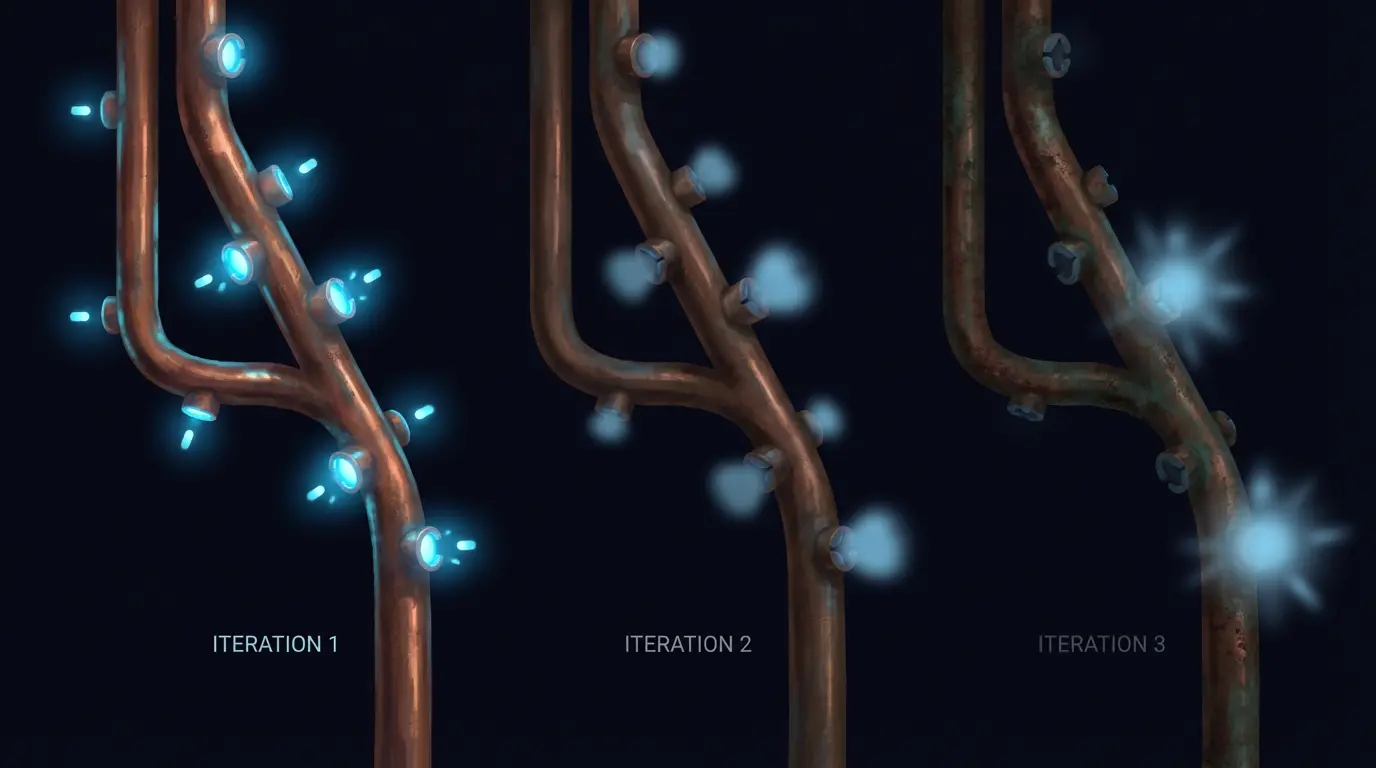
Social media platforms use variable ratio reinforcement (the identical reward schedule that drives slot machine behavior) to produce disproportionately strong dopamine responses. Unlike fixed schedules where rewards arrive predictably, variable reinforcement delivers likes, comments, and shares at unpredictable intervals, and this unpredictability is precisely what makes the dopamine system fire hardest.
The neuroscience is straightforward. Your ventral tegmental area (VTA) releases dopamine not primarily in response to the reward itself, but in response to the anticipation of reward. When the timing and magnitude of that reward are uncertain, dopamine neurons increase their firing rate substantially compared to predictable delivery. A landmark 2003 study in Science by Fiorillo, Tobler and Schultz demonstrated that uncertain rewards activate the dopaminergic midbrain more robustly than certain rewards of identical value. For a deeper look, see what the research reveals about youtube shorts reward loops.
This is not a design accident. Platform engineers optimize for engagement metrics (time on screen, scroll depth, return frequency) and variable ratio reinforcement is the most potent behavioral lever available. Every pull-to-refresh gesture mimics the slot machine handle. Every notification badge exploits the same circuit.
The Anticipation-Reward Gap
The critical mechanism is not the reward. It is the gap between anticipation and delivery. When you post a photo and wait for responses, your dopamine system activates before any likes arrive. The VTA begins firing during the waiting period, producing the restless checking behavior that most people misidentify as boredom. It is not boredom. It is pharmacological anticipation: your brain running a prediction error calculation on an intentionally unpredictable schedule.
What Happens in the Dopamine Feedback Loop?
You tell yourself you will just check notifications. Then you are scrolling. Then the screen dims because it has been too long. You feel vaguely worse than before you picked up the phone, but ten minutes later, you pick it up again. If that sequence feels involuntary, it is because, neurologically, it nearly is.
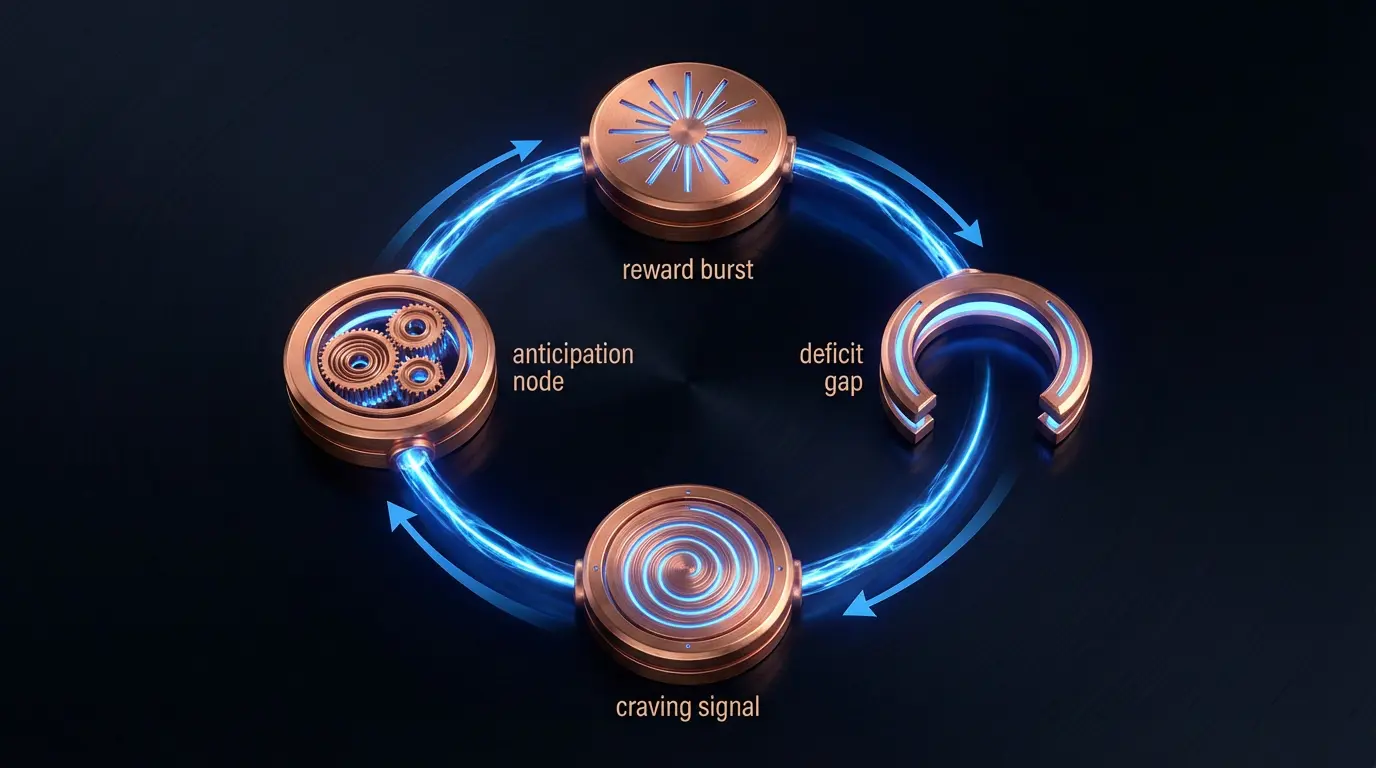
The compulsive cycle follows a five-stage neurochemical sequence that, once established, becomes self-perpetuating without conscious intervention.
Stage 1: Trigger. A notification, a vibration, or simply the passage of time since the last check activates the salience network, flagging the phone as a high-priority stimulus.
Stage 2: Anticipation. The VTA releases dopamine in response to the cue, producing the urge to check. This dopamine burst is anticipatory: it precedes the reward and is often larger than the reward itself.
Stage 3: Consumption. Scrolling delivers intermittent micro-rewards: a liked post, an interesting image, a provocative comment. Each one produces a small dopamine pulse that sustains engagement.
Stage 4: Depletion. Sustained dopaminergic activation depletes available dopamine in the synaptic cleft. The rewarding feeling fades. Users describe this as the moment they realize they have been scrolling for 40 minutes and feel worse than when they started.
Stage 5: Craving. The post-depletion deficit produces a below-baseline state, a mild dysphoria that the brain has learned to resolve by returning to the same stimulus. The cycle restarts.
Research published in the Journal of Behavioral Addictions found that problematic social media use activates the same neural circuitry observed in substance use disorders, including heightened cue-reactivity in the ventral striatum and diminished inhibitory control signals from the prefrontal cortex.
In my practice, I see this loop operating beneath nearly every digital behavior pattern clients present. The language they use (“I know I should stop but I can’t,” “I pick up my phone without deciding to”) is the language of a circuit that has automated itself below conscious control. What strikes me most is how much shame accompanies it. People feel broken. They compare themselves to others who seem to manage their devices without effort and conclude the problem is personal. It is not personal. It is architectural, and recognizing that distinction is often the first moment of relief a client experiences in our work together.
Does Social Media Physically Change Your Brain?
You used to read books for an hour without effort. Now you lose the thread after two paragraphs. You used to fall asleep in minutes. Now your mind races with content fragments until 2 AM. These are not signs of aging or laziness. They are signals that repeated digital overstimulation has physically altered the structures governing your attention, impulse control, and emotional regulation.
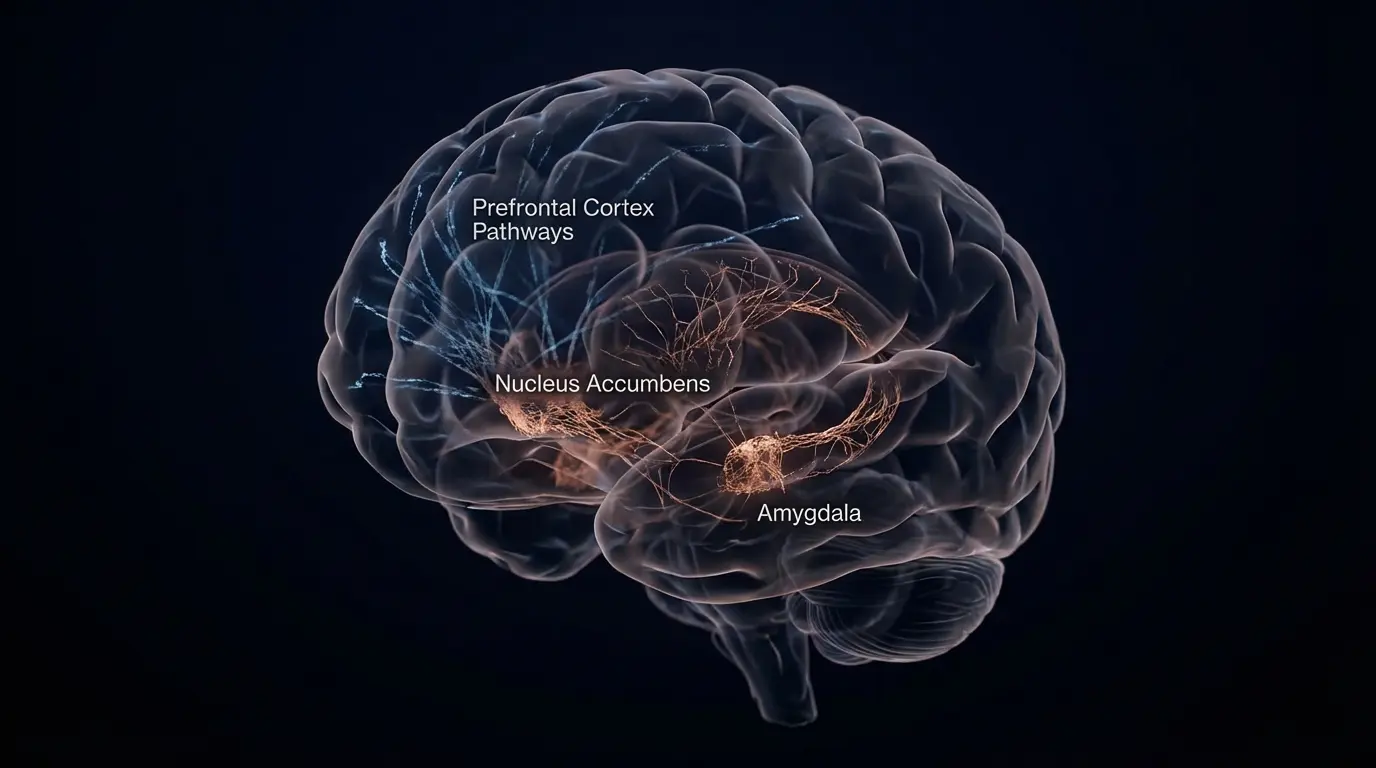
Yes. Chronic, high-frequency social media engagement is associated with measurable structural alterations in multiple brain regions, and the pattern of change mirrors what neuroscience observes in behavioral addictions broadly.
Nucleus accumbens. This region, the brain’s primary reward-processing hub, shows reduced gray matter volume in individuals with problematic social media use. The reduction reflects a compensatory downregulation, the brain physically remodeling in response to sustained overstimulation of reward circuits.
Amygdala. Structural changes in the amygdala are associated with heightened emotional reactivity to social cues, making users more responsive to the social comparison dynamics that platforms amplify. A neuroimaging study published in World Psychiatry documented these morphological changes and their correlation with compulsive usage patterns.
Prefrontal cortex (PFC). The dorsolateral PFC (the region responsible for executive control, impulse regulation, and the ability to override automated behaviors) shows weakened functional connectivity with subcortical reward areas. This means the brain’s “braking system” becomes less effective at interrupting the dopamine-driven pull to engage.
White matter integrity. Diffusion tensor imaging studies have identified reduced white matter coherence in tracts connecting the PFC to limbic structures, suggesting that the communication pathways between rational decision-making and emotional reward-seeking degrade with sustained overuse.
These changes are not theoretical. They are observable on imaging, they correlate with behavioral severity, and they explain why willpower-based approaches to reducing screen time consistently fail. You are not fighting a bad habit. You are working against a brain that has physically reorganized itself around the stimulus.
One pattern I encounter frequently in my practice is what I call the “phantom scroll”: clients report the physical sensation of scrolling even when their phone is not in their hands. Their thumb moves. Their eyes track downward across a page as if expecting new content to load. The motor pattern has embedded itself so deeply that it runs independent of the device. When I see that, I know the reinforcement loop has crossed from behavioral into somatic territory, and the intervention has to address both layers.
When someone sits across from me describing their inability to concentrate, their fractured sleep, their constant sense that time is disappearing, the digital consumption pattern is usually the first place I look. Not because I assume it is the cause, but because in the majority of cases I have worked, it is the accelerant. Whatever else is happening neurologically, the scroll cycle is making it worse, and it is the one variable we can restructure immediately.
Why Does Your Brain Need More Stimulation Over Time?
You used to enjoy scrolling. A funny video, a friend’s vacation photo: it genuinely brightened your afternoon. Now the same content barely registers, yet you cannot stop consuming it. That shift, diminishing pleasure paired with increasing compulsion, has a precise name in neuroscience.
Dopamine tolerance is the mechanism that transforms casual use into compulsive use. It follows the same pharmacological logic observed in every substance that acts on the mesolimbic pathway.
When dopamine floods the synaptic cleft repeatedly, postsynaptic neurons respond by downregulating D2 receptor density. Fewer receptors mean less signal per unit of dopamine released. The subjective experience is that the same content (the same scroll session, the same notification check) produces progressively less satisfaction. Users compensate by increasing dose: more time on the platform, more platforms simultaneously, more extreme or novel content to generate adequate stimulation.
This is the “numbing” effect that heavy users describe without having the neurochemical vocabulary for it. The phone feels less rewarding but more necessary. That paradox, diminishing pleasure coupled with increasing compulsion, is the signature of a tolerance-dependent loop.
The withdrawal component compounds it. When a tolerant user separates from the stimulus (leaves the phone in another room, goes on vacation without service), the depleted dopamine baseline produces genuine dysphoria: restlessness, irritability, difficulty concentrating, a persistent sense that something is missing. These are not metaphorical withdrawal symptoms. They reflect the neurochemical reality of a reward system operating below its set point.
I often ask clients to describe the last time they finished a scroll session feeling genuinely better than when they started. Most cannot. The silence that follows that question is more diagnostic than any assessment instrument I use: it reveals the moment a person recognizes the gap between what the behavior promises and what it delivers. That recognition, uncomfortable as it is, is the beginning of change.
The critical insight is that dopamine tolerance is not a moral failure. It is a predictable neurobiological adaptation to sustained overstimulation, and it reverses when the stimulation pattern changes.
In my practice, I have found it essential to separate two presentations that look identical from the outside but respond to completely different interventions. The first is anticipation-dominant: the pull is toward the dopamine spike of the unopened notification, the checking is relentless, and the content itself barely matters. The second is depletion-dominant: the scrolling is an attempt to escape the below-baseline dysphoria that tolerance has manufactured, and the feed functions more as a sedative than a stimulant. Establishing which one is driving a given person changes everything about where the intervention lands, and it is precisely the distinction the platforms are engineered to blur.
Can These Neurological Patterns Be Reversed?
If you have read this far, you probably recognize yourself in at least some of what has been described. And if you are like most of the people I work with, a part of you is wondering whether the damage is done, whether you have permanently altered something that cannot be restored. You have not.
The same neuroplasticity that allowed these patterns to form is the mechanism through which they can be dismantled. The brain did not arrive at compulsive scrolling because it is broken. It arrived there because it adapted efficiently to the reinforcement environment it was placed in. Change the environment and the reinforcement contingencies, and the neural architecture will reorganize.
Receptor upregulation, the restoration of D2 receptor density, begins within days to weeks of reduced stimulation. Structural gray matter changes in the nucleus accumbens and PFC require sustained behavioral change over months, but the trajectory is consistently toward restoration when the overstimulation ceases.
What does not work is willpower in isolation. The PFC impairment that chronic use produces is precisely the faculty required to exercise restraint. Asking a compromised prefrontal cortex to override a reward circuit it has lost connectivity with is asking the weakest part of the system to defeat the strongest. Effective intervention requires restructuring the reinforcement architecture itself: replacing the variable ratio schedule with competing reward sources that rebuild dopamine sensitivity through natural, predictable engagement.
In my practice, I do not start by telling clients to put their phones down. I start by mapping which specific reinforcement loops are running, because the executive who compulsively checks LinkedIn operates on a different circuit configuration than the college student locked into TikTok, even though the dopamine mechanics look similar at the surface. The intervention that works is the one matched to the architecture, not the one applied generically. That precision is what distinguishes neurological restructuring from another round of advice you already know has not worked.
This article is part of MindLAB’s Addiction & Reward Architecture hub, within the Neural Recalibration pillar.
What the First Conversation Looks Like
Most people who recognize themselves in the patterns described above have already tried reducing screen time through app timers, grayscale settings, digital detoxes, or sheer determination. These approaches address the behavior without touching the neural architecture that produces it, which is why they fail, and why the failure reinforces the belief that the problem is personal weakness rather than circuit design.
A strategy call with Dr. Sydney Ceruto is a standalone conversation, not a sales call, not a consultation that requires commitment. It is one hour with a neuroscientist who will map the specific reinforcement loops sustaining your pattern, identify which circuits have adapted and how, and determine whether the architecture is amenable to restructuring through targeted neural intervention.
If the compulsive pull toward your phone has started affecting your focus, your relationships, or your capacity to be present in your own life, this is not a willpower problem. It is an engineering problem, and engineering problems have engineering solutions.
Schedule a Strategy Call with Dr. CerutoWhy does social media feel more addictive than other screen activities?
Social media platforms employ variable ratio reinforcement, unpredictable reward timing that generates stronger dopamine responses than predictable schedules, combined with social validation signals that activate the brain’s affiliative reward circuits simultaneously. This dual activation of mesolimbic dopamine and social bonding pathways produces a compulsive pull that passive media consumption, which delivers content on a fixed schedule, does not replicate. The unpredictability is the key variable, and it is engineered deliberately.
Can dopamine levels return to normal after reducing social media use?
Dopamine receptor density begins upregulating within days to weeks of reduced stimulation, and most individuals report subjective improvement in mood stability, focus, and baseline contentment within two to four weeks of meaningful reduction. Full structural restoration of gray matter changes in the nucleus accumbens and prefrontal cortex requires sustained behavioral change over several months, but the neuroplastic trajectory is consistently toward recovery once the overstimulation pattern is interrupted.
Is social media addiction a real addiction in a neurological sense?
Neuroimaging research demonstrates that problematic social media use activates the same mesolimbic reward circuitry, including the ventral striatum, ventral tegmental area, and orbitofrontal cortex, observed in substance addiction. It produces tolerance, withdrawal symptoms, continued use despite negative consequences, and impaired prefrontal inhibitory control. While formal classification continues to evolve, the neurobiological substrate is functionally indistinguishable from recognized behavioral addictions.
Why do digital detoxes usually fail long-term?
Digital detoxes address the stimulus without restructuring the neural architecture that drives the compulsive response. During abstinence, dopamine receptor density begins recovering, but the underlying reinforcement circuits, the cue-reactivity patterns, the automated checking behaviors, the weakened prefrontal control, remain intact. When the user re-engages with the platform, the original pattern reactivates rapidly because the circuit was preserved, not dismantled. Lasting change requires replacing the reinforcement architecture itself, not simply removing access to it temporarily.
How does heavy social media use affect attention and sleep over time?
Chronic social media use is associated with measurable structural brain changes, including reduced gray matter volume in the nucleus accumbens and weakened prefrontal cortex regulation over impulse control. The subjective effects follow directly from that architecture: people who once read for an hour without effort lose the thread after two paragraphs, and minds that once settled quickly at night race with content fragments into the early hours. These are not signs of aging or laziness, they are signals that repeated digital overstimulation has physically altered the structures governing attention, impulse control, and emotional regulation, and the same neuroplasticity that formed the pattern is what allows it to be reversed.