Key Takeaways
- Theta clocks working memory at 3-6 Hz, generated by frontal eye fields and parietal cortex.
- Frontal theta, EEG workload signature, tracks cortex load: 2022, 24 studies, 723 participants, Hedges’ g=0.68.
- Theta-gamma cross-frequency coupling is the readout: theta synchrony tracks accuracy, theta-gamma coupling tracks reaction time.
- The 2:30 PM collapse is theta desynchronization, not exhaustion: load fragments working memory’s oscillatory scaffolding.
- Theta frequency tunes to task demands; work landed inside peak windows outperforms work outside.
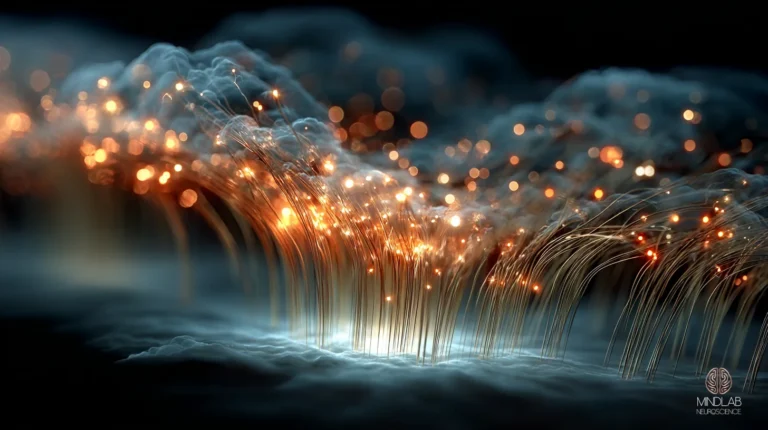
Theta brain waves act as a radar sweep across working memory. Cortical circuits in the frontal eye fields and parietal cortex generate a 3-6 Hz rhythm that samples behaviorally relevant information in narrow, repeating windows. Working memory readout depends on which phase of the theta cycle aligns with target content. The 2 PM wall is not fatigue, it is theta desynchronization, and the mechanism is precise.
This article is part of our hub on working memory and mental clarity, where the brain’s moment-to-moment capacity is mapped.
What Do Theta Brain Waves Do for Memory?
Theta waves are the brain’s clocking signal for working memory. Frontal eye fields and parietal cortex generate a 3-6 Hz rhythm that alternates between engagement and disengagement states. Working memory readout occurs in narrow, repeating windows, not continuously. Information arriving at the wrong theta phase is poorly encoded regardless of overall alertness.
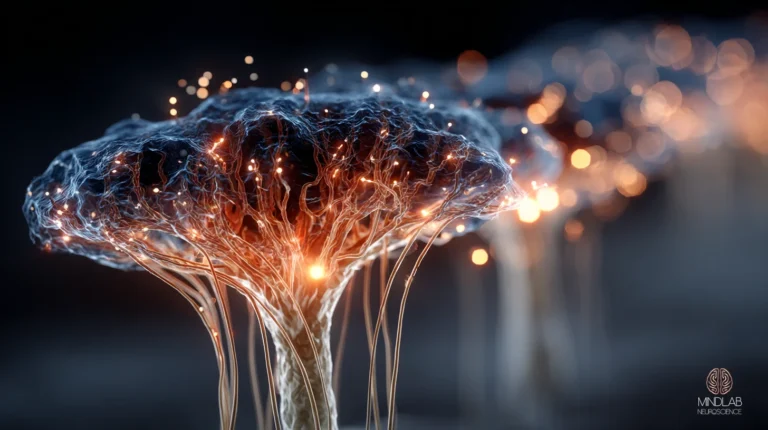
Theta oscillations, slow rhythmic fluctuations in cortical voltage between 3 and 6 Hz, are the substrate that holds working memory together across short delays. The cortex does not run a continuous high-fidelity stream. It samples. Each theta cycle opens an engagement window where sensory information is preferentially encoded, then closes into a disengagement window where motor responses are preferentially gated. The whole circuit operates on a roughly 200-millisecond beat.
The radar-sweep framing is not metaphor. Fiebelkorn and colleagues’ 2019 study in Nature Communications recorded from the macaque fronto-parietal network during rhythmic spatial attention. The team demonstrated that the mediodorsal pulvinar coordinates 3-6 Hz cycling between sensory-engagement and motor-engagement states. Each theta cycle samples one location, then another, then returns. Perceptual sensitivity rises and falls precisely with theta phase.
In my practice, I see this architecture surface most clearly in clients running complex non-corporate systems. A mother managing a charity board, school logistics for three children, and a family business reorganization described it without knowing the mechanism. She could hold any one of those domains. The moment a fourth input arrived, the whole working-memory scaffold became porous, items dropped, names slipped, the morning’s clearly-held priorities went hazy. The architecture was not failing. It was sampling, and the sample density had been exceeded.
It sits within the broader architecture of cognitive function that governs how attention and control are allocated.
How Can You Time High-Stakes Decisions to Your Theta Cycle?
Theta frequency adaptively tunes toward task-optimal values, and the shift predicts performance. Senoussi and colleagues demonstrated this in 2022: the brain is not running a fixed clock, it tunes its clock to demand. High-stakes cognitive work landed inside peak theta windows is reliably stronger than the same work pushed against the trough. Timing is controllable.
The peak windows are observable, even without an EEG. They follow three signals together: time of day, recent cognitive load, and recovery distance from the last deep-work block. Most adults running complex systems have their cleanest theta substrate between 9 and 11 a.m. and a second, smaller window between 4 and 6 p.m. after a midday recovery period. The afternoon trough is not a personality feature. It is the predictable consequence of morning load on a circuit whose phase precision has a budget.
The intervention follows from the mechanism. Yuan and colleagues’ 2025 work on theta-gamma coupling under varying loads showed that modulating the coupling itself improves working memory accuracy, capacity, and reaction time. The timing handle is not just observational, it is causal. Abubaker and colleagues’ 2021 review of the working-memory literature reached the same conclusion: cross-frequency coupling underlies capacity, and the coupling can be modulated.
This is the territory where Real-Time Neuroplasticity™ operates. Theta-phase-locked plasticity is the single most important fact about how working memory consolidates. Long-term potentiation in hippocampal-prefrontal circuits is gated by theta-cycle timing, and learning at the peak of the theta cycle is reliably stronger than learning at the trough. The live-moment intervention question is not “are you focused enough?”, it is “is the theta architecture in the right phase right now?” That distinction is what makes the rewiring window visible. The window is real, the timing is controllable, and the consequential cognitive work belongs there.
For the chemistry that holds the same buffer online, see how dopamine tunes working memory.
“Theta-phase-locked plasticity means the rewiring window is not always open. It is a recurring 200-millisecond opportunity, and the architecture knows when.”
References
Abubaker, M., Al Qasem, W., & Kvašňák, E., 2021. Working memory and cross-frequency coupling of neuronal oscillations. Frontiers in Psychology, 12, 756661. https://doi.org/10.3389/fpsyg.2021.756661
Croce, P., Quercia, A., Costa, S.H.A.M., & Zappasodi, F., 2018. Circadian rhythms in fractal features of EEG signals. Frontiers in Physiology, 9, 1567. https://doi.org/10.3389/fphys.2018.01567
Senoussi, M., Verbeke, P., Desender, K., De Loof, E., & Talsma, D., 2022. Theta oscillations shift towards optimal frequency for cognitive control. Nature Human Behaviour, 6(7), 1000–1013. https://doi.org/10.1038/s41562-022-01335-5
The skill-learning counterpart of this timing is detailed in how procedural learning builds unconscious competence.
Yuan, X., Tu, Z., Li, R., Pan, C., & Ma, J., 2025. Cross-frequency neuromodulation: Leveraging theta-gamma coupling for cognitive rehabilitation in MCI. Frontiers in Aging Neuroscience, 17, 1541126. https://doi.org/10.3389/fnagi.2025.1541126
What the First Conversation Looks Like
The first conversation with Dr. Sydney Ceruto at MindLAB Neuroscience is not an intake. It is a structured read of where your theta architecture is currently working and where it is desynchronizing, by hour, by load, by recovery posture. We do not start with a list of symptoms. We start with the precise moments in your week when working memory holds and the moments when it collapses, because the difference between those moments is the read. By the end of the conversation, you have a working map of your peak windows, the inputs that compress them, and the live-moment recalibration the architecture is already producing. The intervention starts when we identify the first one together.
What does it mean that theta waves act as a radar sweep?
Theta oscillations between 3 and 6 Hz produce alternating engagement and disengagement windows in the frontal eye fields and parietal cortex. Each theta cycle samples one location or representation, then another, then returns. Perceptual sensitivity rises and falls precisely with theta phase, meaning information that arrives during a high-excitability window is preferentially encoded while information arriving in a trough is not. The radar metaphor describes a real architectural property, the cortex samples discretely, not continuously, and timing matters at the millisecond level.
How is theta-gamma cross-frequency coupling related to working memory?
Theta-gamma coupling is the readout mechanism that lets working memory hold multiple items at once. Gamma bursts carrying individual representations are restricted to specific theta-phase windows of higher excitability, and the coupling allows multiple items to be held in non-overlapping phase positions within a single theta cycle. The Johnson 2022 NeuroImage study showed theta network synchrony tracks accuracy while theta-gamma coupling tracks reaction time, two distinct theta-based mechanisms supporting the same cognitive function in the same cortical circuit.
Is the 2 PM wall really theta desynchronization rather than fatigue?
Yes. Cumulative cognitive load through the morning fragments the oscillatory scaffolding that holds working memory together, and the failure mode is specifically a loss of theta phase precision. Croce and colleagues sampled EEG at 2:30 PM in 2018 and found oscillatory complexity reductions distinct from morning baseline. The Chikhi 2022 meta-analysis quantified the load-scaling component. The afternoon brain is not a tired version of the morning brain, it is a desynchronized version, and that distinction matters because the intervention is different.
Can you increase theta waves naturally without devices or supplements?
Yes, three evidence-based levers reliably raise theta power: sustained attentional training, sleep, and aerobic activity. Each acts on a different node of the theta-generating circuit. Sustained attentional focus drives the medial septum-prefrontal pathway directly. Sleep restores the hippocampal theta architecture wakefulness degrades. Aerobic activity raises cortical theta amplitude for hours afterward. The three levers stack rather than substitute, and the cumulative effect on afternoon working-memory precision is measurable across weeks rather than across single sessions.
How do you time high-stakes decisions to your theta cycle?
Track three signals together: time of day, recent cognitive load, and recovery distance from the last deep-work block. Most adults have their cleanest theta substrate between 9 and 11 a.m. and a second, smaller window between 4 and 6 p.m. after midday recovery. The afternoon trough is the predictable consequence of morning load on a phase-precision budget, not a personality feature. Land consequential cognitive work in the peak windows. Push administrative work into the trough.