Key Takeaways
- Prefrontal cortex D1 dopamine receptors set working memory’s inverted-U: too little weakens, excess collapses.
- Prefrontal D1 dopaminergic receptor signaling explains 26 percent of working-memory variance (2022 meta-analysis, 75 studies).
- Stimulants are not universal: they improve working memory below the inverted-U peak, degrade it above.
- Stress drives prefrontal dopamine: mild can lift low-baseline brains, sustained pushes high-baseline past D1 optimum.
- Finding your zone is observation, not measurement: stimulant response, stress response, morning performance triangulate it.
Dopamine and working memory follow an inverted-U. At low prefrontal D1 receptor stimulation, the cortex cannot hold mental representations across delay periods. At high stimulation, the same cortex suppresses every representation indiscriminately. Performance peaks inside a narrow middle band, and the band is narrower than most ambitious brains assume.
This article belongs to our hub on working memory and mental clarity, where the limits of cognitive bandwidth are mapped in depth.
How Does Dopamine Affect Working Memory?
Dopamine sets the gain on prefrontal cortex circuits that hold information in mind across short delays. At low stimulation, the gain is too weak to maintain a representation against distraction. At high stimulation, the gain amplifies everything, including noise. Working memory is the ability to keep the relevant signal alive, and that ability is dose-dependent on dopamine.
Working memory: the brain’s ability to hold and manipulate information across seconds-long delays without external storage: depends on a specific neural maneuver. Pyramidal neurons in the dorsolateral prefrontal cortex must keep firing during the delay period when the input is no longer present. That sustained firing is what makes the next decision possible.
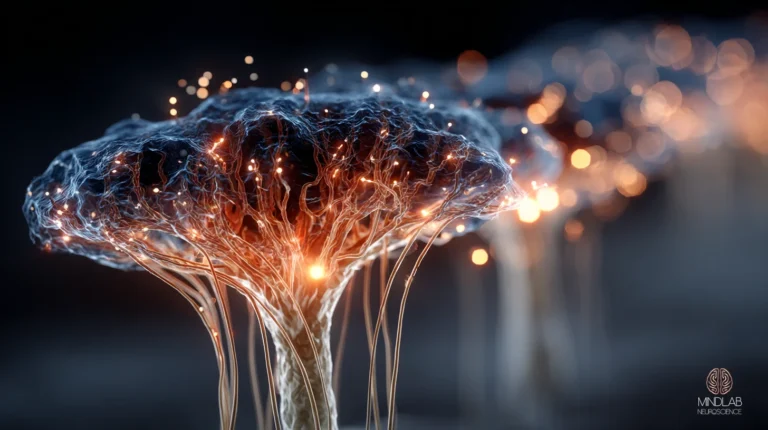
The mechanism that enables sustained firing is dopaminergic modulation. Dopamine D1 receptors on prefrontal pyramidal neurons act as a tuning circuit. At moderate stimulation, the cortex stabilizes its delay-period firing and holds the representation. The signal-to-noise ratio is high. The relevant information stays vivid against the surrounding noise of competing inputs.
Weber and colleagues’ 2022 meta-analysis in Behavioral Neuroscience reviewed 646 studies and isolated 75 that met inclusion criteria. The result was unambiguous. Prefrontal D1 receptor activity, on its own, accounted for 26 percent of the variance in working memory performance: the strongest single dopaminergic predictor in the published record. The inverted-U is not a heuristic. It is the most empirically supported dose-response curve in cognitive neuroscience.
In my practice, I see this ceiling clearly in clients running complex non-corporate systems. A mother managing a difficult charity board, her aging parents’ care, and a family in flux described it precisely. She could think clearly through a difficult board email. She could not think through the board email plus a simultaneous family crisis. The architecture has a ceiling, and once you cross it, the ceiling crashes downward.
What Happens When Dopamine Is Too High in the Prefrontal Cortex?
Excess prefrontal dopamine collapses working memory by erasing the signal-to-noise distinction that defines it. At supranormal D1 receptor activity, the cortex stops differentiating relevant representations from background neural noise. Every representation becomes equally salient, which functionally means none of them are. The architecture does not slow: it dissolves.
The mechanism was demonstrated at the single-neuron level by Vijayraghavan and colleagues’ 2007 Nature Neuroscience study. Recording from prefrontal neurons in monkeys performing a spatial working memory task, the researchers manipulated D1 receptor stimulation directly. At moderate stimulation, delay-period firing was robust. At elevated D1 stimulation, the same neurons stopped firing selectively. Activity did not decrease: selectivity disappeared. Every direction became equally activating. The cell could no longer say which location was being held.
From the inside, this feels like a particular kind of cognitive failure. You know you should be thinking about something. You can sense the cognitive activity. But the content has lost its edge. You cannot quite hold the meeting agenda. You cannot quite remember what you walked downstairs to do.
In a burnt-out C-suite client whose baseline already runs hot (sustained high-stakes decisions, no recovery windows, dopamine stimulation chronically elevated) adding any further dopaminergic load crosses the saturation threshold. The executive who tells me the same morning espresso that used to sharpen him now leaves him jittery and unfocused is describing supranormal D1 stimulation in real time. His baseline drifted upward. The same dose now lands past the peak.
It sits within the broader study of cognitive architecture that frames how the brain allocates and protects attention.

“Past the peak, the cortex has not slowed: it has lost selectivity. The activity is still there. The content has lost its edge.”
Why Do Stimulants Sometimes Make Focus Worse?
Stimulants help individuals operating below the inverted-U peak and degrade individuals operating above it. The same dose that lifts a low-baseline brain into its optimal zone pushes a high-baseline brain past the optimum into supranormal stimulation. The pharmacology is identical. The position on the curve determines whether the molecule is medicine or saboteur.
Manza and colleagues’ 2022 PET study in Communications Biology measured cortical D1 and D2 receptor availability in healthy adults, then administered methylphenidate, the dopamine-boosting agent in widespread cognitive use, and tracked working memory effects. The impact was not uniform. It depended on each subject’s baseline D1-to-D2 receptor ratio in association cortices. Different baselines produced different responses to the same dose.
Mehta and colleagues had shown the same baseline-dependence years earlier in a working memory task. Methylphenidate’s beneficial effect on prefrontal-parietal activation was largest in subjects with lower baseline working memory capacity, and smallest, occasionally reversed, in subjects with higher baseline capacity. The healthy adult population is not homogeneous. Some sit below the optimum and respond favorably. Some sit at the optimum and gain nothing. Some sit past it and degrade further.
The young professional who self-medicates a difficult deadline with espresso plus a prescribed stimulant plus a nootropic stack is rarely operating below the peak. She is, characteristically, already running near or past it. Each additional dopaminergic input shifts her further over the optimum. The result is what she actually experiences: cognitive jitter, the inability to hold the long sentence she is trying to write, the strange feeling of being maximally aroused and maximally unfocused at the same time. That experience is not a moral failure. It is the inverted-U.
Can Stress Improve or Impair Working Memory?
Mild, time-limited stress sharpens working memory. Sustained or high-stakes stress collapses it. Stress drives prefrontal dopamine release, and the inverted-U still applies. Brief novel stress can lift a low-baseline brain into its optimal zone. Chronic stress pushes a high-baseline brain past the peak, into the saturation region where supranormal D1 stimulation suppresses every representation in the cortex.
This is the resolution of an apparent paradox most ambitious people live inside. Pressure makes you think more clearly until it makes you think less clearly, and the transition feels abrupt because the curve is. Girotti and colleagues’ 2024 review in Neurobiology of Stress synthesized the chronic-stress literature: prolonged stress consistently impairs cognitive flexibility, behavioral inhibition, and working memory across rodent and human studies. The cognitive effects run through the same prefrontal mechanism the inverted-U describes.
The Weber 2022 meta-analysis quantified the dopaminergic component directly. Of the cognitive variance attributable to prefrontal mechanisms, prefrontal D1 receptor activity alone, pooled across the 75-study sample, explained 26 percent. Stress is one of the largest natural drivers of prefrontal dopamine release in the human brain. The same curve that governs pharmacological dopamine governs stress-induced dopamine.
The system this drive overwhelms is detailed in the neuroscience of working memory.
In my practice, I consistently observe a precise breaking point. Clients describe sharp thinking through three meetings, four meetings, six. Then, somewhere between the seventh and eighth, the architecture flips. The same stress that produced clarity earlier in the day now produces fog. They have not become less competent over the day. They have crossed the saturation threshold.

How Do You Find Your Optimal Dopamine Zone?
The optimal zone is not a number you measure. It is a position you observe. Three signals reveal where you sit on the inverted-U: how stimulants affect your focus, how stress affects your working memory, and how cognitively demanding tasks land in the day’s first hours. Each signal triangulates your baseline. Together they produce a stable read.
The first signal is the stimulant signal. If a moderate dose of caffeine or a prescribed stimulant reliably sharpens your thinking during difficult cognitive work, your baseline likely sits below the optimum. The added dopamine moves you up the curve. If the same dose produces jitter, mental scatter, or the strange combination of high arousal and poor focus, your baseline likely sits at or past the optimum.
The second signal is the stress signal. A brain operating below the peak experiences stress as a clarifier. A brain operating past the peak experiences stress as a disorganizer. If your hardest decisions feel cleanest in moderate stress and fuzziest in high stress, your baseline runs hot, and high-stakes contexts push you into saturation.
The third signal is the morning signal. Prefrontal dopamine baseline tends to rise through the day. If your most demanding cognitive work feels clearest before noon, your optimum likely sits at the lower-dopamine end of the curve, and the day pushes you past it. If complex thinking only resolves after the workday ends, you have spent the day past the peak.
These signals do not produce a number. They produce a map. Once you know where you sit, the intervention question changes. The standard advice (push harder, add more dopamine) is the wrong intervention for anyone already past the optimum. The actionable handle is recalibration, not addition. This is the territory where Real-Time Neuroplasticity™ operates: the live moment when the prefrontal D1 system tips past the optimum, when the executive who has been thinking sharply at 3 p.m. begins to feel the architecture flip at 4. That instant is the rewiring window.
For a complete framework on understanding and resetting your dopamine reward system, I cover the full science in my forthcoming book The Dopamine Code (Simon & Schuster, June 2026).
When the same system tips past its limit, see why the brain defaults to panic over strategy.
“The architecture is not failing. It is delivering a precise signal about its own position on a curve, and the curve is moveable.”
References
Arnsten, A.F.T., Wang, M., & Paspalas, C.D., 2015. Dopamine’s actions in primate prefrontal cortex: Challenges for treating cognitive disorders. Pharmacological Reviews, 67(3), 681–696. https://doi.org/10.1124/pr.115.010512
Diamond, D.M., Campbell, A.M., Park, C.R., Halonen, J.D., & Zoladz, P.R., 2007. The temporal dynamics model of emotional memory processing: A synthesis on the neurobiological basis of stress-induced amnesia, flashbulb and traumatic memories, and the Yerkes-Dodson law. Neural Plasticity, 2007, 60803. https://doi.org/10.1155/2007/60803
Girotti, M., Bulin, S.E., & Carreño, F., 2024. Effects of chronic stress on cognitive function: From neurobiology to intervention. Neurobiology of Stress, 33, 100670. https://doi.org/10.1016/j.ynstr.2024.100670
Zahrt, J., Taylor, J.R., Mathew, R.G., & Arnsten, A.F.T., 1997. Supranormal stimulation of D1 dopamine receptors in the rodent prefrontal cortex impairs spatial working memory performance. Journal of Neuroscience, 17(21), 8528–8535. https://doi.org/10.1523/jneurosci.17-21-08528.1997
What the First Conversation Looks Like
The first conversation with Dr. Sydney Ceruto at MindLAB Neuroscience is not a diagnostic. It is a structured read of how your prefrontal architecture is currently working, and where on the inverted-U your baseline sits right now. We do not begin with a list of symptoms. We begin with the precise moments in your week when working memory holds and the moments when it collapses, because the difference between those moments is the read. By the end of the conversation, you have a working map of your position on the curve, the inputs pushing you off it, and the live-moment recalibration windows your architecture is already producing. The intervention starts when we identify the first one together.
Is more dopamine always better for focus?
No. Dopamine and working memory follow an inverted-U, not a linear curve. Below the peak, additional dopamine sharpens prefrontal signal maintenance and improves focus. Above the peak, additional dopamine collapses signal-to-noise selectivity and degrades focus by erasing the cortex’s ability to distinguish relevant representations from background noise. The popular “more dopamine equals better focus” framing describes only the left half of the curve, and most ambitious adults already operate near or past the right half.
Can stimulants improve working memory in a healthy adult?
It depends on the adult’s baseline. Methylphenidate and similar dopaminergic agents improve working memory in subjects with lower baseline capacity and produce neutral or degrading effects in subjects with higher baseline capacity. The 2022 Manza PET study confirmed that cortical D1-to-D2 receptor ratio modulates the response, and earlier baseline-dependent working memory studies have shown the same. The drug is the same dose. The starting point on the inverted-U determines whether the dose lands in the optimal zone or pushes past it.
How does chronic stress affect prefrontal dopamine and working memory?
Chronic stress drives sustained prefrontal dopamine release, and the inverted-U still applies. In a high-baseline brain, sustained stress pushes D1 receptor stimulation past the optimum into saturation, where representational selectivity collapses. The 2024 Girotti review documented this pattern across rodent and human studies: prolonged stress consistently impairs working memory, cognitive flexibility, and behavioral inhibition. The mechanism is the same curve that governs the dopaminergic effects of pharmacology, simply displaced further along its dopaminergic axis by stress.
Is there a way to test whether you are past the inverted-U peak?
Not by direct measurement, but by triangulation. Three signals together produce a reliable read: how stimulants affect you, how stress affects you, and at what hour of the day your most demanding cognitive work lands cleanest. If stimulants jitter you, stress scatters you, and only the post-workday hours feel mentally tractable, your baseline runs above the optimum. If stimulants sharpen you and morning is your clearest window, you sit on the lower end of the curve.
Why do high achievers describe focus as harder, not easier, the more they accomplish?
Because sustained high-stakes performance shifts prefrontal dopamine baseline upward over time. A baseline that once sat at the optimum drifts past it. The same cognitive demand that used to produce clarity now produces saturation, and the same stimulants that used to sharpen now degrade. The cortex has not weakened. Its operating point has moved along the inverted-U, and the position has crossed the peak. What feels like declining focus is the curve descending past its optimum.