Most people try to change their lives by adjusting their schedules, habits, or goals. Almost no one asks the deeper question that actually drives lasting change:
What, exactly, is my brain learning every single day?
That is what brain learning is about. It is the way your brain rewires itself in response to repeated thoughts, emotions, and behaviors. When you understand how your brain learns and the neuroscience of changing how you think, you can finally see why specific mental patterns feel so stubborn and what it actually takes to replace them.
Old, pernicious thinking does not stick around because you are weak. It sticks around because your brain has turned those thoughts into fast, efficient mental shortcuts. Many of those shortcuts manifest as cognitive distortions and biases. They are not random, and they are not just “negative thinking.” They are the predictable outputs of the way our brains learn and millions of years of evolution.
In this article, we will explore brain learning and the neuroscience of changing how you think in a clear, practical way. You will learn what cognitive distortions are, how they form in the brain, ten of the most common distortions, and exactly how to use neuroscience-based tools to create new neural pathways that lead to more accurate, more helpful thinking.
You do not need to be a scientist. You only need curiosity and a willingness to practice. Your brain will do the rest, I promise.
A Personal Note Before We Dive In
Before we go any further, I want you to know that I am not writing about brain learning from a distance. I have had to use the neuroscience of changing how you think inside my own life, inside my own nervous system, the very same way I am asking you to use it now.
For many years, my brain carried a quiet, painful script: if I was left alone, it meant I was being abandoned. An unanswered text, a delayed reply, someone needing space, or even a quiet evening by myself did not feel neutral. My brain learned to read those moments as rejection. It did not stop to ask, “Is this actually true?” It simply ran the same old pathway: “You are being left. You do not matter.”
Those were not facts. They were pernicious patterns my brain had wired through repetition and emotion. My own brain learning had fused “alone” with “abandoned,” and that fusion shaped how I thought, felt, and behaved for a long time.
The work I do now, and the work I describe in this article, is the same work I had to do for myself. I had to start noticing that pattern in real time, name it for what it was, and gently offer my brain a different option: “Someone stepping away does not mean I am being left. I am still safe. I am still worthy. I am allowed to be with myself.” I practiced this over and over, especially in the small, everyday moments that used to trigger the old story. Slowly, my nervous system began to learn something new. Being alone no longer automatically meant abandonment. It could also mean rest, choice, or simple quiet.
I have watched the same kind of shift happen in hundreds of clients. Very bright, very capable people who came in convinced that “I always mess things up,” “I am too much,” or “I am never enough” were just the truth about who they are. Using the same principles you are about to read, we traced those stories back to the way their brain had learned to think, and then we trained new pathways that were more accurate, more compassionate, and far more useful.
I am sharing this with you now so you know this: there is nothing wrong with your brain. It has been doing exactly what it was designed to do, even if the results have been painful. Brain learning is not your enemy. It is the very process we are going to use to help you change how you think, one practiced pathway at a time.
What Is Brain Learning, Really?
This concept is the ongoing process by which your nervous system turns experience into wiring. It is not about school, textbooks, or formal education. It is about how your brain silently learns from what you repeat and what feels important.
Every time you think, feel, or act a certain way, groups of neurons fire together. When that pattern repeats, brain learning strengthens the connections between those neurons, so the pattern runs faster and more automatically next time.
In simple terms:
• Neurons that fire together wire together.
• The more they fire together, the easier it is for them to wire again.
• Over time, those wires become your default way of thinking.
If you repeatedly think, “I always mess things up,” brain learning regards that as a useful shortcut. It does not judge whether it is fair or kind. It just notices repetition and emotional intensity. The result is that “I always mess things up” becomes the fast lane in your mind.
The neuroscience of changing how you think starts with respecting this basic fact: your brain is continually optimizing for speed and efficiency. The unique way the brain learns is the precise mechanism that makes that possible.
The Neuroscience of Changing How You Think
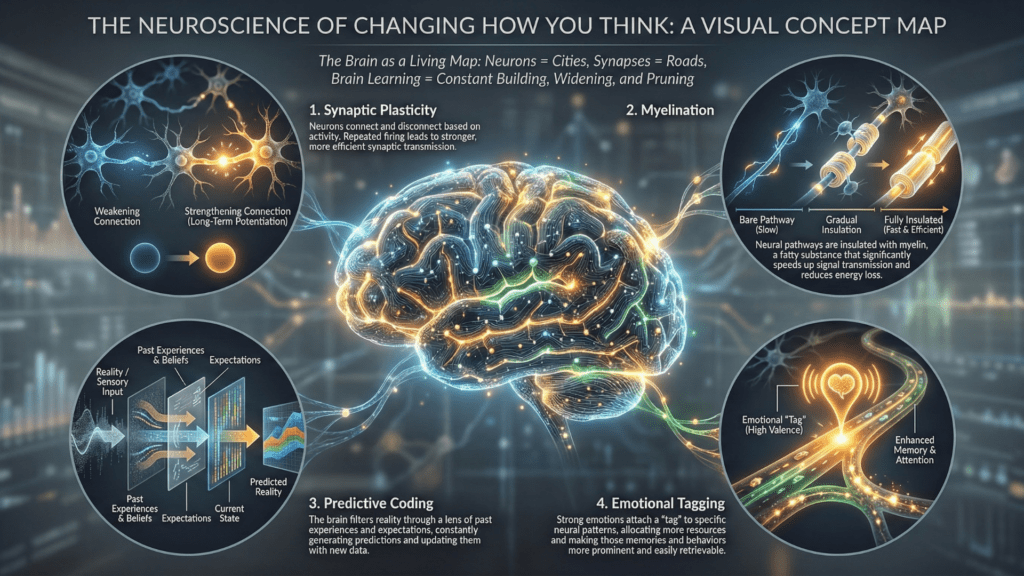
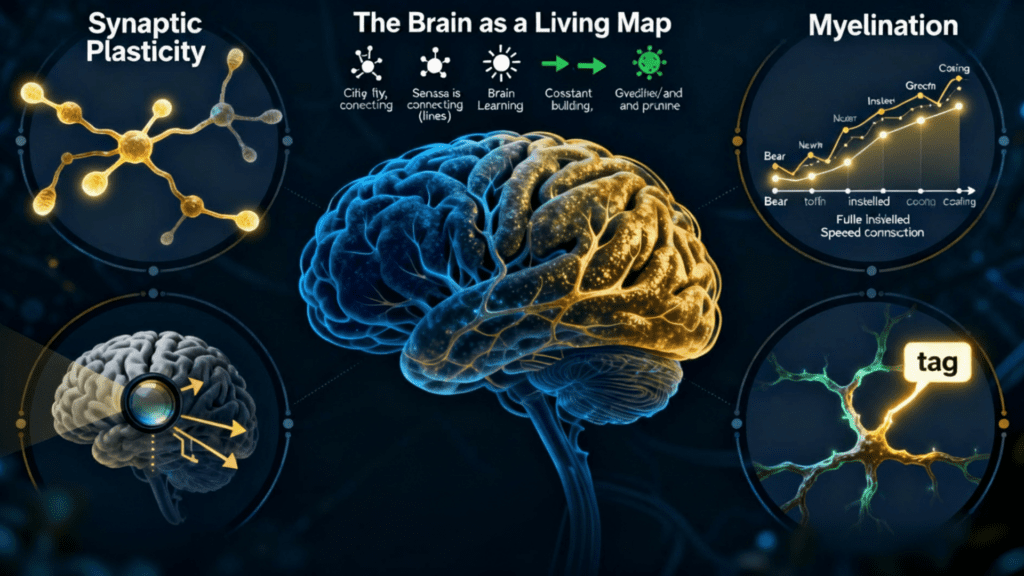
To understand the neuroscience of changing how you think, it helps to imagine your brain as a living map.
• Neurons are the cities.
• Synapses—the connections between neurons—are the roads.
• Brain learning is the constant building, widening, and pruning of those roads.
When you repeatedly think in a particular way, your brain establishes a pathway for that pattern. Electrical signals move more easily along that highway. Chemicals that support that pathway get released more efficiently. Over time, your brain uses that highway almost automatically.
The neuroscience of changing how you think is about building new roads and slowly diverting traffic away from the old ones. It involves a few key processes:
- Synaptic plasticity
The strength of a connection between neurons can increase or decrease. Repeated activation strengthens a synapse. Lack of use weakens it. The brain constantly uses this rule in learning. - Myelination
With repetition, some pathways become insulated with myelin, a fatty substance that speeds signal transmission. That is why some thoughts feel instant. Brain learning has literally made those routes more efficient. - Predictive coding
Your brain does not just react. It predicts. It uses past learning to predict what will happen and what something means, then filters reality through that prediction. This task is a core part of the neuroscience of changing how you think, because distorted predictions produce distorted thinking. - Emotional tagging
When an experience has a strong emotional charge, your brain stamps it as “important.” Brain learning then allocates more resources to that pattern. Many cognitive distortions are built on highly emotional memories that got tagged this way.
The key takeaway is simple: your mind is not just “thinking.” It is running predictions and shortcuts based on previous brain learning. If those shortcuts are distorted, the neuroscience of changing how you think is about training your brain to build better ones.
Why Your Brain Loves Shortcuts—An Evolutionary View
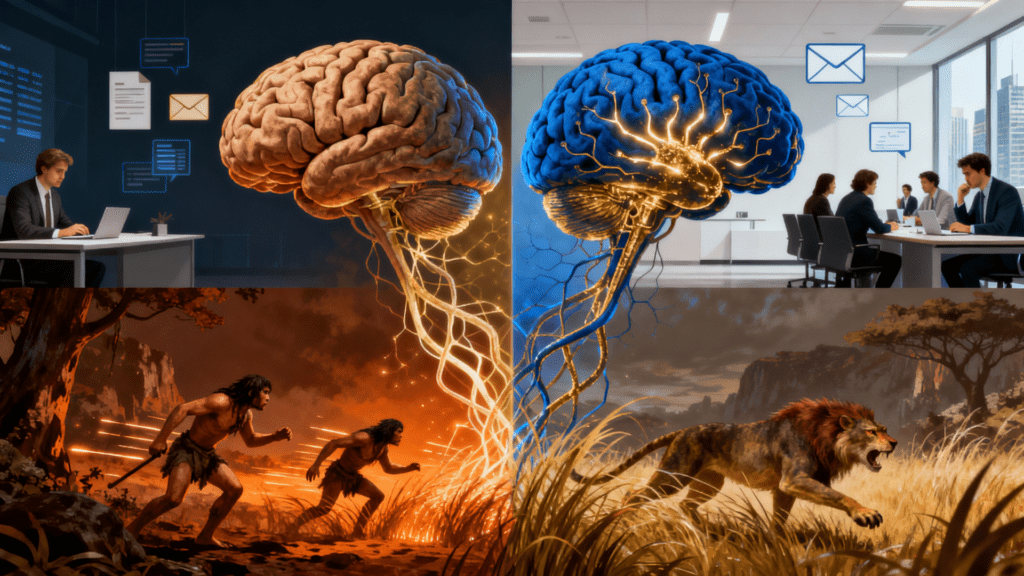
From an evolutionary perspective, brain learning had one main job: to keep you alive long enough to pass on your genes. There was no time to analyze every situation slowly. Your ancestors needed quick, efficient mental rules.
So the brain developed a bias toward shortcuts:
• Better to assume a rustle in the grass is a threat than to weigh options slowly.
• It is preferable to associate danger with greater intensity than safety.
• It’s better to see patterns, even if some of them are false, than to miss the real ones.
These shortcuts were useful for survival, but they also set the stage for cognitive distortions. Brain learning took those ancient priorities and applied them to modern life. Now, instead of rustling bushes, you have emails, texts, meetings, and conversations. Yet the same quick, biased learning system is still running.
That is why many cognitive distortions lean toward:
• Exaggerating risk
• Overvaluing negative information
• Jumping to conclusions
• Oversimplifying complex reality
Understanding this evolutionary context is part of the neuroscience of changing how you think. It shows that distorted thinking is not a moral failure. Your ancient brain is running outdated programming in today’s modern world.
What Are Cognitive Distortions?
Cognitive distortions are patterned ways of thinking that systematically misrepresent reality. They are not random negative thoughts. They are structured biases that your brain has learned over time.
They feel “true” because the brain’s distinct way of learning has strengthened them:
• They fire quickly and automatically.
• They come with intense bodily sensations.
• They usually have been rehearsed many times.
The neuroscience of changing how you think is about recognizing these patterns, understanding how they built them, and then deliberately training your brain to replace them with more accurate, flexible pathways.
Below are ten common cognitive distortions. We will examine each one, including its appearance, how brain learning and evolution support it, and why it is so ingrained.
- All-or-Nothing Thinking
All-or-nothing thinking manifests as binary judgments. Something is either a total success or a complete failure. You are either good or evil, wise or stupid, on track or hopeless. There is no gray area.
Brain learning and evolution:
From an evolutionary perspective, clear categories were safer. “Safe” versus “dangerous” needed to feel like two separate buckets. This technique taught you to sort quickly so you could act fast.
Your brain frequently perceives a strong correlation between performance and safety. Repeated experiences where small mistakes felt huge can be wired into a pattern:
• Slight error → big internal alarm → harsh self-judgment
With repetition, the brain learns this pathway, making it automatic. The prefrontal cortex (considerate, nuanced thinking) gets overridden by older circuits that prefer simple, absolute rules.
- Catastrophizing
Catastrophizing is the tendency to immediately jump to the worst possible outcome, even when the situation is uncertain or minor. A delay becomes a disaster. A small problem becomes a total collapse in your mind.
Brain learning and evolution:
Your ancestors survived by over-predicting danger. A brain that assumed “it might be bad” was more likely to survive than a brain that always assumed “it will be fine.” Brain learning inherited this bias.
In modern life, this unique way of learning reinforces repeated panic thoughts, such as “This will be terrible” and “This will ruin everything.” Emotional arousal teaches your nervous system that these predictions are essential. Over time, your internal “prediction engine” leans toward catastrophe as its default.
- Overgeneralization
Overgeneralization takes one event and turns it into a sweeping rule. One failed attempt becomes “I always fail.” One awkward moment becomes “I am bad with people.”
The brain’s pattern-seeking nature drives this distortion in learning and evolution. Your brain wants to turn single experiences into broad rules because these rules help conserve energy. Brain learning encodes rules to prevent the need for constant re-evaluation.
If we don’t update painful events with new, more nuanced experiences, our brain continues to operate according to outdated rules. The result is a mental world filled with “always” and “never” statements that do not match real data.
- Mental Filter
A mental filter is when you focus almost exclusively on the negative and ignore the neutral or positive information in a situation. One criticism blocks out ten compliments. One tiny error defines the entire project.
The relationship between how the brain learns and the process of evolution is significant:
Your survival system evolved to highlight potential threats. The brain naturally gives more weight to negative signals than positive ones. Brain learning then trains your attention to keep looking in that direction.
If you repeatedly review your day by replaying only what went wrong, brain learning builds a filter that shows you mostly flaws and risks. Movement through reality becomes like looking through dark glasses that dim everything except problems.

- Discounting the Positive
Discounting the positive is noticing good things but quickly dismissing them. Compliments “do not count” because the person was being kind. Wins are “not a big deal.” Progress is “still not enough.”
Brain learning and evolution:
From a survival perspective, dwelling on the positive did not add much protection. The system prioritized “what still might hurt me” instead. The brain became more sensitive to gaps and threats than to achievements.
If you consistently downplay your successes in your internal narrative, your brain learns to adopt that as the correct script. The pathways that support appreciation and satisfaction remain weak, while those that support self-criticism grow stronger.
- Mind Reading
Mind reading is assuming you know exactly what others are thinking, without clear evidence. It usually leans negative: “They think I am incompetent,” “They are bored with me,” “They are judging me right now.”
Brain learning and evolution:
Humans evolved in groups where social standing mattered. Anticipating others’ reactions helped avoid conflict and exclusion. This incredible way of learning and discovery became very effective at simulating others’ minds.
However, when simulations are repeatedly skewed toward rejection or disapproval, those biased simulations become the default. Brain learning fuses “uncertainty” with “negative prediction,” and the brain stops checking for more accurate information.
- Fortune Telling
Fortune telling involves making negative predictions about the future and viewing those predictions as if they are facts. “This will not work.” “They will say no.” “The outcome is already bad.”
Brain learning and evolution:
Your brain is a prediction machine. It constantly uses past data to guess what will happen next. Simply put, the brain builds internal models and tests them against reality.
If your internal model has been trained predominantly with fearful or pessimistic expectations, the prediction system will tend to forecast failure. The neuroscience of changing how you think involves feeding this prediction system new data, so brain learning can update those internal models instead of reusing the same distorted forecasts.
- Emotional Reasoning
Emotional reasoning is when you use your feelings as proof that a thought is actual. “I feel like a fraud, so I must be one.” “I feel unsafe, so my actions must be dangerous.”
Brain learning and evolution:
Feelings evolved as rapid, global signals indicating that something may require attention. They were never meant to be perfect maps of reality. However, brain learning can train you to regard them as the absolute truth.
When you repeatedly pair certain feelings with certain stories, for example, feeling tense and telling yourself, “This means I cannot handle it,” the brain links them tightly. Emotional signals become fused with specific distorted beliefs. The neuroscience of changing how you think requires gently separating feeling from fact through new neural pairings.
- Personalization
Personalization is taking excessive responsibility for events that are not entirely under your control or assuming that neutral events are secretly about you. “They are quiet, so I must have done something wrong.”
Brain learning and evolution:
Humans evolved in tightly knit groups where social standing mattered. It was safer to wonder, “Is this information about me?” than to miss an important signal.
If brain learning is trained over time by environments where you felt overly responsible or had to scan for subtle shifts in others, it can build a bias toward self-blame. The brain then over-attributes causality to the self, even when other factors clearly matter.
- Labeling and Identity Fusion
Labeling and identity fusion happen when you define yourself with a harsh, global label based on specific events. “I am a failure.” “I am broken.” “I am incapable.”
Brain learning and evolution:
The brain likes stable identities because they simplify prediction. If you are “this type of person,” the brain can make quick guesses about your future behavior.
However, when labels form during intense experiences and are repeated internally, brain learning carves them deeply into your self-concept. Neurons that encode memories of specific events become tightly linked with neurons that encode your sense of self. The result is a rigid identity that does not flex with new evidence.
How Brain Learning Locks In Cognitive Distortions
Now that you have seen these ten distortions, it is easier to appreciate how this fascinating learning works behind the scenes to keep them in place.
Three primary mechanisms are at play:
- Repetition
Each time you run a distorted thought, you fire the same neurons in the same sequence. Brain learning strengthens those synapses. Over time, the pattern becomes faster and more automatic. - Emotion
Distorted thinking often carries strong emotional energy. That energy acts like a highlighter for brain learning. The brain flags the pattern as meaningful, making it easier to retrieve. - Attention
When you pay attention to specific thoughts and ignore others, you train your selective attention networks. Brain learning then biases you toward noticing information that fits the distortion and skipping information that does not.
This combination means cognitive distortions can feel incredibly “true,” even when they are objectively inaccurate. To change them, the neuroscience of changing how you think must work through the same three levers: repetition, emotion, and attention.
Brain Learning and Cognitive Biases
Cognitive distortions and cognitive biases are closely related. Distortions tend to be personal and subjective. Biases are more general mental shortcuts that all humans share to some degree. Both arise from brain learning and evolutionary pressures.
Examples of biases that interact with distortions:
• Confirmation bias: your brain favors information that confirms what it already believes. This supports overgeneralization and mental filters.
• Negativity bias: your brain gives more weight to negative inputs. This feature supports discounting the positive and catastrophizing.
• Availability bias: your brain overestimates the likelihood of things that are simple to recall. This feature supports fortune-telling based on a few vivid memories.
The neuroscience of changing how you think requires noticing how brain learning has combined distortions and biases into automatic mental routines. Once you see the routine, you can train your brain toward more accurate patterns.

The Neuroscience of Changing How You Think About Your Own Story
Most people assume their inner story is just “who they are.” In reality, that story is the result of years of brain learning. Your brain has been quietly editing and re-editing the narrative of “me” based on what you repeat, what you focus on, and what feels emotionally charged.
Saying statements such as “I am the one who always screws things up” or “I am the one who has to hold everything together” is not merely stating facts. You are rehearsing a line in a script, and your brain’s learning system has already started to memorize it. Neurons that encode your memories, your feelings, and your sense of identity fire together. Through repetition, these neurons connect to form a stable “self-story.”
This is where the neuroscience of changing how you think becomes very real. Calling out a distortion, such as all-or-nothing thinking or labeling, and observing how it shapes your story illuminates the neural wiring underlying that narrative. You are not just changing words. You are changing which networks in your brain get activated when you think about yourself.
Imagine two different internal lines: “I failed, so I am a failure” versus “I failed at this task, and I am learning how to do it better.” Both statements travel through your brain. The first fuses a single event to your identity. The second keeps them separate. Brain learning notices which one you repeat more often and quietly builds that into your self-concept.
When you work with the neuroscience of changing how you think about your own story, you are doing something very specific:
• You recall an old, emotionally loaded story.
• You see the cognitive distortion inside it, like overgeneralization or labeling.
• You offer a more accurate, flexible version.
• You repeat that new version enough times that your brain starts to prefer it.
Each time you remember an event and see it through a new lens, the memory becomes slightly less fixed. The emotional charge can soften. The story can be updated. The brain uses those updates to adjust the wiring that supports your identity. Over time, “I am broken” can genuinely become “I am someone who has been through hard things and is still capable of growth,” not just as a slogan, but as a pathway your brain actually believes.
This is the neuroscience of changing how you think at the deepest level: not just swapping individual thoughts, but gradually training your nervous system to support a more accurate, compassionate, and practical story of who you are.

The Neuroscience of Changing How You Think When It Actually Matters
There is another crucial layer to brain learning that most people miss. You can understand your patterns perfectly when you are calm, but you still find yourself hijacked in high-stakes moments. The reason lies in the neuroscience of changing how you think under pressure.
When the stakes feel high, sensory input, old emotional memories, and fast survival pathways all light up at once. Your brain does not ask, “What did I write in my journal last week?” It reaches for whatever pattern has been most deeply practiced in similar states. If you have spent years pairing tension with catastrophizing or conflict with all-or-nothing thinking, those are the tracks your brain learning system will grab first.
This is why you can have insight on the couch and still feel stuck in the boardroom, on a call, or in a difficult conversation. Calm insight and high-arousal performance are not stored as the same experience. The neuroscience of changing how you think says you must train your brain in the same states where you want new patterns to show up.
Practically, that means using brain learning in small, real-time ways when it actually matters:
• In the first thirty seconds of a challenging conversation, you notice the urge to mind-read and instead ask a straightforward question.
• In the moment right before you hit send on an email written in all-or-nothing thinking, you pause, breathe once, and rewrite a single sentence in more balanced language.
• In the instant you hear your mind say, “This will be a disaster,” you quietly insert, “This might be uncomfortable, and I will still have options,” and then take the next small step.
These seemingly insignificant moments hold significant neurological value. You are taking a situation your brain has historically tagged as “danger,” letting the old distortion start to fire, and then interrupting the script. Brain learning records that interruption as new data: “In this kind of moment, another response is possible.”
Repeat that often enough, and the neuroscience of changing how you think predicts something powerful: your default response in those same high-stakes situations will begin to shift. The old highway of distortions will still exist, but the new pathway you have practiced will start to feel more available and eventually more natural.
This approach is the heart of applied brain learning. You are not just working on yourself in quiet, reflective moments. You are training your nervous system in the very seconds your old wiring is loudest. That is where the neuroscience of changing how you think turns from an idea into a lived, repeatable skill.
Neuroscience-Based Ways To Change Distorted Thinking
Changing distorted thinking is not about forcing yourself to “think positive.” It is about taking the neuroscience of changing how you think seriously and using brain learning to your advantage.
Here are core principles, grounded in brain learning, that help you create new, enduring pathways.
- Train Awareness as a Neural Skill
Before you can change a distortion, you have to see it in action. Awareness is not just a vague idea. It is a trainable neural skill.
When you repeatedly pause and notice a thought pattern, you are strengthening networks in the prefrontal cortex that monitor inner experience. Brain learning then makes it easier to catch distortions earlier.
Practical approach:
• Choose one distortion from the list that you recognize in yourself.
• For one week, your only goal is to notice when it appears.
• Each time, mentally name it: “all-or-nothing thinking,” “catastrophizing,” and so on.
You are not trying to fix it yet. You are building the neural circuitry that lets you see it clearly. That is the first step in the neuroscience of changing how you think.
- Slow Down the Automatic Pathway
Distorted thoughts are fast. They run on well-insulated highways. To change them, you need to slow the signals just enough for the conscious brain to step in.
Simple physical actions can help:
• One or two slower breaths
• Relaxing your jaw and shoulders
• Pausing before replying or clicking send
These actions shift activation away from pure survival circuits, giving your prefrontal cortex a chance to engage. Brain learning then begins to link “trigger” with “pause” instead of “trigger” with “instant distortion.”
- Create Specific Neural Alternatives
The neuroscience of changing how you think is not about telling yourself, “Do not think that.” It is about giving your brain a concrete, repeatable alternative. It is perfectly normal for the brain to need a specific new pattern to strengthen.
For each distortion, design one replacement thought that is:
• More accurate
• Still emotionally believable
• Stated in simple language
Examples:
All-or-nothing thinking
Distortion: “If this is not perfect, it is worthless.”
Alternative: “This can be imperfect and still be valuable.”
Catastrophizing
Distortion: “If this goes wrong, everything falls apart.”
Alternative: “If this goes wrong, it will be uncomfortable, and I will still have options.”
Overgeneralization
Distortion: “I failed once, so I always fail.”
Alternative: “I failed this time. That is data, not destiny.”
Each time the original distortion appears, you gently insert the alternative. Brain learning slowly builds a new pathway that can compete with the old one.

- Pair New Thoughts With New Actions
Purely intellectual change often does not stick because brain learning responds strongly to behavior. When you pair a new thought with a new action, the brain receives more substantial evidence that the new pattern matters.
Examples:
• When you notice mind reading, you ask one clarifying question instead of staying silent.
• When you catch emotional reasoning, you write down three pieces of observable evidence before acting.
• When you spot discounting the positive, you pause to write down one thing that did go well.
This combination of thought plus action creates a richer experience for brain learning. The neuroscience of changing how you think is always stronger when your body, emotions, and behavior all participate.
- Use Emotion to Strengthen New Pathways
Distortions are often supported by strong emotion. You can use that same lever to strengthen healthier patterns. Not an effortless task at first, I know, but trust me, it can absolutely be done.
When you practice an alternative thought, take a moment to feel into what it is like:
• Notice any small sense of relief, freedom, or possibility.
• Let yourself imagine the future impact of using this new pattern.
• Acknowledge even small wins with a sense of quiet satisfaction.
Brain learning pays attention to emotionally charged experiences. By pairing more balanced thinking with even subtle positive emotion, you stamp the new pathway as necessary.
- Engage in Repeated, Spaced Practice
The neuroscience of changing how you think relies on repetition. One new thought will not erase years of brain learning. What changes the brain is repeated activation of the new pathway over time.
Spaced practice works better than an all-at-once effort. It is more effective to practice catching and shifting a distortion many times over the course of weeks than to analyze it in depth once.
Think of each repetition like a single one in strength training. On its own, it is small. Over time, the nervous system thickens and stabilizes the new neural “muscle.”
- Use Reflection To Support Memory Reconsolidation
When you review a situation after the fact and see that a distortion did not match reality, you are guiding your brain through an update process called reconsolidation.
Practical reflection:
• Describe what you predicted at the time, using your distorted thought.
• Describe what actually happened.
• Gently highlight the gap between prediction and reality.
Each time you do this, your adaptive brain adjusts its internal models slightly. The neuroscience of changing how you think uses this gap to weaken old predictions and strengthen new, more accurate ones.
Step-by-Step Protocol To Rewire One Distortion
Here is a simple, neuroscience-based protocol you can use with any single cognitive distortion. It uses brain learning deliberately and honors the neuroscience of changing how you think.
Step 1: Select one specific distortion
Do not try to correct all ten at once. Choose the one that shows up most often or causes the most trouble.
Step 2: Write down three real examples
Capture brief notes from recent situations where this distortion appeared. This procedure makes the pattern concrete for your brain.
Step 3: Design one alternative thought
Craft a short, believable alternative that you can remember without notes. Keep it simple and specific.
Step 4: Choose one small behavioral shift
Decide on one action you will take when you notice the distortion. It could be asking a question, pausing, writing, or changing your posture.
Step 5: Practice in real time for two weeks
During these two weeks, your entire job is to:
• Notice the distortion
• Name it
• Insert the new thought
• Take the new action
Do this even if you only catch it after the moment. Brain learning still notices.
Step 6: Reflect once a week
At the end of each week, spend a few minutes reviewing:
• How often you noticed the distortion
• How it felt to try the new pattern
• Any small differences in outcomes
This reflection helps solidify the new neural pattern.
Step 7: Decide whether to repeat or move on
After two weeks, either keep working with the same distortion or choose a new one. The goal is not perfection. The goal is steady brain learning over time.
A 30-Day Learning Plan For Thought Change
If you want a structured way to apply the neuroscience of changing how you think, here is a 30-day plan built around brain learning principles.
Days 1–7: Awareness and mapping
• Choose two distortions from the list that feel most familiar.
• Spend a week simply noticing each one.
• Write down short notes: situation, thought, and label.
You are building the neural “observer” that can see patterns.
Days 8–14: Alternatives and behavior
• For each distortion, create one alternative thought.
• Choose one behavior shift to pair with each.
• Practice catching, naming, and shifting the thought plus action.
Brain learning starts to connect the old trigger with the new response.
Days 15–21: Emotion and embedding
• Each time you use the new pattern, pause for 10–20 seconds.
• Feel any sense of relief or empowerment.
• Acknowledge your brain for doing something different.
You are adding emotional weight to the new neural pathway.
Days 22–30: Reconsolidation and expansion
• Once per day, reflect briefly on one moment where you used the new pattern or noticed the old one.
• Compare what the distortion predicted to what actually happened.
• Decide if you want to add a third distortion or deepen your work on the first two.
By the end of 30 days, brain learning will have had dozens of chances to practice the neuroscience of changing how you think in real time. The patterns will not be perfect, but the new pathways will be real and growing.
Frequently Asked Questions
What is brain learning in simple terms?
Brain learning is the way your brain turns repeated thoughts, feelings, and actions into wiring. Each time you think a certain thought or react in a certain way, groups of neurons fire together. When that pattern repeats, those neurons wire together more strongly. Over time, the path becomes easier and faster to travel.u003cbru003eu003cbru003eThis is why certain ways of thinking feel automatic. Your brain learning system has decided those patterns are efficient and important. The u003ca href=u0022https://amazingworkplaces.co/why-emotional-intelligence-is-still-the-best-skill-for-managing-people-in-an-ai-world/u0022u003eneuroscience of changingu003c/au003e how you think is about giving your brain new patterns to repeat so it can build different, more accurate pathways.
Can I really change long-standing distorted thinking as an adult?
Yes. Your brain remains plastic for your entire life. Brain learning and neuroplasticity do not stop when you leave school or reach a certain age. They keep reshaping your neural pathways in response to what you practice, pay attention to, and emotionally react to.u003cbru003eu003cbru003eDeep cognitive distortions feel fixed because they have been rehearsed for years. They sit on strong pathways that brain learning has reinforced over and over. The neuroscience of changing how you think says that if you start activating new, more realistic thoughts with enough repetition and emotional engagement, those new pathways can grow strong enough to compete with and eventually replace the old ones.
Why do new, healthier thoughts feel fake at first?
New thoughts feel fake because your brain’s learning system has not yet had time to wire them in. The old distortion runs on a swift, well-insulated highway. The new pattern is more like a small trail you just started to walk. It will feel unfamiliar and effortful.u003cbru003eu003cbru003eFrom the point of view of the neuroscience of changing how you think, that fake feeling is actually a sign that you are doing real work. You are stepping off the automatic route your brain knows and asking it to use a pathway that is not yet fully built. If you keep repeating the new thought in real situations, brain learning will gradually strengthen that pathway until it feels more natural.
What is the difference between a cognitive distortion and a cognitive bias?
A cognitive distortion is a personal, often emotionally loaded pattern of inaccurate thinking. Examples include all-or-nothing thinking, catastrophizing, or labeling yourself with harsh global terms. These distortions usually grow out of specific experiences and stories that brain learning has linked together over time.u003cbru003eu003cbru003eA cognitive bias is a more general shortcut that almost all human brains share, like negativity bias or confirmation bias. These biases are rooted in evolution and help the brain save energy by guessing quickly. The neuroscience of changing how you think involves noticing how your own brain learning has combined general biases with your personal distortions, then training more flexible, accurate ways of interpreting what is happening.
How long does it take to change a distortion with brain learning?
There is no single number of days because every distortion has a different history and emotional weight. Some lighter patterns can begin to shift within a few weeks of steady practice. Heavier patterns that have been reinforced for many years may need months of focused brain learning before they feel truly different.u003cbru003eu003cbru003eWhat the neuroscience of changing how you think tells us is that the key variables are repetition, emotional relevance, and consistency. If you repeatedly catch one distortion, name it, replace it with a specific alternative thought, and pair that new thought with a small new action, you are giving your brain exactly the input it needs to update that pathway.
What is one neuroscience-based exercise I can start using today?
Choose one cognitive distortion that shows up often for you. For the next week, keep a small note on your phone that says:u003cbru003eu003cbru003eName the distortionu003cbru003eNew thoughtu003cbru003eNew actionu003cbru003eu003cbru003eEach time the pattern appears, quickly write the situation, label the distortion, insert your new thought, and take one small new action that matches it. For example, if you notice mind reading, your new action might be asking one clarifying question instead of staying silent.u003cbru003eu003cbru003eThis simple exercise uses brain learning in a very direct way. You are repeatedly activating the old trigger, interrupting the old pathway, and practicing the replacement. The neuroscience of changing how you think predicts that if you do this many times in real situations, the new pattern will gradually become easier and more automatic.u003cbru003e
How do I know if brain learning is actually working for me?
Look for small changes in speed and intensity. You might notice that you catch the distortion a little earlier than before. The thought may still appear, but it feels slightly less gripping. You might find it a bit easier to access your replacement thought, or you recover from a mental spiral more quickly.u003cbru003eu003cbru003eThese are all signs that the neuroscience of changing how you think is playing out in real time. Brain learning rarely looks like an overnight transformation. It looks like shorter spirals, softer edges, and growing access to new responses. Over time, those small shifts add up to major changes in how your mind operates.
Do I need to fix every cognitive distortion, or can I focus on just a few?
You do not need to fix everything at once. In fact, trying to hit every distortion at the same time usually overwhelms your brain’s learning system. It is far more effective to choose one or two patterns that cause the most damage and give them consistent attention.u003cbru003eu003cbru003eWhen you apply the neuroscience of changing how you think to one distortion at a time, you build real neural strength in that area. As those pathways change, other distortions often weaken as a side effect, because they share some of the same circuits and stories. Focused, repeated work on a small number of patterns is usually what creates the clearest long-term results.
#brainlearning #neuroscience #neuroplasticity #changehowyouthink #brainlearning #mindsetchange #habitchange #highperformers #neuroscienceofchange
The patterns described in this article were built through thousands of neural repetitions — and they require targeted intervention to rewire. Real-Time Neuroplasticity™ provides the mechanism: intervening during the live moments when the pattern activates, building new neural evidence that a different response is architecturally possible.
Key Takeaways
- The brain does not think in errors — it thinks in patterns that were automated because they once provided useful shortcuts.
- Cognitive distortions are Hebbian reinforcements: neural pathways that were activated repeatedly until they became the default route.
- The prefrontal cortex can override automated thinking patterns, but only when it is not depleted and when the override is practiced consistently enough to become the new default.
- Prediction error — the signal fired when reality does not match the brain’s expectation — is the primary neurochemical trigger for cognitive change.
- Change does not require insight alone; it requires repeated, neuroplasticity-compatible experiences that prove the old pattern wrong at the circuit level.
| Cognitive Distortion | Neural Automation | Prefrontal Override | Neuroplasticity Approach |
|---|---|---|---|
| All-or-nothing thinking | Binary pattern matching in amygdala | PFC introduces nuance and gradients | Practice finding the third option |
| Catastrophizing | Threat pathway amplification | PFC evaluates statistical probability | Evidence log: outcomes vs predictions |
| Mind reading | Social prediction model overconfidence | PFC requests actual data before concluding | Test predictions explicitly, update model |
| Personalization | Attribution circuit linking events to self | PFC evaluates external causal factors | Causal attribution widening exercises |
| Overgeneralization | Pattern completion from minimal data | PFC requires sample size before rule | Counter-example tracking |
| Filtering (negative magnification) | Negativity bias circuit prioritization | PFC balances threat signals with neutral data | Deliberate positive-evidence logging |
“Cognitive distortions are not thinking errors — they are efficiency shortcuts the brain automated because they once served a purpose. Changing them is not a matter of trying harder. It is a matter of giving the brain better data, repeatedly enough to update the circuit.”
Can the brain actually unlearn cognitive distortions?
Yes. Neuroplasticity research confirms that neural circuits, including those underlying habitual thinking patterns, can be restructured through repeated new experience. The process is not erasure — existing pathways are not deleted — but the new pathway becomes stronger and faster with use, eventually outcompeting the default distortion route. This requires consistency and specificity: vague “thinking more positively” is insufficient. The brain needs concrete, repeated prediction-and-correction cycles to build the override circuit.
How long does cognitive change actually take?
The timeline depends on how deeply the distortion is encoded, how frequently you encounter the triggering situation, and the quality of the override practice. Mildly entrenched patterns can shift meaningfully in 8-12 weeks of consistent practice. Deeply wired patterns — particularly those formed in early attachment contexts — typically require 6-18 months of neuroplasticity-compatible work. The key metric is not “am I thinking differently yet” but “is the old pattern activating less automatically when triggered.” That weakening of automaticity is the measurable sign of circuit change.
What makes some cognitive patterns harder to change than others?
Three factors increase a pattern’s resistance to change: the age at which it was formed (earlier = more deeply embedded), the emotional intensity with which it was first learned (high emotion = stronger synaptic encoding), and the frequency with which it has been repeated since (more repetitions = stronger circuit). Patterns formed in childhood under conditions of threat or unpredictability are particularly resistant because they were wired by survival-level learning, not ordinary experience.
Why does insight alone rarely produce lasting cognitive change?
Insight — knowing that a pattern is distorted — engages the prefrontal cortex. But the distortion lives in subcortical circuits that predate and outrun conscious awareness. By the time insight arrives, the emotional reaction has already happened. Lasting change requires working at the level where the pattern fires — which means creating new experiences, not just new understandings. The brain updates through prediction error: when the expected bad outcome consistently fails to materialize, the circuit weakens. Insight tells you the pattern; new experience proves it wrong.
Is cognitive change the same as willpower or discipline?
No. Willpower and discipline are prefrontal cortex resources — they deplete and can fail under stress or fatigue. Cognitive change at the circuit level is different: it is the process of making the desired pattern the default, so that effortful override is no longer required. The goal is not to become better at resisting distorted thinking but to build a nervous system in which the distorted pattern fires less automatically to begin with. That is neuroplasticity — not discipline. The difference is the difference between fighting the current and redirecting the river.
Overthinking & Mental Clarity — MindLAB Locations
References
- Ochsner, K.N. & Gross, J.J. (2005). “The cognitive control of emotion.” Trends in Cognitive Sciences, 9(5), 242-249. DOI: 10.1016/j.tics.2005.03.010
- Doidge, N. (2007). The Brain That Changes Itself: Stories of Personal Triumph from the Frontiers of Brain Science. Viking.
- LeDoux, J.E. & Daw, N.D. (2018). “Surviving threats: neural circuit and computational implications of a new taxonomy of defensive behaviour.” Nature Reviews Neuroscience, 19(5), 269-282. DOI: 10.1038/nrn.2018.22
At MindLAB Neuroscience, Dr. Ceruto works with clients using Real-Time Neuroplasticity™ (RTN™) to map the specific distortions most active in a client’s neural architecture and design a structured correction protocol. Unlike cognitive-behavioral approaches that rely on conscious reframing, RTN™ works at the circuit level — targeting the specific prediction patterns that produce the distortion and building the override pathway through precise, repeated correction experiences.
If this pattern has persisted despite your understanding of it, the neural architecture sustaining it is identifiable and addressable. A strategy call with Dr. Ceruto maps the specific circuits driving the cycle and identifies whether it can be interrupted at its neurological source rather than managed from its surface.
This article is part of our Cognitive Flexibility & Thought Patterns collection. Explore the full series for deeper insights into cognitive flexibility & thought patterns.