
Dopamine Menu: A Neuroscientist’s Framework for Sustained Motivation and Joy
The Dopamine Menu is a personalized, three-layer framework I developed across 26 years of clinical practice to help people engineer sustained motivation and genuine fulfillment — without the crash cycles that follow quick-fix dopamine strategies. Rather than chasing a single high or white-knuckling through a detox, the Dopamine Menu maps your neurological reward architecture across three distinct activation layers, each calibrated to different time horizons and depth of engagement. I detail the complete system in The Dopamine Code (Simon & Schuster, June 2026), but this page walks you through the clinical framework and how I apply it with clients every day.
Key Takeaways
- The Dopamine Menu is a three-layer framework — Micro-Doses, Sustainable Layer, and Deep Layer — that restructures how your brain accesses reward
- Single-intervention approaches (detoxes, hacks, cold plunges alone) fail because of hedonic adaptation and the pleasure-pain balance
- Each layer targets different dopamine circuits with different adaptation rates, creating a diversified neurological portfolio
- Construction starts with an audit of your current reward architecture — not a brainstorm of pleasant activities
- The framework is personalized through clinical assessment and designed to evolve as your brain changes
What the Dopamine Menu Is
Most of the “dopamine hack” content circulating online reduces the reward system to a single lever — cold plunges, phone fasts, gratitude journaling. These interventions are not wrong, but they are incomplete. They treat dopamine as a faucet you turn up or down. In my practice, I consistently observe that lasting motivation requires a structural approach — it requires a dopamine menu: a diversified architecture of reward sources that mirrors the layered way your prefrontal cortex actually evaluates and prioritizes goals.
The Dopamine Menu organizes reward inputs into three layers. The first is what I call Micro-Doses — nervous system resets that take two to five minutes. These are not leisure activities; they are neurological pattern interrupts. A 90-second cold-water hand immersion, a specific breathing cadence, a deliberate shift in visual focus from near to far field. The purpose is not pleasure. The purpose is recalibrating the baseline from which your brain evaluates reward. Research on how the brain drives motivation at the mesolimbic level confirms that tonic dopamine — your resting baseline — determines whether effort feels worthwhile or pointless. Micro-Doses maintain that baseline across the day rather than letting it erode.
The second layer is the Sustainable Layer — effort-linked reward experiences lasting ten to thirty minutes that build capacity rather than deplete it. Running, deep reading, skill practice, structured creative work. The defining feature is that these activities involve voluntary effort and produce an earned dopamine signal — the kind generated by the dorsal striatum, the brain’s effort-reward circuit — rather than the ventral tegmental surge that passive consumption produces. This is why the Sustainable Layer is the backbone of any effective dopamine menu — the layer most people neglect entirely, defaulting instead to either high-stimulation entertainment or grinding productivity with no reward architecture at all. When I work with executive clients, the pattern is consistent: they have forgotten how to experience sustained motivation through dopamine optimization because their entire reward system has been organized around outcomes, never process.
The third layer is the Deep Layer — high-meaning, high-return experiences that feed identity-level motivation. These are not daily activities. They are quarterly or seasonal anchors: completing a significant creative project, deepening a relationship through sustained vulnerability, tackling a physical challenge that redefines your self-concept. What the research doesn’t capture is that this layer operates on a different neurological timescale. Deep Layer activities generate dopamine through anticipatory circuits — what neuroscientists call reward prediction — and their motivational residue persists for weeks, not hours (Schultz, 2015). They become the gravitational center around which the other two layers organize.
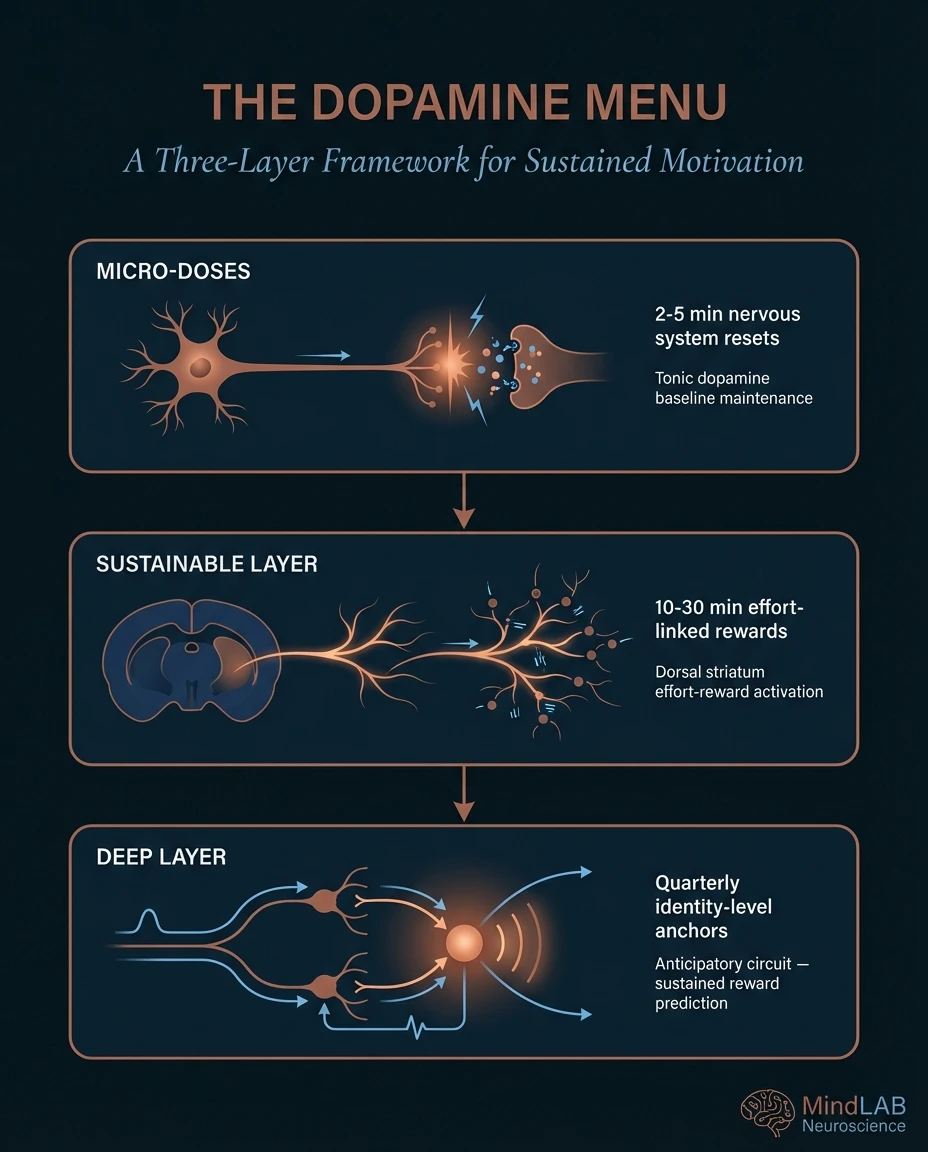
| Clinical Framework | In The Dopamine Code | Duration | Purpose |
|---|---|---|---|
| Micro-Doses | Restorative Desserts | 2–5 min | Nervous system reset |
| Sustainable Layer | Main Courses | 10–30 min | Effort-linked capacity building |
| Deep Layer | Side Dishes | Variable | Identity-level motivation |
The clinical terms reflect how I apply this framework in practice. The Dopamine Code uses the menu metaphor for accessibility — the architecture is identical.
Why Your Brain Needs a Dopamine Menu, Not a Fix
The single-intervention model fails because of a principle called the pleasure-pain balance. Every dopamine spike is followed by a compensatory dip below baseline — a neurological opponent process that the brain deploys to maintain homeostasis. Pursue one reward source repeatedly and the dip deepens: you need more of the same stimulus just to reach neutral. This is hedonic adaptation at the circuit level, and it explains why we want what we cannot have — the wanting intensifies precisely as the having delivers less. It is the single biggest reason why a structured dopamine menu outperforms any individual intervention.
Abstinence without reconstruction leaves a vacuum, and vacuums get filled with whatever is most accessible.
This is also why the popular “dopamine detox” model, while useful as a recalibration tool, is insufficient as a standalone strategy. A detox lowers your stimulation threshold — and I do recommend structured versions of it — but it does not rebuild the reward architecture that was eroded in the first place. Abstinence without reconstruction leaves a vacuum, and vacuums get filled with whatever is most accessible, which is usually the same high-stimulation behavior that created the deficit. I explore this dynamic in depth in a neuroscience-based guide to dopamine detox, but the short version is that detox is a reset button, not a blueprint. The dopamine menu is that blueprint.
The Dopamine Menu solves this by distributing reward inputs across multiple circuits with different adaptation rates. Micro-Doses adapt slowly because they target tonic regulation rather than phasic spikes. Sustainable Layer activities resist adaptation because effort-linked dopamine engages learning circuits — your brain recalibrates to the growing skill, not the static reward. And Deep Layer experiences resist adaptation entirely because they are infrequent and involve genuine novelty and meaning, the two variables that keep reward prediction error high (Berridge & Robinson, 2016). Each layer of the dopamine menu targets a different adaptation rate, which is why the framework as a whole resists the tolerance that collapses single-source strategies. A menu diversifies your neurological portfolio the way a financial advisor diversifies investments — no single position can crash your system.
A menu diversifies your neurological portfolio the way a financial advisor diversifies investments — no single position can crash your system.
How to Build Your Dopamine Menu
When I build a dopamine menu with a new client, the construction process begins with an audit, not a brainstorm — and with ensuring the neurochemical foundation is sound, because dopamine-boosting nutrition and brain health form the biochemical floor on which all three layers operate. Before adding anything to the menu, I need to understand what is currently occupying each layer — and where the gaps are. In practice, the audit reveals a consistent pattern: the Micro-Dose layer is either empty (no nervous system resets whatsoever, just grinding through the day) or filled with passive scrolling that masquerades as a break but actually elevates stimulation. The Sustainable Layer is usually dominated by exercise alone, with no other effort-linked reward sources. And the Deep Layer has been abandoned entirely — sacrificed to operational urgency sometime in the person’s late thirties.
For the Micro-Dose layer, I help clients identify two to three nervous system resets that work with their physiology and environment. One executive I worked with replaced her between-meeting phone scrolling with a 90-second bilateral eye movement exercise that supports neuroplastic momentum and brain rewiring. The shift was not dramatic in isolation. But across 50 workdays, she reported that the chronic low-grade depletion she had normalized simply stopped appearing. That is the function of this layer within the dopamine menu: not peak experience, but erosion prevention.
Building the Sustainable Layer requires identifying activities that involve progressive challenge. This is where I differentiate from the generic “do things you enjoy” advice: the activity must involve skill development or effort escalation, because that is what triggers the effort-reward circuit rather than passive consumption reward. One client — a portfolio manager who described himself as incapable of overcoming procrastination on anything not tied to financial return — discovered that thirty minutes of architectural drawing activated an entirely different reward pathway than his work did. The effort was real, the skill acquisition was genuine, and the dopamine signal came from mastery rather than outcome. Within six weeks, he reported that the drawing sessions had eliminated his afternoon motivation collapse, a problem he had been trying to solve with caffeine and deadline pressure for a decade.
Another client — a mother of three who had spent a decade building a household that functioned like a well-run organization — had the opposite problem. Her Sustainable Layer was full of effort, but none of it registered as reward. She had optimized meal planning, school logistics, and family finances into a system so efficient that nothing required the kind of novel challenge that generates earned dopamine. I helped her identify a Sustainable Layer activity completely disconnected from her caretaking identity: learning to sail. The progressive skill acquisition — the genuine difficulty of it — reactivated a reward pathway that years of competent management had quietly shut down. This is how the Sustainable Layer of a well-constructed dopamine menu transforms effort from obligation into fuel.
The Deep Layer requires calendar architecture, not willpower. I ask clients to identify one high-meaning commitment per quarter and anchor it with non-negotiable dates, resources, and accountability structures. This layer connects directly to the neuroscience of happiness — research consistently shows that anticipation of meaningful events generates more sustained dopaminergic activity than the events themselves. A client who schedules a wilderness expedition for September begins deriving motivational benefit in June. That anticipatory signal — the brain modeling a future self navigating difficulty and achieving mastery — maintains reward prediction error without requiring constant novel stimulation. This is the architecture behind building a dopamine menu for sustained happiness: structuring your reward inputs so they compound rather than collapse.

The Dopamine Menu in Practice
When a client comes in describing what I call motivation collapse — the state where nothing feels compelling despite objectively having resources, freedom, and capability — the dopamine menu is the framework I reach for. The pattern is remarkably consistent across demographics. A founder post-exit who cannot start the next thing. A senior partner who keeps performing but feels nothing. A parent who has optimized every system and feels emptier for it. In every case, the reward architecture has collapsed to a single layer or a single source, and the opponent-process deficit has made baseline existence feel flat.
I also apply the dopamine menu framework with clients navigating dopamine dysregulation in relationship contexts, where novelty-seeking behaviors have hijacked the reward system away from sustainable bonding circuits. And with clients in burnout recovery, where the Deep Layer has been so thoroughly sacrificed to performance that the brain’s anticipatory circuits have essentially gone dormant — there is nothing on the horizon worth modeling, so motivational drive collapses. In these contexts, rebuilding the dopamine menu is not a productivity optimization. It is a neurological intervention that restores the brain’s capacity to generate wanting, the drive state that precedes every meaningful action.
One thing I emphasize with every client: the dopamine menu is not a static document. Neuroplasticity means the architecture that works in January will need recalibration by April. The Micro-Doses that reset your nervous system today will lose their pattern-interrupt quality as your brain adapts. The Sustainable Layer activities that generate earned dopamine now will eventually become routine — and routine does not trigger the effort-reward circuit. I build a 90-day rebuild cycle into every client’s dopamine menu, where we reassess each layer and swap activities that have gone stale for new ones that restore the novelty and challenge signals. The framework is designed to evolve because your brain evolves. That is the architecture working as intended.
Rebuilding the dopamine menu is not a productivity optimization. It is a neurological intervention that restores the brain’s capacity to generate wanting.
Frequently Asked Questions
What are dopamine menus?
A dopamine menu is a structured framework that organizes your reward-producing activities into distinct categories based on the neurological circuits they activate. The concept gained popularity on social media as a list of pleasant activities sorted by effort level — and that version is a fine starting point. The clinical dopamine menu I developed goes further: it maps three layers of your reward architecture (Micro-Doses, the Sustainable Layer, and the Deep Layer), each targeting different dopamine pathways with different adaptation rates. The result is a personalized system that sustains motivation over months, not a brainstorm exercise that loses potency in weeks. I cover the complete construction process in The Dopamine Code.
What boosts dopamine immediately?
The fastest evidence-based dopamine interventions are what I classify as Micro-Doses in the dopamine menu framework: cold-water exposure (even a 30-second hand immersion activates norepinephrine co-release), deliberate breathing patterns that shift autonomic tone, and specific visual focus shifts from near to far field that reset attentional circuits. These are not hacks — they are targeted neural pattern interrupts that recalibrate your tonic dopamine baseline within minutes. The critical distinction is that these immediate boosts should maintain your baseline rather than spike it. Activities that spike dopamine rapidly — social media, sugar, gambling — produce a compensatory dip that leaves you below where you started.
What is the best food to eat for dopamine?
Dopamine is synthesized from the amino acid tyrosine, which your body obtains from protein-rich foods — eggs, fish, poultry, legumes, and dairy are among the most bioavailable sources. However, the relationship between what you eat and how your dopamine system functions is more architectural than transactional. No single food “boosts dopamine” the way a supplement advertisement implies. What matters is consistent intake of tyrosine-rich protein, adequate iron and B-vitamins for the enzymatic conversion process, and — critically — avoiding the blood sugar volatility that disrupts tonic dopamine regulation. Nutrition forms the biochemical floor of the dopamine menu framework; the three layers of your dopamine menu cannot function on a depleted foundation.
What foods can release dopamine?
Foods that support dopamine release include those rich in tyrosine (the dopamine precursor): wild-caught fish, free-range eggs, almonds, avocados, bananas, and fermented foods like kimchi and yogurt that support the gut-brain axis — since roughly 50% of your dopamine is produced in the gastrointestinal tract. Dark chocolate triggers a modest dopamine response through both theobromine and the sensory pleasure pathway. But I caution my clients against treating food as a dopamine lever in isolation. In the context of a dopamine menu, nutrition is the foundation layer — necessary but insufficient. Sustainable motivation comes from the three-layer architecture above that foundation, not from optimizing any single input.
References
Schultz, W. (2015). Neuronal reward and decision signals: From theories to data. Physiological Reviews, 95(3), 853–951. https://doi.org/10.1152/physrev.00023.2014
Berridge, K. C., & Robinson, T. E. (2016). Liking, wanting, and the incentive-sensitization theory of addiction. American Psychologist, 71(8), 670–679. https://doi.org/10.1037/amp0000059
If you recognize yourself in these patterns — the flattened motivation, the single-source reward dependency, the creeping sense that nothing quite lands the way it used to — a strategy call is the next step. I will map your current reward architecture, identify where the gaps and collapses are, and build a personalized Dopamine Menu calibrated to your neurology, your life structure, and the specific outcomes you are working toward.