
Why EQ Leadership Still Matters More Than Ever
If you are a serious leader, you have probably heard the words “EQ leadership” so often that they feel like a slogan. For years, emotional intelligence was the buzzword of every presentation. People linked it to success, better culture, and happier teams. Then the world sped up, markets shifted, and constant crisis became the norm. Many leaders quietly decided that EQ leadership was nice to have, but speed, efficiency, and sharp strategy mattered more.
Yet if you look honestly at the leadership failures around you, you will see a different story. Brilliant people lose talented teams because they cannot stay calm in conflict. Smart executives burn out because they do not know how to downshift their nervous system. Entire organizations stall, not because of bad ideas, but because fear, confusion, and resentment spread through every level. These are EQ leadership problems. They are emotional intelligence problems inside the brain, not intelligence problems on paper. When you grasp how closely emotional intelligence and leadership effectiveness are tied together, you stop viewing EQ as optional and start prioritizing it as core infrastructure.
I have spent more than twenty-five years building MindLAB Neuroscience and working with high performers, founders, and senior leaders. I sit with people who control billions of dollars, manage thousands of employees, or carry visible public roles. They are not asking me how to be nicer. They are asking me how to stay clear and steady when pressure and uncertainty are constant. They want to know how to avoid the blowups, shutdowns, and quiet withdrawals that can wreck trust in a single quarter. What they are really asking for, even if they do not use the words, is true EQ leadership.
The fresh truth is that emotional intelligence is not a personality trait you either have or do not have. It is the output of specific neural networks that can be trained. EQ leadership is what happens when those networks are tuned for connection instead of constant threat. Your nervous system can learn how to move out of survival mode and back into a grounded, connected state where you think and relate at your best. That shift is not mystical. It is built on the science of attention, emotion regulation, and neuroplasticity.
In this article, I will pull EQ leadership out of the shallow self-help pool and place it in the real world of the brain. You will see how emotional intelligence shows up in specific circuits, why your reactions under stress are not personal flaws, and how small, directed practices can change your wiring. You will meet real client stories, with details changed to protect privacy, and you will walk away with a concrete way to practice EQ leadership this month, not someday.
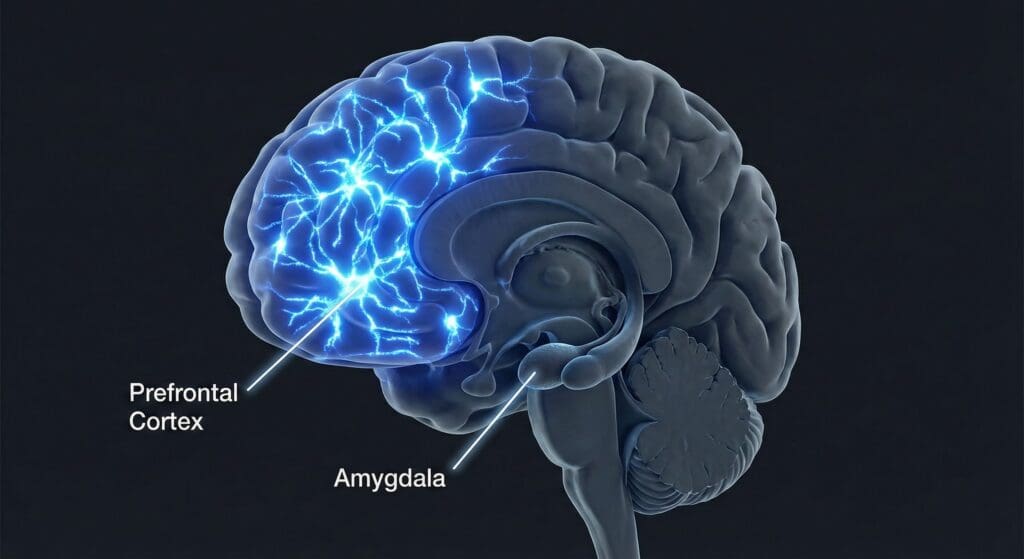
What EQ Leadership Looks Like Inside The Brain
Most articles describe emotional intelligence as self-awareness, empathy, and social skill. Those words are accurate, but they are like chapter titles. They do not show you the machinery underneath. Eq leadership lives in how your brain coordinates three main tasks: sensing threat, regulating your state, and reading other people.
When you understand this, emotional intelligence stops feeling mysterious. You can stop asking yourself, why did I react that way, and you can start asking, which part of my system fired first? That simple shift in language is powerful. It moves you from shame into curiosity. Instead of saying, “I am inadequate at EQ leadership,” you can say, “My threat system is too jumpy,” or, “My regulation system is slow to respond.” Those are specific problems that we can solve.
The first task is threat sensing. Deep in the brain, regions like the amygdala scan for danger at high speed. They search for changes in tone, posture, facial expression, and context. If something feels off, your body shifts before you are aware of it. Your heart rate changes, your muscles brace, and your attention narrows. In a true emergency such clarity is a gift. In a modern workplace, this same system can misread a tough question as a personal attack or a blank face as rejection.
When that happens, EQ leadership drops. Emotional intelligence shrinks down to one thought: protect myself. You talk faster, cut people off, or go silent. You focus on winning the point instead of understanding the room. From a neuroscience perspective, your survival circuits have hijacked your prefrontal cortex, the part of your brain that helps you plan, reflect, and stay flexible.
The second task is regulation. EQ leadership depends on how quickly and reliably your prefrontal cortex can send a different signal back down to your body. When that pathway is strong, it indicates that the impact is intense, but it is not life-threatening. Your breath deepens, your heart rate settles, and the field of attention opens again. That opens the door for real emotional intelligence. You can stay curious, listen to nuances, and choose your words with care.
The third task is social reading. EQ leadership is not only about what happens inside you. It is also about how well your brain maps what is happening inside others. A network of regions in your brain helps you simulate another person’s experience. It pulls together tone, eyes, posture, and context into a quick sense of what they might be feeling. This is the neural basis of empathy. When you are exhausted or stressed, this network goes offline. You literally see less of what is in front of you.
When I coach leaders, I am looking at all three tasks at once. I watch how quickly their body flips into threat, how skillfully they regulate back to center, and how clearly they read other people. Emotional intelligence leadership emerges when the systems of attention, emotion regulation, and neuroplasticity work together. Emotional intelligence is not a soft cloud around your personality. It is a hard skill in how your nervous system processes and responds to the world.

EQ Leadership As Nervous System Mastery
Because I work from a neuroscience frame, I define this form of leadership in a different way. For me, emotional intelligence is nervous system mastery in motion. It is the ability to sense your own state, shift it, and use your regulated presence to shift the room.
The first layer is awareness. You cannot practice EQ leadership if you have no idea what is happening inside you. Many high performers can tell you the status of ten projects, yet they cannot tell you what emotion they are feeling right now beyond “fine” or “stressed.” Their body has been regarded as a machine that carries their brain from meeting to meeting.
In our work together, we slow the process down. I ask basic questions. Where do you feel tension right now? What happens in your chest or jaw when someone challenges you? How does your vision change when you feel blamed? This discussion is not merely for the sake of talking. We are building a live map of your nervous system. EQ leadership starts when you stop viewing your body as a black box and start using it as a real time sensor.
The second layer is regulation. Once you can read your state, you can learn how to shift it. Emotional intelligence is not about never feeling anger, fear, or shame. It is about how quickly you can move through those states without acting them out on other people.
I teach leaders simple, brain-based tools, like slow exhale breathing to tone the vagus nerve, gaze shifts that reset the visual system, and micro movements that release excess adrenaline. When you practice these techniques deliberately, you train your nervous system to recover more quickly after a trigger.
The third layer is impact. EQ leadership is always visible to others. Your team does not live inside your head. They live inside your presence. They feel whether you are actually with them or lost in your story. They feel whether your calm is real or forced. Emotional intelligence is shown in how you enter a room, listen, and fix mistakes.
From a brain perspective, humans are wired to sync up. Your tone, eye contact, and microexpressions act as signals that other nervous systems read quickly. When you have done the inner work of EQ leadership, your regulated state becomes a kind of anchor. People feel less scattered and more clear in your presence. The result is not charm. It is well-trained emotional intelligence at work in the real world.
One of the mistakes I see leaders make is trying to copy someone else’s style. They watch a famous figure and decide that EQ leadership means talking in a certain gentle tone or using a certain posture. The brain sees through that rapidly. If your nervous system is not actually regulated, people will feel the mismatch between your words and your microexpressions. True emotional intelligence is not an act. It is a state of inner alignment, where your words, feelings, and appearance are all in sync. Leading with emotional intelligence means you train your brain to stay curious, grounded, and clear enough that people feel safe bringing you the truth.

Real Stories Of EQ Leadership In Action
To make this shift more tangible, let me share a few clients, with names and details changed. Each individual entered with a unique problem, yet the solution consistently involved emotionally intelligent leadership grounded in neuroscience.
Daniel was a managing partner at a fast-growing firm. He was known as brilliant and demanding. In high stakes meetings, people braced for his reactions. He did not yell, but his face would harden, and his questions would come out like cross-examination. After one tense offsite, a trusted colleague told him, people feel like they are on trial with you. They do not feel led.
When Daniel and I started working together, he explained that he could feel his body surge whenever someone pushed back on his ideas. His chest tightened, his jaw locked, and his mind narrowed down to proving his point. There was no space left for emotional intelligence. His nervous system was in full defense mode, making EQ leadership unfeasible.
We began with awareness drills. Before every key meeting, he would sit for ninety seconds, notice his breath, name his baseline state, and choose one word for how he wanted to show up, such as “steady,” “curious,” or “clear.” During meetings, he practiced feeling his chest and jaw when he felt challenged, then using one slow exhale to interrupt the surge. At first it felt forced.
Over time, it became automatic. His team noticed that even when he disagreed, his face stayed open and his tone stayed calm. This shift was a result of emotional intelligence in leadership, rather than following a script; it stemmed from a nervous system that was attuned to remain out of threat mode.
Another client, Maya, ran operations for a global company. She was deeply caring in private, yet in rooms she often seemed rushed and unavailable. People described her as all business. She hated hearing that because she actually felt a lot. Her emotional intelligence was high on the inside, but almost none of it reached the surface.
With Maya, EQ leadership work meant slowing down enough for her inner world to have a voice in the room. We practiced a simple habit. At the start of her weekly team meeting, she would take twenty extra seconds to connect. Sometimes, she would name the obvious mood in the room by saying, “It feels like we are all carrying a lot this week.” At other times, she would share one honest sentence about her own state, saying, “I am excited about this project but also nervous about the timeline.”
These are small, concrete moves, but they send powerful signals to other nervous systems. Her team began to open up, ask better questions, and bring issues forward sooner. EQ leadership in this case was not a grand gesture. It was emotional intelligence expressed in short, real sentences that made the room feel safer.
Then there was Leo, a founder whose vision and energy had carried his company through rapid growth. The company needed more structure and more senior hires as it scaled. Leo knew this, yet he kept undermining the very people he had hired. He would jump into conversations his leaders were already handling or change direction in the middle of a rollout. People felt whiplash.
In our sessions, it became clear that his nervous system tied control to safety. Letting others lead triggered a subtle threat response. For Leo, EQ leadership involved rewiring the connection between emotional intelligence and effective leadership. We did this by creating controlled experiments. In one standing meeting with his senior team, he agreed to speak only after two other people had weighed in. He had to notice his urge to jump, feel it, and let it pass. The first few times felt almost unbearable.
Over several months, his nervous system learned that nothing terrible happened when he held back. In fact, the quality of ideas improved. Emotional intelligence for him looked like trusting that shared leadership could be safe and even beneficial.
These stories all show the same pattern. Such leadership is not an abstract quality. It is built through repeated experiences where your brain learns that presence, curiosity, and collaboration are safe, even when stakes are high. When you practice in real situations, your emotional intelligence becomes a default habit, not a special performance. EQ leadership becomes part of how you move, speak, and decide, not a technique you have to remember.

A Brain-Based Framework For Practicing EQ Leadership
To make EQ leadership practical, I often teach a simple three-step framework: notice, name, and navigate. It fits the way the nervous system works, and it turns emotional intelligence into a clear behavior pattern.
Notice is the first step. You train yourself to catch your internal state as early as possible. Before an important call, you might pause for thirty seconds and scan from head to toe. You pay attention to breath, muscle tone, and the speed of your thoughts. You are not judging your state; you are gathering data. EQ leadership begins with this quiet honesty: “I am more anxious than I want to be,” or “I feel flat and dull today.”
Name is the next step. You put simple, accurate words on what you find. My chest feels constricted, my thoughts are racing, and I am prepared for a confrontation. Or, my energy is low and I want to withdraw. When you name a state with clear language, you activate the prefrontal cortex and reduce the raw grip of the emotion. Emotional intelligence grows when you can say, “Here is my state right now,” without collapsing into shame or denial.
Navigate is the action step. Based on what you noticed and named, you choose how to move. If you are wired and aggressive, navigating might mean one minute of slow breathing before you enter the room, plus a decision to ask one curious question before you make any statements. If you feel flat, navigating might mean sharing that you are low on energy but still committed to the conversation, so others do not misread your quiet tone as disapproval.
The power of this framework is its repeatability. This kind of leadership does not depend on perfect conditions. It relies on hundreds of small cycles of noticing, naming, and navigating through various days and situations. Over time, these cycles lay down new pathways in your brain. Your default response shifts to, “I feel triggered; let me ground myself before I respond.” That is emotional intelligence in action. You can rely on EQ leadership, rather than letting it fluctuate based on your mood.

Daily Practices To Strengthen Your EQ Leadership
People often ask me, “How much time do I need to invest each day in growing my emotional intelligence as a leader?” They imagine long routines that they do not have time for. The reality is that small, well-targeted practices can have a large impact, because they teach your brain new patterns right where life happens.
One simple practice is a ninety-second morning check-in. Before you pick up your phone, you sit on the edge of your bed or at your desk, feel your feet on the floor, and ask, where is my nervous system right now?. You do not try to fix anything. You just notice and name your state. Over days and weeks, the process builds a strong baseline of self-awareness. Emotional intelligence becomes less of a mystery because you are in the habit of meeting yourself honestly at the start of the day.
Another practice is a short reset between meetings. Instead of rushing from one call to the next, you close your eyes for three breaths, let your shoulders drop, and ask, “What kind of presence do I want to bring into the next room?” You might choose grounded, open, or decisive. Setting this intention sends a clear signal through your brain. EQ leadership is not only about reacting well when something goes wrong. It is about proactively shaping your state before you influence others.
You can also build emotional intelligence through deliberate reflection at the end of the day. Pick one interaction that went well and one that did not. For each, ask yourself, what state was I in, what state were they in, and how did I navigate? This is not about blame. It is about mapping how EQ leadership shows up in real time. As you do this regularly, patterns emerge. You may notice that conflict with peers is harder than conflict with direct reports, or that late afternoon meetings pull more reactivity from you than morning sessions. With those insights, you can start to design around your brain instead of fighting it.
If you lead a team, you can even make emotional intelligence a shared language. You can normalize brief state checks without making your meetings feel like group therapy. For example, you might open a tense discussion by saying, “This topic matters, and I notice I feel a bit on edge. I want us all to stay curious.” When leaders model this kind of simple emotional intelligence, it gives others permission to be honest about their state. That honesty reduces hidden tension and increases psychological safety.
You can even weave these ideas into your performance conversations. Instead of moving straight into targets, you might start with a brief reflection on how the last cycle felt for both of you. You are not turning the meeting into therapy; you are bringing EQ leadership into a space that is often stiff and guarded. When people feel seen as human beings first, they are more willing to hear the numbers and the feedback that follow.
The Business Case For EQ Leadership
Some leaders worry that focusing on emotional intelligence will make them soft or less focused on results. They imagine long, vague conversations that drift away from hard decisions. Neuroscience points the other way. EQ leadership supports clear thinking, better risk assessment, and more stable execution.
When your nervous system is stuck in survival mode, your brain tends to see extremes. A project is either a total success or a complete disaster. A person is either for you or against you. Emotional intelligence allows for nuance. It keeps more of your prefrontal cortex online, so you can see trade-offs, mixed motives, and partial wins. This kind of thinking is vital in complex markets and high-stakes deals.
EQ leadership also builds trust faster than any motivational speech. When people experience you as steady, fair, and honest about your own state, their nervous systems relax around you. They bring you problems sooner. They take more ownership. They do not waste energy guessing which version of you will show up today. That freed-up energy goes back into the work.
There is also a direct link between emotional intelligence and creativity. The brain needs a certain level of safety to take risks, suggest new ideas, or admit uncertainty. Leaders who practice EQ leadership create that safety through how they respond to negative news and dissent. When people see that you can hear hard truths without attacking or shutting down, they are far more likely to tell you what you truly need to know.
In my work with high-stakes leaders, I have watched revenue, retention, and innovation improve as a side effect of better emotional intelligence in leadership. These gains did not come from a new strategy deck. They came from nervous systems that were less flooded and more connected. Emotional intelligence is not a soft add-on. It is one of the most practical forms of risk management you have.
There is also a long-term retention effect that is easy to overlook. People remember how you made them feel in high-pressure moments. Years later, they can still recall whether you dismissed them during a crisis or whether you slowed down, listened, and stood with them. EQ leadership creates those memories on purpose. When your emotional intelligence is strong, people feel safe growing their careers with you instead of looking for the first exit.

The Future Of EQ Leadership And Your Next Step
We are moving into a world where data, automation, and technical skill are becoming baseline. What will set leaders apart is not what they know, but how they show up under pressure. EQ leadership is the difference between a mind that collapses into panic or rigidity and a mind that stays flexible, present, and creative.
The future of emotional intelligence in leadership is deeply tied to neuroscience. Understanding the brain’s processing of threat, reward, and connection can enhance our ability to train EQ leadership. We can stop giving vague advice and start offering concrete, brain-based practices that any motivated leader can use.
My work at MindLAB Neuroscience centers on this intersection. For more than two decades, I have helped leaders upgrade their inner hardware, using the science of neuroplasticity, dopamine, and nervous system regulation. Time and time again, I watch the same pattern. As EQ leadership grows, influence deepens. Teams feel safer. Decisions improve. People describe the leader not only as smart but also as someone whose presence makes them think and feel at their best.
If you see yourself in any of these stories, the next step is not to judge where you are. It is to get curious. Where does EQ leadership already show up in your life? Where does it vanish? What situations pull you into fight, flight, or freeze? What would it look like to bring even five percent more emotional intelligence into one key relationship or recurring meeting?
You do not need to overhaul your entire style at once. Choose one simple practice from this article, maybe the morning check-in, the three-breath reset, or the end-of-day reflection. Commit to it for the next month. Consider each repetition as a small signal to your brain that EQ leadership matters to you.
Over time, those small signals add up. Your nervous system learns that stability is possible even in fast-moving, high-pressure environments. Emotional intelligence stops being a concept and starts being your default way of leading. That is the real promise of EQ leadership—not perfection, but a steady, grounded presence that changes how you and the people around you move through the world.
#eqleadership #emotionalintelligence #neuroscience #leadership #executivecoaching #mindlabneuroscience
This article is part of our Emotional Intelligence Mastery collection. Explore the full series for deeper insights into emotional intelligence mastery.