Key Takeaways
- In animal studies, chronic stress makes amygdala neurons branch out and fire more readily
- In the prefrontal-amygdala circuit, excessive cortisol-amplified catecholamine signaling suppresses prefrontal control and heightens amygdala reactivity
- Safe exposure builds fear extinction: prefrontal cortex can override amygdala associations, memory intact, regulation strengthened
- In one study, people kept awake all night showed about 60 percent more amygdala reactivity
- Progress shows in the body too: calmer startle, less muscle tension, better sleep
That knot in your stomach before a difficult conversation, the cascade of worst-case scenarios at 3 AM, the disproportionate reaction to a neutral email: these are not character flaws. They are the output of a threat-detection system running at a gain setting calibrated for environments you no longer inhabit.
In animal studies, chronic stress grows the branches of amygdala neurons and makes the amygdala more reactive. The amygdala responds to psychological pressure with much of the same threat response it mounts against physical danger: the circuitry overlaps, and so do many of the stress chemicals that follow. Professionals under sustained cognitive and social stress can spend much of the day with their stress response switched on, and over time that has measurable effects on the brain.
Dr. Sydney Ceruto has worked with individuals whose amygdalae had become severely dysregulated across more than 26 years of practice. What she has observed is that amygdala regulation is not achieved through willpower, generic relaxation techniques, or a single modality. It is achieved through a systematic approach that targets the specific neurochemical pathways governing threat-response calibration, an approach grounded in how the nine signs your nervous system is dysregulated actually function, not how popular wellness content imagines they do. This is the foundation of the broader work of stress and nervous system regulation.
A meta-analysis of 15 brain imaging studies found that when people try to regulate an emotion, the amygdala works in step with prefrontal regions. Related reading: the Stress, Resilience & Regulation pillar overview.
In one small study of an eight-week mindfulness course, the participants whose stress fell most showed the largest decreases in amygdala gray matter density. A later randomized trial of 218 people found no structural brain change from the course compared with control groups, apart from an amygdala volume reduction among those who practiced the most. For how threat responses can turn inward, see the evolutionary neuroscience of self-hatred.
Why Does the Amygdala Get Stuck in Overdrive?
One likely reason is sensitization: repeated stress can leave the threat response easier to set off. In rats, J. Amiel Rosenkranz and colleagues at Rosalind Franklin University found that chronic stress makes amygdala neurons more excitable and increases the excitatory input they receive.
The mechanism is self-reinforcing. Stress makes the amygdala more reactive. Increased reactivity generates more stress responses. More stress responses further sensitize the system. Over time, this creates a baseline shift: the person is not experiencing discrete anxiety episodes. They are living in a sustained state of partial threat activation that has become their neurological normal. They have often lost the reference point for what a regulated nervous system feels like. For a deeper look, see the neuroscience hacks for public speaking anxiety.
Trauma compounds sensitization significantly. When someone experiences a traumatic event, the amygdala essentially encodes a rule that the world is dangerous. Research by Gregory Quirk, mostly in rats, shows that fear associations survive extinction and can return, with the amygdala a key site of that memory. The brain, designed to prevent future harm, begins scanning more aggressively for signs of threat. This hypervigilance would have helped ancestors in dangerous environments. In safe modern contexts, it becomes a source of suffering rather than protection. For the mechanism behind this, see the neuroscience of examples of overgeneralization.
The encouraging reality is that neuroplasticity works in both directions. In a 2012 review of fear extinction, Mohammed Milad described how the prefrontal cortex can override amygdala-stored threat associations. Repeated safe exposure creates a new inhibitory memory, supported by the ventromedial prefrontal cortex, that suppresses the original fear rather than erasing it. The amygdala retains the threat memory, but the prefrontal cortex learns to regulate the response. This is why regulation is the accurate term rather than elimination. The goal is not to silence the amygdala. It is to restore the prefrontal-amygdala relationship that allows threat signals to be evaluated rather than automatically executed.
The Prefrontal-Amygdala Circuit: Where Regulation Actually Happens
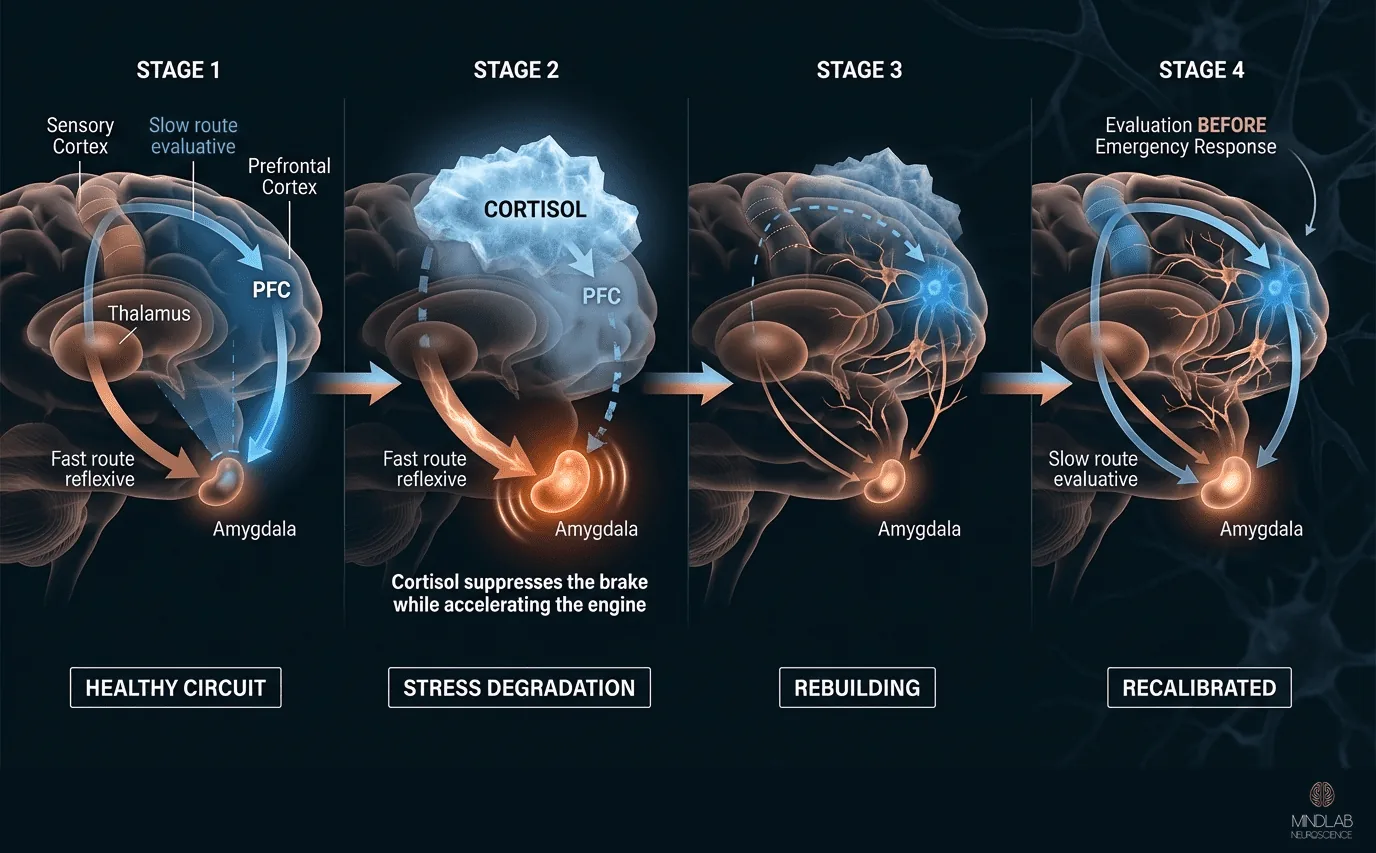
Understanding amygdala regulation requires understanding the circuit architecture. Research in animals, mostly rats, describes two routes by which sensory information reaches the amygdala. One is a quick, crude route straight from the thalamus, and the other runs more slowly through the sensory cortex, carrying a more detailed picture. The quick route can start a defensive reaction early, while the slower one allows a fuller evaluation. Reinterpreting a trigger is what cognitive reappraisal trains the prefrontal cortex to do, and it can reduce the amygdala’s response.
In a well-regulated nervous system, the prefrontal cortex helps keep the amygdala’s reaction in proportion. The prefrontal cortex (particularly the ventromedial prefrontal cortex and the anterior cingulate cortex) evaluates the threat signal and either permits or inhibits the amygdala’s response based on contextual assessment. Research by Ahmad Hariri has linked individual differences in amygdala function and in the prefrontal cortex and amygdala connection to traits such as anxiety.
In chronic stress, this circuit degrades. Excessive catecholamine signaling, amplified by cortisol elevation, suppresses prefrontal function while simultaneously potentiating amygdala reactivity, creating a double disadvantage. The braking system weakens while the engine accelerates. The observed result is what clients describe as feeling like their emotional responses have a mind of their own: the prefrontal evaluation step is being bypassed not because they lack the cognitive capacity for it, but because the circuit conditions favor the fast pathway over the slow one.
Much of amygdala regulation comes down to strengthening this prefrontal control. Many effective interventions, whether breath work, exposure, movement, or changes to your environment, seem to work by supporting prefrontal control over the threat response, by reducing the conditions that weaken it, or both.
If this circuit description matches your experience (the feeling that your emotional responses have a mind of their own, that the braking system weakens precisely when you need it most), the pattern can often change. In a strategy call, Dr. Sydney Ceruto looks at your pattern of dysregulation and identifies which intervention pathway is most likely to help.
| Pathway | Mechanism | Timeframe to Effect | Sustainability |
|---|---|---|---|
| Social connection | Social buffering of stress (oxytocin’s amygdala effect varies by sex) | Immediate, within minutes | Requires ongoing social engagement |
| Controlled sympathetic activation | Stress inoculation: manageable doses of stress may build tolerance for more | Weeks of consistent practice | Can last, with continued practice |
| Environmental stressor reduction | Reduces chronic low-grade stress (sleep loss, notifications, blood sugar swings) | Days to weeks | Holds while it is sustained |
| Neurochemical support (daylight, exercise, yoga) | Supports mood-related brain chemistry such as serotonin and GABA | Weeks of consistent practice | Requires daily maintenance |
| Prefrontal-amygdala regulation training | Strengthens prefrontal regulation of the threat response through practice such as reappraisal and mindfulness | Months of regular practice | Can last, with continued practice |
How Systematic Amygdala Regulation Actually Works
Through professional work with individuals whose amygdalae had become severely dysregulated, Dr. Ceruto developed an approach that targets the multiple pathways governing threat-response calibration simultaneously rather than relying on any single intervention. The amygdala does not operate in isolation: it sits within a web of social, autonomic, environmental, and neurochemical systems, and lasting regulation often involves several of them. She organizes that work through her PACE Protocol™, a phased framework that calibrates the threat response across each of those pathways rather than leaning on one technique.
Social connection is an easily overlooked pathway. Oxytocin is often credited here, but its effect on the amygdala depends on sex. Research co-authored by Markus Heinrichs of the University of Freiburg found that intranasal oxytocin reduces amygdala activation to threatening and other emotional faces in men, and his group found the effect reverses in women. Support from people you trust also buffers stress, through touch, shared activities, and honest conversation. For people living in sustained isolation (whether geographic, emotional, or the particular loneliness of high-pressure roles), that buffer is missing.
What seems counterintuitive is that controlled activation of the sympathetic nervous system can be a path to calm. When you engage your stress response through cold exposure, high-intensity movement, or structured breathwork, you can help train the nervous system to move between activation and recovery rather than staying locked in chronic activation. The idea behind stress inoculation is that repeated, manageable doses of stress teach you, body and brain, that activation passes, which can make unexpected stressors feel less alarming. This is fundamentally different from avoidance-based approaches that teach the nervous system to fear its own activation. The underlying research is covered in the neural patterns behind fear of public speaking.
Reducing the chronic low-grade stressors that keep the stress response running also helps. Constant digital notifications, disrupted sleep, unstable blood sugar, and sustained noise can all add to background stress that keeps the threat response on a hair trigger. In a 2007 study co-authored by Matthew Walker of the University of California, Berkeley, people kept awake for a night showed about 60 percent more amygdala reactivity to negative pictures than rested people. The study also found weaker links between the amygdala and the medial prefrontal cortex. It has not been repeated with the same design. Across 64 studies, though, losing sleep reliably worsens mood, so protecting sleep is a sensible place to start.
The neurochemical dimension ties these pathways together. Several brain chemicals are involved, including GABA (the brain’s primary inhibitory neurotransmitter), serotonin, oxytocin, and endorphins. Most of the research in the section that follows measures mood, stress, or brain chemistry in general rather than amygdala activity directly. What professional practice consistently demonstrates is that the key principle is consistency rather than intensity: the nervous system recalibrates through sustained signal, not dramatic single interventions.
The Neurochemistry of Calm: Four Systems That Govern Amygdala Activity
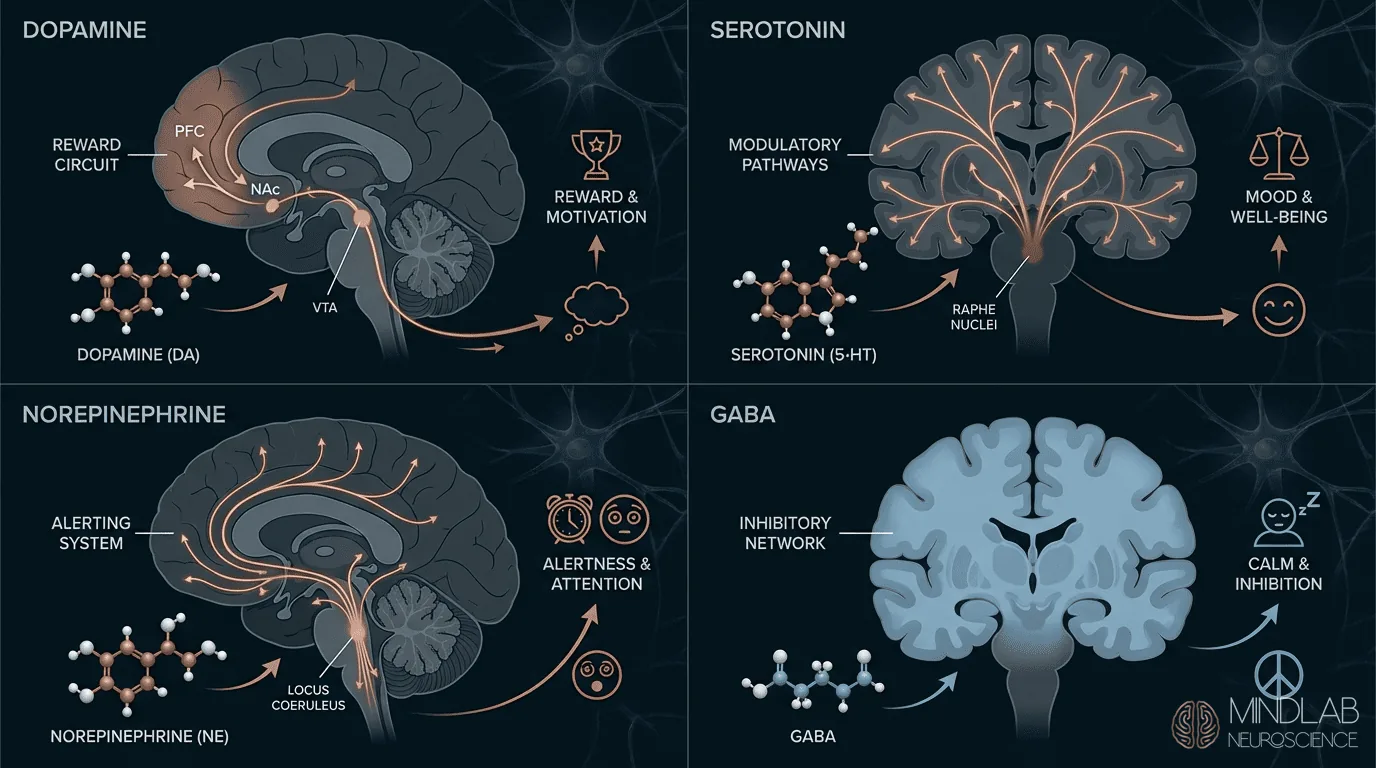
GABA is the brain’s main inhibitory neurotransmitter. In one small study of healthy adults, the threat of an electric shock lowered GABA in the prefrontal cortex by about 18 percent. Hour-long yoga sessions raised brain GABA in small studies, by 27 percent in one.
Serotonin modulates how the amygdala processes emotional information. Daylight appears to matter: in a study of 101 healthy men, brain serotonin turnover was lowest in winter and rose with hours of bright sunlight on the day it was measured.
Oxytocin’s effect on amygdala reactivity depends on sex: in brain imaging studies it tends to damp the response in men and raise it in women. What holds more consistently is the value of the social contact oxytocin is part of, such as affection from trusted people and acts of care, which can buffer stress.
Endorphins and the body’s other opioids can ease anxiety, but they are not the whole story. In one study of 63 people, the calm and good mood after a run still appeared when opioid receptors were blocked, while endocannabinoids rose. Enjoyable movement, laughter, and creative activities can still lift your mood.
Measuring Progress: How Regulation Shows Up Before You Feel Different
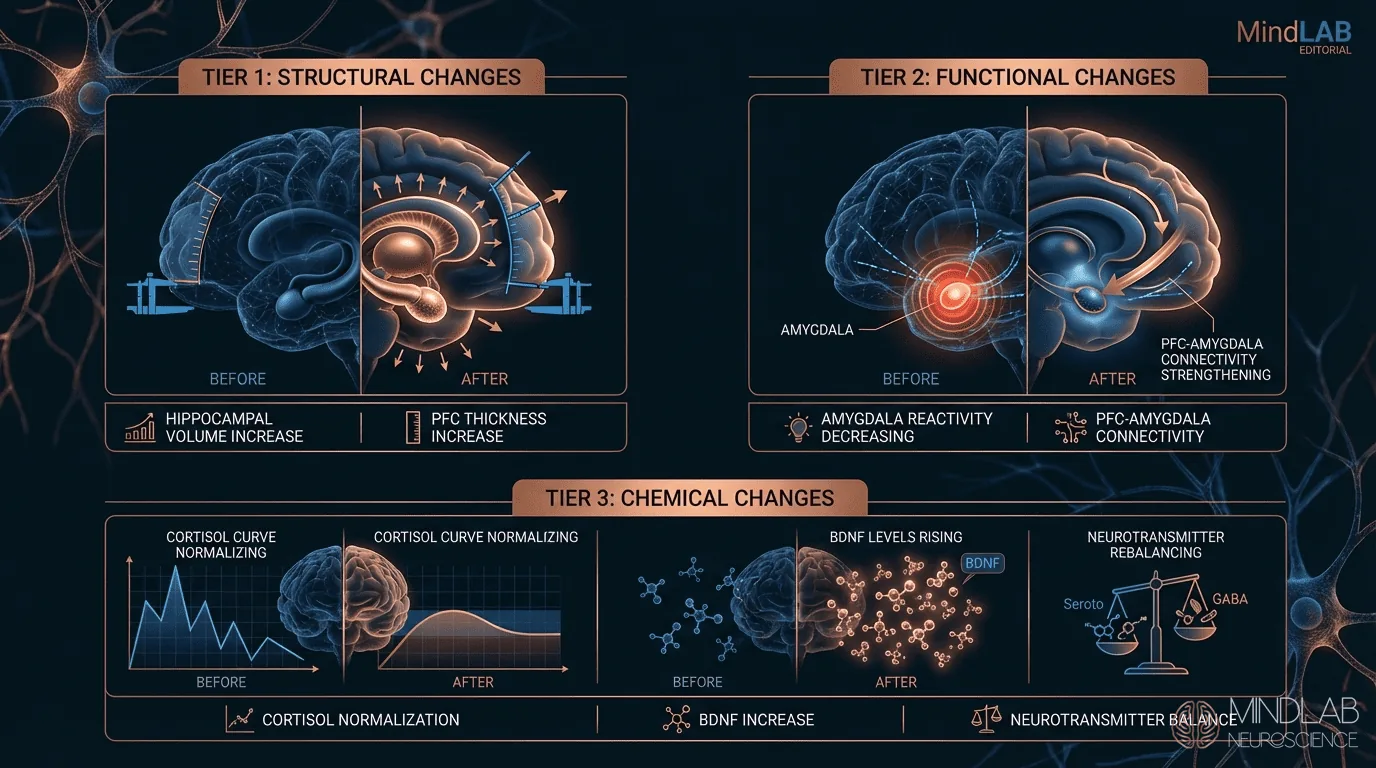
Progress in regulation often shows up in the body as well as in mood. A startle response that matches the actual surprise, rather than a perceived threat, is one sign. Another is chronic muscle bracing, such as jaw clenching and raised shoulders, easing without effort as your baseline level of arousal comes down.
Sleep is another useful indicator. When the threat response stays on alert, falling asleep can be hard, and people often wake during the night with racing thoughts. As regulation improves, sleep usually comes more easily and feels more restful.
Cognitive and emotional shifts show up too. Emotional recovery time shortens. Previously, minor setbacks might have created hours of rumination. Social invitations feel appealing rather than threatening. Risk assessment becomes proportional rather than catastrophic. These are not forced changes. They are the natural state of a nervous system that has been restored to appropriate calibration.
“Your amygdala is not broken. It is calibrated for an environment you no longer inhabit. Regulation is not about silencing the alarm. It is about restoring the circuit that decides whether the alarm is warranted.”
– Dr. Sydney Ceruto
Regulation Is Not a Technique: It Is an Architecture That Can Be Built
Individual techniques like breathing exercises can ease momentary distress, and lasting regulation takes sustained practice. In a randomized trial, eight weeks of mindfulness training increased functional connectivity between the amygdala and the ventromedial prefrontal cortex during emotional pictures, compared with an active control.
Dr. Ceruto works with individuals whose nervous systems have been running at emergency calibration for months or years. In a strategy call, she looks at the pattern of your threat response: how easily it is triggered, what helps you recover, and the environmental and lifestyle factors keeping it on alert. That conversation helps clarify whether the starting point is strengthening regulation skills, reducing chronic stressors, retraining the stress response through controlled activation, or a coordinated approach across all three.
This is a standalone conversation, not a program pitch, not a relaxation technique. It is one focused hour on what your threat response is reacting to, why it stays on alert, and what would help regulation become your default state.
Schedule a strategy call with Dr. Ceruto
How long does it take to calm an overactive amygdala?
There is no fixed timeline for calming an overactive amygdala. Changes such as better sleep and less muscle tension can show up within weeks of consistent practice. More lasting change in how the threat response behaves usually takes months of regular practice.
Can an overactive amygdala be durably recalibrated?
The amygdala can be recalibrated through neuroplasticity, but it remains designed to detect and respond to genuine threats. The goal is not to eliminate amygdala function but to restore appropriate sensitivity, responding to actual danger rather than perceived threats. With consistent practice, recalibrated sensitivity can become the new baseline.
Why does anxiety sometimes get worse when starting regulation practices?
Anxiety can rise at first because some people react to relaxation-based practices with a paradoxical increase, an effect researchers have studied since the early 1980s as relaxation-induced anxiety. If anxiety keeps climbing, it is worth trying a different approach with a professional’s help.
Is amygdala regulation the same as anxiety management?
Anxiety management typically refers to coping strategies applied to anxiety responses. Amygdala regulation addresses how readily the threat response is set off in the first place. The distinction is between managing output (stress responses) and restructuring the system that produces the output (threat-detection sensitivity).
Can medications help with amygdala regulation?
Anti-anxiety medications can complement regulation practices by reducing baseline activation levels, making it easier to engage in the sustained practice that regulation takes. Combining the two is common and can work well. Medication can ease symptoms while regulation practices build skills you keep using over time. Consult a prescribing physician about integration.
What role does exercise play in calming the amygdala?
Exercise can ease anxiety within a single session, and it gives the nervous system regular practice at recovering from activation. On average, a workout also raises blood levels of BDNF, a protein that supports neural plasticity, by a moderate amount. The idea behind stress inoculation is that repeatedly moving from activation back to baseline helps the nervous system handle unexpected stressors.
References
- Berboth S, Morawetz C (2021). Amygdala-prefrontal connectivity during emotion regulation: A meta-analysis of psychophysiological interactions. Neuropsychologia.
- Kral TRA, Schuyler BS, Mumford JA, et al. (2018). Impact of short- and long-term mindfulness training on amygdala reactivity to emotional stimuli. NeuroImage.
- Brooks SJ, Stein DJ (2015). A systematic review of the neural bases of psychotherapy for anxiety and related disorders. Dialogues in Clinical Neuroscience.
- Milad, M. R., & Quirk, G. J. (2012). Fear extinction as a model for translational neuroscience: Ten years of progress. Annual Review of Psychology, 63, 129-151. https://doi.org/10.1146/annurev.psych.121208.131631
- Hariri, A. R., & Whalen, P. J. (2011). The amygdala: Inside and out. F1000 Biology Reports, 3, 2. https://doi.org/10.3410/B3-2
- Heinrichs, M., von Dawans, B., & Domes, G. (2009). Oxytocin, vasopressin, and human social behavior. Frontiers in Neuroendocrinology, 30(4), 548-557. https://doi.org/10.1016/j.yfrne.2009.05.005
From Reading to Rewiring
These questions address the most common concerns about calming amygdala activity based on current neuroscience research. Each answer focuses on the threat response behind emotional reactivity and on what evidence-based approaches can help calm it in everyday stress and high-arousal moments. Related reading: the brain science of AI and cognitive enhancement.
Schedule Your Strategy Call