Dear reader,
You did the thing.
You hit the goal. You closed the deal. You shipped the project. You walked off the stage. You got the praise. You got the number. You got the title.
And then the room got quiet.
Impostor feelings love the pause after praise because it is the first moment your brain has time to doubt.
No pings. No fires. No one needing you. There is no next task demanding your attention.
That is when the weird part starts.
During this time, feelings of impostor syndrome often become more pronounced.
Some people call this imposter syndrome, but what you are feeling is a nervous-system alarm, not a lack of talent.
Your body should feel relief, but it does not.
Instead, your chest tightens. Your mind starts scanning. A small voice appears and says, “You fooled them.” You got lucky. Any minute now, they will see the truth.
If that is you, I want you to hear this clearly.
Impostor feelings do not mean you are a fraud.
They mean your nervous system does not feel safe in stillness.
If impostor feelings spike in calm moments, that is not proof you are failing; it is proof your nervous system is still bracing.
When life is loud, your brain stays busy solving problems. When life becomes quiet, your brain finally has space to look inward, and it does not always like what it finds. It pulls up old fears. It reviews old mistakes. It replays old moments. It asks old questions.
Am I enough?
What if I cannot do it again?
What if they find out I am not who they think I am?
This is not a character flaw. This is a brain pattern.
If impostor feelings are visiting you, that does not make you weak. It makes you human.
And patterns can change.
What impostor feelings actually feel like
Most people think impostor feelings are just a thought, like a belief in your head.
But for many high performers, impostor feelings show up first in the body.
You feel it in the stomach, like a drop.
You feel it in the throat, like a clamp.
You feel it in the chest, like pressure.
You feel it in the jaw, like tension.
You feel it in the breath, like you cannot fully exhale.
Then your mind tries to explain that body signal. This is why feelings of impostor syndrome can manifest as physical sensations.
Your brain hates not knowing why you feel something. So it tells a story. Impostor feelings often show up as a sense of urgency, as if you have to do something right now to earn your place again.
The story might sound like this:
I do not deserve this.
I am not as smart as they think.
They will replace me.
I am one mistake away from being exposed.
If you have these thoughts, you probably need a better mindset.
But here is the neuroscience truth.
When your threat system is active, your thinking brain becomes a lawyer for fear. It builds a case. It finds evidence. It edits the past. It predicts the future.
You are not weak. You are not broken.
Your brain is doing its job, just with the wrong setting.

Why success does not resolve impostor feelings
This is the part that confuses people.
If impostor feelings were about skill, they would disappear after success.
But many of the most capable people I meet are the ones who feel this most.
Why?
Because high performers are trained to use performance as a safety signal.
They learned, often early, that being impressive keeps them protected.
Protected from criticism.
Protected from rejection.
Protected from being ignored.
Protected from shame.
Therefore, the brain associates a person’s worth with their output.
When you are producing, you feel a kind of safety.
When you are resting, your brain loses that safety signal.
That is why feelings of impostor syndrome often intensify in quiet moments.
Quiet removes the external proof.
The quieter the room, the louder impostor feelings can get, because your brain starts measuring your worth instead of your work.
Your nervous system questions, “If I am not achieving right now, am I still okay?”
In that gap, impostor feelings try to fill the silence.

The part no one sees when you look “confident”
Here is the piece most people never say out loud.
Impostor feelings do not only show up when you are failing. They can hit hardest when you are winning.
You smile. You nod. You say thank you. You act normal. Then you get in the car, or you shut the laptop, and your body drops. Your stomach turns. Your mind starts racing.
You start reviewing everything.
Did I talk too much?
Did I sound shaky?
Did they notice that pause?
Was that praise real, or polite?
Impostor feelings are not just “self-doubt.” They are a threat scan. They are your brain looking for the moment you will be judged, rejected, replaced, or embarrassed.
And high performers are very good at hiding that scan.
You hide it with competence.
You hide it with charm.
You hide it with preparation.
You hide it with one more task.
Impostor feelings can even make you feel addicted to being needed.
Because when people need you, your brain relaxes for a second. It says, I matter. I belong. I am safe.
Then the need disappears. The quiet returns. And impostor feelings come back like a bill you forgot you owe.
This is why calm can feel uncomfortable.
Calm gives your nervous system room to feel what it has been holding all day. If your system learned that being “on” is safety, then being “off” can feel dangerous.
Here is what I want you to notice.
Impostor feelings often rise when your brain senses exposure.
Exposure can be public. A bigger role. More visibility. More eyes.
Exposure can also be private. A quiet room. A quiet weekend. A quiet night.
In both cases, your brain asks the same question.
What if they see me?
That question is not always about other people. Sometimes it is about you.
Because quiet is when you can feel your own fear. Quiet is when you can feel your own needs. Quiet is when you can feel your own exhaustion.
And impostor feelings will do anything to keep you from feeling that.
They will push you back into motion.
They will push you back into proving.
They will push you back into “fine.”
If you are reading this and thinking, That is me, I want you to pause.
Not to analyze it. Not to fix it.
Just to name it.
These are impostor feelings.
This is my threat system.
This is my brain using performance as protection.
That naming matters because it is the first crack in the loop.

A client story: “Maya” and the moment the applause ended
I am going to tell you a client story. Details are changed to protect privacy, but the pattern is real.
Maya was highly successful. Senior role. High income. Great reputation. People came to her for answers.
On paper, she was the kind of person others called “confident.”
But after big wins, she would crash.
Not in a dramatic way. More like an invisible collapse.
She would go home, sit on her couch, and suddenly feel empty. Her mind would start replaying the day. “One sentence,” she said. One slide she missed. One question she answered a second too late.
Then the thought would hit.
They are going to realize I am not supposed to be here.
Those were her exact words.
She was not lazy. She was not “too sensitive.” She was not trying to be dramatic.
Her nervous system was stuck in a loop. On her hardest nights, impostor feelings sounded like facts.
In our work, we mapped the pattern.
Trigger: the project ends, the meeting ends, the applause ends, and the urgency ends.
Body: heart faster, breath shallower, shoulders up.
Mind: a flood of doubt, shame, memories, and future fear.
Behavior includes overworking, over-preparing, avoiding rest, scrolling, drinking, numbing feelings, and delaying sleep.
Relief: temporary, then the loop returns.
Maya did not need more facts about impostor syndrome.
She needed her brain to learn a new association with quiet.
She needed quiet to feel safe.
That is the real work.
The neuroscience of why quiet makes impostor feelings louder
Let me simplify what is happening.
Your brain is a prediction machine. All day long, it tries to keep you safe by guessing what comes next.
When life is busy, prediction is easier.
Email comes in, and you answer.
Problem shows up, and you solve it.
Meeting starts, and you perform.
A busy life gives your brain a script.
Quiet life does not.
Quiet is open space. Open space means uncertainty. For many people, uncertainty is the doorway where impostor feelings walk in.
Quiet is open space. Open space means uncertainty. And uncertainty can feel like danger, especially if your system learned that being “ready” is the only way to stay safe.
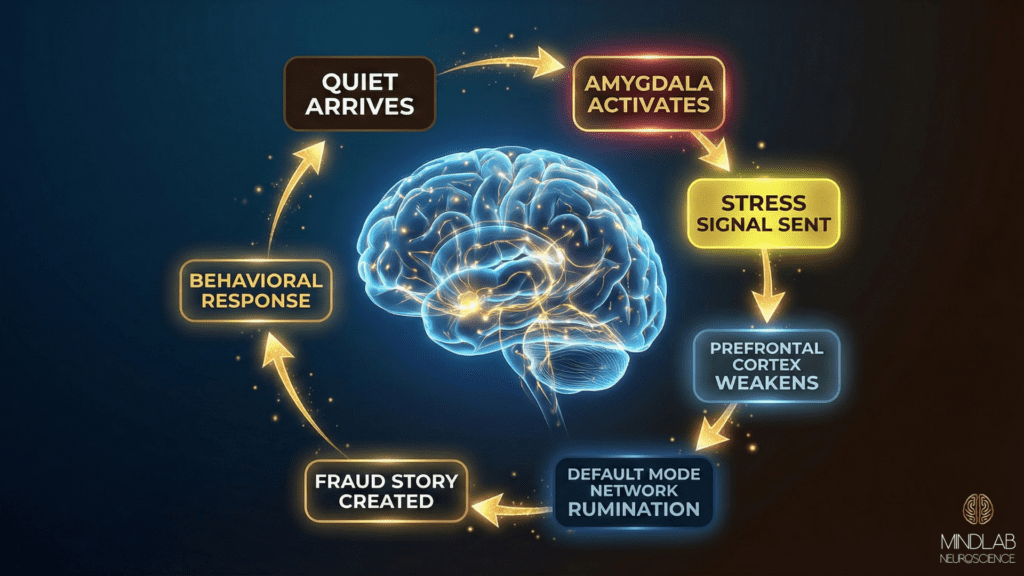
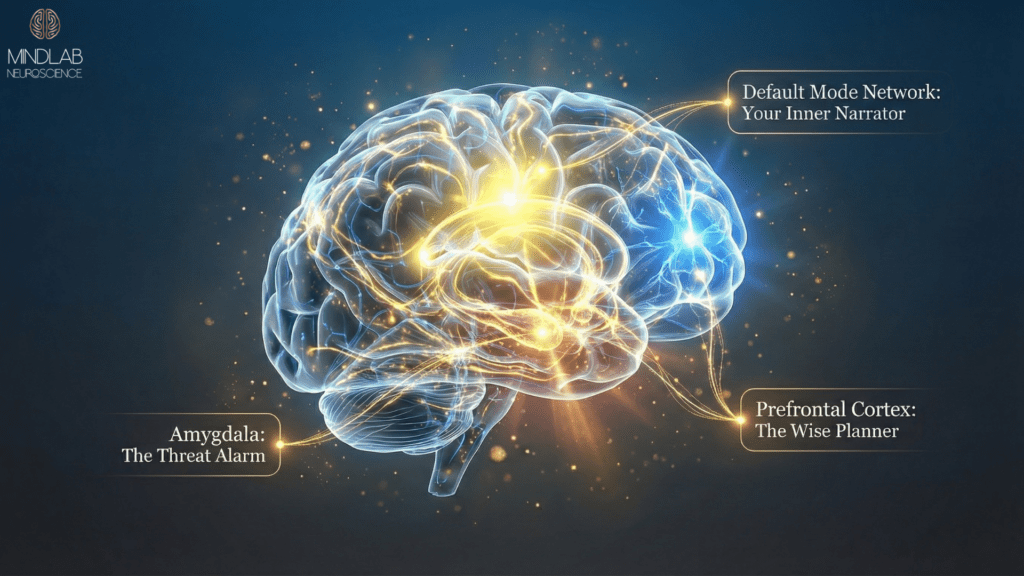
Here are the main brain systems involved, in plain language.
The amygdala: your threat alarm
The amygdala is like a smoke detector.
It is swift. It is protective. It does not care about your resume.
It cares about risk.
When the amygdala senses uncertainty, social judgment, or a sense of loss of control, it can trigger your stress response.
In that state, feelings of being an impostor become more than mere thoughts; they become fear signals. They are fear signals.
The prefrontal cortex: your wise planner
The prefrontal cortex helps you plan, choose, and hold perspective.
But when the threat alarm is loud, the prefrontal cortex has less access.
That is why, in the quiet, you can “know” you are competent and still feel like a fraud.
Impostor feelings can be a state, not a belief.
The default mode network: your inner narrator
When you are not focused on a task, your brain shifts into an internal network often called the default mode network.
This is where self-story lives.
It can be beneficial, like reflection and meaning.
But it can also turn into rumination.
In quiet moments, the inner narrator gets the microphone.
If your narrator was trained on old fear, it will replay it.
That is why impostor feelings often show up at night, in the shower, on vacation, or after a win.
The anterior cingulate and insula: your error radar and body map
High performers often have a strong “error radar.”
The anterior cingulate cortex helps detect mistakes and conflicts.
The insula helps you sense what is happening inside your body.
When these systems are sensitive, you may notice small changes and interpret them as danger.
A tiny wobble in confidence feels like proof you do not belong.
A normal stress spike feels like a sign you will fail.
Your brain is not lying to you. It is over-reading the data.
Dopamine and the moving finish line
Dopamine is not just pleasure. It is motivation and pursuit.
When you live in pursuit mode, your brain learns to feel alive while chasing.
Then you reach the goal.
The dopamine peak drops, which is normal.
But the nervous system can interpret that drop as a sign that something is wrong.
This leads to feelings of impostor syndrome, which push you to continue pursuing success.
Work more.
Prove more.
Prepare more.
Achieve again.
This is how impostor feelings can become a source of fuel.
It feels awful, but it also keeps you moving, which is why it can be so difficult to stop.
The hidden belief under impostor feelings
If I boil this down, most impostor feelings rest on one hidden rule:
If I am not performing, I am not safe.
That rule can come from childhood.
It can come from a harsh workplace.
It can come from a relationship where love was conditional.
It can come from being the “smart one” or the “responsible one.”
It can come from being underestimated, excluded, or doubted.
Once that rule gets wired, quiet feels risky.
Quietness signifies the absence of proof.

Performance becomes a shield—achievements protect against criticism, rejection, and shame, making rest feel dangerously exposed.
A quick check: is this you?
Read these slowly and notice what your body does.
- When I rest, I feel uneasy.
- After praise, I feel pressure.
- When things are calm, I start searching for what is wrong.
- I downplay my wins, even privately.
- I prepare more than I need to because I fear being exposed.
- I feel most alive when I am under pressure.
- I feel guilt when I do nothing.
- I fear that my best work was “the last time.”
If you nodded, you are not alone.
Impostor feelings are common in capable people.
But common does not mean you have to live with them.
What helps most is not arguing with the thought
Many people try to beat impostor feelings by debating them.
They make a list of achievements.
They repeat affirmations.
They force confidence.
Sometimes that helps a little.
However, if the body is in a state of threat, logic may be easily defied.
A more effective approach is this:
Regulate first.
Reframe second.
Rewire through repetition.
To overcome impostor syndrome, you have to calm the body first, because a regulated nervous system can think clearly again.
When impostor feelings hit, your first job is to calm the body, because a regulated nervous system thinks more accurately.
When the body settles, the mind becomes flexible again.
That is not motivational talk. That is physiology.
The “quiet proof” practice: a nervous-system protocol for impostor feelings
This is the practice I use with many high performers.
It is not about becoming arrogant.
It is about acknowledging your doubts.
It is about teaching your brain a new link. When feelings of impostor syndrome arise, respond with self-regulation rather than overwork.
Quiet can equal safety.
Stillness can equal stability.
Success can equal permission to rest.
You will do these exercises in small reps.
Step 1: Name what is happening, without drama
Say it out loud if you can:
“These are impostor feelings.”
“My threat system is on.”
“My brain is scanning because it is quiet.”
Naming reduces fusion. It helps your prefrontal cortex come back online.
You are not denying reality.
You are labeling a state.
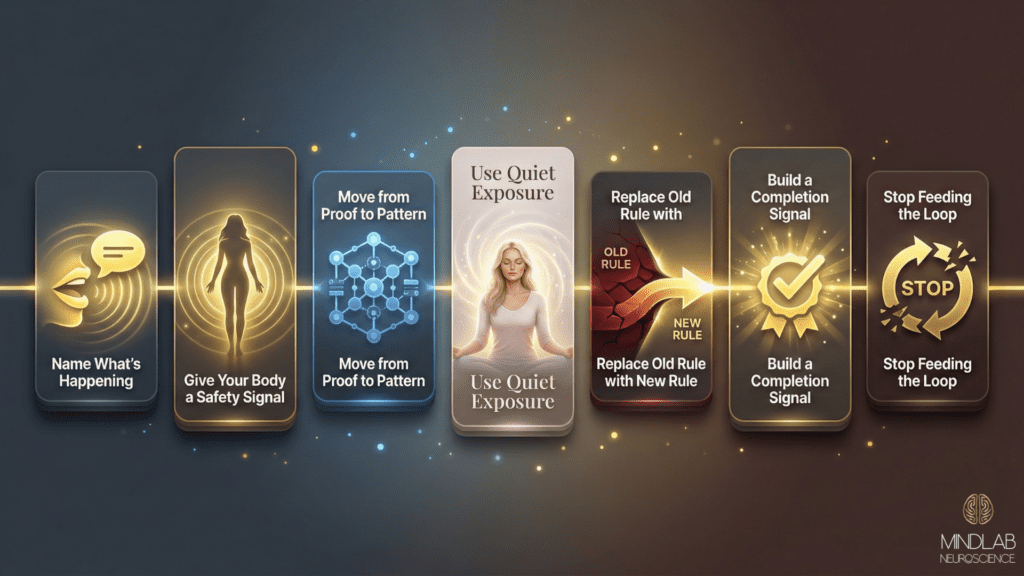
Step 2: Give your body a clear safety signal
Choose one of these and do it for 90 seconds.
Option A: The long exhale
Inhale through the nose for four counts.
Exhale through the mouth for six to eight counts.
Do five rounds.
Option B: The shoulder drop
Lift your shoulders up to your ears.
Hold for two seconds.
Drop them hard.
Do it five times.
Option C: The orienting reset
Turn your head slowly.
Look for three neutral objects.
Name them quietly.
Chair. Lamp. Window.
These are not tricks. They are signals to the brainstem, the part of you that runs survival.
That fraud sensation softens when the body gets proof of safety.
Step 3: Move from “proof” to “pattern”
This is where people get stuck.
They try to prove they belong by listing wins.
Instead, I want you to name patterns.
Write three sentences:
- “In high-pressure moments, I usually…”
- “People often rely on me for…”
- “When things go wrong, I tend to…”
These sentences point to stable traits, not one-time luck.
This doubt hates stable patterns because patterns are harder to dismiss.
Step 4: Use a two-minute “quiet exposure”
This is the rewiring part.
Set a timer for two minutes.
Sit still.
No phone.
No planning.
No fixing your life.
Your job is not to feel good.
Your job is to remain present even when feelings of impostor syndrome arise.
When the wave hits, do not wrestle it.
Say, “I can feel this and still be safe.”
This is exposure, but gentle.
It teaches your brain that quiet does not equal danger.
Over time, raise it to five minutes, then seven.
Step 5: Replace the old rule with a new one
Old rule: If I am not performing, I am not safe.
New rule: If I can settle, I am safe.
Write your new rule on a note and place it where you will see it.
It’s important to remember that a note does not necessarily transform your life.
Repetition trains the nervous system.
This pattern is trained. Safety can be taught, too.
Step 6: Build a “completion signal” after big moments
After you finish a major task, your brain needs closure.
Without closure, it keeps scanning.
Create a tiny ritual:
- Write one sentence: “What I did well today was…”
- Write one sentence: “What I learned today was…”
- Close your laptop.
- Physically change rooms, even for one minute.
This tells your brain: the event is over. It reduces the chance that impostor feelings will restart the scan.
That doubt often spikes when the brain cannot feel the end.
Step 7: Stop feeding the loop with “one more proof”
This is the hardest part.
The loop says, “Work more so you feel safe.”
But the relief you get is temporary.
And it teaches the brain that quiet is dangerous.
So pick one boundary.
For example:
No work email after 7 pm.
No rewriting the same slide after the meeting.
No “just one more” verification of the metrics.
When feelings of impostor syndrome urge you to seek further validation, respond with this one sentence:
“I am allowed to stop.”
You will not believe it at first.
That is okay.
Belief follows repetition.

What changed for Maya
Back to Maya.
We did not try to erase her doubt.
We trained her nervous system to stop responding to quiet like a threat.
At first, she could only tolerate 2 minutes of quiet exposure before feeling itchy and restless.
Her mind would say, You are wasting time.
That was not the truth. That was withdrawal from a lifetime of proving.
We worked in tiny steps.
We also tracked what her body did after wins.
Her heart rate would stay high for hours. She would keep “checking” in her mind. She would replay conversations. Her brain was not celebrating; it was scanning for danger.
So we trained a new sequence after every high-stakes event:
Exhale and reset.
Completion ritual.
Two-minute quiet exposure.
One supportive message to a trusted person.
Within weeks, her nights changed.
She slept better.
She stopped reworking everything.
She could feel pride without panic.
Most importantly, she stopped believing that this feeling was proof of truth.
She started seeing it as a state that passes.
That is freedom.
If you want a deeper explanation, here is the simple model
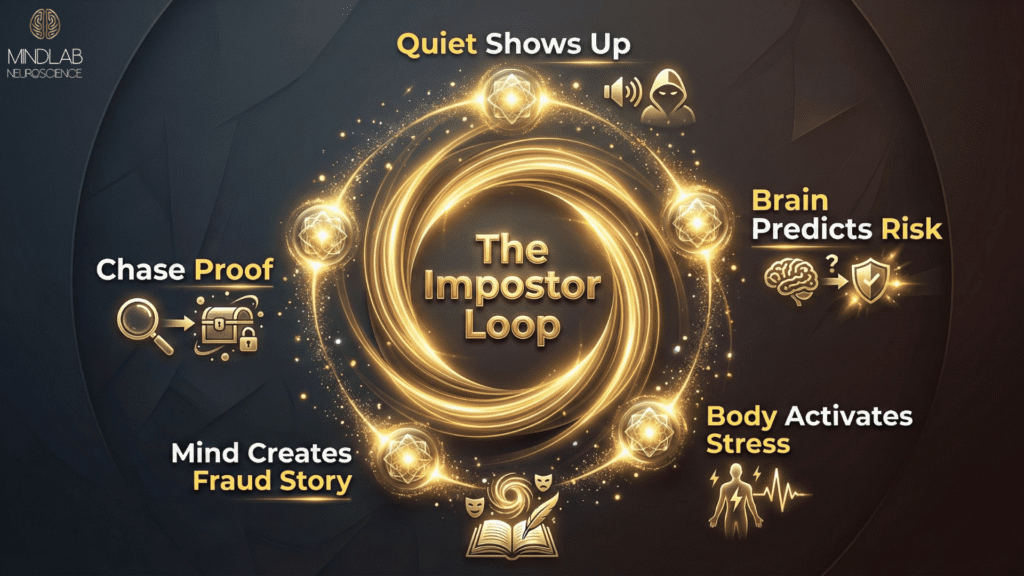
This pattern often runs on this loop:
- Quiet shows up.
- The brain predicts risk.
- The body activates stress.
- The mind creates a story of fraud.
- You chase proof through work.
- Temporary relief.
- Quiet returns, and the loop restarts.
Your job is not to “fix” step 4 first.
Your job is to interrupt step 3.
When the body feels safe, the story loses power.

The quiet is where your real self tries to return
Here is a truth many high performers do not expect.
When you slow down, your system may bring up feelings you have been out-running.
Grief.
Anger.
Loneliness.
Old shame.
Old fear.
The fraud story can be a cover for deeper pain.
This is not always the case, but it does happen occasionally.
If you feel a wave of sadness or dread when it gets quiet, do not shame yourself.
Your brain may finally have space to process.
That is not failure. That is recovery.
How to tell the difference between healthy doubt and impostor feelings
Healthy doubt says:
I want to improve.
I want to learn.
I want to grow.
The fraud alarm says:
I am unsafe.
I do not belong.
I will be exposed.
Healthy doubt leads to action with steadiness.
That fraud alarm triggers panic.
If the feeling comes with a tight chest, racing thoughts, and urgency, that is often a nervous-system signal.
When impostor feelings are a sign to get support
If this fraud alarm comes with any of the following, it’s time for deeper support: If your mental health is taking a real hit—sleep, panic, hopelessness, or numbness—please get support instead of trying to muscle through alone.
You cannot sleep for weeks.
You have frequent panic symptoms.
You are using alcohol, stimulants, or screens to numb yourself every night.
You feel hopeless.
You feel detached from life.
You have a trauma history and quiet triggers, flashbacks.
Support is not weakness. It is nervous-system care.
A small reframe can change everything.
This is not proof that you are a fraud.
It is proof that you care, and your brain is trying to protect your position.
Protection is not the enemy.
Overprotection is.
The goal is not to shut off your protective brain.
The goal is to teach when to stand down.
The real cost of living with this loop
Let me be blunt in a caring way.
Impostor feelings are expensive.
Not in money. In life.
They cost you sleep because your brain continues to scan at night.
They cost you joy, because even wins feel like pressure.
They cost you relationships because you are present but not fully there.
They cost you peace, because calm feels like something you have to earn.
Impostor feelings can also make you feel lonely in a room full of people.
Because you are not being seen. You are being evaluated. Even if no one else is evaluating you, your nervous system is still doing so.
You become the person who is “great” but never settled.
You become the person who is “successful” but never satisfied.
You become the person who is “strong” but quietly worn out.
And here is the part that is hardest to admit.
Impostor feelings can make you protect your image more than your health.
You keep showing up polished, even when you are running on fumes.
You keep over-preparing, even when it is not needed.
You keep proving it, even when nobody asked.

Because the loop tells you something scary.
If I stop, I will fall apart.
If I slow down, they will catch up.
If I rest, I will lose my edge.
That fear feels real because it lives in the body.
This is why simply thinking positively is not a practical solution.
The solution involves instilling a sense of safety in your nervous system, thereby preventing impostor feelings from taking over.
And there is one ingredient people miss.
You cannot fully rewire a social fear in isolation.
Impostor feelings are often a social threat pattern. They are about belonging, respect, status, and judgment. Your brain learned this pattern around people, around pressure, around performance.
That is why the most powerful change often happens in a high-trust space where you can be seen without performing.
Not seen as an image. Seen as a nervous system.
Because when a nervous system finally feels safe, it stops needing to prove.
Here is a simple question to ask yourself today.
Are my impostor feelings making my life smaller?
If the answer is yes, do not wait for rock bottom. You do not need a crisis to deserve support. You do not need to lose something before you take yourself seriously.
You can be successful and still need a different internal experience.
You can be capable and still be tired of carrying this alone.
If impostor feelings keep showing up in the same exact way, that is not a personal failure.
That is a pattern asking for a better method.
And you already know this.
Because the part of you that is reading this is not looking for more information.
It is looking for relief.

Your next step
If you read this and feel seen, here is what I want for you.
I want you to stop measuring your worth only during motion.
I want you to practice being safe in quiet.
Start tonight.
Two minutes.
Long exhale.
Name the state.
Let the wave pass without proving anything.
If impostor feelings show up again, regard it like a cue to soften, not a cue to sprint.
Then do it again tomorrow.
You are not trying to become a different person.
You are teaching your nervous system a different rule.
And if you want guided support, this is precisely the kind of work I do with high performers who look “fine” on the outside but feel pressure and fear on the inside. The work is not about hype. It is about training your brain in real time.
Questions people ask when impostor feelings hit
Why does the fraud voice show up after a win?
A win can create exposure. A win can increase visibility, expectations, and stakes. Your brain reads that as social risk. Furthermore, the “pursuit” chemicals drop after the finish, which can feel like a crash. Quiet makes the inner narrator louder, and doubt steps in.
Are these feelings the same as low self-esteem?
Not always. Many people with this pattern are confident in their skills, but their nervous system still reacts as if they are unsafe. This is why the body-first approach matters.
Why does it feel so real, even when I have proof?
This is because feelings often stem from the physical state. When your stress system is active, your brain searches for reasons. It can create a convincing story. Proof helps, but regulation assists more.
Can this be linked to trauma or past criticism?
Yes. If you learned that mistakes led to shame, punishment, or rejection, your brain may stay on alert. Quiet removes distractions and can bring old fears to the surface. That does not mean you are broken. It means your system learned a survival strategy.
What if this fear pushes me to succeed, and I am afraid to lose that edge?
This is common. Fear can act like fuel. But fuel that burns you is not a long-term strategy. The goal is clean motivation, not panic-driven output.
How long does it take to change this pattern?
You can feel a shift in minutes when you regulate the body. Long-term rewiring depends on repetition. Think in weeks, not days. Small daily reps teach your nervous system that quiet is safe.
What is one sentence I can use in the moment?
Try this:u003cbru003e“These are impostor feelings, and I do not have to prove anything right now.”u003cbru003eSay it while you exhale.
What if the quiet exposure makes me anxious?
Start smaller. Thirty seconds count. Your brain learns through safe doses. If anxiety is intense, work with a professional who can guide exposure in a paced way.
One last note, from me to you
You do not need to earn your right to rest.
You do not need to be perfect to belong.
When it becomes quiet, and the fraud voice knocks, let that be your cue.
Not to work harder.
To come home to yourself.
The patterns described in this article were built through thousands of neural repetitions — and they require targeted intervention to rewire. Real-Time Neuroplasticity™ provides the mechanism: intervening during the live moments when the pattern activates, building new neural evidence that a different response is architecturally possible.
Key Takeaways
- Impostor feelings after success are a nervous system response, not a character flaw — the amygdala is detecting a threat signal where none exists.
- When performance is the only state your nervous system learned to feel safe in, stillness activates a threat response.
- Cortisol can spike during periods of success when the brain interprets inactivity as dangerous exposure.
- The default mode network, active during rest, replays the question “Am I allowed to be here?” — fueling doubt in quiet moments.
- Real-Time Neuroplasticity™ builds a settled nervous system state as the new baseline — so success can be received, not feared.
| Survival Mode Signal | Brain Interpretation | Body Response | What It Feels Like | Recalibration Target |
|---|---|---|---|---|
| Achievement reached | Threat signal: “Now I can be evaluated” | Cortisol elevation, vigilance increase | Anxiety after good news | Decouple evaluation from identity |
| Stillness / quiet period | “Performance stopped — danger” | Sympathetic activation, restlessness | Inability to enjoy success | Train rest as safety signal |
| Praise or recognition | Mismatch: doesn’t fit internal model | Dissonance, urge to deflect | “They don’t know the real me” | Update self-model to match evidence |
| High visibility after success | Social evaluation threat activated | Heightened threat monitoring | Waiting to be “found out” | Reduce amygdala sensitivity to visibility |
| Comparison to peers | Relative status threat processing | Dopamine depletion, withdrawal | Success feels empty or stolen | Anchor achievement to internal evidence |
“Stillness after achievement feels like danger because your nervous system was trained that only performance keeps you safe. The feeling of being found out is not intuition — it is a learned threat response.”
Why do impostor feelings spike right after a success?
The amygdala processes high-visibility situations as social evaluation threats. When you achieve something notable, the brain’s threat monitoring circuit activates — not because you don’t deserve the win, but because the nervous system has learned that performance keeps you safe and recognition increases exposure. Success raises the stakes for being “found out,” which triggers cortisol even when nothing is actually wrong.
Why does quiet feel dangerous after reaching a goal?
If your nervous system learned to feel safe only when you are producing, performing, or problem-solving, then stillness registers as a loss of the protective mechanism. The brain has essentially automated “activity = safety.” When the activity stops, the threat circuit notices the absence. This is why many high achievers feel inexplicably anxious during vacations, after project completions, or in the days following major milestones.
What role does the amygdala play in impostor syndrome?
The amygdala does not evaluate whether a fear is logical — it evaluates whether a pattern matches a prior threat signature. If early experiences encoded “being seen” as dangerous (through criticism, invalidation, or conditional approval), the amygdala fires the same threat response when you are seen as accomplished. Impostor feelings are the conscious experience of that misfiring. The signal is real; the threat is not.
Does early conditioning explain why some people are more vulnerable to impostor feelings?
Yes. The nervous system builds its safety map in early environments. If approval was conditional on performance, the brain automated a rule: “I am safe when I am producing.” When that rule is wired deeply enough, it runs automatically in adulthood — regardless of how much evidence of competence exists. The neural pattern is not erased by achievement; it must be deliberately recalibrated through new experience.
Can impostor feelings after success be rewired, or are they permanent?
The neural patterns driving impostor feelings are learned — which means they can be updated. Neuroplasticity research confirms that repeated new experiences, when processed at the level of the nervous system rather than just the intellect, can shift the baseline threat response. The goal is not to eliminate all self-doubt but to build a settled nervous system state as the default — so that achievement can be received rather than feared.
Anxiety & Stress — MindLAB Locations
References
- Eisenberger, N.I. & Lieberman, M.D. (2004). “Why rejection hurts: A common neural alarm system for physical and social pain.” Trends in Cognitive Sciences, 8(7), 294-300. DOI: 10.1016/j.tics.2004.05.010
- Dickerson, S.S. & Kemeny, M.E. (2004). “Acute stressors and cortisol responses: A theoretical integration and synthesis of laboratory research.” Psychological Bulletin, 130(3), 355-391. DOI: 10.1037/0033-2909.130.3.355
- Clance, P.R. & Imes, S.A. (1978). “The impostor phenomenon in high achieving women: Dynamics and therapeutic intervention.” Psychotherapy: Theory, Research & Practice, 15(3), 241-247. DOI: 10.1037/h0086006
At MindLAB Neuroscience, Dr. Ceruto works with clients using Real-Time Neuroplasticity™ (RTN™) — a methodology that targets the nervous system patterns driving impostor responses. Rather than reframing beliefs intellectually, RTN™ addresses the subcortical threat circuits that activate when achievement raises exposure. The work is not about confidence — it is about building a settled nervous system that can receive success without converting it into danger.
If this pattern has persisted despite your understanding of it, the neural architecture sustaining it is identifiable and addressable. A strategy call with Dr. Ceruto maps the specific circuits driving the cycle and identifies whether it can be interrupted at its neurological source rather than managed from its surface.
This article is part of our Stress & Nervous System Regulation collection. Explore the full series for deeper insights into stress & nervous system regulation.