Key Takeaways
- Interoception is perception of internal bodily condition: heartbeat, breathing, hunger, gut, distinct from outward senses.
- Signals ascend the vagus nerve and spinal pathways through the brainstem, mapping in the insula.
- Interoceptive accuracy, detecting your own heartbeat, varies widely and tracks right anterior insula gray matter.
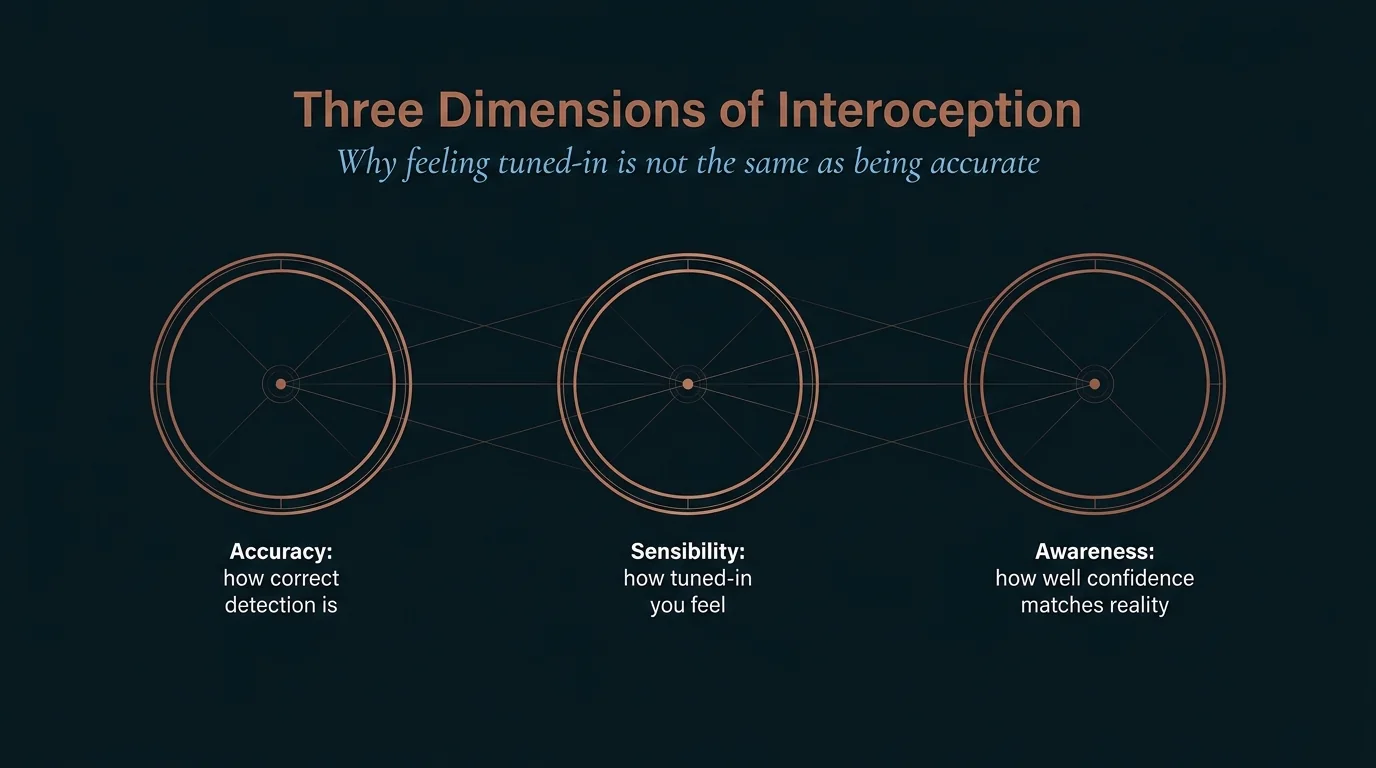
- Accuracy, confidence, and their match are three dimensions; feeling in touch does not guarantee accuracy.
- Emotion and the felt self are built from interoceptive signals, registered bodily before words.
Interoception is the brain’s sense of the body’s internal state, the steady stream of signals from your heart, lungs, and gut that the brain reads, predicts, and turns into feeling. It is one of the quiet foundations of the self. Long before you can name what you feel, your brain is already listening to your body, and what it hears becomes part of how it knows that it is you.
What Is Interoception, and Why Does the Brain Listen to the Body?
Interoception is the sense of the body’s internal physiological condition. Where vision and hearing point outward, interoception points inward, gathering information about your heartbeat, your breathing, the fullness of your stomach, your temperature, and the general state of your tissues, and assembling it into the background feeling of being alive in a body. We notice it most when it shifts: the flutter before a difficult conversation, the heaviness of fatigue, the unease that arrives before you can explain it.
The neuroscientist A. D. Craig reframed this sense in influential work describing a dedicated afferent system that represents the physiological condition of the entire body and feeds it forward to the cortex. His argument was that this stream is not a minor housekeeping signal but the raw material of subjective feeling. The body sends a continuous report upward, and the brain reads that report to answer a question it never stops asking, which is simply: how am I doing right now? On this account, interoception is the biological basis of what we experience as mood, urge, and the plain sense of the self as a feeling thing rather than a disembodied mind.
This is why interoception belongs at the foundation of self-awareness rather than off to the side of it. A great deal of what we call insight begins as a bodily signal that has not yet been put into language. The work of self-awareness is, in large part, the work of reading that signal accurately, which is exactly the terrain the rest of our hub on self-awareness and interoception maps in detail, and which our step-by-step guide to building self-awareness turns into daily practice.
How Do Your Heartbeat, Breath, and Gut Reach the Brain?
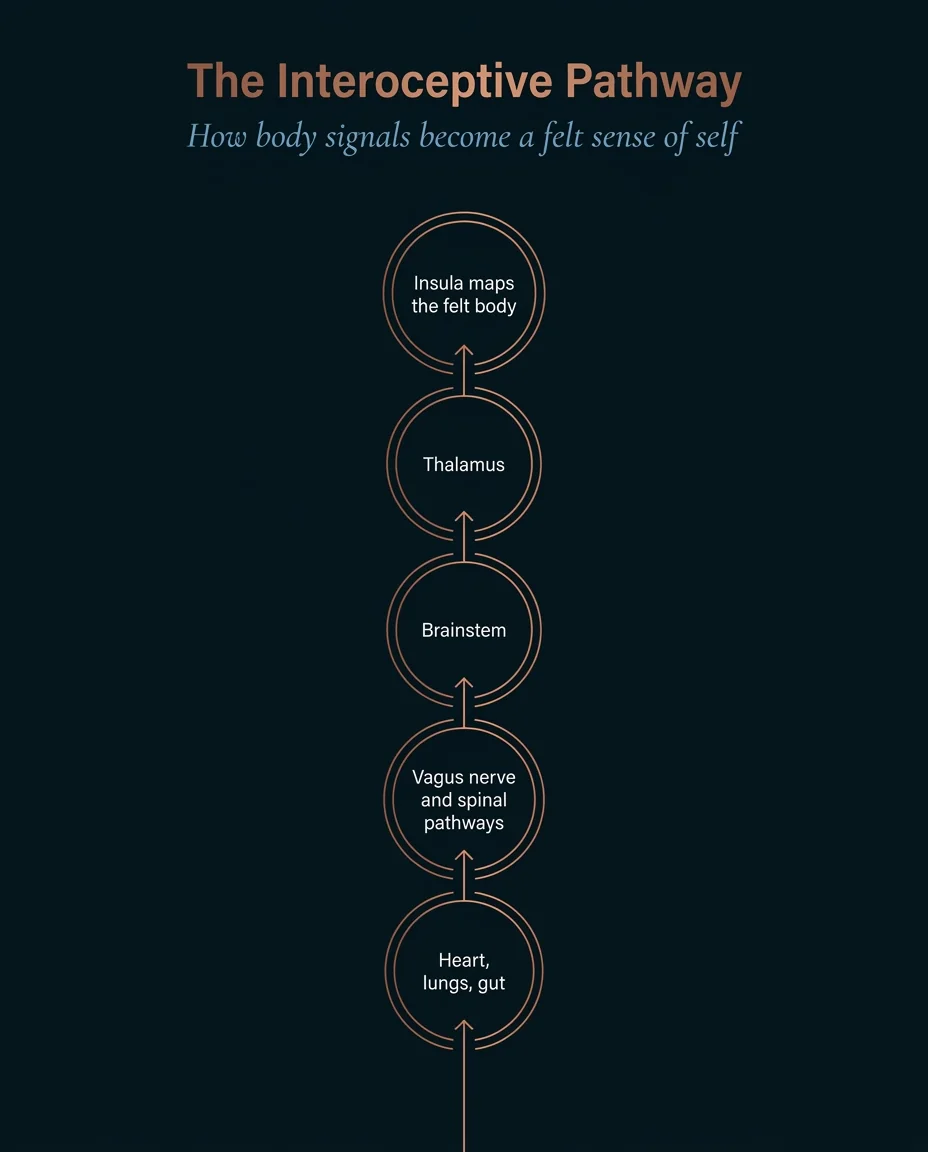
Bodily signals reach the brain along two main highways. Most visceral information, from the heart, lungs, and gut, travels up the vagus nerve and related pathways to the brainstem, where it first arrives at a hub called the nucleus of the solitary tract. A second route carries signals about the body’s tissues up through the spinal cord. From the brainstem these messages relay through the thalamus and are mapped in the insula, the strip of cortex folded deep in each hemisphere that serves as the brain’s interoceptive headquarters.
The gut deserves special mention, because the phrase gut feeling turns out to be more literal than most people assume. The digestive tract is laced with neurons and is in constant two-way conversation with the brain. In a widely cited review of the emerging biology of gut-brain communication, the neuroscientist Emeran Mayer describes a bidirectional system in which signals rising from the gut are likely to shape affect, motivation, and even higher cognition, not only digestion. I want to be careful here, because this is a young and fast-moving field and the strongest claims still outrun the evidence. What is well established is the pathway itself: the gut talks to the brain continuously, much of that traffic runs through vagal afferents, and the brain folds those messages into how a situation feels before you have consciously thought it through.
The detail worth holding onto is the direction of flow. We tend to imagine the brain issuing orders to a passive body. Interoception is the return channel, the body reporting back, and that return traffic is dense. The vagus nerve carries far more fibers upward, from body to brain, than downward. The body is not just being driven. It is being heard.
What Is Interoceptive Accuracy, and Can You Actually Measure It?
Interoceptive accuracy is how correctly you can detect your own internal signals, and yes, it can be measured. The classic test is deceptively simple: people are asked to silently count their own heartbeats over a set interval without taking their pulse, and their count is compared against an actual recording. Some people are strikingly accurate. Others are far off, and most have no idea which group they fall into.

What makes this more than a parlor trick is where the accuracy lives in the brain. In a landmark study on the neural systems supporting interoceptive awareness, Hugo Critchley and colleagues found that activity in the right anterior insula predicted how accurately people could detect their own heartbeats, and that the amount of gray matter in that same region tracked with both their accuracy and their subjective sense of how attuned they were to their bodies. Strikingly, people with better interoceptive accuracy also tended to report more intense negative emotional experience, the kind that anxiety is made of. The brain region that reads the body and the capacity to feel turned out to be the same neighborhood.
There is an important catch that protects you from overreading your own body. Sarah Garfinkel and colleagues showed that interoception is not one ability but three dissociable ones: accuracy (how correct your detection actually is), sensibility (how tuned-in you believe you are), and awareness (how well your confidence lines up with your real performance). These came apart cleanly in their data. Plenty of people feel deeply connected to their bodies while scoring poorly on accuracy, and the gap between felt connection and real signal is itself worth knowing about. Confidence is not correctness, and treating a strong bodily conviction as automatic truth is one of the more common ways the system misleads us.
How Do Bodily Signals Become a Felt Sense of Self?
The brain does not simply receive the body’s signals. It predicts them, compares the prediction against what arrives, and reads the result as feeling. In this view the felt sense of self is not a thing the brain finds inside you so much as a model it builds, continuously, out of the body’s interoceptive stream. You feel like a stable someone because the brain is running a steady, low-level simulation of your bodily state and treating that simulation as the ground of who is having the experience.
A. D. Craig proposed that the anterior insula is where this comes together, re-representing the body’s interoceptive signals in a way that gives rise to all subjective feelings and to the awareness of oneself as a sentient being present in this moment. You can read his account of how the anterior insula supports human awareness for the full argument. The neuroscientist Anil Seth has extended this into what he calls interoceptive inference, a framework in which emotions and the embodied self emerge from the brain’s best predictive guesses about the causes of its bodily signals. Critchley and Garfinkel, reviewing the field, put the core claim plainly: emotional feeling states arise from physiological changes within the body, and interoception is how those changes become feelings at all.
I hold the strongest forms of these models loosely, because the predictive framework is still being worked out and reasonable neuroscientists disagree about the details. What is not seriously in dispute is the direction of the relationship. Emotion is not something that happens purely in thought and then trickles down into the body. Much of it begins in the body and is read upward. That is why naming a feeling so often requires first noticing it physically, and why people who lose touch with their interoceptive signal frequently describe feeling strangely flat, unsure of what they want, or disconnected from themselves.
The self is not something the brain finds. It is something the brain builds, breath by breath and heartbeat by heartbeat, out of the body’s report on itself.
Why the People Who Override Their Bodies Pay for It
If interoception is the body reporting upward, then learning to ignore that report has a cost, and it is paid quietly. In more than twenty-six years of working with high-functioning people, the pattern I see most often is not a missing skill but a muted signal. The accomplished professional who has trained themselves to push through hunger, fatigue, and unease, who regards the body as an obstacle to be managed rather than an instrument to be read, slowly loses access to the very data their nervous system was using to keep them oriented. They have optimized everything except the channel that tells them how they are actually doing.
The consequences show up downstream and look like other problems. Decisions get harder, because the fast bodily signal that usually tips a close call has gone quiet. Emotions blur together, because the granularity that lets you tell anxiety from excitement, or anger from hurt, depends on reading the body precisely. Stress lingers, because you stop noticing the early physical cues that would have let you intervene before a surge became a state. None of this presents as an interoceptive problem. It presents as indecision, flatness, or burnout. The body kept a ledger the whole time, and the bill comes due in a currency that looks unrelated.
This is why I regard interoception as a trainable foundation rather than a fixed trait. Attention can be turned back toward the body deliberately, and the signal can be made legible again. That is the principle behind the applied approach in our walkthrough of the SENSE method for reading internal signals, and it connects directly to the broader work of shifting the nervous system from high alert back to a settled state, part of the wider arc of how the brain meets stress and finds its way back to baseline. You cannot regulate a signal you cannot feel. Restoring the signal is where steadier judgment and steadier emotion both begin.
| Dimension | A muted interoceptive signal | A legible interoceptive signal |
|---|---|---|
| Signal detection | Bodily cues are pushed through and overridden until they become loud | Early, subtle cues are noticed while they are still quiet |
| Emotional granularity | Feelings blur into a vague good or bad | Anxiety, excitement, anger, and hurt are told apart precisely |
| Decision-making | Fast gut input is missing, so close calls stall | The body’s quick read informs the choice without overruling thought |
| Stress recovery | The surge is noticed only once it is a full-blown state | The early physical cue is caught, so recovery starts sooner |
Understanding that the self is built from the body’s signals is the first step. Learning to read those signals accurately, and to act on them without being ruled by them, is where steadier judgment and steadier emotion actually begin.
If you carry pressure well on the outside but feel increasingly disconnected from what your body is telling you, the missing variable is often interoceptive, not a matter of discipline. Book a Strategy Call with Dr. Sydney Ceruto to map where your internal signal has gone quiet and design a neuroscience-based path back to a clearer sense of yourself.
What is interoception in simple terms?
Interoception is your sense of your body’s internal state, the brain’s ongoing perception of signals like your heartbeat, breathing, hunger, and gut sensations. It is sometimes called the eighth sense because it points inward at the body rather than outward at the world the way sight and hearing do. It is what lets you feel your heart race, sense that you are hungry, or notice unease before you can explain it, and it forms much of the background feeling of being you.
Where in the brain is interoception processed?
The main hub is the insula, a region of cortex folded deep within each hemisphere. Signals from the body travel up the vagus nerve and spinal pathways to the brainstem, relay through the thalamus, and are mapped first in the posterior insula and then re-represented in the anterior insula. The right anterior insula in particular is closely tied to how accurately people detect their own bodily signals and to the conscious feeling those signals produce.
Can you improve your interoceptive awareness?
Interoception behaves more like a trainable capacity than a fixed trait, and deliberately turning attention toward the body, rather than away from it, is the core of most approaches to strengthening it. Practices that involve slow, attentive contact with the breath and bodily sensations are commonly used for this. It is worth being realistic rather than promotional here: the science is still developing, individual results vary, and more attention is not automatically more accuracy. The honest aim is a clearer, better-calibrated signal, not a guarantee.
What is the difference between interoception and a gut feeling?
A gut feeling is one product of interoception. Interoception is the whole system by which the body’s internal signals reach and are read by the brain. A gut feeling is the moment when some of that bodily information, often arriving before conscious reasoning catches up, tips you toward a judgment. The phrase is more literal than it sounds, because the digestive tract really is in constant communication with the brain, and a great deal of that traffic travels along the vagus nerve.
Is poor interoception linked to anxiety or feeling disconnected?
Research has linked altered interoception to both heightened anxiety and to states of feeling flat or detached from oneself, though the relationships are complex and run in more than one direction. Some people are flooded by bodily signals and read threat into them; others are cut off from the signal and lose the felt texture of their own emotions. These are associations observed in research, not a label to pin on yourself, and noticing such a pattern is best treated as a useful starting question rather than a conclusion.
References
- Craig, A. D. (2002). How do you feel? Interoception: the sense of the physiological condition of the body. Nature Reviews Neuroscience, 3(8), 655-666. https://doi.org/10.1038/nrn894
- Craig, A. D. (2009). How do you feel, now? The anterior insula and human awareness. Nature Reviews Neuroscience, 10(1), 59-70. https://doi.org/10.1038/nrn2555
- Critchley, H. D., Wiens, S., Rotshtein, P., Ohman, A., & Dolan, R. J. (2004). Neural systems supporting interoceptive awareness. Nature Neuroscience, 7(2), 189-195. https://doi.org/10.1038/nn1176
- Garfinkel, S. N., Seth, A. K., Barrett, A. B., Suzuki, K., & Critchley, H. D. (2015). Knowing your own heart: Distinguishing interoceptive accuracy from interoceptive awareness. Biological Psychology, 104, 65-74. https://doi.org/10.1016/j.biopsycho.2014.11.004
- Seth, A. K. (2013). Interoceptive inference, emotion, and the embodied self. Trends in Cognitive Sciences, 17(11), 565-573. https://doi.org/10.1016/j.tics.2013.09.007
- Mayer, E. A. (2011). Gut feelings: the emerging biology of gut-brain communication. Nature Reviews Neuroscience, 12(8), 453-466. https://doi.org/10.1038/nrn3071
- Critchley, H. D., & Garfinkel, S. N. (2017). Interoception and emotion. Current Opinion in Psychology, 17, 7-14. https://doi.org/10.1016/j.copsyc.2017.04.020