







Key Points
- Wall Street trains the brain to allocate its best neural resources exclusively to professional performance.
- The partition between personal and professional life is architectural, not a matter of priorities or willpower.
- Integration means rebuilding a single operating system, not balancing two competing ones.
- Real-Time Neuroplasticity™ targets the resource allocation circuitry at the structural level.
- Professional capacity does not diminish: the total neural resource base expands when the architecture is unified.
How Wall Street Trains the Brain to Partition, and What the Partition Costs
The Financial District does not merely demand long hours. It trains the brain to operate in a specific mode where professional performance consumes all available neural bandwidth. The first-year analyst at Morgan Stanley learns this implicitly: the quality of your attention, the speed of your emotional regulation, the sharpness of your decision-making: all of it belongs to the desk. What remains after the markets close is not the same person. It is whatever the professional system did not consume. This is not a complaint about work-life balance. It is a description of how the brain reorganizes itself under sustained professional pressure.
By the time that analyst becomes a managing director, the partition is architectural. The professional system has been reinforced by fifteen years of rewards: promotions, compensation, recognition, the specific dopamine pattern that accompanies closing a significant deal. The personal system received no equivalent reinforcement. The brain, doing what brains do, optimized for the system that was rewarded. The result is a person who can navigate a billion-dollar transaction with surgical precision but struggles to be emotionally present at a dinner table. Not because they do not care. Because the neural resources that presence requires were allocated elsewhere years ago.
The trading floors and investment banking divisions between Broad Street and the World Financial Center produce a specific version of this architecture. The speed and intensity of the work trains the brain for rapid-cycle decision-making: short time horizons, binary outcomes, immediate feedback. Personal relationships operate on the opposite parameters: slow-building trust, ambiguous outcomes, feedback that arrives months or years later. A brain optimized for Wall Street’s professional tempo cannot simply shift to personal tempo at the end of the day. The circuitry is calibrated for a different speed, and switching costs are neurally expensive.
The private equity professionals in Midtown South and the hedge fund managers scattered across Lower Manhattan face an additional layer. Their work is cognitively isolating. The analysis happens alone or in very small teams. The decisions carry enormous consequences. The stress is sustained and largely invisible. By the time they arrive home to Battery Park City or take the ferry to their families in New Jersey, the brain has spent twelve hours in a state of concentrated individual processing. The shift to collaborative, emotionally available, relationally attuned functioning requires a neural transition that most professionals cannot execute cleanly. The result is the specific phenomenon of being physically home but cognitively absent: present in the room but still running the professional operating system.
Bonus season, December through February, intensifies the partition every year. The number arrives carrying more weight than compensation. It is processed by the brain as validation of the professional identity, and the weeks of uncertainty that precede it activate the self-referencing circuits at maximum intensity. During this period, the personal domain receives the lowest quality attention of the entire year. Partners, children, friendships all absorb the cost of a brain that is entirely consumed by professional self-evaluation. This cycle repeats annually, and each repetition deepens the partition.
The younger cohort entering Wall Street, analysts and associates in their mid to late twenties, are beginning to question the partition before it fully hardens. They see the senior professionals who built their lives around a single system and recognize the cost. But recognition does not reverse architecture. Knowing the partition exists does not provide the neural mechanism to dissolve it. The brain needs a different kind of intervention: one that operates at the level where the partition was built, not at the level of insight or intention.
Dr. Sydney Ceruto works with professionals across the Financial District who have reached the point where the partition is producing visible costs: relationships that have thinned, a personal life that feels hollow despite professional success, or a growing sense that the person they are at work and the person they are everywhere else have become irreconcilably different. Real-Time Neuroplasticity™ targets the architecture directly, rebuilding the circuitry so that professional capacity and personal depth share a common operating system. A Strategy Call is a phone conversation: the first step toward understanding what the partition cost and what integration looks like at the structural level.


Dr. Sydney Ceruto, PhD, Neuroscientist & Author, MindLAB Neuroscience
Dr. Ceruto holds a PhD in Behavioral & Cognitive Neuroscience from NYU and Master’s degrees in Clinical Psychology and Business Psychology from Yale University. She lectures at the Wharton Executive Development Program at the University of Pennsylvania and has been an Executive Contributor to the Forbes Coaching Council since 2019. Dr. Ceruto is the author of The Dopamine Code (Simon & Schuster, June 2026). She founded MindLAB Neuroscience in 2000 and has spent over 26 years leading it, pioneering Real-Time Neuroplasticity™, a methodology that durably rewires the neural pathways driving behavior, decisions, and emotional responses.
Also available in: Miami · Midtown Manhattan · Beverly Hills · Lisbon
Take the First Step
One hour with Dr. Sydney Ceruto. You leave knowing which neural pattern is actually driving this, and what to do about it.
Book a Strategy Call
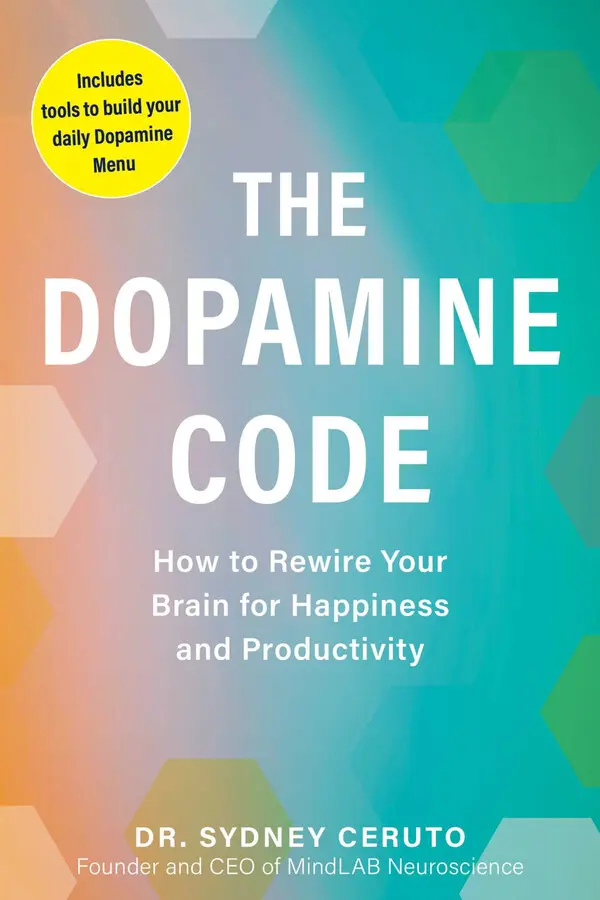
The Dopamine Code
Decode Your Drive
Why Your Brain Rewards the Wrong Things
Your brain's reward system runs every decision, every craving, every crash, and it was never designed for the life you're living. The Dopamine Code is Dr. Ceruto's framework for understanding the architecture behind what drives you, drains you, and keeps you locked in patterns that willpower alone will never fix.
Published by Simon & Schuster, The Dopamine Code is Dr. Ceruto's framework for building your own Dopamine Menu, a personalized system for motivation, focus, and enduring life satisfaction.
Order Now!Available now