







I work with the brain systems that produce motivation, focus, and follow-through. The systems themselves, and what changes them.
I’m Dr. Sydney Ceruto, PhD, Neuroscientist & Author, a neuroscience advisor for high-stakes moments, and Founder & CEO of MindLAB Neuroscience. Over 26 years founding and leading it, I’ve worked with clients on the patterns that were holding them back, using methods grounded in neuroscience. My journey started with personal pain. As a teenager, I lost both parents. I became deeply depressed and suffered from chronic anxiety. That loss pushed me to study the mind-brain connection at Yale, where I earned two master’s degrees in Clinical Psychology and Business Psychology, and later a PhD in Behavioral and Cognitive Neuroscience from NYU. What I learned changed everything, and it is the reason my practice is built the way it is.
That experience left me with a question I’ve spent my career answering. Why do capable, motivated people stay stuck in patterns they can clearly see and genuinely want to change? The answer isn’t effort, and it isn’t insight. In my experience, people arrive already understanding their patterns in detail. Understanding a circuit and changing a circuit are two different operations.
What Has to Change for a Pattern to Stop
A pattern that repeats is a circuit that has been reinforced. It fires quickly, it fires before you have decided anything, and it fires because at some point it was useful. Procrastination, conflict avoidance, the collapse of drive halfway through something that mattered: these are not character flaws. They are learned neural responses running on schedule.
Changing one requires three things. You have to identify which circuit is actually firing, rather than the one you assume is firing. You have to catch it in the moments when the brain is most receptive to encoding something new. And you have to give it a competing response often enough, and precisely enough, that the new route becomes the faster one. That is neuroplasticity put to work, and it is what neuroscience-based change actually means. I call the method Real-Time Neuroplasticity™.
None of this is guaranteed, and I want to be straightforward about that. Brains differ, circumstances differ, and the pace of change differs with them. What I can describe is the mechanism, and how I apply it to a specific person.
- Unlock Neuroplasticity In 10 Steps: A Guide To Brain Mastery
- Dopamine Depletion: The Hidden Epidemic in Brain Health
What Neuroscience Actually Studies
I’m a neuroscientist with a PhD in Behavioral and Cognitive Neuroscience. My training is in how the brain encodes, consolidates, and rewrites behavior at the molecular and systems level. That is a research discipline. I work with mechanisms: how patterns form, what conditions allow new ones to take hold, and what reliably interferes.
In practice the first thing I do is work out which part of the pattern is carrying the problem. Is drive failing to initiate, or failing to sustain? Is attention fragmenting at the start of a task or at the first obstacle? Is the response you want available at all under load, or only when you’re calm? Those are different circuits with different interventions, and collapsing them into one is why a strategy that transforms one person does nothing for the next.
This is applied neuroscience. It changes what we do together, and what I can be accountable for.
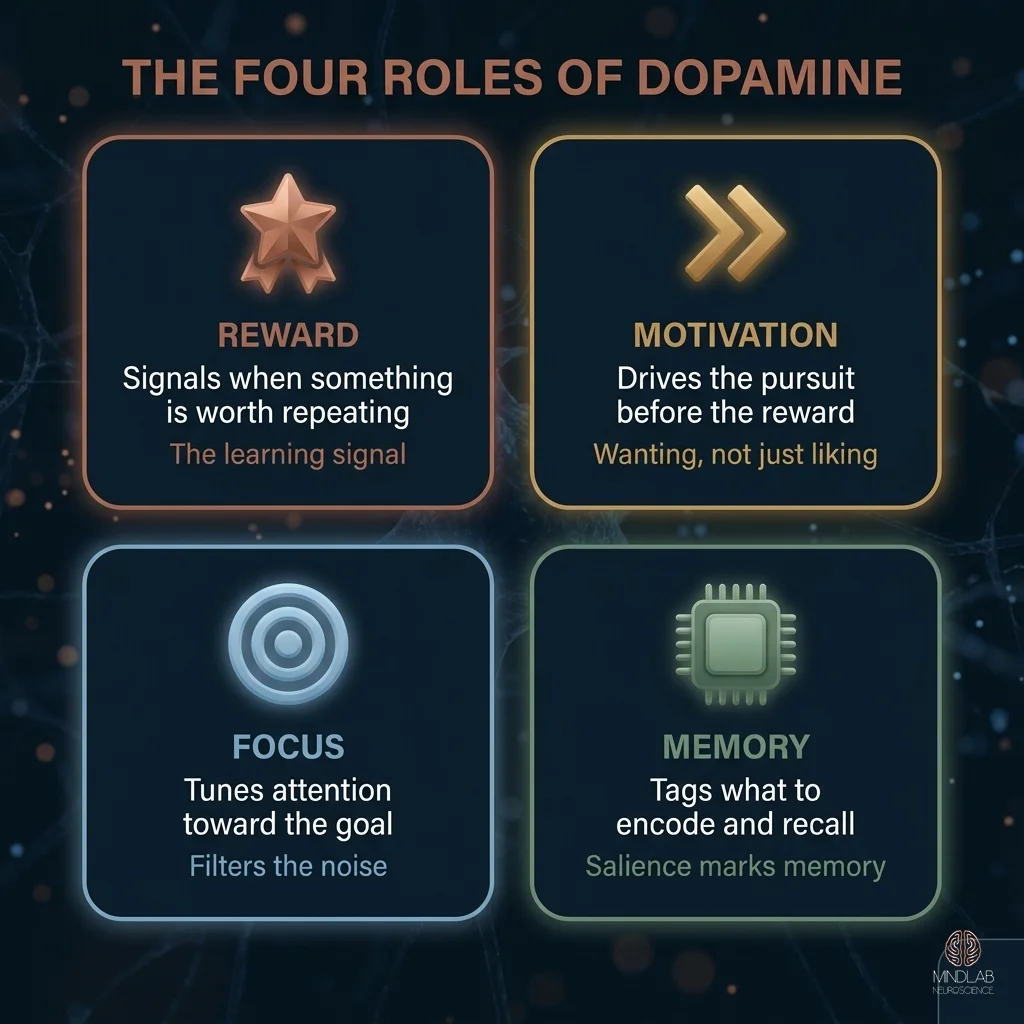
The Dopamine Roles Behind Motivation and Follow-Through
Dopamine is not the pleasure chemical, and the popular version of it gets the mechanism backward. It is closer to a signal about what is worth pursuing and how much effort to spend getting there. That signal does several jobs at once. I organize them into four, and that framing is how I work.
Reward dopamine marks what is worth repeating. Motivation dopamine drives the pursuit before any reward arrives. Wanting something and enjoying it run on different machinery, which is why they can come apart. Focus dopamine tunes attention toward the goal and filters what is not the goal. Memory dopamine tags which experiences get encoded strongly enough to shape the next decision.
When these roles are working together, effort feels available. When one of them is dysregulated, the failure looks like a character problem from the outside and feels like one from the inside. Someone whose drive initiates poorly is called lazy. Someone whose attention cannot filter is called scattered. Neither description is accurate, and neither points at anything you can change.
My assessment work is built to tell those apart. Once it is clear which part of the pattern is carrying the problem, the work gets specific rather than general: what you practice, when in the day you practice it, what has to be removed for it to hold, and what signal tells us it is holding. Clients describe drive returning as the underlying pattern shifts, along with steadier focus and better regulation under pressure. How much, and how quickly, varies.
Dopamine, and how to work with it, is the research my program is built on, and the core of my book, The Dopamine Code. It explains how dopamine shapes motivation, choice, and the ability to sustain change, in practical terms. You can read more about The Dopamine Code at Simon & Schuster.
- Dopamine and Motivation: Unlock Focus
- The Dopamine Paradox: Wanting vs. Liking Explained
- NeuroSync™: Personalized Dopamine Optimization
How I Work With a Client
I take a deliberately small number of clients, and I work with each of them myself. That constraint is what makes the rest of it possible.
I review your case before we speak, so we start from where the work actually is. I prepare interventions for your situation specifically, and I adjust them based on what the period since we last spoke actually produced. Between conversations, when something happens that the work bears on, you can message me directly. Over time I come to know your patterns and how your system behaves under load, which is what lets me tell the difference between a bad week and a wrong approach.
The Research and Recognition Behind This Work
Dr. Sydney Ceruto, PhD. Neuroscientist & Author.
Neuroscience Advisor · Founder & CEO, MindLAB Neuroscience.
I hold a PhD in Behavioral and Cognitive Neuroscience from New York University and master’s degrees in Clinical Psychology and Business Psychology from Yale University. Lecturer, Wharton Executive Development Program, University of Pennsylvania. I’m an Executive Contributor to the Forbes Coaching Council and an executive writer for Brainz Magazine. I’m the author of The Dopamine Code and The Dopamine Code Workbook (Simon & Schuster), and Rewire for Resilience (MindLAB Press).
Those credentials matter here for one reason. The mechanism I’ve described is only useful if the person applying it can read your situation accurately. That reading is what the training is for.
What Clients Describe
A chief operations executive at a multinational technology company came to me struggling with emotional leadership. We worked on what fired in those high-stakes moments, and on catching it before the reaction rather than after it. She told me afterward that it was essential for any leader seeking genuine growth.
A brand executive arrived close to burnout and unsure whether she wanted to stay in her field. Our work focused on the thought patterns generating the overwhelm and on restoring the drive that had gone flat. She gained clarity, rebuilt confidence, and describes the work as life-changing.
A mid-level manager whose position was at risk came to me with a procrastination pattern she had not been able to shift. We worked on task initiation and prioritization. Her situation at work improved over the following months.
These are three cases from my own practice.
What This Work Asks of You
This is a serious commitment and a significant investment. Here is what that buys.
It buys direct access to a PhD neuroscientist who is thinking about your case between conversations. It buys assessment built around how your motivation and attention actually behave under load. The work stays continuous, so each conversation builds on the last. And you get a clear sense of what we are doing and how we will know whether it is working.
The 90-day program is built around one issue, with a defined scope and rhythm. The concierge engagement runs a year and is a different kind of relationship: I work across the whole of a client’s life rather than one problem in it. The distinction is scope and depth.
It also asks something. The interventions happen in your life, not in our conversations, and they only work if you run them. Clients who get the most out of this are the ones who count the work between conversations as the real work.
- Dynamic Dopamine-Aware Leadership
- Success-Focused Mindset: Unlock Powerful Potential In 6 Steps
- Astonishing Ways The Brain Drives Motivation
Whether This Is the Right Fit
This is not the right fit for everyone, and I would rather say so here than in a first conversation.
If you are in crisis, contact the 988 Suicide and Crisis Lifeline, or your local emergency number, now.
This work fits a specific situation: you can see the pattern, you have tried to change it, you are capable and motivated, and it keeps happening anyway. That gap between knowing and doing is a mechanism, and mechanisms can be worked on.
Where to Start
If that describes where you are, the next step is a conversation. We look at what is actually happening and what is driving it. Whether or not we move forward, you’ll walk away with something tangible.