In my twenty-five years of clinical practice at MindLAB Neuroscience, I have sat across from thousands of people who are searching for the same thing. They might call it finding a soulmate, fixing a broken marriage, or just feeling less lonely, but, from a neurological perspective, they are all seeking one specific biological mechanism. They are looking for oxytocin bonding.
Key Takeaways
- Oxytocin is not simply the “love hormone” — it is the brain’s safety-in-connection signal that determines whether the nervous system opens to bonding or activates defensive withdrawal.
- Oxytocin release requires specific conditions: eye contact, physical touch, vocal warmth, and perceived reciprocity. Without these, the bonding circuit does not activate regardless of proximity.
- The oxytocin system interacts with the dopamine system to create the feeling of love: dopamine drives the pursuit (wanting), while oxytocin sustains the bond (trusting).
- Early attachment experiences calibrate the oxytocin system — secure attachment produces responsive oxytocin release; insecure attachment produces blunted or dysregulated release.
- The oxytocin bonding circuit is neuroplastic: even adults with insecure attachment histories can rebuild oxytocin responsiveness through corrective relational experiences.
It is the invisible glue that holds our social world together. We often talk about love as if it were a purely poetic or spiritual concept, and while it certainly feels that way, the machinery behind it is grounded in hard science. As a neuroscientist, I look at the brain and see a complex orchestra of chemicals, and oxytocin is the conductor of that orchestra when it comes to human connection.
You might have heard oxytocin called the “love hormone” or the “cuddle chemical.” While those nicknames are cute, they barely scratch the surface of what is actually happening in your brain. At its core, the hormone is oxytocin, but what truly matters is how your brain learns to link that chemical signal to real experiences of safety, trust, and emotional holding. Oxytocin bonding isn’t just about feeling fuzzy after a hug. It is a powerful survival mechanism that has evolved over millions of years to ensure we stay safe, build tribes, and raise our young. It is the architect of trust and the foundation of intimacy.
Today, I want to take you on a deep dive into this topic. We are going to strip away the fluff and look at the fundamental neuroscience. We will talk about how oxytocin bonding works, how it interacts with other heavy hitters like dopamine, and how you can actually use this knowledge to rewire your brain for deeper, more meaningful relationships.
The Neuroscience of the “Cuddle Chemical”
To understand oxytocin bonding, we have to start with the hardware. Oxytocin is a neuropeptide, which is a fancy way of saying it acts as both a hormone and a neurotransmitter. It is produced in the hypothalamus, which is a small but mighty region at the base of your brain responsible for maintaining balance in your body. You might wonder, are oxytocin levels controlled only by fixed biology, or can your daily experiences and habits shift them over time? The pituitary gland secretes it into the bloodstream, but it also stays in the brain to affect behavior.
When I explain oxytocin bonding to my clients, I often describe it as a biological “safety signal.” When oxytocin is released, it quiets the amygdala. The amygdala is the part of your brain that acts like a smoke detector; it is constantly scanning for threats and triggers the fear response. Oxytocin tells the amygdala to stand down. It effectively says, “You are safe here. You can lower your guard.”
This is why oxytocin bonding is so critical for intimacy. You might ask, can oxytocin positively affect more than just how you feel in the moment, and the answer is yes, it can gradually reshape how your entire nervous system responds to closeness and connection. You cannot truly connect with someone if your brain is in fight-or-flight mode. By dampening the fear response, oxytocin creates a window of opportunity for trust to form. It allows us to misinterpret social cues less negatively and increases our empathy.
In my practice, I have seen brain scans of individuals who struggle with social anxiety or past trauma. Often, their amygdala is hyperactive. They perceive threats where none exist. One of the goals of neuroplasticity-based practice is to help them regulate that fear response, and facilitating natural oxytocin bonding is a huge part of that process. When you engage in behaviors that release oxytocin, you are literally changing the chemical environment of your brain to favor connection over protection.
| Bonding Chemical | Role in Love | Activation Trigger | When Absent |
|---|---|---|---|
| Oxytocin | Safety, trust, attachment deepening | Eye contact, touch, vocal warmth, reciprocity | Relationships feel transactional; intimacy triggers anxiety |
| Vasopressin | Pair-bonding, territorial protection of bond | Sustained physical proximity, sexual bonding | Commitment feels unstable; no “mine” feeling |
| Dopamine | Pursuit, excitement, romantic obsession | Novelty, unpredictability, anticipation | Relationship feels flat; seeking intensity elsewhere |
| Serotonin | Emotional stability, mood regulation within bond | Consistent routines, predictable safety | Mood swings, irritability, relational volatility |
| Endogenous opioids | Comfort, pain relief, felt security | Physical closeness, laughter, shared experience | Partner absence feels like physical pain |
Dopamine and Oxytocin: The Dynamic Duo
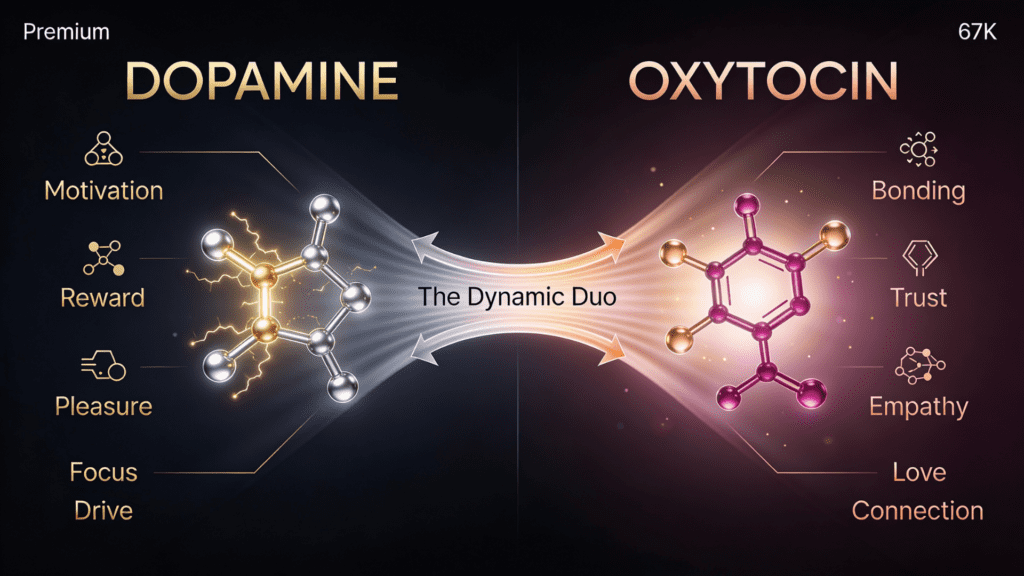
You cannot discuss oxytocin bonding without mentioning dopamine. If oxytocin is the “glue” of a relationship, dopamine is the “spark.” This is the arc of neuroplasticity-based practice for dopamine optimization.
Dopamine is your brain’s reward chemical. It is what makes you chase goals, crave sugar, and check your phone a hundred times a day. In the early stages of a relationship, dopamine is running the show. That rush of excitement you feel when you see a new partner? That is a massive dopamine spike. It feels incredible, bordering on addictive.
But dopamine is fleeting. It is designed for pursuit and acquisition, not for the long haul. This is where oxytocin bonding steps in to save the day. As a relationship matures, the wild spikes of dopamine tend to level out. If there is nothing to replace them, the relationship often crumbles because the “high” is gone. However, in healthy long-term partnerships, oxytocin takes the baton.
The interplay between these two is fascinating. Dopamine draws you toward someone, but oxytocin bonding is what makes you want to stay. The full spectrum of brain chemicals during sex illustrates this handoff most vividly — from the initial dopamine surge of arousal through the deep oxytocin flood of sustained connection. Interestingly, oxytocin can actually influence the dopamine pathways. It helps link the rewarding feeling of dopamine specifically to the person you are bonding with. It is no longer just a generic good feeling; it is a good feeling associated with that specific partner.
I often see couples in my clinic who are worried that the “spark” is gone. I have to explain to them that the spark has just transformed. They are moving from a dopamine-dominant phase to an oxytocin bonding phase. This isn’t a downgrade; it is an upgrade in stability. You are moving from the anxiety of the chase to the security of the bond.
Understanding this shift is crucial. We live in a culture that is obsessed with the dopamine rush. We swipe on apps looking for the next hit of excitement. But true fulfillment, the kind that calms your nervous system and improves your long-term health, comes from the sustained release of oxytocin bonding.
The Developmental Roots of Connection
We aren’t born knowing how to bond; we learn it, and the lessons start the moment we enter the world. The very first instance of oxytocin bonding happens between a mother and her infant. During childbirth and breastfeeding, women experience massive surges of oxytocin. This ensures that despite the pain and exhaustion, the mother bonds intensely with the baby.
But it goes both ways. When a baby is held, rocked, or looked at with affection, their developing brain releases oxytocin. This sets the template for how they will handle relationships for the rest of their lives. In neuroscience, we talk about “attachment styles,” which are deeply rooted in early experiences of oxytocin bonding.
I have worked with many adult clients who have what we call an “avoidant” or “anxious” attachment style. Often, if we dig into their history, we find disruptions in that early bonding process. Maybe a parent was emotionally unavailable, or perhaps there was early trauma. Their brain didn’t get enough “reps” of that safety signal we talked about earlier.
The good news is that the brain is plastic. Neuroplasticity means that the brain can change and rewire itself throughout your life. Just because you didn’t have a secure foundation of oxytocin bonding as a child doesn’t mean you are broken. It just means we have to do some work to train your brain to accept and produce oxytocin more efficiently now.
When I work with clients on this, we are reparenting the brain. We are teaching the nervous system that the connection is safe. It is remarkable to watch someone who has spent decades pushing people away finally learn to lean into oxytocin bonding. Their anxiety drops, their sleep improves, and they report feeling a sense of peace they have never known before.

The Physiology of Heartbreak and Healing
We have talked about how good oxytocin bonding feels, but what happens when that bond is severed? Breakups, divorce, or the loss of a loved one can feel physically painful. There is a neurological reason for this.
When you are deeply bonded with someone, your brain maps them as part of your “self.” Your biological rhythms often synchronize with theirs. You rely on them for co-regulating your emotions. When that person is suddenly removed, your brain goes into a state of withdrawal that is very similar to coming off a drug.
What happens when oxytocin levels suddenly crash after a breakup or major loss is that your brain enters a kind of withdrawal state, which is why the emotional pain can feel so physical and overwhelming.
The drop in oxytocin and dopamine, combined with a spike in stress hormones like cortisol, creates a chemical storm. You crave the person because your brain is screaming for the oxytocin bonding hit it is used to. It is trying to restore homeostasis.
In my practice, I help clients navigate this by understanding that they are in a withdrawal period. We focus on finding other sources of oxytocin to help soothe the brain during the transition. You can get small doses of oxytocin bonding from friends, family, and even pets.
The human-animal bond is a perfect example of this. Research shows that just staring into your dog’s eyes raises oxytocin levels in both you and the dog. It is a pure, uncomplicated form of oxytocin bonding that can be incredibly healing for someone recovering from relationship trauma.
I remember a client, let’s call him Mark. Mark came to me after a devastating divorce. He was isolated, depressed, and convinced he would never trust again. His brain was starved of connection. We started a protocol that included volunteering at an animal shelter. It sounds simple, but the tactile contact and the non-judgmental affection from the animals began to jumpstart his oxytocin bonding system again. Slowly, he relearned how to feel safe in the presence of another living being. It was the bridge he needed to form human connections again, eventually.
Oxytocin in the Digital Age
We are living in a strange time for oxytocin bonding. We are more “connected” than ever before digitally, yet we are seeing an epidemic of loneliness. Why? Because you cannot get a hit of oxytocin from a text message.
Oxytocin bonding relies heavily on physical presence. It needs touch, eye contact, and the synchronization of voice and movement. When we replace face-to-face interaction with screens, we strip away the biological signals our brains crave. A “like” on social media might give you a tiny dopamine blip, but it doesn’t provide the deep, calming nourishment of oxytocin.
I see this constantly in younger clients or those who work entirely remotely. They have hundreds of online friends but feel profoundly empty. Their nervous systems are agitated because they are missing the regulatory effect of oxytocin bonding.
We have to be intentional about countering this. I advise my clients to prioritize “analog” time. Put the phone down. Look people in the eye. Shake hands. Hug your friends. These aren’t just polite social gestures; they are biological necessities. You have to feed your brain the proper diet of sensory input if you want it to function optimally.
This is especially true for romantic relationships. I have seen couples who sit on the same couch but stare at separate screens for hours. They are physically close, but they are not experiencing oxytocin bonding. Over time, this erosion of connection creates a gap that is hard to cross. The fix is often surprisingly simple: physical touch without distraction. Holding hands while watching a movie or just sitting together in silence without phones can reactivate those dormant pathways.

The Role of Trust and Empathy
Trust is an expensive resource for the brain. It requires us to suppress our survival instincts and make ourselves vulnerable. Oxytocin bonding is the currency that pays for that transaction.
There have been fascinating studies where participants were given a nasal spray containing oxytocin. In economic trust games, those who received oxytocin were significantly more likely to trust strangers with their money. It lowered their social fear and increased their willingness to cooperate.
Now, I am not suggesting you walk around snorting oxytocin spray—in fact, I strongly advise against looking for pharmaceutical shortcuts like that unless prescribed for specific medical conditions. But the science highlights how integral oxytocin bonding is to our ability to function in society.
It also enhances empathy. When you have high levels of oxytocin, you are better at reading facial expressions and interpreting emotional tone. You become more attuned to what others are feeling. This creates a positive feedback loop. You understand your partner better, which makes them feel seen and safe, boosting their oxytocin and making them more affectionate toward you, which increases your oxytocin bonding even more.
In my practice, we work on “empathic attunement.” This is the skill of tuning into another person’s emotional frequency. It is a learnable skill, and practicing it strengthens the neural pathways associated with oxytocin. It is about moving from a “me-centered” brain to a “we-centered” brain.
Practical Protocols for Boosting Oxytocin
So, how do we apply this science to our daily lives? You don’t need a prescription or a lab coat to boost oxytocin bonding. You need to understand the triggers. Here are some of the protocols I use with my clients at MindLAB.
First, prioritize touch. The skin is our largest organ and is packed with sensors that communicate directly with the brain. A hug that lasts twenty seconds or more is the gold standard. It takes about that long for the oxytocin release to really kick in and for the cortisol levels to drop. I tell couples to make the “20-second hug” a daily ritual. It resets the nervous system.
Second, use the power of eye contact. In our distracted world, we rarely hold eye contact for long. But gazing into someone’s eyes is a potent trigger for oxytocin bonding. It signals focused attention and safety. Try to maintain eye contact when your partner is speaking to you, rather than glancing around the room or at your phone.
Third, engage in shared activities. Doing something together—whether it is cooking, hiking, or even solving a puzzle—creates a sense of “us.” The coordination required for these activities stimulates the brain’s social centers. I often recommend partner dancing or team sports as excellent ways to facilitate oxytocin bonding because they require movement synchronization.
Fourth, practice active listening. This goes back to empathy. When you genuinely listen to someone without interrupting or planning your response, you are giving them a gift of safety. Feeling heard is incredibly bonding. It validates the other person’s existence and strengthens the attachment cord between you.
Lastly, don’t forget the physical intimacy. Sexual activity is a massive releaser of oxytocin, particularly post-climax. This is nature’s way of ensuring that partners stay emotionally connected after the physical act. It is the “cuddle time” after sex where the real oxytocin bonding magic happens, so don’t skip it.
The Nuance: Is Oxytocin Always Good?
As a scientist, I have to be honest with you. Biological systems are rarely black-and-white. While we celebrate oxytocin’s role in bonding for its role in love, it also has a more complex side.
Oxytocin strengthens the bond with your “in-group,” but it can sometimes increase suspicion toward “out-groups.” It is a tribal chemical. It makes you fiercely protective of your own people. In some contexts, this can fuel defensiveness or exclusion.
I mention these characteristics because it is essential to understand that our biology pushes us toward bias. Being aware of this allows us to use our higher cognitive functions—our prefrontal cortex—to override those impulses. We can consciously choose to widen our circle of empathy. We can choose to extend that oxytocin bonding feeling to people who aren’t exactly like us.
Furthermore, for people with a history of severe trauma or abuse, sudden closeness can sometimes feel terrifying rather than soothing. Their brain has cross-wired intimacy with danger. In these cases, we have to go very slowly. Rushing into intense oxytocin bonding activities can actually trigger a panic response. We have to titrate the connection, giving the nervous system time to adjust.
Rewiring Your Relationship Brain
At the end of the day, your brain is designed to connect. We are social animals. Isolation is damaging to our physical and mental health. The concept of oxytocin bonding provides a roadmap for building a life rich in love and support.
I have seen people in their sixties and seventies change their relationship patterns. I have seen marriages that seemed dead in the water come back to life. It wasn’t a miracle; it was neurobiology. They stopped doing the things that triggered the amygdala and started doing the things that provoked oxytocin bonding.
You have more control over this process than you think. Every interaction you have is an opportunity to release a little bit of this chemical. A smile at a barista, a pat on the back for a coworker, a cuddle with your child—these are all deposits in the oxytocin bank.
If you are struggling with connection, don’t beat yourself up. Your brain might just be stuck in a protective pattern. It is doing what it thinks it needs to do to keep you safe. But you can teach it that it is safe to let people in. You can strengthen the pathways for oxytocin bonding just like you can strengthen a muscle at the gym.
Frequently Asked Questions About Oxytocin Bonding
Q: Can I take a supplement to boost oxytocin bonding? A: I see ads for “liquid trust” sprays all the time. While clinical treatments exist for medical issues, there is no magic pill for relationships. Proper oxytocin bonding relies on the feedback loop between you and another person. Your brain needs the behavioral cues—eye contact, touch, safety—to build lasting pathways. Supplements might give a fleeting effect, but they won’t rewire your attachment style.
Q: Do men and women experience oxytocin bonding differently? A: There are some biological nuances. Estrogen tends to enhance the effects of oxytocin, while testosterone can sometimes dampen them. However, men absolutely rely on oxytocin bonding. The difference often lies in the trigger: men sometimes bond better through shared activities (doing things side-by-side), which involve vasopressin, a cousin of oxytocin, whereas women often respond faster to face-to-face interaction and verbal intimacy.
Q: Can chronic stress stop me from falling in love? A: Biologically, yes, it makes it much harder. Cortisol, the stress hormone, and oxytocin exhibit a reciprocal relationship. When cortisol is high, oxytocin is suppressed. If you are constantly in fight-or-flight mode, your brain prioritizes survival over connection. This is why we often work on stress regulation as the first step to improving oxytocin bonding in relationships.
Q: How long does it take to “rewire” my brain for better connection? A: Neuroplasticity isn’t an overnight process. In my practice, I usually tell clients to commit to a protocol for at least 60 to 90 days. You are physically building new bridges between neurons. If you practice oxytocin bonding behaviors daily—like the 20-second hug—you will likely start feeling a shift in your baseline security within a few weeks.
Q: Does oxytocin bonding only happen with romantic partners? A: Not at all. The machinery is the same whether it is a spouse, a best friend, a parent, or even a pet. In fact, platonic oxytocin bonding is crucial for long-term health. Having a strong tribe of friends lowers inflammation and improves heart health just as effectively as a romantic partner.
Final Thoughts
Despite the societal emphasis on independence and self-reliance, our biology contradicts this notion. We are wired for each other. The neuroscience of oxytocin bonding proves that we function best when we are connected.
From the first breath we take to the partnerships we form in adulthood, this chemical is guiding us toward love and trust. It soothes our fears, deepens our empathy, and anchors us in a chaotic world.
Whether you are looking to heal from a breakup, strengthen your marriage, or feel more grounded, the prescription is the same: lean into connection. Seek out the moments that trigger oxytocin bonding. Be the person who offers safety to others.
In my twenty-five years of studying the brain, I have learned that while neurons and neurotransmitters are the mechanics, the result is something truly profound. It is the feeling of being known, being held, and being home. That is the power of oxytocin bonding, and it is waiting for you to tap into it.
Frequently Asked Questions About Oxytocin Bonding
Can I just take a supplement to boost oxytocin bonding?
A: I see ads for u0022liquid trustu0022 sprays all the time. While clinical treatments exist for medical issues, there is no magic pill for relationships. True u003cstrongu003eoxytocin bondingu003c/strongu003e relies on the feedback loop between you and another person. Your brain needs the behavioral cues—eye contact, touch, safety—to build lasting pathways. Supplements might give a fleeting effect, but they won’t rewire your attachment style.
Do men and women experience oxytocin bonding differently?
There are some biological nuances. Estrogen tends to enhance the effects of oxytocin, while testosterone can sometimes dampen them. However, men absolutely rely on u003cstrongu003eoxytocinu003c/strongu003e. The difference often lies in the trigger: men sometimes bond better through shared activities (doing things side-by-side), which involve vasopressin, a cousin of oxytocin, whereas women frequently respond more quickly to face-to-face interaction and verbal intimacy.
Can chronic stress stop me from falling in love?
Biologically, yes, high cortisol levels make it much harder. The relationship between cortisol, the stress hormone, and oxytocin is complex and dynamic. When cortisol is high, oxytocin is suppressed. If you are constantly in fight-or-flight mode, your brain prioritizes survival over connection. This is why we often work on u003ca href=u0022/neuroplasticity-stress-reduction/u0022u003echronic stressu003c/au003e regulation as the first step to improving u003cstrongu003eoxytocin u003c/strongu003ein relationships.
How long does it take to u0022rewireu0022 my brain for better connection?
Neuroplasticity isn’t an overnight process. In my practice, I usually tell clients to commit to a protocol for at least 60 to 90 days. You are physically building new bridges between neurons. If you practice u003cstrongu003eoxytocin bondingu003c/strongu003e behaviors daily—like the 20-second hug—you will likely start feeling a shift in your baseline security within a few weeks.
Does oxytocin bonding only happen with romantic partners?
Not at all. The machinery is the same whether it is a spouse, a best friend, a parent, or even a pet. In fact, platonic u003cstrongu003eoxytocin bondingu003c/strongu003e is crucial for long-term health. Having a strong tribe of friends lowers inflammation and improves heart health just as effectively as a romantic partner.
#oxytocin #neuroscience #brainhealth #relationships #mentalhealth #mindlabneuroscience
The patterns described in this article were built through thousands of neural repetitions — and they require targeted intervention to rewire. Real-Time Neuroplasticity™ provides the mechanism: intervening during the live moments when the pattern activates, building new neural evidence that a different response is architecturally possible.
Frequently Asked Questions
Can you boost oxytocin naturally?
Yes — oxytocin release responds to specific behavioral inputs: sustained eye contact (minimum 4 seconds), warm physical touch (holding hands, hugging for 20+ seconds), synchronized activities (walking in step, breathing together), vocal warmth (tone matters more than words), and acts of generosity or trust. These are not metaphorical suggestions — each one activates the hypothalamic oxytocin release pathway through measurable sensory inputs. Supplements claiming to boost oxytocin do not cross the blood-brain barrier effectively and are not a reliable substitute for relational input.
Do men and women experience oxytocin bonding differently?
The oxytocin system operates in both sexes but interacts differently with sex hormones. Estrogen amplifies oxytocin’s bonding effects, which is why oxytocin-mediated bonding may be more readily accessible for women in some contexts. Testosterone can blunt oxytocin’s effects, which may contribute to the commonly observed pattern where men bond more slowly through sustained proximity and shared activity rather than through emotional disclosure. However, individual variation far exceeds gender differences — attachment history is a stronger predictor of oxytocin responsiveness than sex.
Why does oxytocin sometimes increase anxiety instead of calm?
In individuals with insecure attachment histories, oxytocin can amplify social threat sensitivity rather than promote bonding. Research shows that oxytocin enhances the salience of social cues — if the brain’s attachment system is calibrated to expect rejection, oxytocin makes rejection cues more prominent, increasing anxiety. This is why oxytocin is not simply “the bonding chemical” — it is a social signal amplifier. In a safe relational context, it amplifies safety signals. In a threatening context, it amplifies threat signals.
Can chronic stress prevent oxytocin bonding?
Yes — cortisol (the primary stress hormone) directly suppresses oxytocin release and receptor sensitivity. Chronic stress creates a neurochemical environment where bonding is physiologically difficult regardless of relationship quality. This is why couples under sustained external stress (financial, professional, health) often report feeling disconnected despite loving each other — the neurochemical infrastructure for bonding is being suppressed by the stress response. Reducing stress is not just a wellness recommendation; it is a neurological prerequisite for oxytocin-mediated connection.
How long does it take to build an oxytocin bond?
The oxytocin bonding system builds gradually through repeated positive relational experiences — typically 3-6 months of consistent, safe, reciprocal contact for a durable bond to form. This is neurologically distinct from the dopamine-driven “falling in love” phase (which can happen in hours). The dopamine phase creates attraction and pursuit; the oxytocin phase creates attachment and trust. Relationships that collapse after the initial excitement fades often had strong dopamine activation but insufficient oxytocin accumulation — the pursuit system engaged but the bonding system never consolidated.
Relationships & Dating — MindLAB Locations
References
- Feldman, R. (2012). Oxytocin and social affiliation in humans. Hormones and Behavior, 61(3), 380-391. DOI
- Shamay-Tsoory, S. G., & Abu-Akel, A. (2016). The social salience hypothesis of oxytocin. Biological Psychiatry, 79(3), 194-202. DOI
- Carter, C. S. (2014). Oxytocin pathways and the evolution of human behavior. Annual Review of Psychology, 65, 17-39. DOI
If this pattern has persisted despite your understanding of it, the neural architecture sustaining it is identifiable and addressable. A strategy call with Dr. Ceruto maps the specific circuits driving the cycle and identifies whether it can be interrupted at its neurological source rather than managed from its surface.
This article is part of our Intimacy & Bonding collection. Explore the full series for deeper insights into intimacy & bonding.