With time and effort, you can train your brain to make better decisions and overcome indecisiveness. Start by applying the...
Read article : Brain Based Strategies for Indecisiveness: Neuroscience of Better DecisionsStrategic Thinking
The architecture of long-term planning. We dissect the role of the Prefrontal Cortex in "mental time travel" and the protocols required to simulate future outcomes and outmaneuver competition.
29 articlesThe Simulator
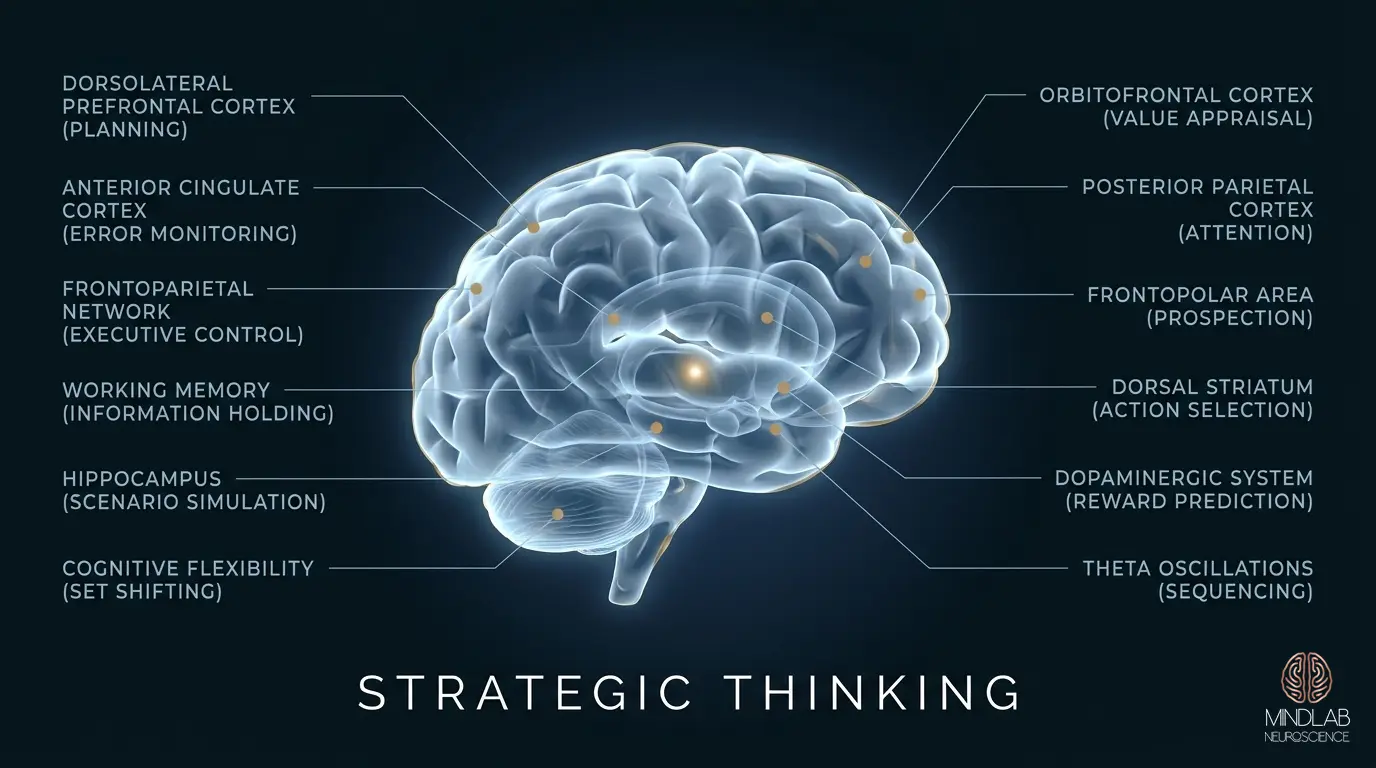
Strategic thinking is not abstract philosophy; it is a specific cognitive function known as “Mental Time Travel.” It relies heavily on the Dorsolateral Prefrontal Cortex (dlPFC), the brain’s simulation engine. This region allows for “counterfactual thinking”—the ability to detach from the present reality and construct detailed, hypothetical future scenarios. It essentially allows you to make mistakes in a simulation so you do not have to make them in reality.
Cognitive Decoupling
To think strategically, the brain must perform “Cognitive Decoupling.” This is the inhibition of “bottom-up” sensory data (current emails, slack pings, immediate threats) to prioritize “top-down” abstract models.
-
The Reactivity Trap: Most leaders fail at strategy because they are stuck in the “Salience Network,” reacting to whatever is loudest right now. Strategy requires the metabolic discipline to ignore the urgent in favor of the important.
-
Resource Allocation: The brain treats decision-making energy like a battery. High-level strategic modeling is metabolically expensive; it cannot be done effectively after a day of low-level administrative tasks.
Second-Order Mechanics
True strategy requires Second-Order Thinking (Game Theory).
-
First-Order: “If I do X, Y happens.” (Linear cause and effect).
-
Second-Order: “If Y happens, how will the competitor react? And what will I do then?” (Recursive modeling). This recursive processing recruits the Anterior Cingulate Cortex to calculate probabilities and risks across multiple timelines, creating a decision tree that navigates uncertainty rather than ignoring it.

Latest Articles
Indecisiveness can stem from various factors, including evolutionary adaptations that once served as protective mechanisms for our ancestors. From a...
Read article : Why Am I So Indecisive? 10 Methods That Can Help You Make Decisions ConfidentlyEmbark on a transformative journey of perspective change guided by cutting-edge neuroscience. Discover how reshaping your mental landscape can unlock...
Read article : Optimizing Perspective Shifts: Neuroscience Insights for Enhanced Cognitive FlexibilityExplore how executive presence and leadership impact are shaped by neuroscience. Learn brain-based strategies for confidence, influence, and authentic leadership.
Read article : Executive Presence & Leadership Impact: The Neuroscience AdvantageDiscover how thinking dispositions—such as open-mindedness, curiosity, and truth-seeking—shape decision-making, fuel personal growth, and set the foundation for true innovation...
Read article : Thinking Dispositions: The Secret Drivers of Exceptional Reasoning; Leadership; and GrowthWaiting for an email or a call from an employer to schedule an interview with you and wondering why you...
Read article : Why Didn’t I Get an InterviewAdaptive leadership isn’t instinct — it’s neurobiology in motion. At MindLAB Neuroscience, the neuroscience of adaptive leadership reveals how the...
Read article : Adaptive Leadership Neuroscience: Leading Through UncertaintyIs fear of risk stalling your business growth? Learn how neuroscience-backed strategies can help you master calculated risk taking, enhance...
Read article : Calculated Risk Taking Neuroscience: Strategic Decisions in the Modern Business WorldDeveloping a visionary mindset means thinking beyond the present, embracing innovation, and taking strategic risks. Visionaries don’t just predict change—they...
Read article : The Power of a Visionary Mindset: How to Think, Lead, and SucceedDiscover the five moves to achieve astonishing personal and professional success. With strategies like self-reflection, trust-building, and effective negotiation, you’ll...
Read article : Optimizing Personal and Professional Success in 5 Strategic MovesUnlock your leadership potential with coaching. Empower yourself to inspire teams and drive growth. Embrace change and develop a growth...
Read article : The New Standard In Leadership Development: Reaching New Heights Through Neuroscience-Based CoachingOptimism strengthens executive function, sharpens working memory, and fuels the persistence that distinguishes high performers from everyone else.
Read article : Optimism and Cognitive Ability: Expose 3 Critical Hidden Dangers of Excessive Positivity