Career decisions activate a complex neural network, prefrontal cortex for strategic planning, limbic system for emotional processing, and dopamine circuits...
Read article : Career Decisions Neuroscience: How Your Brain Shapes Professional ChoicesStrategic Thinking
The architecture of long-term planning. We dissect the role of the Prefrontal Cortex in "mental time travel" and the protocols required to simulate future outcomes and outmaneuver competition.
29 articlesThe Simulator
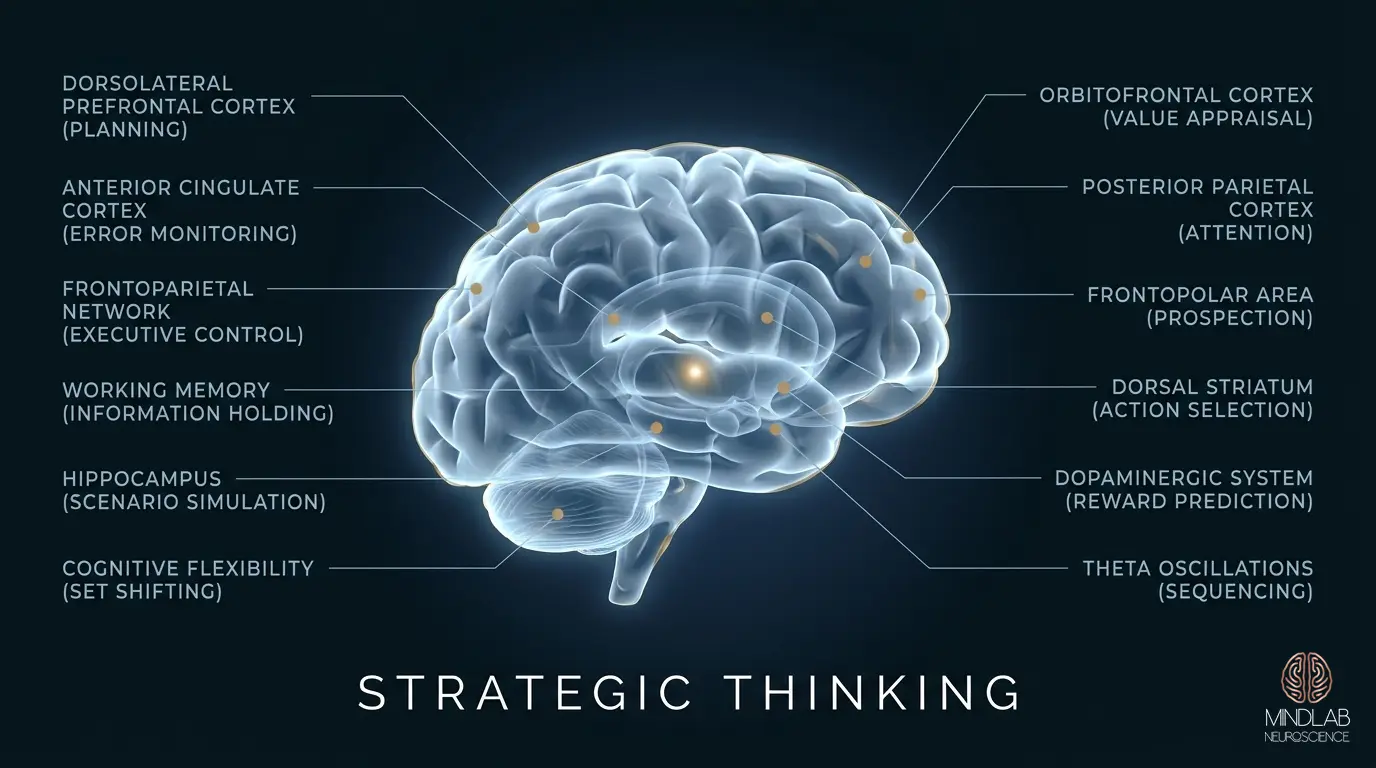
Strategic thinking is not abstract philosophy; it is a specific cognitive function known as “Mental Time Travel.” It relies heavily on the Dorsolateral Prefrontal Cortex (dlPFC), the brain’s simulation engine. This region allows for “counterfactual thinking”—the ability to detach from the present reality and construct detailed, hypothetical future scenarios. It essentially allows you to make mistakes in a simulation so you do not have to make them in reality.
Cognitive Decoupling
To think strategically, the brain must perform “Cognitive Decoupling.” This is the inhibition of “bottom-up” sensory data (current emails, slack pings, immediate threats) to prioritize “top-down” abstract models.
-
The Reactivity Trap: Most leaders fail at strategy because they are stuck in the “Salience Network,” reacting to whatever is loudest right now. Strategy requires the metabolic discipline to ignore the urgent in favor of the important.
-
Resource Allocation: The brain treats decision-making energy like a battery. High-level strategic modeling is metabolically expensive; it cannot be done effectively after a day of low-level administrative tasks.
Second-Order Mechanics
True strategy requires Second-Order Thinking (Game Theory).
-
First-Order: “If I do X, Y happens.” (Linear cause and effect).
-
Second-Order: “If Y happens, how will the competitor react? And what will I do then?” (Recursive modeling). This recursive processing recruits the Anterior Cingulate Cortex to calculate probabilities and risks across multiple timelines, creating a decision tree that navigates uncertainty rather than ignoring it.

Latest Articles
The executive mindset is a brain state, not a trait: the prefrontal cortex staying in command under pressure while the...
Read article : The Executive Mindset: The Neuroscience of How Leaders Decide Under PressureDiscover how to refine your strategic thinking by recognizing and avoiding 10 common cognitive distortions. Enhance your decision-making and leadership...
Read article : Strategic Thinking: How To Avoid 10 Disastrous Cognitive DistortionsCognitive distortions are systematic thinking patterns wired into the brain that quietly warp executive decisions. How to spot and correct...
Read article : The Influence of Cognitive Distortions on Executive Decision-MakingWhen a leader thinks through cognitive distortions, the pattern spreads to the whole team through three mechanisms. How to spot...
Read article : Unveiling the Impact of Cognitive Distortions on Team LeadershipHow the brain actually makes career decisions, why high-stakes pressure derails them, and the practical neuroscience of choosing well.
Read article : Explosive Tactics to Enhance Your Decision-Making Skills for Career AdvancementThe eight cognitive distortions that quietly skew workplace judgment, the neuroscience behind each, and practical techniques to rewire them.
Read article : Navigating Cognitive Distortions in the Workplace: A Comprehensive GuideYour amygdala processes threat faster than your prefrontal cortex can evaluate logic, creating split-second biases that feel like rational thought...
Read article : Cognitive Bias Brain Regions: The Neuroscience of Flawed DecisionsEmbark on a journey into the transformative world of Artificial Intelligence with our latest article. Discover how AI is revolutionizing...
Read article : The Rise of Artificial Intelligence: How AI is Revolutionizing Industries and Transforming the FutureEmployee engagement is a brain-state problem, not a morale one. Thirteen neuroscience-backed practices that switch a team from threat to...
Read article : Optimize Employee Engagement: 13 Strategies for LeadersGoal shelving is a powerful tool for managing competing priorities and achieving success in the long run. This method helps...
Read article : Goal Shelving: An Effective Method to Optimize Goal Setting and AchievementAre you struggling with making informed and balanced decisions in your personal or professional life? Are you working with confident...
Read article : Confident Decision Making With Neuroscience