
Perfectionism vs high standards is the line that separates clean excellence from expensive excellence. On paper, both can produce impressive results. In the body, they feel nothing alike. High standards create focus, clarity, and a sense of direction. Perfectionism creates pressure, hesitation, and the private belief that one mistake could cost you respect, belonging, or momentum.
In my work with high performers, the fastest breakthroughs come from diagnosing this distinction early. When a client thinks they need “more discipline,” but what they actually have is a threat-driven perfectionism loop, they will keep trying to force their way through a nervous system problem. They will burn time, energy, and eventually trust in themselves. When we identify the pattern correctly, the solution becomes precise: we maintain the standards and retrain the threat response masquerading as excellence.
This article is a deep dive into how I tell the difference in real clients, why evolution makes the pattern predictable, how modern culture amplifies it, and what the neuroscience says is actually happening in the brain when “perfect” starts to feel like the only safe option.
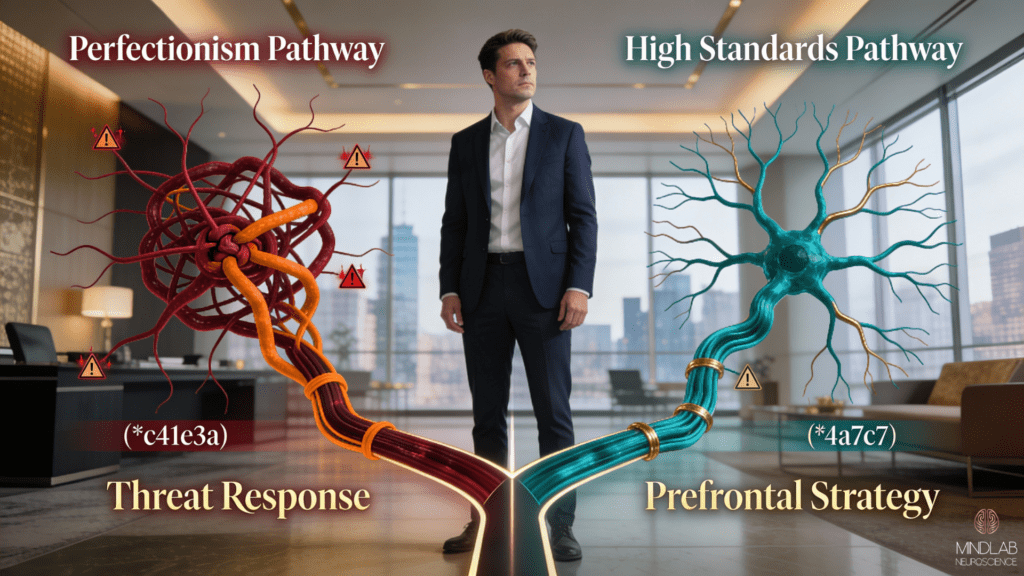
What high standards actually are
Perfectionism vs high standards becomes obvious when you define standards properly. High standards are chosen criteria for quality that match a specific goal within a particular context. They are not a mood, not a fear response, and not a referendum on your worth. They represent the standard of what is considered good in this context.
When a person has high standards, they can calibrate. They can distinguish between a board presentation and an internal email, between a client deliverable and a personal note, and between a public-facing launch and an internal draft. Their standards can rise when the stakes demand it and downshift when speed matters more than polish. The key feature is flexibility.
High standards also tend to create clean motivation. Even when the work is difficult, the internal stance is stable: this matters, and I can do it. There is effort and intensity, but it is directed intensity. The person may care deeply, but they are not trapped in endless checking, endless tweaking, or endless self-interrogation.
What perfectionism actually is
Perfectionism vs high standards is not a debate about quality. It is a difference in how the nervous system codes error, judgment, and visibility. Perfectionism is a protective strategy that regards mistakes as a threat. It is the brain acting as if being wrong, being criticized, or being considered less-than-excellent could carry a social cost.
Perfectionism often presents as “I just want it to be good,” but the underlying question is usually different: Will I be safe if my work is not perfect? Safe can mean emotionally safe, socially safe, professionally safe, or identity safe. In high performers, perfectionism commonly attaches to reputation, competence, and status. It becomes an invisible rule: I can’t afford to be average here.
That rule rarely starts as a conscious choice. It begins as learning. If praise arrived only when you were exceptional, if mistakes were punished or mocked, if your environment equated achievement with worth, or if early life felt unpredictable, then “perfect” can become the brain’s shortcut to certainty. The body learns: control reduces risk.
Why your brain confuses them
Perfectionism vs high standards gets blurred because the brain is a prediction machine. It always asks, “What happens if I do this? What if I don’t?” If your brain learns that excellence reduces criticism, rejection, or chaos, it will consider it as a form of protection. That does not mean the brain is dramatic. It means the brain is doing its job: trying to prevent pain.

This is why self-talk alone rarely changes perfectionism. When you tell yourself to “stop being perfectionistic,” your protective system hears: stop doing the thing that keeps us safe. It pushes back. It increases checking, increases delay, and increases control. The person interprets such behavior as being stuck, but it is a predictable threat response.
Perfectionism vs high standards is best distinguished by looking at the cost. High standards cost effort and attention, but they tend to pay off with satisfaction and a clean finish. Perfectionism costs peace. It costs time. It costs sleep. It costs flexibility. It often costs joy, because the nervous system stays on watch even after the work is objectively reasonable.
How I determine perfectionism vs high standards in clients
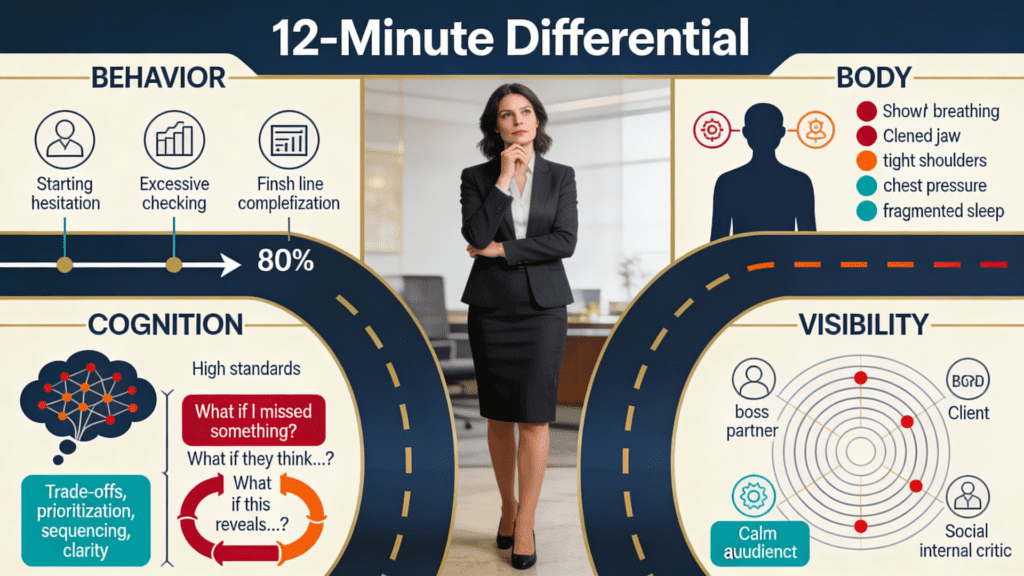
Perfectionism vs high standards is one of the first distinctions I map, because it changes the entire plan. I do not determine this by asking, “Are you a perfectionist?” Most high performers will say no, especially if they are productive. I determine it by tracking patterns across four lanes: behavior, body, cognition, and visibility.
Behavior: what happens at start, middle, finish
Perfectionism vs high standards becomes visible at the starting line. High standards can start once the goal is clear. Perfectionism often delays beginning because it creates a fear of exposure. The mind says, “I’m not ready; I need more information,” or “Let me just fix this first.” It looks responsible, but the emotional tone is braced.
In the middle of work, perfectionism often shows up as excessive rechecking, polishing, and reworking parts that do not change the outcome. High standards are refined strategically. Perfectionism refines compulsively.
At the finish line, perfectionism commonly appears as “almost done” paralysis. Finishing makes the work visible. Visible work can be judged. So the brain stalls. Clients often have a shelf of 80–90% complete projects. That is not a character issue. It is a visibility issue.
Body: what the nervous system does
Perfectionism vs. high standards can be detected in the body more quickly than in the story. High standards can feel intense, but the body is organized. Breathing is fuller. The jaw is not clenched all day. The shoulders can drop. Perfectionism often brings tightness: shallow breathing, chest pressure, jaw clenching, stomach tension, sleep fragmentation, and an inability to downshift after work.
I pay close attention to the moment a client opens the document, walks into the meeting, or reviews feedback. If the body spikes as if danger is present, we are not dealing with standards. We are dealing with a threat.
Cognition: what the mind is trying to solve
Perfectionism vs. high standards differ in the thinking they produce. High standards foster evaluative thinking: trade-offs, prioritization, sequencing, and clarity. Perfectionism produces certainty-seeking: what if I missed something, what if they interpret this wrong, what if this reveals I’m not as competent as they think?
That kind of thinking creates a loop. It does not resolve, because the nervous system is not looking for truth. It is looking for relief.
Visibility: who you feel watched by
Perfectionism vs high standards is ultimately about visibility. Many clients are calm when work stays private, but tense when it becomes public. “Public” can mean a boss, a partner, a client, a board, a social audience, or even an imagined internal critic. When the internal audience activates, the nervous system reacts as if it were undergoing an evaluation.
This is why some people can do brilliant work alone but struggle to publish, present, or delegate. The problem is not competence. The problem is that the brain associates visibility with threat.
The neuroscience behind the distinction
Perfectionism vs high standards is the difference between a prefrontal strategy and a threat-network strategy. High standards rely heavily on planning, working memory, and flexible control. Your prefrontal systems help you hold the goal, filter distractions, and choose actions that align with your values.
Perfectionism recruits error-monitoring and threat processing more aggressively. The brain becomes hyper-attuned to “wrongness.” Many people feel this as a constant internal alarm: something is off, something is missing, something could be better. Even when the work is strong, the body does not relax because the brain is still scanning.
This is why perfectionism can make me feel like I can’t stop contemplating my work. The mind is not obsessed with excellence; it is obsessed with preventing exposure. Once the threat system is engaged, attention narrows. Creativity often drops. Decisions become harder. The person may become slower and more rigid, even though they are trying harder.
Perfectionism vs high standards also changes how feedback lands. When prefrontal control is dominant, feedback is information. When threat circuits are dominant, feedback hits identity. Identity threat triggers reactivity, rumination, defensiveness, or collapse. The client might seem calm in the room, then replay the conversation for two days. This replay represents the brain’s attempt to reduce uncertainty by repeatedly analyzing the scene.
Deeper neuroscience: what “error” means to your brain
Perfectionism vs high standards becomes workable when you translate the experience into prediction and correction. Your brain is constantly comparing what it expected to what actually happened. In a high-standards state, a mismatch is regarded as information: you notice it, correct it, and move on.
Perfectionism vs. high standards shifts when a mismatch is labeled a threat. The brain elevates the sense that something is wrong, reallocates attention to micro-flaws, and narrows your thinking. That narrowing is why a single word choice can hijack an evening and why you can feel compelled to examine one more time even after the work is strong. When we train the nervous system to tolerate normal mismatches without rushing to control them, flexibility and speed return, and standards become strategic again.
How the pattern forms: development, conditioning, and “earned safety”
Perfectionism vs high standards usually begins as an intelligent adaptation. Many clients learned early that excellence reduced chaos, criticism, or emotional unpredictability. Over time, the brain generalizes the rule: safety must be earned through performance.
Perfectionism vs high standards does not resolve through reassurance, because reassurance rarely updates the prediction system. The nervous system updates through repeated evidence: I shipped and survived, I was imperfect and stayed respected, and I asked for help and did not lose status. Evidence rewires the model that mistakes equal danger.
The 12-minute differential I run in my head during intake
Perfectionism vs high standards is something I can usually distinguish within the first session because the pattern is consistent. I listen for time-based language, visibility language, and identity language.
If a client says, “I lose hours perfecting,” that points toward compulsion. If they say, “I can’t start until I’m sure,” that points toward certainty-seeking. If they say, “If I mess this up, they’ll realize I’m not as good as they think,” that points toward identity threat.
Perfectionism vs high standards also shows up in how a client explains success. High standards clients discuss the process—what they did, what they learned, and what they improved. Perfectionists discuss relief: how they barely made it, how it could have gone wrong, and how lucky they were. The nervous system narrative is different.
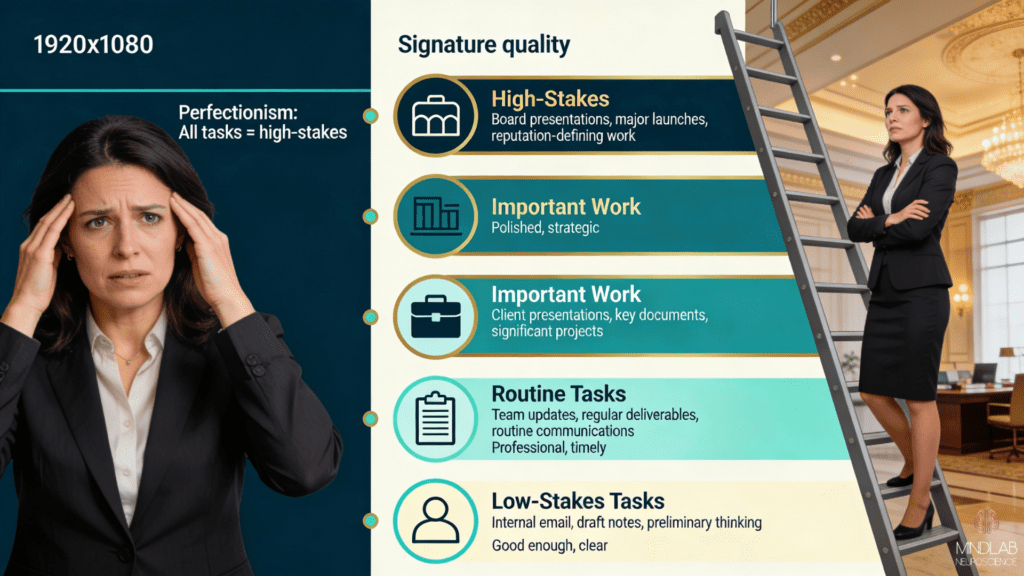
Then I test the calibration. I ask them to walk me through two tasks: a high-stakes task and a low-stakes task. Perfectionism tends to flatten the difference. In the body, everything becomes high-stakes, regardless of its actual low-stakes nature. High standards preserve hierarchy.
Finally, I ask one question that almost always clarifies the mechanism: when you imagine sending the draft before it’s perfect, what do you feel in your body? If the answer is tightness, dread, irritation, shame, or exposure, we are not looking at standards. We are looking at protection.
Case examples: how it looks in real life
Perfectionism vs high standards shows up differently depending on context, but the nervous system logic is the same.
A founder comes in with high output and a hidden stall. They can move fast on strategy, but they freeze on messaging. They rewrite a landing page for weeks. This is not due to a lack of skill, but rather the visibility of the messaging. Messaging can be judged. Messaging can be screenshotted. As soon as we label the loop correctly, the work becomes clean: we keep the standard for clarity, and we train the body to tolerate visibility.
A senior executive comes in with leadership fatigue. They are praised, promoted, and exhausted. The pattern is not workload alone. It is over-responsible, driven by fear of error. They double-check everything, attend meetings they do not need to attend, and address details their team can handle. The behavior looks like excellence. The body reveals the truth: it is threat-driven control. Once we differentiate perfectionism vs high standards, delegation becomes a nervous system skill, not a management debate.
A high-achieving professional comes in with the success hangover. They land a win and immediately feel pressure. They interpret that as gratitude or ambition. Under the surface, their brain anticipates increased scrutiny. Success increases visibility, so the threat system rises. The intervention is not to downplay success. It is to train the brain to metabolize success without converting it into danger.
The evolutionary bearing: why perfectionism makes sense
Perfectionism vs high standards becomes even clearer when you look at evolution. Human beings evolved in small groups where belonging mattered. Being excluded did not just hurt feelings; it threatened access to food, protection, and opportunity. In that context, social evaluation carried survival weight.
Perfectionism can be understood as an anti-exclusion strategy. If you are impeccable, you are harder to reject. If you are exceptional, you are harder to replace. If you do not make mistakes, you reduce the chance of shame, criticism, or loss of status. That logic is ancient. It is not pathological. It is protective.
What changed is the environment. The modern world has scaled social evaluation. You can be evaluated by more people, more often, with fewer buffers. The brain still uses the same circuitry, but now it runs in an environment that constantly feeds it signals of comparison, competition, and replaceability.
Perfectionism vs high standards, therefore, is not a mystery. It is a predictable interaction between an ancient belonging system and a modern visibility economy.

The sociological bearing: how culture turns standards into pressure
Perfectionism vs high standards is more problematic to distinguish today because culture blurs the line. Many communities moralize productivity. Being busy becomes a virtue. Rest becomes weakness. Speed becomes proof of worth. In that environment, high standards can quietly turn into constant self-surveillance.
Another cultural driver is curated comparison. You are exposed to other people’s outcomes without their process. That inflates the perceived baseline. Your brain interprets it as a rank threat: everyone is ahead. Rank threats push you toward overcontrol. Over-control pushes you toward perfectionism.
Economic insecurity matters as well. In industries where people feel replaceable, the nervous system becomes more vigilant. Clients tell me I can’t mess this up. That sentence is the gateway. If your brain believes one mistake could cost stability, it will push you toward obsessive polishing and decision avoidance because avoidance can feel safer than visible imperfection.
Perfectionism vs high standards is also influenced by identity branding. When people live as brands, everything feels like performance. The internal audience never stops watching. In that environment, good enough can feel like a reputational risk even when it is not.
A practical test: the after-effect
Perfectionism vs high standards can be identified with a straightforward question: what happens after you finish?
When you operate from high standards, completion brings closure. You may still care about the outcome, but your body can downshift. There is satisfaction.
When you operate from perfectionism, completion brings relief, then scanning. You check again. You revisit the email. You replay the meeting. You look for what could go wrong. The nervous system stays on watch because done equals exposure.
If you have ever delivered something excellent and then immediately felt uneasy, that is not ambition. That is a threat.
One nuance I emphasize with clients is that the after-effect is often quieter than panic. It can be low-grade vigilance: a subtle urge to recheck, a mental sense of unfinishedness, or a body that stays slightly tight even while you move on to the next thing. Many high performers normalize that tension and assume it is the price of ambition. It is not. It indicates that your system did not register the closure. When we train closure physiologically, your brain learns that completion is safe, and rumination drops.
Common client patterns that reveal perfectionism vs high standards
Perfectionism vs high standards often shows up in a few repeating patterns.
One is preparation disguised as productivity. The person reads, outlines, revises the structure, researches more, and delays shipping. They are working, but they are also protecting.
Another is the last-mile freeze. The client can build 90% of the project, but the final 10% raises serious doubts. That final stage forces commitment. Commitment forces visibility. Visibility triggers the protective system.
Another is feedback hangover. A client receives a minor correction and feels disproportionate activation. They ruminate, become self-critical, or over-correct. They are not reacting to the correction. They are responding to what it implies about them.
Perfectionism vs high standards also appears in delegation. High standards delegate with clarity. Perfectionism often involves delegating tasks with distrust or taking over tasks after they have been delegated. The intent is not arrogance; the purpose is certainty.
How I address perfectionism without lowering standards
Perfectionism vs high standards is not solved by telling a high performer to care less. I do not address it by lowering excellence. I address it by removing fear from the performance equation. The goal is clean excellence.
The first step is mapping the perfectionism signature. We identify where it turns on. Is it strongest with authority figures? With peers? With public visibility? With money? With identity-defining work? Most clients have perfectionism in some areas. They occur in specific contexts in which the brain predicts a higher social cost.
Perfectionism vs high standards improves fastest when we stop viewing it as a personality and start approaching it as a conditioned state. Then we can update it through precise experiences.
Next, we separate standards from safety behaviors. Safety behaviors are the extra actions you perform to reduce anxiety rather than improve outcomes: over-checking, over-explaining, over-researching, and over-polishing. Standards are what you are aiming for. Safety behaviors are actions you take when your nervous system does not feel safe while pursuing your goals.
Then we build a calibration ladder. This preserves excellence while restoring flexibility. We define multiple quality levels that match the stakes. The brain learns that not every task requires signature-level performance. When calibration returns, stress drops and speed increases.
Perfectionism vs high standards also requires completion training. Perfectionistic clients often need repeated reps of finishing and letting the work be seen while staying regulated. That is the nervous system update. They learn, through evidence, that visibility is survivable.
I use controlled exposure to ensure it is sufficient. Not sloppy. Not careless. Context-appropriate. The client ships a version that meets the goal without feeding the compulsion to perfect. Then we track what happens. Almost always, the feared consequence does not arrive. Over time, the brain updates its prediction: I can be seen without being destroyed.
Perfectionism vs high standards improves when we train uncertainty tolerance. Many perfectionistic loops are certainty loops. The client is not chasing excellence; they are chasing a feeling of certainty that never fully arrives. So we practice deciding with partial information, shipping without perfect readiness, and tolerating typical ambiguity. This is how the nervous system learns that uncertainty is not danger.
Perfectionism, status, and the modern reputation economy
Perfectionism vs high standards is amplified by compressed evaluation: quick impressions, public metrics, and constant comparison. The nervous system experiences a double bind: be flawless and be fast, then responds with over-control, over-checking, and diminished recovery. Naming the sociological pressure matters because it lets you design against it instead of blaming yourself for reacting to it.
How to keep high standards without feeding perfectionism
Perfectionism vs high standards stabilizes when clients adopt three operating rules.
First, define done before you start. If you do not define “done,” perfectionism defines it for you. Done becomes perfect, which is not a real endpoint. I help clients create acceptance criteria that match the goal: what must be true for this to be complete, persuasive, and timely.
Second, separate refinement from reassurance. Refinement improves outcomes. Reassurance reduces anxiety. Many perfectionistic loops are reassurance loops dressed as refinement. If the action does not measurably improve clarity, accuracy, or impact, it is often reassurance. Naming that distinction reduces wasted hours.
Third, run a post-ship debrief. High standards get better by learning. Perfectionism gets louder with self-attacks. A post-ship debrief is a structured reflection: what worked, what did not, and what I will change next time. No moral judgment. Just data.
When clients live by these rules, they keep quality and gain freedom. The standards remain. The threat behavior fades.

The most important internal shift: from performance to practice
Perfectionism vs. high standards often breaks down when a client stops perceiving their life like a trial. Many high performers unconsciously feel on trial. Every output feels like evidence. That stance keeps the threat system engaged.
We shift the stance to practice. Practice does not mean lowering the bar. Practice means you can iterate without fear of identity theft. When the brain is in practice mode, it becomes more creative, more resilient, and more consistent.
Perfectionism vs. high standards also becomes clearer when a client learns to evaluate outcomes rather than themselves. Standards can be applied to work. Perfectionism applies judgment to the person.
In sessions, I repeatedly bring clients back to a clean question: what does this work need to do? What does this work say about you? That single shift reduces identity load and restores strategic thinking.
Perfectionism in leadership and relationships
Perfectionism vs high standards is not only a work issue. In leadership, perfectionism can become micromanagement, over-responsibility, and an inability to tolerate team variability. Leaders frequently tell me they are maintaining high standards. Usually, they are holding their nervous system together through control.
High standards in leadership look like clear expectations, strong feedback, and consistent follow-through. Perfectionism in leadership looks like over-involvement, redoing work, and difficulty trusting others to learn.
In relationships, perfectionism can look like emotional control, people-pleasing, or a fear of being too much. The person tries to be the perfect partner, the perfect friend, and the perfect parent and then feels quietly resentful. The nervous system is optimizing for approval instead of connection.
Perfectionism vs high standards is crucial here because high standards can improve relationships through clarity and integrity. Perfectionism often damages relationships through rigidity, self-criticism, and chronic tension.
A distinction that stops the debate
Perfectionism vs high standards can be distilled into one line.
High standards are about the work.
Perfectionism is about what the work proves.
That is why perfectionism is sticky. It is attached to identity and belonging. When the brain thinks your worth is being tested, it will not easily release control.
The goal is not to convince yourself you are worthy. The goal is to train your brain to stop perceiving imperfection as a social danger.
A 30-day plan that keeps excellence and removes pressure
Perfectionism vs high standards shifts most reliably through repetition, not insight. Insight helps you name the pattern. Repetition updates the pattern.
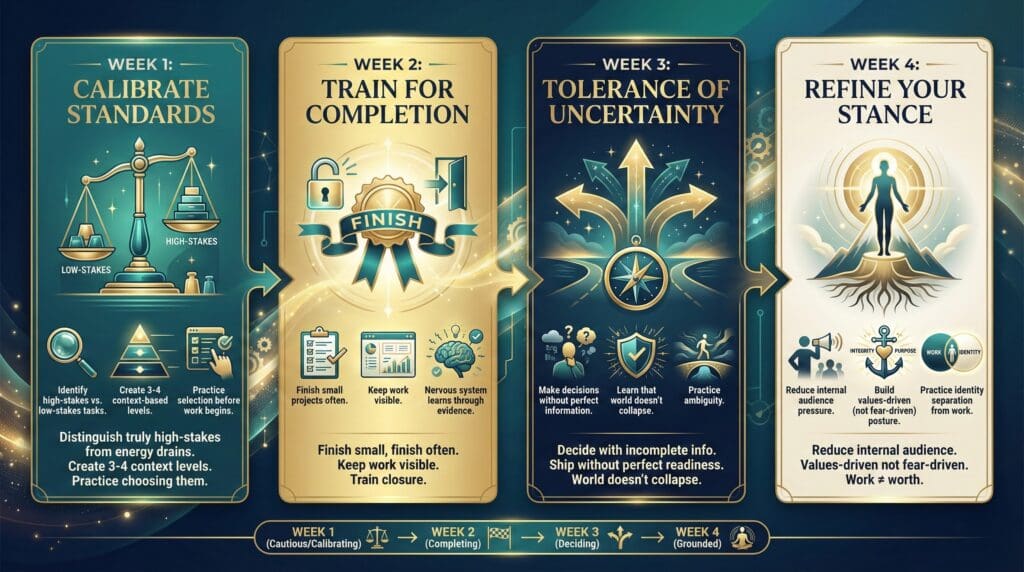
In the first week, we calibrate standards. We identify which tasks are truly high-stakes and which ones are draining you for no reason. We create context-based levels and practice choosing them before work begins.
In the second week, we train for completion. The client finishes small, often, and keeps the work visible. The nervous system learns through evidence.
In the third week, we train in tolerance of uncertainty. The client makes decisions without perfect information and learns that the world does not collapse.
In the fourth week, we refine our stance on identity. We reduce internal audience pressure and build a more stable internal posture: values-driven, not fear-driven.
Perfectionism vs high standards becomes less confusing because the body starts giving different signals. Work feels cleaner. Decisions feel simpler. Rest becomes possible again.
FAQs: Perfectionism vs High Standards
What is the simplest way to tell perfectionism vs high standards apart?
High standards are u003cstrongu003econtext-based criteriau003c/strongu003e: they scale up or down depending on stakes, time, and purpose. Perfectionism is u003cstrongu003ethreat-based controlu003c/strongu003e: it regards being “wrong” as socially dangerous, so the work becomes a shield rather than a tool. If your standards can flex, they are not standards. If your body can’t relax until it’s flawless, you’re in protection.
Can perfectionism still produce high-quality work?
Yes—and that is why it is so deceptive. Perfectionism can produce impressive output, but it often comes with hidden costs: delayed starts, “almost done” paralysis, overchecking, and post-delivery rumination. The question isn’t, “Is the work good?” The question is, “What did it cost your nervous system to get there?”
Why do I freeze at the beginning if I’m capable?
Because starting is the first moment of u003cstrongu003eexposure, u003c/strongu003eu003cspan style=u0022box-sizing: border-box; margin: 0px; padding: 0px;u0022u003emau003c/spanu003eny clients interpret the early phase as high risk: once you begin, you can be judged. The delay is not laziness; it’s a protective prediction—“If I don’t start, I can’t be evaluated yet.”
Why does the last 10% take the longest?
The last 10% is where work becomes u003cstrongu003evisible and finalu003c/strongu003e—final means it can be measured, compared, and criticized. Perfectionism often spikes right before completion because completion removes escape routes. High standards finish strategically; perfectionism stalls because finishing feels like stepping into an evaluation.
What’s the difference between refining and overchecking?
Refining improves outcomes in measurable ways: clarity, accuracy, persuasiveness, or usability. Overchecking is reassurance-seeking dressed as quality control. A clean test: “If I do this extra pass, what specific improvement will it create?” If you can’t name one, you’re likely feeding the loop.
Why does feedback hit so hard even when it’s minor?
In a standards-driven state, feedback is information. In a threat-driven state, feedback becomes an identity verdict. The intensity is not about the comment—it’s about what your brain believes the comment implies: competence, status, belonging, or safety.
Is perfectionism a trauma response?
It can be, but it doesn’t require trauma to form. Many clients learned perfectionism through u003cstrongu003econditioningu003c/strongu003e: praise only for exceptional performance, punishment for mistakes, unstable expectations, or environments where being “good enough” was not safe. It is best understood as an adaptation that once reduced social risk.
What role does evolution play in perfectionism?
Humans evolved in small groups where social exclusion had real survival consequences. Your brain is built to treat evaluation as meaningful. Perfectionism is an “anti-exclusion strategy”: a way to reduce the risk of rejection by controlling outcomes. The circuitry is old; the modern visibility economy gives it more triggers.
The patterns described in this article were built through thousands of neural repetitions — and they require targeted intervention to rewire. Real-Time Neuroplasticity™ provides the mechanism: intervening during the live moments when the pattern activates, building new neural evidence that a different response is architecturally possible.
If this pattern has persisted despite your understanding of it, the neural architecture sustaining it is identifiable and addressable. A strategy call with Dr. Ceruto maps the specific circuits driving the cycle and identifies whether it can be interrupted at its neurological source rather than managed from its surface.
Key Takeaways
- Perfectionism and high standards look identical from the outside but run on entirely different neural circuits: perfectionism is driven by the amygdala’s fear of failure, while high standards are driven by the prefrontal cortex’s pursuit of excellence.
- The functional difference is the direction of motivation: perfectionism moves away from failure (avoidance-motivated), while high standards move toward a goal (approach-motivated). Same behavior, opposite neurological driver, dramatically different outcomes under pressure.
- Perfectionism reliably produces procrastination because the amygdala classifies “imperfect attempt” as a threat — delaying action protects against the emotional pain of visible inadequacy more than it protects against actual failure.
- High standards are sustainable because they allow iteration: the prefrontal circuit can acknowledge a gap between current and desired performance without classifying that gap as a threat to identity or safety.
- Perfectionism is not a personality trait — it is a fear response that has been rationalized as a productivity strategy. It is addressable through the same neuroplastic mechanisms as any other automated threat pattern.
| Dimension | Perfectionism | High Standards |
|---|---|---|
| Primary driver | Fear of failure / inadequacy (amygdala threat avoidance) | Pursuit of excellence / mastery (prefrontal approach motivation) |
| Relationship to mistakes | Catastrophic — mistakes threaten identity and safety | Informative — mistakes are data for improvement |
| Performance under pressure | Degrades — threat activation narrows focus and access to creative solutions | Sustains — approach motivation is robust under challenge |
| Procrastination risk | High — starting exposes work to evaluation; delay is protective | Low — progress toward a goal is rewarding, not threatening |
| Finishing rate | Lower — standards become impossible as completion approaches; abandonment protects against evaluation | Higher — completion is the goal, not perfect execution |
| Self-assessment | Identity-fused — “I failed” = “I am a failure” | Performance-separated — “This didn’t work” = “I need a different approach” |
Perfectionism is not high standards. It is fear wearing the costume of standards. The brain running perfectionism is not trying to produce excellent work — it is trying to avoid the emotional pain of visible inadequacy. Those are different goals, and they produce different outcomes.
Frequently Asked Questions
Is perfectionism always harmful?
Perfectionism produces mixed outcomes in low-stakes contexts but reliably degrades performance and well-being in high-stakes, high-pressure, or creative domains. Research distinguishes “adaptive” from “maladaptive” perfectionism — but the adaptive variant is better described as high standards (approach-motivated, tolerant of iteration) rather than perfectionism proper (avoidance-motivated, intolerant of inadequacy). True perfectionism — driven by fear of failure rather than pursuit of excellence — consistently produces procrastination, burnout, creative inhibition, and relationship strain under pressure. The contexts where it appears to “work” are typically those where the fear happens to align with a high-effort standard, not because fear is a productive motivational architecture.
Why does perfectionism lead to procrastination?
The amygdala circuit driving perfectionism classifies an imperfect attempt as a threat — specifically, the threat of being seen as inadequate. Procrastination protects against that threat: if you never start, you never produce imperfect work that exposes inadequacy. The delay is not laziness; it is the nervous system implementing a threat-avoidance strategy. The perfectionist brain often produces the most elaborate justifications for delay precisely because the amygdala’s threat signal is strong and the prefrontal rationalization engine is also strong. The result is high-functioning procrastination: extremely busy with everything except the thing that exposes the person to evaluation.
How do you know if you have perfectionism or high standards?
The diagnostic question is: what does an imperfect result feel like? High standards: disappointing, motivating, informative — producing a drive to iterate. Perfectionism: threatening, shameful, identity-undermining — producing a drive to explain, hide, or abandon. A second diagnostic: what happens to your performance and output under high pressure? High standards tend to be robust — the approach motivation sustains focus even under challenge. Perfectionism degrades — the amygdala threat activation under pressure further narrows the prefrontal capacity that producing good work requires. If pressure consistently reduces both your output quality and your willingness to attempt, the driver is avoidance, not excellence.
Can perfectionism be rewired into high standards?
Yes — the distinction between perfectionism and high standards is a difference in which circuit is dominant, not which circuits exist. Every perfectionist also has prefrontal approach-motivation circuitry; it has simply been outcompeted by the amygdala’s fear response in the relevant performance contexts. Rewiring involves building the approach-motivation circuit’s dominance in those contexts while reducing the amygdala’s threat classification of imperfection. This requires practice specifically in the situations that trigger perfectionism — not in low-activation states, but inside the activation itself. The target is the moment the imperfect attempt registers as threatening, and the intervention is in that live moment.
Do perfectionists actually produce better work?
In narrow, low-pressure contexts, perfectionism can produce meticulous output. In complex, creative, iterative, or time-pressured domains — which describe most meaningful work — perfectionism reliably underperforms high standards. The mechanism: perfectionism narrows what gets attempted (only projects where success is likely), reduces iteration speed (each revision is emotionally costly), and degrades performance under deadlines (threat activation shrinks the prefrontal capacity that creative and complex work requires). High achievers who identify as perfectionists are typically succeeding despite their perfectionism, not because of it — sustained by talent, effort, and occasional approach-motivation breaking through the fear architecture.
Career & Performance — MindLAB Locations
References
- Flett, G. L., & Hewitt, P. L. (2002). Perfectionism and maladjustment: An overview of theoretical, definitional, and treatment issues. In G. L. Flett & P. L. Hewitt (Eds.), Perfectionism: Theory, Research, and Treatment (pp. 5-31). American Psychological Association.
- Elliot, A. J., & McGregor, H. A. (2001). A 2 × 2 achievement goal framework. Journal of Personality and Social Psychology, 80(3), 501-519. DOI
- Eisenberger, N. I., & Lieberman, M. D. (2004). Why rejection hurts: A common neural alarm system for physical and social pain. Trends in Cognitive Sciences, 8(7), 294-300. DOI
If perfectionism has become the obstacle rather than the standard — if the fear of imperfect work is producing more avoidance than excellence — the threat circuit behind it is identifiable and adjustable. A strategy call with Dr. Ceruto maps the specific pattern and the intervention that shifts it from avoidance to approach.
This article is part of our Leadership & Executive Performance collection. Explore the full series for deeper insights into leadership & executive performance.