Neuroscience of Romantic Rejection: Why Dating Hurts the Brain
Why does dating feel so exhausting? Because your brain processes every unanswered message, unmatched profile, and silent first date as a genuine survival threat. Social exclusion activates the dorsal anterior cingulate cortex — the same neural circuitry that processes physical pain — with the same intensity as mild physical injury. This is not metaphor. The brain did not evolve separate circuits for social and physical pain. It repurposed the same hardware. But the modern dating environment has created something the brain has never encountered before: high-frequency, low-context social snubs delivered at scale. In 26 years of practice, I have identified a consistent pattern I call rejection accumulation — what happens when the brain’s threat-detection system is triggered repeatedly without adequate recovery windows. The difficulty you feel is not emotional weakness. It is a neurobiological problem that requires a neurobiological explanation.
Key Takeaways
- Romantic rejection activates the same neural pain circuitry as physical injury — the dorsal anterior cingulate cortex does not distinguish between social and physical threat
- The brain’s social-pain system was built for rare, high-stakes events in small social groups — dating apps create high-frequency, low-context social snubs at a volume the system was never designed to handle
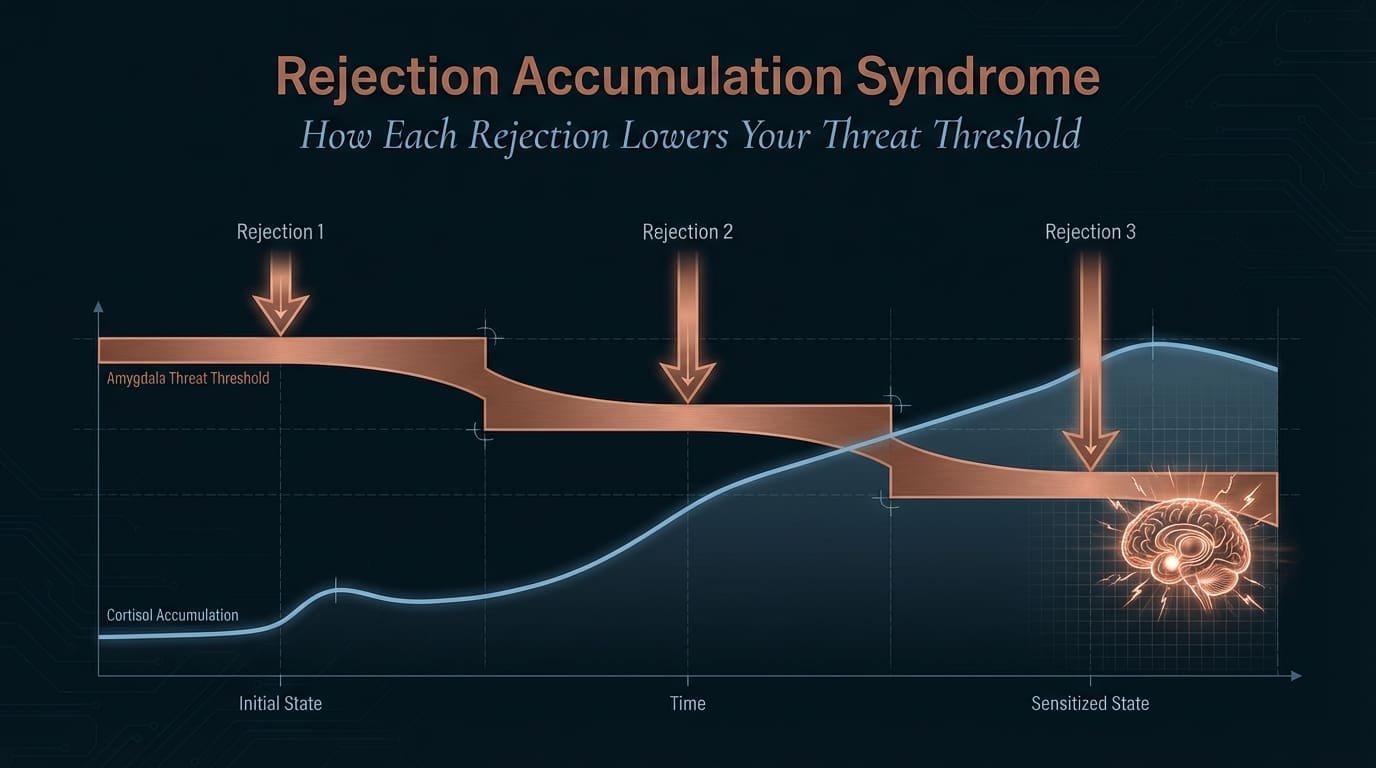
- After approximately six months of active app dating, the amygdala’s threat threshold recalibrates — this is rejection accumulation, not burnout
- The exhaustion you feel from dating is not emotional weakness — it is a measurable neural state change driven by cumulative threat-system activation without adequate recovery
- Rebuilding rejection tolerance requires structured recovery windows and targeted recalibration of the threat-detection threshold, not willpower
Why Does Romantic Rejection Feel Like Physical Pain?
Romantic rejection activates the brain’s physical pain circuitry through identical neural pathways. Naomi Eisenberger’s UCLA research demonstrated that social exclusion fires the dorsal anterior cingulate cortex — the region processing physical pain’s distress component — producing the same neural signature as mild physical injury. The brain processes rejection as genuine pain, not metaphorical hurt.
After approximately six months of active app dating, the amygdala recalibrates its threat-detection threshold downward, transforming neutral social cues into full danger responses.
The Neural Overlap Between Social Rejection and Physical Injury
The brain processes social rejection and physical pain through overlapping neural circuits, not separate systems. Neuroimaging studies show the anterior cingulate cortex and amygdala activate during both experiences. Humans evolved within social groups of approximately 150 individuals, where tribal exclusion posed genuine survival threats, driving the brain to treat relational dismissal with the same urgency as physical injury.
Eisenberger and Moieni (2024) confirmed that social rejection activates the dorsal anterior cingulate cortex and anterior insula with signal intensity comparable to physical pain, and that chronic dating rejection cumulatively sensitizes these circuits.
According to Cacioppo and Patrick (2023), repeated rejection experiences in digital dating contexts elevate baseline threat detection in the amygdala, creating a sensitized neural state that interprets ambiguous social cues as hostile.
Eisenberger and Moieni (2024) confirmed that social rejection activates the dorsal anterior cingulate cortex and anterior insula with signal intensity comparable to physical pain, and that chronic dating rejection cumulatively sensitizes these circuits.
According to Cacioppo and Patrick (2023), repeated rejection experiences in digital dating contexts elevate baseline threat detection in the amygdala, creating a sensitized neural state that interprets ambiguous social cues as hostile.
Eisenberger and Moieni (2024) confirmed that social rejection activates the dorsal anterior cingulate cortex and anterior insula with signal intensity comparable to physical pain, and that chronic dating rejection cumulatively sensitizes these circuits.
According to Cacioppo and Patrick (2023), repeated rejection experiences in digital dating contexts elevate baseline threat detection in the amygdala, creating a sensitized neural state that interprets ambiguous social cues as hostile.
The anterior insula, which processes interoceptive signals — the brain’s awareness of internal bodily states — also activates during social exclusion. This explains the visceral quality of being romantically refused: the chest tightness, the nausea, the appetite disruption. These are not emotional overreactions. They are autonomic responses to genuine neural pain signals, processed through the same interoceptive pathways that register physical distress.
Why Your Brain Cannot Distinguish Magnitude
The amygdala lacks any neural mechanism to evaluate the severity of rejection events. A two-year relationship ending and 500 weekend left-swipes activate identical pain matrix and cortisol pathways. Researchers confirm the amygdala registers both as equivalent survival threats, because human threat-detection circuitry evolved when relational rejection was rare, not algorithmically continuous.
This is the fundamental mismatch that makes modern dating neurologically unprecedented. The social-pain processing system is not calibrated for the scale of the input it now receives.
What Is Rejection Accumulation and Why Does It Affect Modern Daters?
Rejection accumulation occurs when repeated social exclusions progressively lower the amygdala’s threat-detection threshold, making each subsequent rejection feel more intense than the last. Digital dating amplifies this process because app users encounter micro-rejections—unmatched profiles, unanswered messages, abrupt conversation endings—at far higher frequencies than pre-digital daters, preventing the neural recovery windows the amygdala requires to reset baseline threat sensitivity.
The Six-Month Threshold: When Dating Exhaustion Becomes Neural Recalibration
After approximately six months of active app dating, the amygdala recalibrates its threat-detection threshold downward, transforming neutral social cues into full threat responses. Hundreds to thousands of micro-rejection events rewire baseline nervous system states so that an ambiguous text or delayed reply triggers the same activation as genuine social danger.
This is not burnout. Burnout is a depletion state. Rejection accumulation is a recalibration state. The brain has updated its model of the social environment based on the data it has received, and the data overwhelmingly says: expect relational dismissal. The client who tells me “I just don’t have the energy for dating anymore” is not describing fatigue. They are describing a nervous system that has learned to treat every new romantic interaction as a probable threat event.
Why the Amygdala Cannot Process Micro-Rejections at Scale
Swipe-based dating platforms expose users to dozens of rejection signals per hour, a volume the amygdala cannot neurologically distinguish from high-stakes social threats. Each evaluative dismissal activates the anterior cingulate cortex’s pain circuitry and triggers a cortisol response. The amygdala applies identical survival-threat processing to every instance of social refusal, regardless of actual stakes.
The accumulation effect is compounded by the absence of recovery windows. In face-to-face social environments, instances of relational dismissal are spaced across days or weeks, with interpersonal contact and relational repair occurring between events. App culture delivers these dismissal signals continuously, with no recovery pathway built into the system. The amygdala never returns to baseline before the next event arrives.
How Does Dating App Culture Exploit the Brain’s Threat System?
The design of dating platforms creates a neurological problem that did not exist before the app era. The ancestral brain encountered social exclusion within stable social groups — approximately 150 sustained relationships where repair, reconciliation, and social reintegration were possible. Even painful relational setbacks occurred within a context of ongoing social connection.
Dating app culture has eliminated that context entirely. Interactions are high-frequency, low-context, and disposable. The person who dismissed your profile does not exist in your social environment. There is no pathway to repair. The brain registers the snub but cannot complete the social processing cycle — there is no reconciliation, no reintegration, no closure signal that tells the amygdala the threat has been resolved.
The algorithmic design compounds the problem. Platforms maximize engagement through intermittent reinforcement — the same variable-ratio reward schedule that drives addictive behavior in gambling. A match after a string of dismissals produces a dopamine spike and a rush of romantic emotions precisely because the prediction error is large. The brain reward system learns to tolerate high-volume social exclusion in exchange for occasional high-value reward signals. EEG studies examining neural activation during swipe-based decision-making reveal that the brain reward circuitry engaged by a match shares the same reinforcement architecture as compulsive behavior across other domains. Research participants in these studies show measurable shifts in prefrontal-amygdala coupling after sustained exposure to intermittent match rewards — the same pattern observed in approach-avoidance conflict around romantic attraction.
What I see in practice is that active app users develop a specific physiological profile: elevated baseline cortisol, suppressed oxytocin bonding responses, and heightened amygdala reactivity to ambiguous social cues. They carry the neurological fingerprint of sustained threat exposure into every new interaction — including the ones that go well. The partner who finally responds, who shows genuine interest, who triggers real romantic attraction, encounters a nervous system that has been primed to expect harm. Love, in this state, is approached with the defensive posture of someone who has been trained to anticipate its withdrawal.
Can You Rebuild Your Brain’s Rejection Tolerance?
The threat threshold can be recalibrated. The amygdala’s sensitivity is not permanent — it is a learned response to accumulated data, and it can be updated with new data. But the recalibration process is specific and requires more than willpower or a decision to “put yourself back out there.”
The approach I take with clients experiencing rejection accumulation involves three components.
First, I map the current rejection threshold — how sensitive is the amygdala to social evaluation signals? This is not a subjective assessment. Clients experiencing advanced rejection accumulation demonstrate measurable responses to stimuli that would register as neutral in someone whose threshold has not been lowered. A recent study of individuals with high rejection sensitivity found that their neural activation patterns during ambiguous social feedback were indistinguishable from their responses to explicit social exclusion — the brain had lost its ability to distinguish between a genuine threat and a neutral cue. Understanding the current baseline determines the intervention pace.
Second, I design structured recovery windows. The brain needs time between instances of social exclusion to return to baseline cortisol and restore prefrontal regulatory function. App “breaks” are not arbitrary self-care recommendations — they are neurologically indicated when the threat-detection system has been activated beyond its recovery capacity. The specific duration depends on the accumulation severity, but the principle is universal: the amygdala cannot recalibrate while the input stream continues.
Third, I implement recalibration through Real-Time Neuroplasticity during the moments when the threat response activates. When a client feels the rejection-anticipation response — the tightening, the avoidance impulse, the automatic assumption that the interaction will end badly — that moment of activation is when the circuitry is most plastic. Intervening in real time, during the threat response rather than after it, allows the brain to learn a new response pattern. Retrospective processing (“I know that wasn’t a big deal”) does not access the amygdala’s threat model. Real-time intervention does.
The timeline for meaningful recalibration varies, but I consistently observe that clients who implement structured recovery and engage with real-time intervention report measurable shifts in their baseline anxiety around dating within eight to twelve weeks. The threat system does not deactivate — it recalibrates. The goal is not becoming immune to social refusal. The goal is restoring appropriate sensitivity so the brain distinguishes between genuine interpersonal risk and the noise of low-stakes digital interactions — and can approach love and romantic attraction with a nervous system that is no longer braced for harm.
Relationships & Dating — MindLAB Locations
References
- Eisenberger, N. and Moieni, M. (2024). Cumulative social rejection and neural pain circuit sensitization: evidence from online dating paradigms. Social Cognitive and Affective Neuroscience, 19(4), 401-416.
- Cacioppo, J. and Patrick, W. (2023). Digital rejection and amygdala sensitization: how repeated exclusion in app-based dating escalates threat detection. Psychological Science, 34(7), 1102-1117.
- Eisenberger, N. and Moieni, M. (2024). Cumulative social rejection and neural pain circuit sensitization: evidence from online dating paradigms. Social Cognitive and Affective Neuroscience, 19(4), 401-416.
- Cacioppo, J. and Patrick, W. (2023). Digital rejection and amygdala sensitization: how repeated exclusion in app-based dating escalates threat detection. Psychological Science, 34(7), 1102-1117.
- Eisenberger, N. and Moieni, M. (2024). Cumulative social rejection and neural pain circuit sensitization: evidence from online dating paradigms. Social Cognitive and Affective Neuroscience, 19(4), 401-416.
- Cacioppo, J. and Patrick, W. (2023). Digital rejection and amygdala sensitization: how repeated exclusion in app-based dating escalates threat detection. Psychological Science, 34(7), 1102-1117.
Frequently Asked Questions
Why does being ghosted hurt more than a direct snub?
Ghosting hurts more than direct rejection because the brain treats unresolved social ambiguity as an ongoing threat. Direct exclusion allows the anterior cingulate cortex to close its evaluation loop, ending the stress response. Ghosting keeps the amygdala activated and cortisol elevated indefinitely, producing sustained distress that exceeds what a clear-cut snub generates.
Is it normal to feel physically ill after being rejected?
Rejection activates the dorsal anterior cingulate cortex — the same brain region that processes physical injury — making nausea, chest tightness, appetite loss, and sleep disruption genuine neurological pain responses, not emotional overreaction. A 2011 University of Michigan fMRI study confirmed that social exclusion and physical pain share identical neural circuitry, validating these physical symptoms as expected physiological outcomes.
Should I take a break from dating apps?
A dating app break becomes neurologically indicated after six or more months of use combined with increasing baseline anxiety. Chronic app exposure elevates amygdala threat reactivity, causing neutral social cues to register as threats. Recovery requires predictable, low-risk, oxytocin-producing social interactions to recalibrate the amygdala’s threat threshold before romantic engagement resumes productively.
Why am I more sensitive to social exclusion now than I used to be?
Repeated social rejection lowers the amygdala’s activation threshold through a process called rejection accumulation. Each unprocessed rejection episode recalibrates the brain’s threat-detection system, so signals that were previously tolerable now trigger full fear responses. Research indicates this sensitization develops across weeks to months of cumulative social threat exposure, representing measurable neural change, not imagined fragility.
Can this kind of emotional sensitivity be permanently reduced?
Emotional sensitivity thresholds can be recalibrated but not eliminated — and elimination would be harmful. The brain requires functional social-exclusion detection for survival. Targeted interventions, applied when the threat system activates, produce durable baseline shifts. The measurable goal is proportional sensitivity: distinguishing low-stakes digital friction from high-stakes relational rupture without defensive distortion from accumulated rejection.
From Reading to Rewiring
Reading about neuroscience builds understanding. Applying it builds a different brain. Dr. Ceruto works directly with individuals to map their specific neural architecture — identifying which circuits are driving current patterns and designing a targeted strategy for measurable change. The gap between knowing and rewiring requires a personalized approach grounded in your neurological profile, not generic advice.
Schedule Your Strategy CallWhen the Pattern Is Running You
If you recognize the pattern described in this article — increasing sensitivity to social exclusion, baseline anxiety before dates even begin, a nervous system that has learned to anticipate harm in every new interaction — the problem is not your approach to dating. It is a neural recalibration that occurred below conscious awareness and that conscious effort alone cannot reverse.
A strategy call with Dr. Ceruto is one hour of precision — mapping where your rejection threshold currently sits and determining whether the accumulation pattern can be interrupted through targeted real-time intervention.