Key Takeaways
- Caring and staying emotionally engaged are separate capacities: love is not emotional skill.
- Patterns matter more than promises: follow-through during conflict and repair, not fleeting warmth.
- Chasing, over-explaining, and shrinking your needs usually strengthen the avoidance loop and erode your self-trust.
- Small, specific requests with clear time boundaries reduce threat and reveal genuine willingness.
- Your nervous system reads reliability: chronic loneliness inside a relationship is real data, not oversensitivity.
When you can love deeply but your partner cannot meet you there, the pain is uniquely confusing: you do not doubt that they care, yet closeness keeps slipping away exactly when you reach for it. This is rarely a character flaw. It is a nervous system that learned, early, to read emotional depth as danger and to protect itself by pulling back. Understanding that mechanism is what lets you decide clearly what is changeable and what is not, a clarity that relationship intelligence grounded in the brain makes possible.
If you are reading this, you are not looking for a quote about “self-love.” You want clarity: to know whether you are asking for too much, whether your needs are “dramatic,” or whether you are slowly training your brain to accept less than you deserve. You also want to understand what is actually happening inside a nervous system when emotional depth feels unsafe. This is not about blaming your partner, and it is not about blaming you for caring. It is a neuroscience-based map of emotional depth mismatch: why one person reaches for depth while the other retreats, why love does not land, and what to do next.
I will add something personal, because it matters to me that you know I am not writing this only from an authoritative place. I have loved deeply, and I have also been with an emotionally unavailable partner. The confusing part was that I never doubted they cared: the pain came from their inability to consistently hold, accept, or stay present with the depth of love I was offering. It was not a lack of love. It was a question of individual capacity, nervous-system threat, and emotional skill. If you have been loving that openly and still feel alone, there is nothing wrong with your depth. The mismatch is real, and you deserve clarity about what is changeable and what is not.

What “emotionally unavailable” really means
The phrase is shorthand for three distinct patterns, and separating them matters before any major decision. There is an emotional skill gap: your partner wants closeness but lacks the skills to build it. There is an emotional depth mismatch: they can connect, but not to the level you need. And there is emotional avoidance: they experience closeness itself as a threat and protect themselves by distancing. Early affect-regulation experiences shape the neural architecture that governs emotional access in adult relationships, which is why each of these patterns is biologically distinct rather than a simple choice. The profile most people mean is the third: the person may be kind, capable, and loyal, showing up at work and handling responsibilities, but when it is time for vulnerability, repair, or emotional intimacy, they shut down, deflect, get irritated, disappear, or turn the conversation into something else.
Emotional unavailability is rarely a character flaw. It is a nervous system that learned early to read depth as danger and to protect itself by pulling back.
Common signs of an emotionally unavailable partner
The signs below are the relational view, what the pattern looks like across weeks of a relationship. For the full neural breakdown of each one, the companion guide details the signs of emotional unavailability in relationships and the brain architecture beneath them.
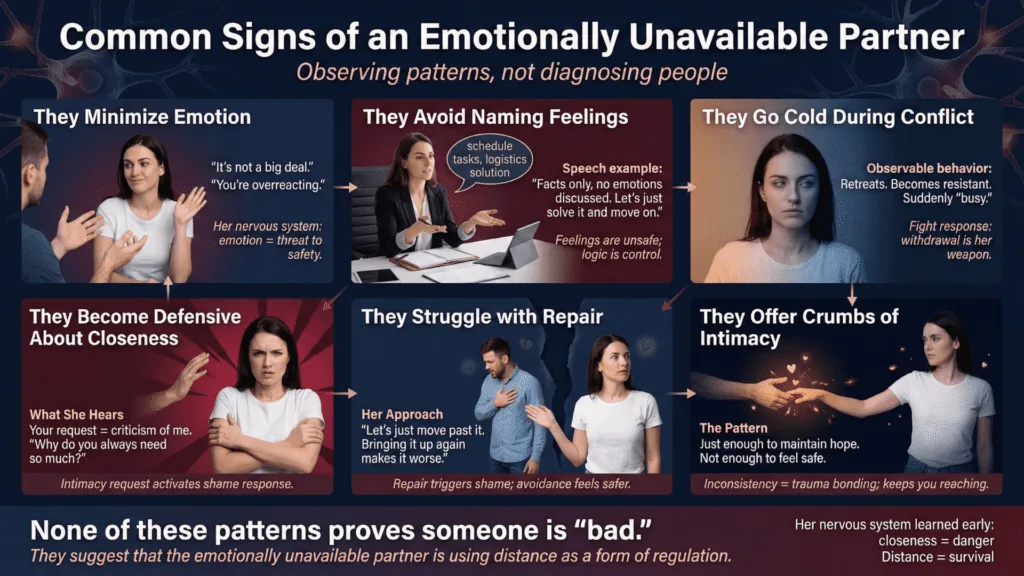
Recognizing the pattern means watching behavior over time rather than isolated incidents, and remembering that the autonomic nervous system drives much of this below conscious awareness: the distance is often automatic protection, not a deliberate decision to withhold. The recurring signs: they minimize emotion (“it’s not a big deal”); they avoid naming feelings and talk only in facts and logistics; they go cold or preoccupied during conflict; they become defensive when you ask for closeness, hearing your needs as criticism; they struggle to repair, wanting to “move on” without addressing the wound; and they offer just enough intimacy to keep hope alive but not enough to feel safe. None of these prove someone is “bad.” They suggest the person is using distance as a form of self-regulation.
Emotional depth mismatch vs. love-language mismatch
Many couples assume the problem is a love-language mismatch (one feels loved through words, the other through acts) and that can be real and often resolvable through changes in how you communicate. Emotional depth mismatch is different. It is not about whether they buy flowers; it is about whether they can stay with your inner world, tolerate emotional truth without shutting down, and hear “I feel lonely” without reacting as if attacked. That is why you can notice such a confusing split: they can be generous and still feel far away, loyal and still emotionally absent, wanting your presence yet avoiding you the moment you are being authentic. You are asking for connection at a depth their nervous system has not yet learned to hold.
Why deep love can feel unsafe in the brain
To understand an emotionally unavailable partner, you have to understand safety, not romance. Your nervous system is always asking one question: am I safe right now? When the answer is yes, the brain can access curiosity, empathy, and intimacy. When the answer is no, it shifts into protection, which can look like fight (arguing, blaming), flight (leaving, avoiding), freeze (shutting down), or fawn (people-pleasing). Emotional unavailability most often maps to the flight and freeze responses, and the partner usually does not consciously choose the distance: their body chooses it first.
Here is the core mechanism: for some people, emotional closeness was paired with danger early in life. Closeness may have meant criticism, control, rejection, shame, or chaos, so the nervous system learned a rule: intimacy equals risk. Later, in adult relationships, the person can love you and still feel threatened by emotional depth. When you ask for vulnerability, you are not only asking for closeness; you may be tripping an outdated alarm. The somatic markers formed through early relational wiring keep generating threat responses in adult intimate contexts even when the present environment is completely safe, which is why logic alone rarely reaches the pattern.
The avoidance loop: how it becomes a pattern
Emotional unavailability tends to run in a predictable loop. You move toward depth: you want a real conversation, a repair, reassurance. Their nervous system reads it as pressure, even a demand. They create distance: shut down, get irritated, change the subject, or disappear. You escalate: repeating yourself, over-explaining, trying harder, expressing more. They distance further, and the gap widens. You feel abandoned; they feel controlled; both of you end up alone. This is not a moral failure: it is a nervous-system mismatch, but it still has consequences. Over time your brain begins to associate love with uncertainty, your body starts scanning for the next withdrawal, and the relationship quietly erodes the trust it is supposed to build.
The day-to-day cost of loving someone who cannot go deep
Stay long enough and you may notice changes in yourself: you overthink every shift in tone, replay conversations in your head, shrink your needs to avoid conflict, and become “high-functioning” and numb at the same time. The loneliness is confusing because the surface looks fine: they show up, handle logistics, do responsible things, but when emotional availability is needed, they fade. Day to day it arrives as “micro-rejections”: you reach for their hand and they don’t notice; you share something vulnerable and they change the subject; you cry and they go silent, then act as if nothing happened. Each one is small enough that you feel silly naming it, yet consistent enough that your body starts to brace. Those moments teach the nervous system a painful lesson: closeness is not reliable here, and you begin adapting to the pattern you have learned to expect, often sliding into the kind of self-doubt that asks “am I too sensitive? am I asking for too much?” When your partner carries avoidant tendencies, your bid for closeness feels to them like pressure while their withdrawal feels to you like rejection, and over time that distance can extend to physical intimacy as well, creating the disconnection patterns of a sexless marriage neither person intended. If you are living with a chronic lack of emotional connection, your brain will read the relationship as an unstable environment and push you toward hypervigilance, rumination, and emotional exhaustion. That does not mean you are weak. It means your nervous system is doing its job.
How to tell whether change is actually possible
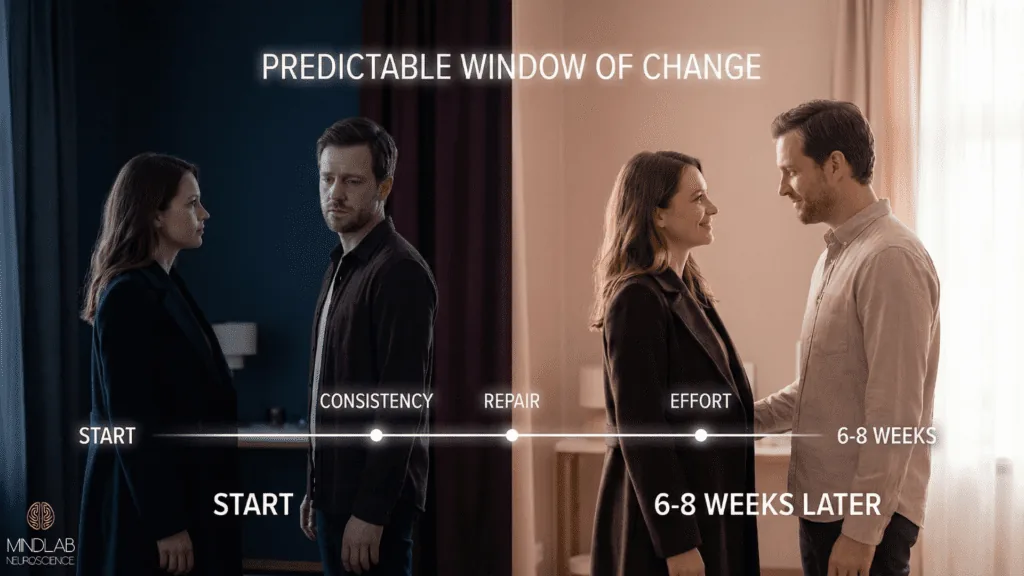
Not every emotionally unavailable partner is permanently stuck. The key question is not “do they love me?” but “can they build emotional capacity with me?” Love is usually present; availability is the variable. To answer it honestly, stop listening only to hope and start tracking evidence over a defined window, roughly six to eight weeks. Five tests cut through the fog.
First, can they name the pattern without attacking you? Someone who can grow might say, “I get overwhelmed when emotions get intense,” or “I shut down when I feel like I’m failing.” Someone who cannot usually denies it, minimizes it, or flips it onto you: “you’re too sensitive,” “this is just how I am.” That tells you whether they can tolerate self-reflection, and without self-reflection there is no growth. Second, do they show willingness, not just agreement? Look for small concrete behaviors: staying in a hard conversation two minutes longer than last time, answering a feeling question without sarcasm, initiating a check-in even when it is awkward, apologizing without turning it into a debate, repairing instead of pretending nothing happened. Third, is there follow-through in that predictable window? A partner who can change should show at least some measurable movement: more consistency under stress, less stonewalling, more repair attempts, even if imperfect. Fourth, what happens when you stop over-functioning? When you stop carrying the relationship out of a codependent pattern, a partner who can change notices the gap and steps in; one who cannot enjoys the quiet and lets the distance grow. If you stop chasing and the relationship goes emotionally dead, that is not cruelty: it is data. Fifth, and deepest: does the relationship make you more yourself or less? If being with them is making you smaller, quieter, more anxious, and more careful with your feelings, the relationship is training your nervous system to tolerate less and less connection, and even if they are not “bad,” the outcome is still damaging.
The bottom line: an emotionally unavailable partner can change only if they have both willingness and capacity. Willingness is what they choose; capacity is what their nervous system can currently tolerate. If either is missing, you will keep living the same cycle, and you deserve more than building your whole life around someone else’s emotional limits. Green flags are real: they can admit “I don’t know how to do this but I want to learn,” practice specific tools rather than just discuss them, tolerate your emotions without punishing you, follow through on small agreements, and seek help when stuck. Red flags are just as clear: they mock your needs or call you “too much,” refuse accountability and rewrite history, punish you with silence after you share feelings, and only warm up when they sense you are about to leave.
Why you may bond harder to an emotionally unavailable partner
Many people feel embarrassed by this: “Why do I want them more when they withdraw?” Two mechanisms explain it. First, scarcity creates intensity: when affection is inconsistent, the brain starts treating it like a reward that must be earned, and intermittent reinforcement strengthens craving in a way that can feel like chemistry. Second, your nervous system may be replaying an old template: if you learned early that love comes with distance, you may mistake that distance for normal and feel oddly bored by steady, available love because it is unfamiliar. This does not mean you “like pain.” It means your brain is trying to solve a familiar puzzle, and recognizing the puzzle is the first step to setting it down.
A neuroscience-based approach: what to stop, and what to do instead
With an emotionally unavailable partner, your most loving instincts often make things worse. Stop over-explaining: the more you explain, the more pressure they feel and the more they withdraw. Stop chasing during a shutdown: chasing teaches their nervous system that distance is the way to get relief. Stop accepting “I don’t know” as the final word, stop taking responsibility for their comfort, and stop turning your needs into a courtroom case. Instead, create conditions that reduce threat and increase capacity. Regulate first, then relate: if you feel activated, pause, slow your breath, relax your jaw and shoulders: you are signaling safety to your own nervous system before you ever speak. Lead with impact, not accusation: “When we don’t talk for two days after a conflict, I feel alone,” rather than “you never care.” Ask for one specific behavior: vague requests feel endless, specific ones feel doable. Use time boundaries to reduce overwhelm (“let’s do ten minutes now and revisit tomorrow”). And track follow-through, not words: watch what they actually do over the next two weeks.
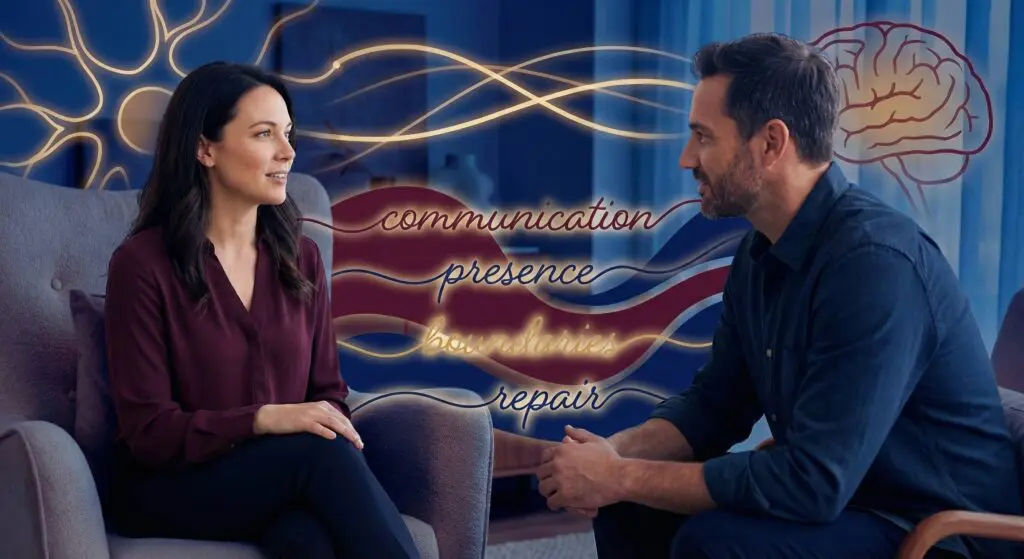
Scripts you can adapt
Use these as templates: rephrase them in your own voice, speak calmly, then pause and let the silence do some work. They are built for a partner who becomes defensive or shuts down under emotional pressure.
- Naming the pattern without blaming: “I care about you and I want us to feel close. I’ve noticed a pattern: when I raise something emotional, you tend to withdraw or redirect, and when that happens I feel alone. I’m not attacking you; I’m asking us to build a better way to talk.”
- Asking for presence instead of solutions: “I’m not asking you to fix this right now. I’m asking you to stay present with me for a few minutes while I share what’s going on inside me. Then you can tell me what you heard.”
- One specific request with a time boundary: “Can we do fifteen minutes tonight with phones away? I’ll share one feeling and one need, and I want to hear one feeling and one need from you. If either of us gets overwhelmed, we pause and come back tomorrow.”
- When they minimize your feelings: “When you say it’s not a big deal, I feel dismissed. It matters because it affects how safe and connected I feel with you. I’m asking you to take it seriously, even if you don’t experience it the same way.”
- When they shut down mid-conversation: “I can see you’re shutting down, so I’m going to stop talking for a moment before this turns into a fight. But I need us to come back to it: can we restart at 8:30 for ten minutes?”
- A clean repair request after conflict: “I want us to repair instead of acting like nothing happened. For me, repair means we name what happened, each own our part, say what we needed, and agree on one thing we’ll do differently next time.”
- A boundary without threats: “I’m willing to work on this with you. I’m not willing to stay in a relationship where emotional connection is repeatedly avoided. If we can’t build a healthier way to communicate, I’ll need to rethink what I’m doing here.”
- The willingness test: “Are you willing to practice a different way of talking about feelings with me, even when it’s uncomfortable? I’m not asking for perfection: I’m asking for effort and follow-through.”
Loving deeply without losing yourself
Loving deeply is not the problem: it is a strength. The trouble begins when you use your depth to earn love from someone who cannot meet you, confusing over-giving with loyalty and endurance with commitment. Deep love is not proved by how long you can tolerate feeling alone. It is proved by mutual care, mutual repair, and mutual presence, by consistency, accountability, and the willingness to stay when it matters. You can hold compassion for why an emotionally unavailable partner struggles and be honest about what you need to feel safe. Both can be true at once.
If you ever rebuild your standards after a relationship like this, do it with softness and clarity rather than hardening into suspicion. Name your non-negotiables plainly: repair after conflict, honesty, emotional presence, respect. Move slowly at the start and bond through consistency rather than chemistry, giving your nervous system time to read the pattern. Watch how they respond to your emotional bids, and check your body, not just your thoughts: do you feel calm more often than anxious, more like yourself or like you are managing the connection? Your nervous system is wise. If you listen, it will tell you when you are safe, and when you are quietly repeating the old dynamic in a new relationship.
I will say this with complete honesty, because I have lived it: I have been in relationships where I could offer a depth of love the other person simply could not return. Sometimes they did love me: it was their capacity to show it, receive it, and stay present that was limited. That is a hard truth, because it forces you to stop bargaining with your own needs. Your love cannot fix someone else’s avoidance. You can offer safety, consistency, and a calm invitation; you cannot build capacity for them. What you can do is choose yourself: ask for what you need, watch behavior over time, and honor your depth. It is a strength, and it deserves a partner and a life that can hold it.
What causes emotional unavailability in a partner, according to neuroscience?
Emotional unavailability often originates in a nervous system that learned to equate vulnerability with danger during early attachment experiences. The brain’s bonding circuits become wired to trigger protective withdrawal rather than approach behavior when intimacy deepens, creating an automatic neural defense that operates below conscious awareness. This is why the distance can feel reflexive to them and bewildering to you.
Why does my partner shut down emotionally when we get closer?
Shutting down is often a freeze-like protective response in which the nervous system reads increasing closeness as a potential threat. The brain’s threat-detection system, operating below awareness, flags emotional depth as unsafe based on early wiring and automatically dampens the social-engagement system to reduce perceived vulnerability. It is a body-level reaction, not a considered choice to reject you.
What is an emotional depth mismatch in a relationship?
An emotional depth mismatch occurs when two partners have nervous systems wired for different levels of closeness and vulnerability. One brain seeks co-regulation through deep connection while the other’s attachment circuitry signals danger at that same depth, creating a painful push-pull dynamic rooted in incompatible safety thresholds. It can exist even when love is genuinely present on both sides.
Can an emotionally unavailable person change their brain wiring?
Neuroplasticity makes it possible, but it requires the person to consistently practice staying present in emotional connection rather than defaulting to withdrawal. Over time, repeated experiences of safe vulnerability can retrain the threat system to stop flagging closeness as dangerous, gradually widening the nervous system’s tolerance for intimacy. The variables that decide it are willingness and capacity, and both have to be present.
Is a mismatch in emotional depth the same as them not loving me?
No. Emotional depth mismatch can exist even when love is real, because love and emotional skill are not the same thing. A partner can care about you and still lack the nervous-system capacity to stay present at the depth you need. But love without emotional connection can still leave you feeling profoundly lonely, and that loneliness is valid data.
What if I am afraid to leave?
That fear is real, and it deserves respect rather than rushing. It may be grief, it may be attachment, and it may be the nervous system’s natural fear of the unknown. You do not have to decide in a single day. What you do need is a plan that protects your dignity and self-trust while you watch behavior over a defined window and let your own nervous system weigh in on whether you feel safe.
References
- Feldman, R. (2012). Oxytocin and social affiliation in humans. Hormones and Behavior, 61(3), 380-391. https://doi.org/10.1016/j.yhbeh.2012.01.008
- Shamay-Tsoory, S. G., and Abu-Akel, A. (2016). The social salience hypothesis of oxytocin. Biological Psychiatry, 79(3), 194-202. https://doi.org/10.1016/j.biopsych.2015.07.020
- Eisenberger, N. I. (2012). The pain of social disconnection: Examining the shared neural underpinnings of physical and social pain. Nature Reviews Neuroscience, 13(6), 421-434. https://doi.org/10.1038/nrn3231
- Coan, J. A., Schaefer, H. S., and Davidson, R. J. (2006). Lending a hand: Social regulation of the neural response to threat. Psychological Science, 17(12), 1032-1039. https://doi.org/10.1111/j.1467-9280.2006.01832.x
- Gross, J. J. (2015). Emotion regulation: Current status and future prospects. Psychological Inquiry, 26(1), 1-26. https://doi.org/10.1080/1047840X.2014.940781
- Ochsner, K. N., and Gross, J. J. (2005). The cognitive control of emotion. Trends in Cognitive Sciences, 9(5), 242-249. https://doi.org/10.1016/j.tics.2005.03.010
Your Depth Is Not the Problem
Deciding what to do with an emotionally unavailable partner is clearer when you can read your own nervous system accurately. Dr. Sydney Ceruto works with the science of neuroplasticity to lower the anxiety, quiet the rumination, and rebuild the self-trust that makes the decision yours. Schedule a strategy call to begin.
Schedule a Strategy Call