Key Takeaways
- The mesolimbic dopamine pathway (VTA → nucleus accumbens) encodes conflict victories as rewards, driving repetitive argument-seeking.
- Dopamine reward prediction errors spike before conflict begins: the brain craves arguing, not the outcome.
- Tolerance develops through dopamine receptor downregulation, requiring progressively more intense conflicts for the same reward.
- Hedonic dysregulation: high-conflict patterns report boredom, not relief, between arguments; reward tracks conflict, not resolution.
- The escalation pattern operates below conscious awareness; willpower, insight, and rational conversation cannot override it.
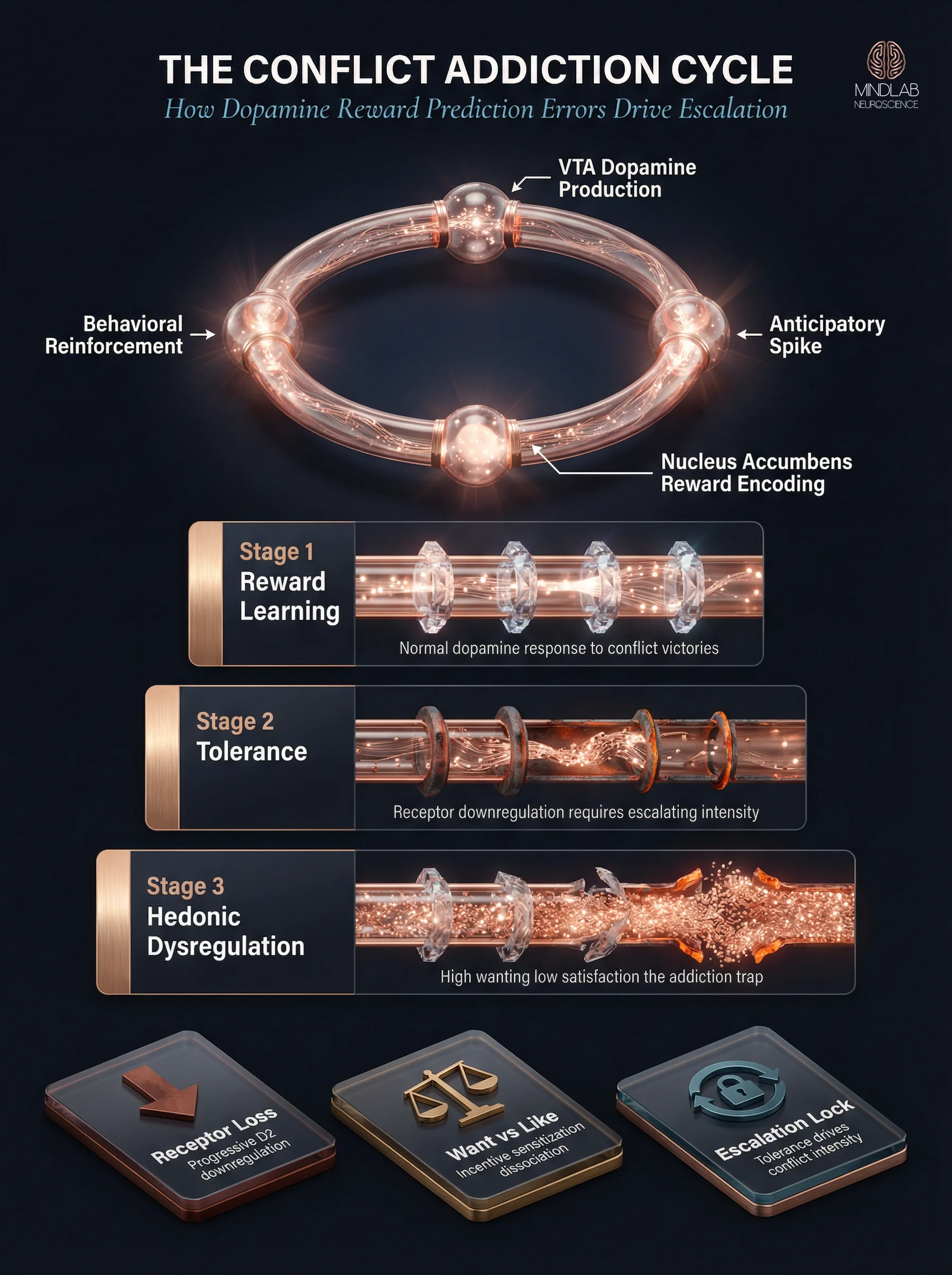
Conflict activates the same dopamine reward circuitry that drives substance dependence. The ventral tegmental area, the brain’s primary dopamine production hub, fires anticipatory signals before an argument even begins, and the nucleus accumbens, the reward encoding center, registers the “victory” as a neurochemical event. Over time, this creates a reinforcement learning loop identical in architecture to how dopamine traps the brain in addiction cycles: the brain requires escalating conflict intensity to produce the same dopamine response. In 26 years of practice at MindLAB Neuroscience, I observe this pattern consistently: individuals who seek conflict don’t experience relief after resolution. They experience boredom.
Can you actually become addicted to conflict?
The brain does not distinguish between dopamine released by a substance and dopamine released by winning an argument. Wolfram Schultz’s research on dopamine reward prediction-error signaling shows the midbrain responds to any stimulus exceeding expectation, including relationship intelligence through neuroscience. The nucleus accumbens encodes each win as rewarding, strengthening the reinforcement learning loop: the brain’s automatic behavior-repetition mechanism.
What makes this architecturally identical to addiction is the prediction-error component. The VTA doesn’t simply respond to winning: it responds to the anticipation of winning. A client I work with described it precisely: the surge begins when the other person says something they can dismantle. Not after they’ve won. Before. That anticipatory dopamine spike is the signature of a reward circuit that has learned to treat conflict as its primary input.
The distinction matters because it shifts the question from “why can’t they stop arguing?” to “what is their dopamine system optimized to pursue?” In every case I’ve mapped in practice, the conflict-seeking individual’s mesolimbic pathway has been trained, through years of reinforcement, to treat interpersonal victory as the highest-value reward available.
Why does winning an argument feel so good to some people?
The nucleus accumbens encodes argument victories using the same reward valuation circuitry that processes financial gains, sexual reward, and drug euphoria. When someone delivers a decisive point in a debate and watches the other person falter, the VTA releases a dopamine burst that the nucleus accumbens registers as a high-value outcome, neurochemically indistinguishable from any other reward event the brain has learned to pursue.
What the research doesn’t capture is the specificity I observe in practice. Not all argument “wins” produce equal dopamine responses. The individuals I work with who exhibit this pattern report that the reward scales with the perceived competence of the opponent. Dismantling a weak argument produces almost nothing. Outmaneuvering someone they respect produces a response they describe as electric. This maps precisely to the dopamine reward prediction error model: the brain calculates expected difficulty, and when the outcome exceeds that expectation, the prediction-error signal amplifies the reward.
“The individuals who seek conflict most intensely aren’t pursuing victory: they’re pursuing the neurochemical spike that only comes from exceeding their own prediction of how the confrontation would unfold.”
This is why logical appeals to “just stop arguing” fail entirely. You’re asking someone to voluntarily abandon their brain’s highest-value reward source through conscious effort alone, a request that has roughly the same success rate as asking someone to will their way out of any other dopamine-mediated compulsion.
What happens in the brain when someone keeps starting fights?
The mesolimbic pathway, running from the VTA through the nucleus accumbens to the prefrontal output regions, undergoes structural strengthening with each conflict-reward cycle. Berridge and Robinson’s incentive-sensitization research demonstrated that repeated dopamine activation doesn’t just reinforce behavior, it sensitizes the wanting system while leaving the liking system unchanged. The brain increasingly wants conflict without increasingly enjoying it.
This dissociation between wanting and liking is what I consistently observe in high-conflict individuals. They describe the buildup to an argument with language that mirrors craving: restlessness, scanning for provocations, a mounting tension that only conflict resolves. But when asked about the aftermath, they rarely describe satisfaction. They describe a brief discharge followed by immediate readiness for the next confrontation.

In a leadership context, this manifests as the executive who cannot tolerate a peaceful quarter. The quarterly review goes well, the numbers are strong, and within days they’ve manufactured a crisis: reorganizing a team, challenging a vendor relationship, escalating a minor disagreement into a strategic confrontation. The pattern is not strategic. The mesolimbic pathway is simply doing what reinforcement learning optimized it to do: seeking the next dopamine input.
How does dopamine drive repetitive conflict behavior?
Tolerance develops in conflict-driven dopamine circuits through the same receptor downregulation mechanism that produces substance tolerance. The nucleus accumbens reduces its dopamine receptor sensitivity in response to chronic overstimulation, requiring progressively more intense stimulation to produce the same reward signal. An argument that produced a significant dopamine response six months ago now barely registers. The brain’s solution is not to reduce conflict-seeking: it is to escalate.
This is the mechanism behind what I see as escalation tolerance across engagements. A client’s partner once described it to me this way: the arguments had to keep getting bigger. Minor disagreements stopped producing any visible response. Only threats (to the relationship, to financial stability, to something genuinely consequential) generated the engagement they recognized as their partner being “present.” The partner wasn’t choosing cruelty. Their reward deficiency had raised the threshold so high that only high-stakes conflict could clear it.

“Tolerance in the conflict-addiction circuit doesn’t produce withdrawal: it produces boredom. And boredom, for a brain wired to pursue conflict, is the most intolerable state of all.”
For a complete framework on understanding and resetting your dopamine reward system, I cover the full science in my book The Dopamine Code (Simon and Schuster, June 2026). The tolerance mechanism driving conflict escalation is one expression of a broader dopamine architecture that governs motivation, pursuit, and reward across every domain.
Why do high-conflict people never seem satisfied after “winning”?
Hedonic dysregulation means the victory is never enough. Each argument produces a brief dopamine burst that decays almost immediately, leaving the reward system in a deficit state that only the next conflict can temporarily resolve. In conflict-driven individuals, this is the terminal stage of dopamine-mediated compulsion: the decoupling of reward pursuit from reward satisfaction.
Blum and colleagues first described reward deficiency syndrome, a state in which baseline dopamine signaling falls below the threshold required for normal satisfaction, and subsequent research has mapped the pattern across behavioral addictions. The conflict-driven brain sits in this deficit state between arguments, scanning for the next stimulus intense enough to clear the threshold.
In one of the clearest examples I’ve encountered, a family system where one member had this pattern running at full intensity, every holiday gathering followed an identical sequence. The individual would arrive, identify the most contentious topic available, escalate it into a confrontation that consumed the entire room, achieve decisive verbal dominance, and then, within twenty minutes, begin scanning for the next point of friction. Their spouse described it as watching someone eat without ever feeling full.

This is not a personality choice. This is a dopamine architecture operating exactly as reinforcement learning designed it to operate, pursuing a reward signal that the system’s own tolerance mechanism has rendered permanently insufficient. The conscious mind experiences this as an inexplicable inability to feel satisfied after winning, an immediate need for the next confrontation, and a genuine confusion about why resolution never feels like enough. The brain is not broken. It is optimized for a target that its own adaptation has made unreachable.
What the First Conversation Looks Like
When someone reaches out to me about a partner, family member, or colleague who cannot seem to stop manufacturing conflict, the first thing I do is map the reward architecture. Not the arguments. Not the triggers. Not the history of who said what. I map the dopamine circuit: when does the anticipatory spike begin, what intensity threshold currently activates the reward signal, and how quickly the dopamine response decays after each confrontation.
What surprises most people is that this isn’t about anger management or communication strategies. Those approaches target the surface behavior while the mesolimbic pathway continues running its reinforcement algorithm underneath. Through Real-Time Neuroplasticity™, I work within the live moment when the escalation pattern activates: the exact window when the brain is most receptive to rewiring the circuit that drives the entire cycle.
What causes someone to become addicted to conflict?
Conflict addiction develops when the brain’s dopamine reward prediction-error system encodes interpersonal victories as high-value neurochemical events. The ventral tegmental area fires anticipatory dopamine signals before arguments begin, and the nucleus accumbens reinforces the pattern by registering each victory as a reward. Over repeated cycles, the mesolimbic pathway strengthens this circuit through standard reinforcement learning: the same mechanism driving any behavioral compulsion. The individual does not choose to seek conflict; their reward architecture has been optimized to pursue it.
Is conflict addiction a real neurological condition?
Conflict addiction operates through documented neurological mechanisms, specifically dopamine reward prediction-error signaling and mesolimbic pathway reinforcement, identical to those underlying recognized behavioral compulsions. The ventral tegmental area and nucleus accumbens respond to conflict victories the same way they respond to any other stimulus the brain has learned to value as rewarding. While the term itself is not a formal classification, the underlying dopamine architecture is well-established in reward neuroscience and incentive-sensitization research pioneered by Berridge and Robinson.
Why do some people seem to enjoy arguments more than others?
Individual variation in dopamine receptor density within the nucleus accumbens determines how strongly the brain encodes argument victories as rewarding events. People with lower baseline receptor availability, a trait Blum and colleagues described as reward deficiency syndrome, experience greater relative reward from high-stimulation inputs like sustained interpersonal conflict. Their brains consistently require more intense experiences to reach the same satisfaction threshold others achieve through routine social interaction, making conflict a disproportionately attractive dopamine source.
Can a person who thrives on conflict actually change?
The dopamine reward circuitry driving conflict-seeking behavior is neuroplastic: built through reinforcement learning, it can be restructured through the same mechanisms. The critical requirement is intervening during live activation of the circuit, when the brain is in its highest plasticity state. Retrospective analysis after the conflict has ended misses this window entirely. Real change requires working within the mesolimbic pathway’s active state, targeting the prediction-error signal when it fires, and redirecting the reinforcement loop toward alternative reward inputs.
How does conflict addiction affect relationships long-term?
Dopamine tolerance in the conflict-addiction circuit creates a progressive escalation pattern that systematically destroys relational stability. As the nucleus accumbens requires increasingly intense stimulation, the individual manufactures larger conflicts for the same neurochemical reward: escalating from minor disagreements to threats endangering the relationship itself. Partners experience this as an impossible dynamic where resolution never produces lasting peace. The conflict-seeking individual cannot feel satisfied after winning because hedonic dysregulation has decoupled their wanting system from their liking system.
References
- Schultz, W. (2016). Dopamine reward prediction-error signalling: a two-component response. Nature Reviews Neuroscience, 17(3), 183-195. https://doi.org/10.1038/nrn.2015.26
- Berridge, K. C., and Robinson, T. E. (2016). Liking, wanting, and the incentive-sensitization theory of addiction. American Psychologist, 71(8), 670-679. https://doi.org/10.1037/amp0000059
- Blum, K., Braverman, E. R., Holder, J. M., Lubar, J. F., Monastra, V. J., Miller, D., Lubar, J. O., Chen, T. J., and Comings, D. E. (2000). Reward deficiency syndrome: A biogenetic model for the diagnosis and treatment of impulsive, addictive, and compulsive behaviors. Journal of Psychoactive Drugs, 32(sup1), 1-112.
- Volkow, N. D., Wise, R. A., and Baler, R. (2017). The dopamine motive system: Implications for drug and food addiction. Nature Reviews Neuroscience, 18(12), 741-752. https://doi.org/10.1038/nrn.2017.130
- Schultz, W. (2015). Neuronal reward and decision signals: From theories to data. Physiological Reviews, 95(3), 853-951. https://doi.org/10.1152/physrev.00023.2014
Crisis & mental-health support resources
If you are in crisis or thinking about harming yourself, support is available right now.
- 988 Suicide & Crisis Lifeline: call or text 988 (24/7, free, confidential).
- Crisis Text Line: text HOME to 741741.
- If you are in immediate danger, call 911 or go to your nearest emergency room.