Key Takeaways
- Self-sabotage is an over-learned neural pattern, not a willpower failure. The brain favors the familiar prediction over the better outcome, and it acts before conscious intention can override it.
- The neurochemical engine is the Pursuit Paradox™: dopamine drives the wanting, not the having, so reward collapses at the moment of attainment and the pattern sends you chasing the next thing.
- Under pressure the prefrontal cortex, the seat of deliberate choice, goes partly offline, and control passes to faster, older circuits that default to the well-worn pathway.
- Insight alone rarely changes the pattern. You can understand precisely why you do it and still do it, because the circuit fires faster than understanding.
- Lasting change happens at the level of the circuit, in the live moment the pattern fires, through the brain’s own machinery of long-term potentiation and synaptic pruning, the mechanism behind Real-Time Neuroplasticity™.
By Dr. Sydney Ceruto, Neuroscientist & Author
You set the goal you actually want. You know the steps. And then, somewhere close to getting there, you do the one thing that undoes it: you pick the fight, miss the deadline, reach for the phone, talk yourself out of the room you fought to get into. Self-sabotage is not weakness of will. It is a trained neural pattern firing exactly as it was built to fire, a fraction of a second before the part of you that knows better can intervene.
That is the first thing to understand, and it changes everything that follows. Self-sabotage is not a character flaw, a discipline problem, or a sign that you do not want the thing enough. It is a circuit. Your brain runs a learned, automatic prediction, decides the familiar outcome is safer than the better one, and acts on that prediction before deliberate intention gets a vote. The behavior feels like a choice. Neurologically, it is closer to a reflex. And a reflex, unlike a flaw, can be rewired.
Self-sabotage is not weakness of will. It is a trained neural pattern firing exactly as it was built to fire, a fraction of a second before the part of you that knows better can intervene.
What is self-sabotage, in neurological terms?
Self-sabotage is a self-defeating behavior that runs automatically, against your own stated goal, because the brain has learned to predict that the familiar outcome is safer than the desired one. It is not irrational. It is a prediction the brain is making on your behalf, using the only data it trusts: what has happened before.
Most people experience self-sabotage as a mystery of motivation. You wanted the promotion, the relationship, the finished manuscript, and yet you behaved as if you wanted the opposite. The standard explanations reach for character: you are lazy, afraid of success, secretly undeserving. In more than twenty-six years of practice I have found almost none of that to be true. The people who come to me with the most punishing self-sabotage are rarely lazy or undeserving. They are usually the opposite: capable, driven, and exhausted from fighting a pattern they cannot see clearly enough to name.
A composite of the people I work with looks something like this. They are accomplished by any external measure, trusted with high-stakes decisions and responsible for people who depend on them. They have solved hard problems everywhere except the one place that matters most to them, and they have usually concluded that the problem is some defect of character they have failed to fix despite real effort. What they have almost never been shown is the circuit. The moment they see the pattern as architecture rather than as a verdict on their worth, the shame that has quietly been powering the whole thing begins to lose its grip, and the problem becomes workable for the first time. You cannot rewire a character flaw. You can rewire a circuit.
The reframe that matters is this. A behavior that keeps recurring against your conscious wishes is not a question of how much you want the outcome. It is a question of which neural pathway your brain reaches for under load, and how deeply that pathway has been carved. The wanting lives in one system. The behavior is produced by another. When those two systems disagree, the older, faster, more automatic system usually wins. That is the mechanism this entire page exists to explain, and to show you can change.
Why do you sabotage yourself right when things start going well?

Because for many people the threat is not failure. It is the threshold of success itself. The closer you get to the thing you want, the more the brain’s threat-prediction machinery treats the unfamiliar new state, the version of your life where you actually have it, as the danger to be avoided.
This is the pattern I see most often, and the one that confuses people the most. They can tolerate striving. What they cannot tolerate is arriving. Right at the edge of the relationship deepening, the business turning the corner, the recognition landing, something in them reaches for the exit. They become, in the most literal neurological sense, their own obstacle. If this is the version of self-sabotage you recognize, the deeper anatomy of it is worth reading in full in our examination of why you become your own worst enemy.
The brain is a prediction machine before it is anything else, and prediction is built on history. If, somewhere in your past, getting what you wanted was followed by loss, exposure, abandonment, or the simple terror of having more to protect, the brain encodes a quiet rule: arrival is dangerous. It does not announce this. It does not argue it. It simply produces the behavior that keeps you a safe distance from the edge, and then hands you a plausible story about why you did it. The story feels like reasoning. It is rationalization arriving after the fact, narrating a decision the circuit already made.
Self-sabotage is the brain protecting you from a danger that no longer exists, using a pattern that was once intelligent and is now simply expensive.
The Pursuit Paradox: why you crave what you cannot have and lose interest once you have it
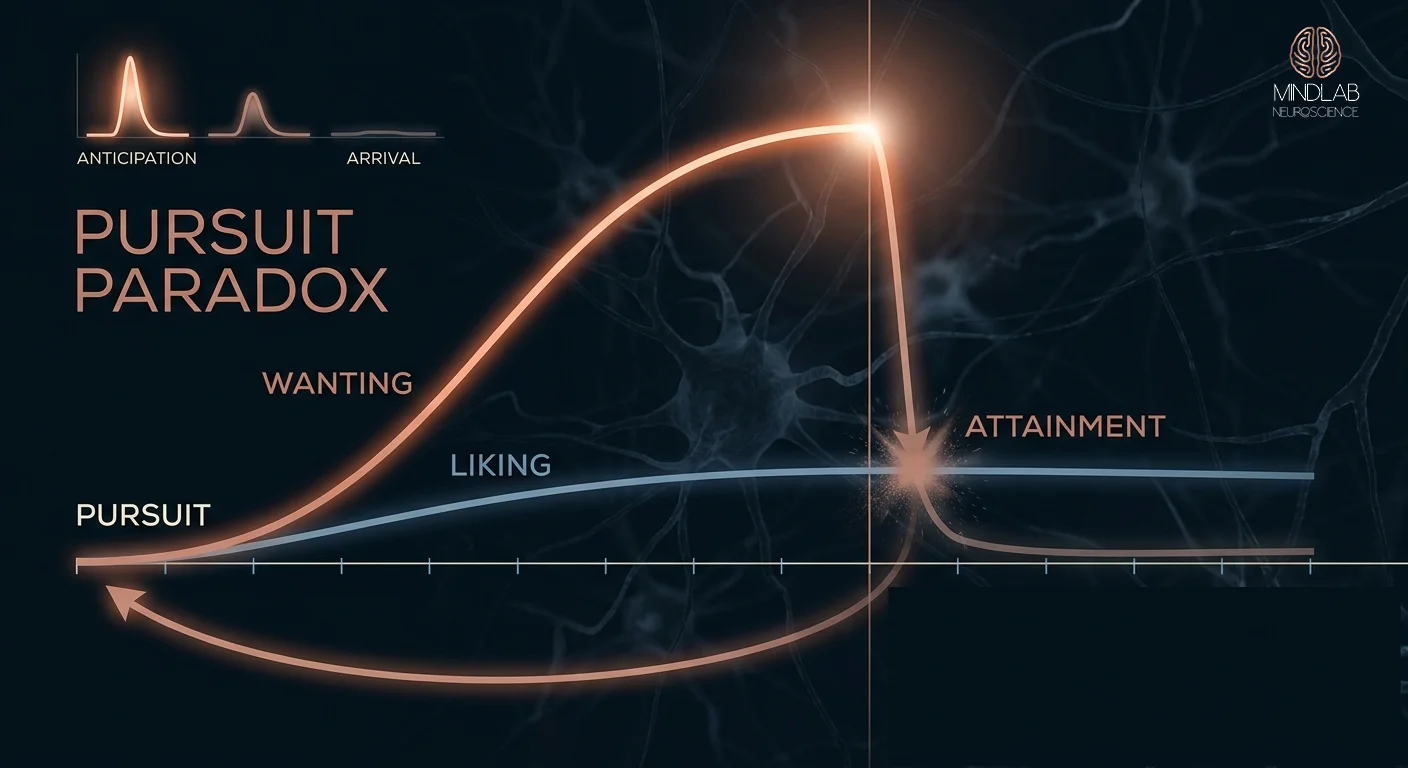
You chase, you catch, you feel the wanting drain away, and the brain immediately points you at the next thing.
The Pursuit Paradox™ is the neurochemical engine underneath a great deal of self-sabotage: the brain’s reward chemistry is built to drive the pursuit of a goal, not the possession of it, so desire runs hot on the way toward something and collapses the moment it is yours. You chase, you catch, you feel the wanting drain away, and the brain immediately points you at the next thing. (The Pursuit Paradox is one of the named frameworks in Dr. Ceruto’s protocol library; this page is its definitive account in the context of self-sabotage. See the Pursuit Paradox framework for the entity overview.)
The science here is unusually clear, and it overturns the intuition most people carry. We assume that wanting something and enjoying it are the same circuit. They are not. The neuroscience of reward separates “wanting,” the motivational pull toward a goal, from “liking,” the actual pleasure of having it, and shows that these are produced by different brain systems. Wanting is driven by large, robust dopamine systems; liking is mediated by smaller, more fragile circuits and does not depend on dopamine at all (Berridge and Robinson, 2016). The practical consequence is strange and familiar at once: it is entirely possible to powerfully want what you will not actually enjoy, and to keep wanting it after the enjoyment is gone.
Dopamine compounds the problem through how it tracks prediction. Dopamine neurons do not fire for reward as such. They fire for the gap between what you expected and what you got. When an outcome is better than predicted, dopamine spikes; when it is exactly as predicted, the signal goes quiet; when it is worse than predicted, the signal drops below baseline (Schultz, 2016). Read that sequence against the experience of getting what you wanted. The pursuit is full of positive prediction error, the surprises and near-misses that keep dopamine high. Attainment, by definition, is the moment reality matches the prediction, so the signal falls silent. The achievement you worked for arrives feeling strangely flat, and the brain, reading that flatness as a problem, sends you looking for the next hit of pursuit.
This is the hinge between healthy ambition and self-sabotage, and it turns on a single distinction: novelty-seeking versus mastery. Novelty-seeking chases the next new thing because the newness itself produces the dopamine of pursuit. Mastery stays with one thing long enough to get good at it, which means tolerating the quiet stretch after the initial excitement fades and before competence arrives. The Pursuit Paradox biases the brain toward novelty, because novelty reliably refreshes the wanting while mastery asks you to keep going through the flat part. Left unexamined, that bias looks like a personality, restless and easily bored and always starting over, when it is really a reward circuit defaulting to whatever keeps dopamine high. Noticing which of the two is actually driving you is often the first place the pattern becomes visible.
This is where the Pursuit Paradox turns into self-sabotage rather than simple restlessness. If having reliably feels empty and pursuing reliably feels alive, the brain learns, without ever telling you, that the way to stay in the alive state is to never quite arrive. So it manufactures reasons to restart the chase: the relationship that was good enough gets blown up so a new pursuit can begin, the finished project gets abandoned at ninety percent so it never has to be judged as done, the win gets discounted the instant it lands. The same chemistry shows up in the smaller compulsions, the open loop of the feed engineered to keep you wanting and never satisfied, which we trace in detail in the dopamine spiral behind compulsive scrolling. For the complete framework on understanding and resetting your dopamine reward system, I cover the full science in my book The Dopamine Code (Simon & Schuster, June 2026).
Why your brain chooses the familiar pattern over the better one
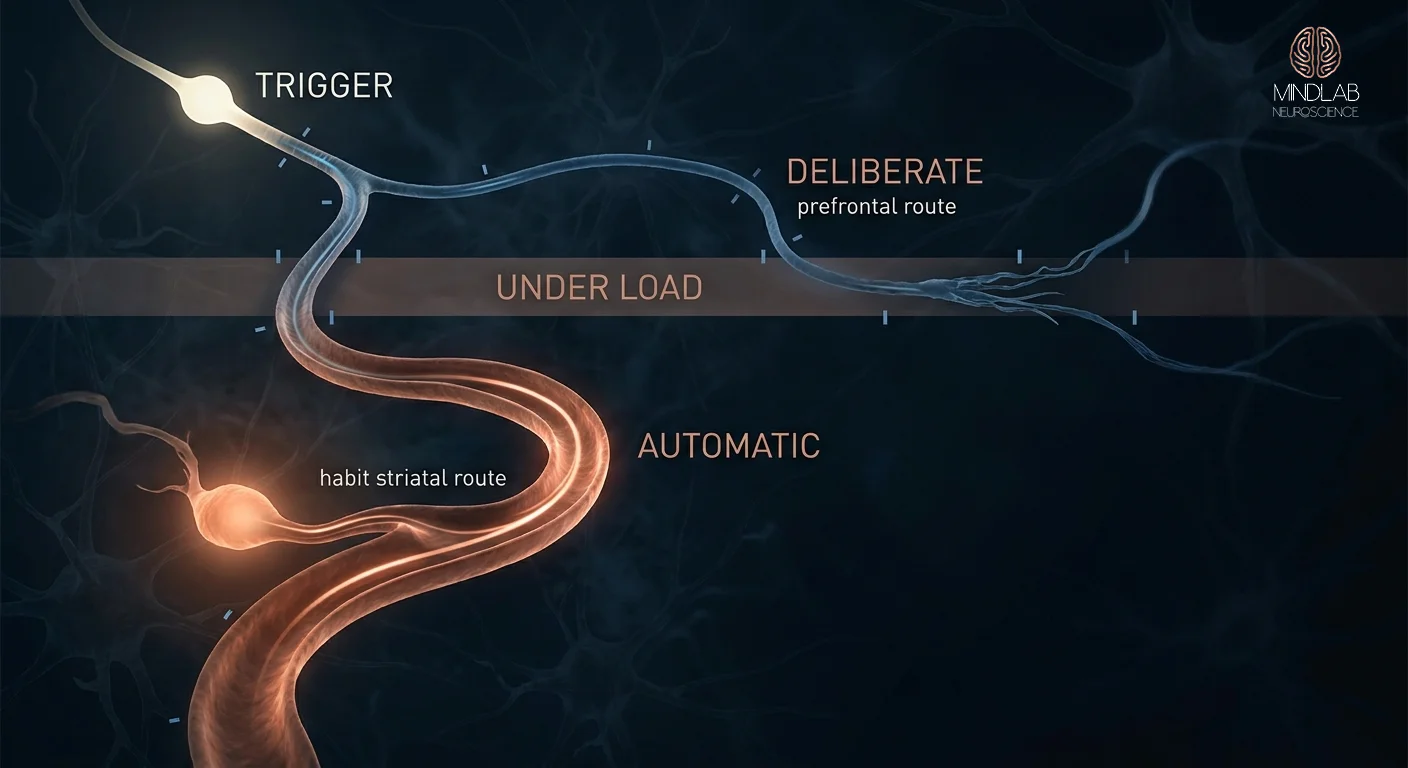
Because the sabotaging behavior is usually a habit in the precise neurological sense: an action that has been repeated enough to migrate out of deliberate control and into automatic circuitry that runs faster than thought, and barely reaches awareness at all.
When a behavior is new, it is run by goal-directed circuits that weigh outcomes and consequences. When it has been repeated many times, control shifts to habit circuits in the basal ganglia, and the behavior becomes a stored routine triggered by context rather than by intention. This is enormously efficient for the behaviors you want on autopilot. It is a trap for the ones you do not, because once self-sabotage is a habit, it no longer waits for your permission. The cue appears, the routine fires, and you are three steps into the old pattern before the deliberate part of you has even registered the moment.
Two facts make this harder to fight by willpower alone. The first is speed. The automatic pathway is faster than the deliberate one by design, so in real time it almost always moves first. The second is what happens under pressure. The prefrontal cortex, the brain region responsible for self-control, foresight, and overriding impulses, is exquisitely sensitive to stress. Even mild, uncontrollable stress causes a rapid loss of prefrontal function, weakening exactly the circuitry you would need to interrupt the pattern, and shifting control toward older, faster, more reflexive systems (Arnsten, 2009). This is why self-sabotage spikes precisely when the stakes are highest. The high-stakes decision, the career-defining moment, the conversation that matters to the people who count on you, is the exact condition that takes your prefrontal cortex partly offline and hands the controls to the pattern you are trying to escape.
This is also why the most common everyday face of self-sabotage is delay. Procrastination is not a time-management problem; it is the brain choosing the immediate relief of avoidance over the larger, later reward, a present-bias the same circuitry produces. The mechanism is worth understanding on its own terms, which is why we cover it in full in the neuroscience of chronic procrastination. What unites procrastination, the success-threshold collapse, and the compulsive chase is a single architecture: a fast, learned pathway that fires under load, before the slower, wiser system can weigh in.
Can you actually rewire self-sabotage? What the neuroscience says about lasting change
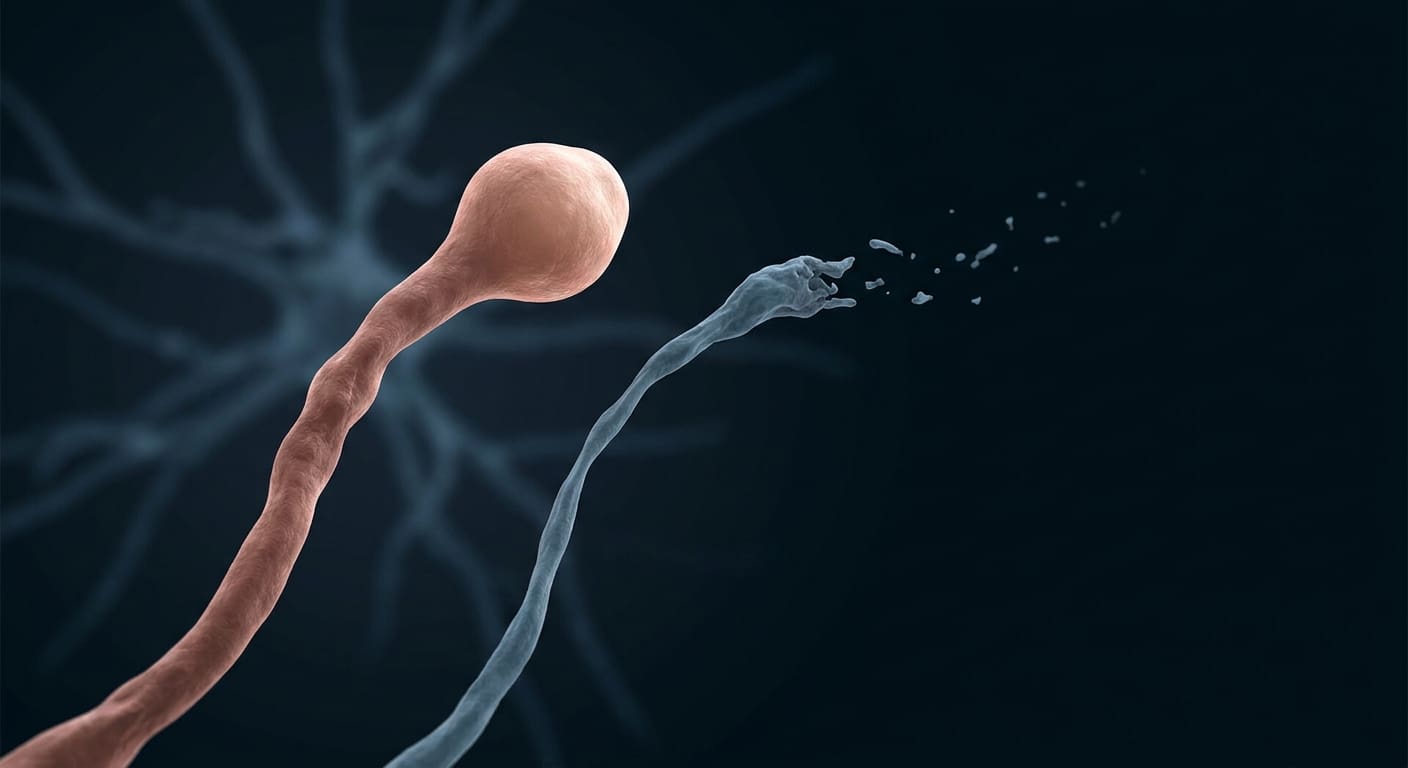
Yes. The same plasticity that built the pattern can rebuild it. The brain changes its physical wiring in response to experience throughout life, strengthening the pathways it uses and weakening the ones it stops using, which means a circuit that was learned can be unlearned and replaced.
The mechanism is not mysterious, and it is not motivational. At the level of the synapse, repeated, coordinated firing between two neurons strengthens the connection between them, a process called long-term potentiation, often summarized as “cells that fire together wire together.” The reverse is also true: connections that stop being used are pruned away. Every self-sabotaging pattern you run is a circuit that has been potentiated by repetition. Every time you run it, you reinforce it. This sounds like a sentence. It is actually the opening, because the same rule that carved the pattern in is the rule that can carve a new one in over the old.
The catch is timing, and it is the catch that defeats most self-help. You cannot rewire a circuit by thinking about it later, on a schedule, after the moment has passed. The window in which a pathway is actually malleable is the moment it is firing, the brief gap between the trigger and your response, when the brain is deciding which pathway to reinforce. Conventional approaches work retrospectively: you review what happened after the fact, in a calm room, with your prefrontal cortex fully back online, analyzing a pattern that only appears when your prefrontal cortex is offline. The insight is real. It simply arrives in the wrong place to change the wiring.
The insight is real. It simply arrives in the wrong place to change the wiring.
This is the principle behind Dr. Ceruto’s Real-Time Neuroplasticity™ methodology, the overarching mechanism this entire body of work rests on. Rather than reviewing patterns after they fire, it intervenes in the live moment they are forming, inside that refractory window, when the pathway is still soft. A new response is strengthened while the old one is allowed to weaken, using the brain’s own long-term potentiation and synaptic pruning, applied deliberately and with precise timing. The Pursuit Paradox is the failure mode; Real-Time Neuroplasticity™ is how the failure mode gets rewritten. The principle is precision of timing over volume of effort: one intervention in the right moment outperforms a hundred resolutions made in the wrong one.
Where insight stops and rewiring begins
The pattern was not learned through insight, and it will not be unlearned through insight. It was learned through repetition in live moments, and that is the only place it can be unlearned.

You can finish this page understanding your self-sabotage with real precision, name the Pursuit Paradox running underneath it, see the habit circuitry, recognize the prefrontal shutdown under stress, and still walk into the next high-stakes moment and run the exact pattern you just understood. This is not a failure of comprehension. It is the whole point. The circuit fires faster than understanding, and understanding alone does not rewire it.
This is the line that separates knowing from changing, and it is where most people get stuck for years. They become experts in their own patterns. They can narrate the childhood origin, the trigger, the cost. They have read the books and built the systems, and perhaps spent time in therapy or coaching working on it from the outside. The self-knowledge is genuine and it is valuable, and it is also not the same thing as a rewired circuit. The pattern was not learned through insight, and it will not be unlearned through insight. It was learned through repetition in live moments, and that is the only place it can be unlearned.
What changes a pattern is working at the level of the architecture, in the moments the pattern actually appears, with enough precision to catch the pathway while it is still malleable and strengthen a different response in its place. That is structural work on how your brain operates, not advice about how to behave. It is the difference between knowing you flinch at the threshold of success and rebuilding the circuit so the threshold no longer reads as a threat.
The cost of leaving the circuit intact is rarely a single dramatic failure. It is the slow accumulation of near-misses: the opportunities not quite taken, the relationships ended a beat before they could deepen, the work left unshipped at the edge of done, each one explained away in the moment and quietly added to a private ledger of self-doubt. The pattern does not need to win every time to shape a life. It only needs to fire at the thresholds that matter most, which is precisely where, as the pressure of the moment pulls the prefrontal cortex offline, it is most likely to.
Most of the work of catching a circuit happens between the dramatic moments, in the ordinary weeks where the pattern shows up small and easy to miss. That steady noticing is what I write about each week in The Intelligence Brief, taking one piece of the neuroscience of self-defeating patterns at a time and making it usable. If you want to keep your own circuit in view while you decide what to do about it, it is a quiet place to begin.
How self-sabotage shows up
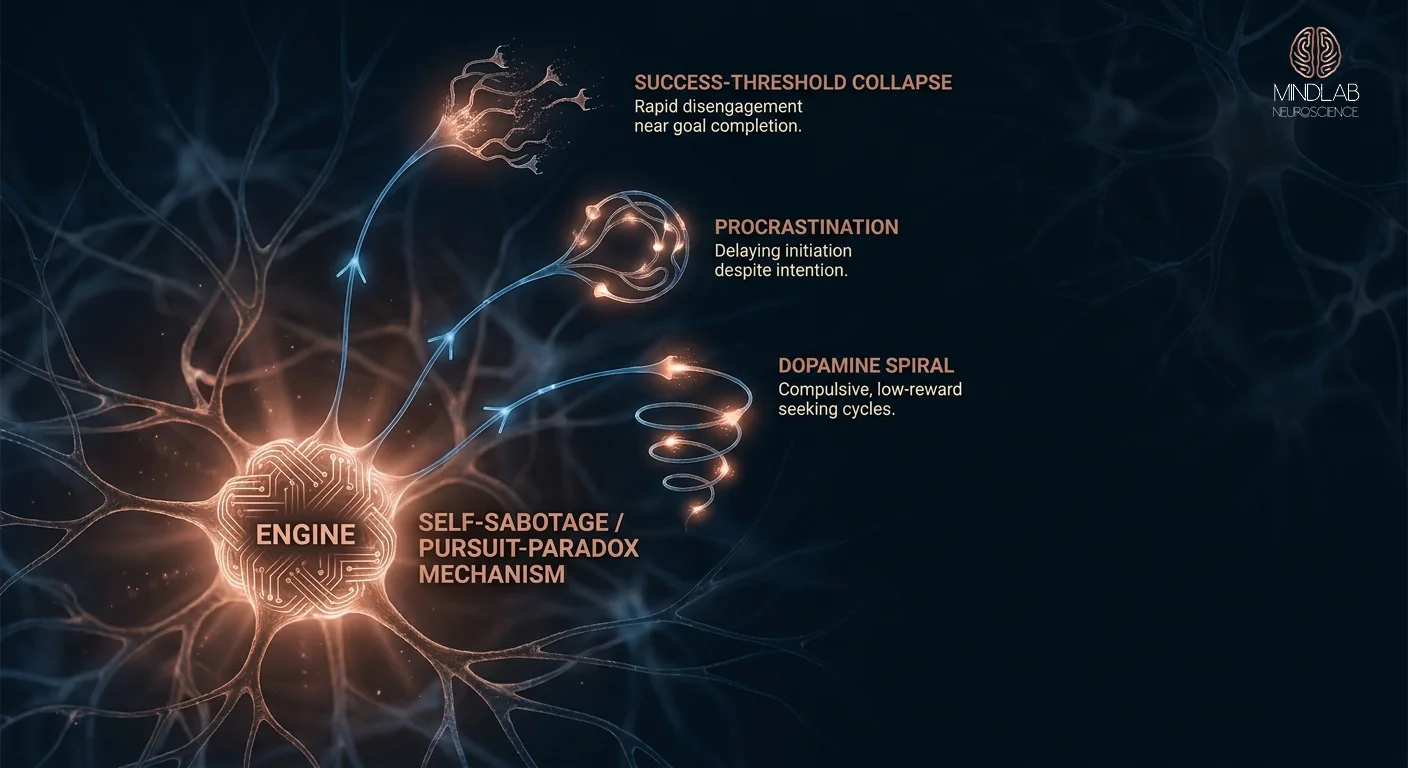
Self-sabotage rarely arrives labeled. It wears ordinary clothes, and most people spend years fighting the symptom without recognizing the shared circuitry underneath. Three of its most common forms each have their own deeper anatomy worth reading in full:
- The success-threshold collapse. The pattern that fires hardest right as things start to work, turning you into the obstacle between yourself and the outcome. The fuller anatomy is in why you become your own worst enemy.
- Chronic procrastination. The brain choosing immediate relief over the larger later reward, dressed up as a scheduling problem. The mechanism, and what actually shifts it, is in the neuroscience of chronic procrastination.
- The dopamine spiral. The compulsive chase, most visibly the endless feed, engineered to keep the wanting hot and the satisfaction permanently out of reach. We trace it in the dopamine spiral behind compulsive scrolling.
Different surfaces, one engine. Whichever version you recognize, the place to intervene is the same: not more discipline applied to the symptom, but a change in the circuit that produces it.
References
- Graybiel AM. Habits, rituals, and the evaluative brain. Annual Review of Neuroscience, 2008. https://pubmed.ncbi.nlm.nih.gov/18558860/
- Long-Term Synaptic Potentiation. Neuroscience (NCBI Bookshelf), National Center for Biotechnology Information. https://www.ncbi.nlm.nih.gov/books/NBK10878/
Understanding the Pursuit Paradox on the page is one thing. Seeing the exact version of it running in your own life, named precisely and traced to the moment it fires, is another, and it is the ground every lasting change is built on. A strategy call with Dr. Ceruto is a real working conversation built to do exactly that: to map the specific pattern driving your situation and show you what rewiring it would actually involve. You leave understanding what your brain is doing, why it is doing it, and what it would take to change it.
Book a Strategy CallFrequently Asked Questions
Is self-sabotage a mental health condition?
No. Self-sabotage is a behavioral pattern, not a medical condition. It describes a learned neural circuit that produces actions against your own stated goals, and it appears across the full range of capable, high-functioning people. The useful frame is not “what is wrong with me” but “which pathway is my brain reaching for under pressure, and how was it trained.” That shift, from defect to circuit, is what makes the pattern changeable rather than permanent.
Why do I sabotage myself when things are going well?
Because for many people the brain’s threat-prediction system treats the unfamiliar state of having what you want as the danger, not the failure. If arrival was once followed by loss, exposure, or simply more to protect, the brain encodes a quiet rule that the edge of success is unsafe, and produces behavior that keeps you a step back from it. The behavior feels like a reasoned choice, but the reasoning is usually a story told after the circuit has already acted.
Can self-sabotage actually be rewired, or do you just learn to manage it?
It can be rewired. The brain rebuilds its physical wiring in response to experience throughout life, strengthening used pathways and pruning unused ones. The pattern was carved in by repetition, and a new pathway can be carved in the same way. The decisive factor is timing: the circuit is only malleable in the live moment it fires, which is why interventions made in that window change the wiring while after-the-fact analysis, however accurate, tends not to.
Why does understanding my self-sabotage not stop it?
Because the pattern fires faster than understanding, and it was not learned through understanding in the first place. Self-sabotage runs on automatic habit circuitry that activates before deliberate thought, and it intensifies precisely when stress takes your prefrontal cortex partly offline. Insight gives you an accurate map, which is valuable, but a map is not a rebuilt road. The circuit was learned through repetition in live moments and can only be changed in the same place.
What is the difference between this and therapy or coaching I have already tried?
Most approaches you may have tried work on the behavior from the outside, after the moment has passed. This works on the neural circuit underneath, in the live moment the pattern fires, using the brain’s own mechanisms of long-term potentiation and synaptic pruning through Real-Time Neuroplasticity™. It is structural work on the architecture itself rather than on the behavior the architecture produces. The aim is not better management of the pattern but a rebuilt pathway, so the response that once felt automatic is replaced by a different one that becomes automatic in its place.