Key Takeaways
- Protest behaviors are attachment-driven: the amygdala reads emotional distance as threat, triggering fight-or-flight reconnection attempts.
- Anxious-preoccupied attachment predisposes protest behaviors: threat-detection calibrated relational absence as danger during a developmental window.
- Protest actions meant to restore connection activate the partner’s threat response, widening the distance instead.
- Each escalation that produces temporary reconnection is encoded as proof escalation works, deepening the circuit.
- Rewiring requires intervention while the amygdala is generating the threat response, not retrospective analysis afterward.
Protest Behaviors in Toxic Relationships: Why the Brain Fights for Connection by Destroying It
Protest behaviors emerge when the amygdala registers relational threat and the attachment system overrides rational prefrontal processing. The amygdala activates fight-or-flight communication patterns (excessive contact, emotional escalation, jealousy provocation) to force reconnection. These responses create a neurological paradox: behaviors designed to restore closeness instead trigger the partner’s threat response, compounding emotional distance.
If protest behaviors in your relationship have escalated into control, coercion, or fear for your safety, that is abuse rather than attachment distress. The National Domestic Violence Hotline is available 24/7 at 1-800-799-7233. This connects directly to the Relationship Intelligence pillar overview.
In 26 years of working with individuals trapped in this cycle, I have found that protest behaviors are among the most misunderstood patterns in relationship dynamics. They are almost never about manipulation. They are about a nervous system that learned, during a critical developmental window, that escalation produces attention, and encoded that circuit as the default response to perceived abandonment. Understanding this distinction changes everything about how the pattern can be interrupted.
The cycle is identifiable, the neural architecture sustaining it is measurable, and the pattern is addressable, but only when the intervention reaches the subcortical level where the circuit actually operates.
Protest behaviors in adult attachment relationships are driven by hyperactivation of the attachment system’s proximity-seeking circuit, specifically the dorsal anterior cingulate and amygdala, which override rational behavioral inhibition when perceived abandonment threat exceeds individual threshold.
Insecure attachment-driven protest behaviors in couples are maintained by reciprocal escalation of cortisol reactivity in both partners, creating a neurobiological feedback loop that makes de-escalation impossible without exiting the interaction entirely.
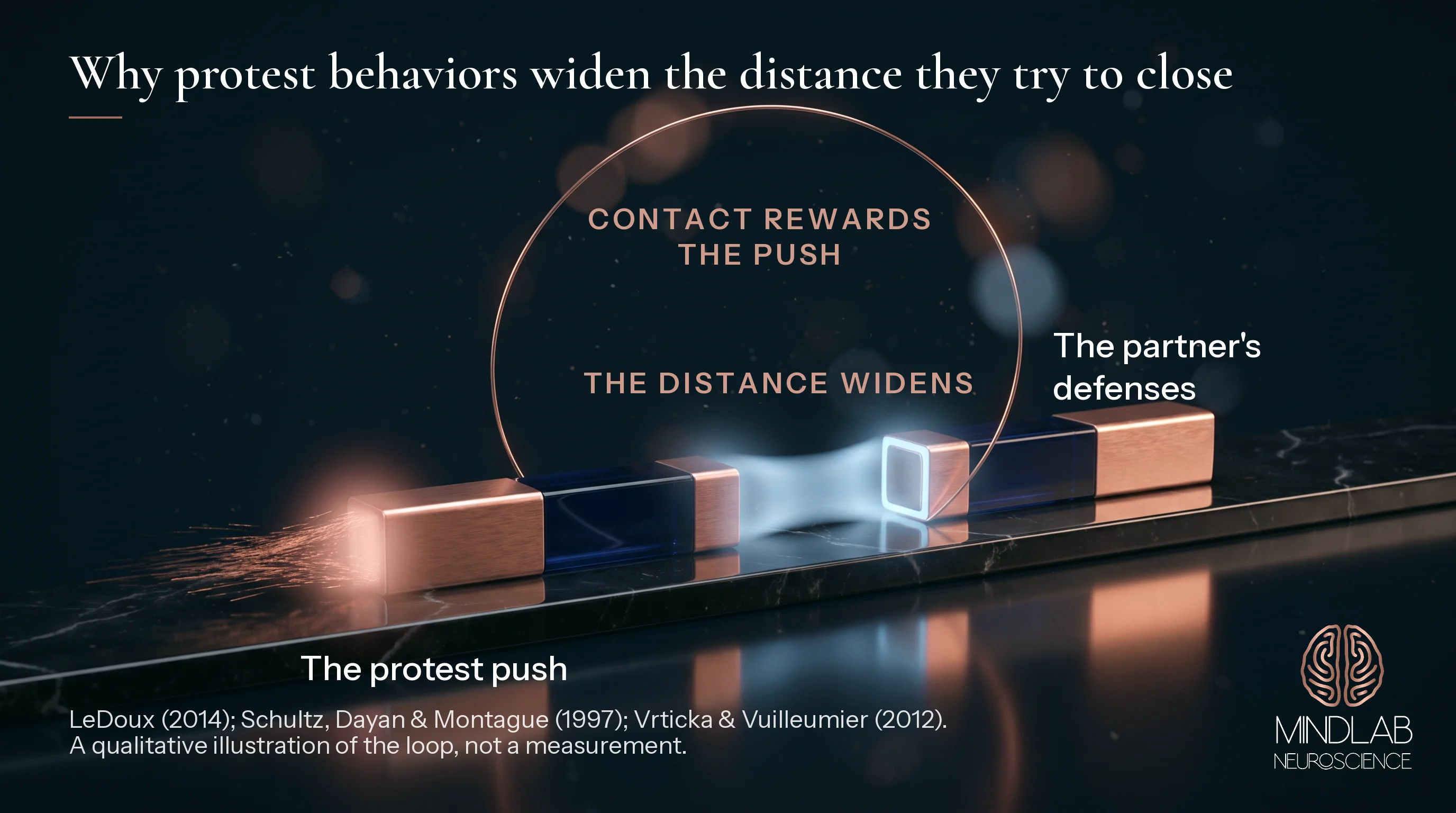
What the illustration shows, beat by beat
| Beat | What happens |
|---|---|
| Distance registers as threat | A delayed reply or a withdrawn mood may be read as a threat to the bond. Attachment history may shape how readily a moment is encoded as threat rather than safety, and anxious attachment heightens that reaction. |
| The protest push | Excessive contact, provocation, or withdrawing: actions aimed at getting contact back now. |
| The partner's defenses | The push lands on the partner's own threat detection, which answers with withdrawal or counter-escalation, so the distance widens. |
| Contact as reward | When contact arrives unexpectedly after the push, the reconnection acts as a reward, and an unexpected reward that follows an action strengthens the behavior that preceded it. The escalation is encoded as what works. |
| Why insight alone rarely stops it | Knowing the pattern is cortical; in the article's account the protest impulse is faster, which is why its approach intervenes while the circuit is firing rather than afterward. |
Why Protest Behaviors Feel Impossible to Stop
Protest behaviors feel impossible to stop because the brain’s dopamine reward circuitry encodes any partner response, even conflict, as evidence the strategy succeeded. The dopamine system registers “action produced contact” and strengthens that neural circuit regardless of relationship outcome. This reinforcement loop operates below conscious awareness, making purely intentional interruption of protest behaviors neurologically insufficient.
This is why insight alone rarely breaks the pattern. A client can articulate with perfect clarity that their excessive texting or emotional ultimatums are counterproductive. That understanding lives in the prefrontal cortex. The protest impulse lives in the amygdala, which fires faster and with more physiological force. During activation, the faster system wins, every time.
What I consistently observe in my practice is that protest behaviors do not indicate the absence of love or the impossibility of a lasting relationship. They indicate that the communication architecture between partners has defaulted to a threat-based operating system. The attachment bond is intact; the signaling method is what has broken down. Recognizing that distinction is the first step toward intervention that actually reaches the circuit driving the behavior.
What Are Protest Behaviors and Where Do They Originate?
Protest behaviors are actions taken to reestablish connection when the brain perceives relational threat. They originate not in conscious strategy but in the amygdala’s threat-detection system: the same neural architecture that governs responses to physical danger. When emotional distance registers as abandonment, the nervous system deploys whatever communication patterns were encoded during early attachment experience.
The critical variable is developmental timing. During the first several years of life, the brain is calibrating its attachment circuitry based on relational experience. If security was inconsistent, if a caregiver was sometimes responsive and sometimes absent, the brain learns that escalation is the most reliable method for producing attention. That circuit becomes the default, and it persists into adulthood with remarkable durability.
Adults with anxious attachment styles show heightened amygdala activation in response to social rejection cues: the neural signature of a threat-detection system that was calibrated to relational absence during a critical window. The protest behavior is not a decision. It is the expression of that calibration.
| Dimension | Protest Behavior (Anxious Activation) | Secure Communication |
|---|---|---|
| Trigger | Perceived distance, delayed response, or unresponsiveness | Same relational concern, but evaluated before response |
| Neural driver | Amygdala threat response and HPA axis activation: subcortical | Prefrontal evaluation of context before selecting response: cortical |
| Timing | Immediate: fires before the cortex can assess whether the threat is real | Delayed: the prefrontal cortex evaluates context, history, and proportionality first |
| Goal | Immediate reconnection at any cost: stop the threat signal now | Long-term relational security: communicate the need without activating the partner’s defenses |
| Method | Escalation, excessive contact, jealousy provocation, emotional withdrawal as punishment | Direct expression of need without manipulation or coercion |
| Partner’s neural response | Threat activation: defensive withdrawal or counter-escalation | Safety signal: engagement, co-regulation, and willingness to address the concern |
| Long-term outcome | Temporary reconnection followed by cumulative erosion of trust and attachment security | Progressive deepening of trust and durable attachment security |
Common Protest Behaviors in Unhealthy Relationships
Protest behaviors in unhealthy relationships fall into identifiable neurological categories based on what the dysregulated nervous system attempts to accomplish. Research shows that many attachment-anxious individuals display cyclical protest patterns driven by cortisol and norepinephrine surges. Clinicians categorize these behaviors by their underlying autonomic function: proximity-seeking, punishing withdrawal, or hypervigilant monitoring.
- Proximity enforcement: Excessive texting, calling, and messaging: the nervous system attempting to close perceived distance through sheer volume of contact. The amygdala cannot distinguish between physical proximity and digital proximity, so the brain treats unanswered messages as confirmation of abandonment.
- Reality distortion: Various forms of dishonesty and its neurological roots, psychological games, and narrative manipulation, including gaslighting that distorts relationship reality. These behaviors emerge when the threat-response system overrides the prefrontal cortex’s capacity for accurate perception.
- Jealousy provocation: Deliberately generating jealousy to test the partner’s investment level. The nervous system is seeking evidence that the attachment bond is still active, using threat as an evaluative tool rather than direct communication.
- Emotional withdrawal as punishment: Withholding engagement, affection, or communication to create the same relational distress the protester is experiencing. The logic is subcortical: “If I can make you feel what I feel, you will understand the urgency.”
- Reactive speech escalation: the neural mechanism behind reactive speech patterns in relationships explains how amygdala activation produces words the prefrontal cortex would never select under regulation.
How Do Protest Behaviors Differ from Secure Communication?
Protest behaviors and secure communication diverge at the neural level, not the behavioral level. Both responses originate from the same trigger, a perceived relational need, but travel opposing neural pathways. Secure communication activates prefrontal cortical regulation, while protest behaviors route through amygdala-driven threat circuits, producing reactive, dysregulated signals that escalate relational conflict rather than resolve it.
In protest behavior, the amygdala generates a threat response and the signal bypasses prefrontal evaluation entirely. The individual reacts before the cortex can assess whether the perceived threat is proportional to reality. The response is immediate, emotionally charged, and oriented toward forcing a reaction.
In secure communication, the same relational concern passes through prefrontal cortex evaluation before a response is selected. The individual assesses context, considers the partner’s perspective, and chooses a communication method that addresses the need without activating the partner’s defensive architecture. The response is deliberate, regulated, and oriented toward mutual understanding.
What the research does not adequately capture, and what I have observed consistently over 26 years, is that the transition from protest to secure communication is not a skill-acquisition problem. Most individuals who engage in protest behaviors already know what healthy communication looks like. The issue is that knowledge is cortical, and the protest impulse is subcortical. Training communication skills without addressing the neural pathway that bypasses those skills during activation produces insight without behavioral change.
How Can You Recognize When You Are in a Protest Behavior Cycle?
Protest behavior cycles begin with physiological signals (elevated heart rate, chest tightness, and disproportionate urgency) before conscious thought forms. Amygdala activation precedes cognitive awareness, meaning the body enters threat-response mode before the mind registers a relational concern. Recognizing these bodily cues first is the earliest reliable entry point for interrupting the cycle.
- Physiological escalation: Notice whether your body responds to relational uncertainty with physical activation: increased heart rate, shallow breathing, restlessness. These signals indicate the threat-response system has engaged before rational evaluation. The protest behavior cycle begins at this physiological threshold.
- Pattern recognition: Reflect on whether specific situations (delayed text responses, canceled plans, perceived emotional withdrawal) consistently produce the same escalation sequence. The consistency of the pattern points to an encoded circuit, not a situational reaction.
- Post-escalation regret: If you consistently feel that your response was disproportionate after the activation subsides, this is the prefrontal cortex reasserting evaluation after the amygdala’s response has already fired. The gap between “what I did” and “what I wish I had done” is the measurable distance between subcortical reaction and cortical intention.

How Do Protest Behaviors Connect to Attachment Architecture?
Protest behaviors are most closely associated with anxious-preoccupied attachment: a neural configuration in which the brain’s threat-detection system was calibrated to relational inconsistency during early development. The neuroscience behind attachment style formation documents precisely how the amygdala’s calibration during critical developmental windows produces this threat-vigilance pattern in adulthood. Individuals with this attachment architecture exhibit a characteristic pattern:
- Hypervigilance to distance signals: The amygdala is tuned to detect micro-shifts in the partner’s engagement level: a slightly shorter text, a moment of distraction during conversation, a change in vocal tone. Each signal is processed as evidence of impending abandonment.
- Reassurance-seeking loops: Frequent requests for verbal confirmation of commitment. The neurological issue is that the reassurance does not update the threat model. The amygdala processes the reassurance, registers temporary relief, and then returns to baseline vigilance within hours, creating dependency on external validation that mirrors patterns formed in early relational experience.
- Jealousy as threat-assessment: Using jealousy provocation to gauge the partner’s investment level. The nervous system is running a continuous cost-benefit analysis on attachment security, and jealousy functions as a stress test.
Anxious attachment confers short-term relational advantages: the hypervigilance that drives protest behaviors also enables rapid detection of genuine relational threats. The neural system is not broken. It is optimized for an environment that no longer exists: the inconsistent caregiving landscape of early development.
The Cascading Impact of Unchecked Protest Behaviors
When protest behaviors become the dominant communication pattern, the relationship enters a self-reinforcing cycle that deteriorates at the neural level. Each escalation that produces temporary reconnection is encoded as confirmation that escalation works. Each withdrawal that provokes a response validates withdrawal as a viable strategy. The brain is building evidence for the very patterns that are destroying the relationship.
The partner’s nervous system adapts in parallel. Repeated exposure to protest behaviors (emotional ultimatums, jealousy provocation, communication flooding) activates their defensive architecture. Over time, the partner’s threshold for threat detection lowers. Neutral interactions begin triggering defensive responses. The relationship reaches a state where both nervous systems are operating in threat mode simultaneously, and neither can generate the safety signal required for genuine connection. Emotional regulation and nervous system responses become increasingly inaccessible for both partners as this cycle deepens.
Chronic stress exposure reshapes the amygdala-prefrontal cortex circuitry: the same circuitry that governs the transition from reactive protest to regulated communication. Extended exposure to protest-behavior cycles does not just strain the relationship. It restructures the neural architecture that both partners would need to resolve it.
Protest behavior is the brain fighting for closeness with the very actions that destroy it: each escalation meant to pull a partner back trips their threat response and widens the gap it meant to close.

How I Address Protest Behavior Patterns in My Practice
Protest behavior patterns originate in dysregulated neural circuits, not in conscious choice. Intervention targeting the circuit, rather than the surface behavior, produces measurable change across attachment-driven responses. Across hundreds of client engagements, circuit-focused approaches consistently outperform behavior-only interventions by addressing the subcortical architecture generating the protest response itself.
Neuroplasticity-Informed Habit Restructuring: I guide clients through structured exercises that leverage the brain’s capacity to form new neural pathways. By identifying the specific circuits associated with protest behaviors, we work together to create and reinforce healthier response patterns. This approach involves:
- Visualization techniques to interrupt and redirect automatic responses at the moment of activation
- Practicing new relational responses in low-stress situations to strengthen neural connections before they are needed under pressure
- Using positive reinforcement to recruit the brain’s reward system in service of the new pattern rather than the old one
Emotional Regulation Through Neural Pattern Recalibration: I use real-time neural pattern monitoring to help clients develop precise awareness of their emotional activation states. This method involves:
- Real-time monitoring of neural activation during simulated relationship scenarios, identifying the exact moment the protest circuit fires
- Teaching clients to recognize and modulate the brain states associated with protest behaviors before they translate into action
- Developing personalized strategies for achieving emotional balance based on individual neurological profiles
Stress Response Modulation: Drawing on research about the brain’s stress response system, I help clients manage the physiological cascade that triggers protest behaviors. This includes:
- Autonomic regulation techniques designed to activate the parasympathetic nervous system and interrupt the sympathetic activation that precedes protest behavior
- Physiological signal mapping to help clients recognize and control stress responses before they reach the behavioral threshold
- Customized stress-reduction protocols based on individual neurological profiles and activation patterns
Cognitive Reframing with Neurological Precision: I incorporate current neuroscientific understanding of cognitive processes to help clients reframe the perceptions and beliefs that feed the protest cycle. This involves:
- Mapping how past relational experiences shaped the neural pathways currently driving protest behaviors, making the invisible architecture visible
- Identifying and challenging cognitive distortions from a brain-based perspective, distinguishing between what the amygdala reports and what is actually happening
- Developing new mental models that promote healthier relational dynamics and gradually replace the threat-based operating system
Attentional Focus and Neuroplasticity Integration: I combine directed attentional training with neuroplasticity principles to enhance self-awareness and promote lasting behavioral change. This approach includes:
- Directed neural focus exercises targeting the prefrontal regions associated with emotional regulation, strengthening the cortical override capacity that protest behaviors bypass
- Present-state awareness training designed to strengthen prefrontal cortex function, enhancing the capacity to evaluate relational signals before reacting
- Integrating attentional discipline into daily routines to maintain and reinforce new neural pathways between structured sessions
By working with the neural circuit rather than the behavioral output, clients develop not just understanding of their protest behaviors but practical capacity to interrupt and redirect the pattern at its neurological source, producing changes that persist because they are structurally encoded, not merely understood.
Building a Communication Architecture That Replaces Protest
Effective relationship communication requires building a prefrontal cortical-routing pathway that intercepts amygdala-driven protest responses before they deploy. Most adults already possess the necessary communication skills in their cortical repertoire. The neurological challenge is constructing the architecture that channels relational distress through prefrontal processing first, a pathway reinforced through deliberate, repeated practice across weeks of consistent effort.
- Voice your needs from the cortex, not the amygdala: Before communicating a relational concern, check whether you are in threat-activation or evaluation mode. If your heart rate is elevated and the words feel urgent, the amygdala is driving. Wait for cortical re-engagement before speaking.
- Replace manipulation with direct signal: The protest behavior exists because the nervous system does not trust that direct communication will produce a response. Building that trust requires a period of consistent direct signaling: naming the need without encoding it in threat, ultimatum, or withdrawal.
- Seek intervention at the circuit level: When the protest pattern has become deeply encoded, when you can describe it perfectly and still cannot stop it, the architecture sustaining it requires professional intervention at the neurological level. Understanding the pattern is necessary but not sufficient. The circuit must be accessed during live activation to be restructured.
The Path Forward: From Protest to Secure Connection
Protest behaviors in relationships are not evidence of weakness, dysfunction, or the absence of love. They are evidence of a nervous system that learned to fight for connection using the only tools available during a critical developmental window, and has not yet been given the opportunity to learn that safer methods exist.
The pattern is identifiable. The neural architecture sustaining it is addressable. And the timeline for meaningful recalibration, when the intervention reaches the subcortical level where the circuit actually operates, is typically 60 to 90 days of structured engagement during live relational moments.
This article explains the neuroscience underlying protest behaviors and attachment-driven relationship patterns. For personalized neurological assessment and intervention, contact MindLAB Neuroscience directly. This pattern is examined in the Relationship Patterns & Partner Selection hub on the neuroscience.
Real-Time Neuroplasticity™ provides the mechanism for rewiring the patterns described in this article: intervening in the live moments when the old circuit fires, building new neural evidence that a different response is possible.
If this pattern has persisted despite your best efforts, the architecture sustaining it is identifiable and addressable. A strategy call with Dr. Sydney Ceruto maps the specific neural circuits driving the cycle and identifies whether it can be interrupted at its neurological source.
Are protest behaviors always a sign of a toxic relationship?
Not always. Protest behaviors exist on a spectrum. Mild forms (reaching out more frequently when disconnected, expressing frustration when a need goes unacknowledged) are normal features of anxious attachment. The dynamic becomes toxic when protest behaviors dominate communication, involve manipulation or coercion, or consistently override a partner’s boundaries. The critical variable is whether both partners can recognize and interrupt the pattern; when neither can, escalation becomes self-reinforcing.
Why do I keep repeating protest behaviors even when I know they do not work?
The amygdala detects relational threat and activates protest behavior within milliseconds, before the prefrontal cortex can apply the knowledge that “this never works.” Understanding is cortical; the impulse is subcortical. During emotional activation, the faster system wins. Additionally, protest behaviors are reinforced because they produce a partner response, even a negative one. The brain encodes any response as reinforcement, regardless of whether the outcome was constructive or destructive.
Can someone with anxious attachment learn secure communication patterns?
Yes. Attachment style is a neural configuration shaped by early relational experience, not fixed architecture. The amygdala’s calibration to relational threat remains plastic throughout adulthood. Recalibration requires intervention during live attachment activation, when the anxious protest impulse fires and the circuit is accessible for rewiring. Retrospective discussions about attachment theory do not access that pathway in real time. Meaningful recalibration typically requires 60 to 90 days of consistent, structured intervention.
How do protest behaviors affect children who witness them?
Children witnessing protest behaviors (escalation, emotional manipulation, withdrawal as punishment, jealousy provocation) don’t need to be direct targets to be neurologically affected. The amygdala encodes these observed patterns as relational templates during critical developmental windows. This is a primary intergenerational transmission mechanism for anxious attachment: the nervous system learns protest behavior as the default relational response before the prefrontal cortex matures enough to evaluate alternatives.
What is the difference between protest behaviors and healthy boundary-setting?
Healthy boundary-setting originates from prefrontal evaluation: assessing a legitimate need and communicating it directly without manipulation. The goal is clarity and self-protection. Protest behavior originates from amygdala threat activation: deploying actions designed to force a partner’s response. The distinguishing signal: a genuine boundary holds regardless of the partner’s reaction, while protest behavior escalates or shifts tactics until it produces the desired relational response.
References
- Ein-Dor, T., Mikulincer, M., Doron, G., & Shaver, P. R. (2010). The Attachment Paradox: How Can So Many of Us (the Insecure Ones) Have No Adaptive Advantages? Perspectives on Psychological Science, 5(2), 123-141. https://doi.org/10.1177/1745691610362349
- Vrticka, P., & Vuilleumier, P. (2012). Neuroscience of human social interactions and adult attachment style. Frontiers in Human Neuroscience, 6, 212. https://doi.org/10.3389/fnhum.2012.00212
- Tottenham, N., & Galván, A. (2016). Stress and the adolescent brain: Amygdala-prefrontal cortex circuitry and ventral striatum as developmental targets. Neuroscience & Biobehavioral Reviews, 70, 217-227. https://doi.org/10.1016/j.neubiorev.2016.07.030
- DeWall CN, Masten CL, Powell C, et al. (2012). Do neural responses to rejection depend on attachment style? An fMRI study. Social Cognitive and Affective Neuroscience.
- Lahousen T, Unterrainer HF, Kapfhammer HP (2019). Psychobiology of Attachment and Trauma–Some General Remarks From a Clinical Perspective. Frontiers in Psychiatry.
- Panksepp J, Watt D (2011). Why does depression hurt? Ancestral primary-process separation-distress (PANIC/GRIEF) and diminished brain reward (SEEKING) processes in the genesis of depressive affect. Psychiatry.
From Reading to Rewiring
Protest behaviors emerge when the amygdala registers relational threat and the attachment system overrides rational prefrontal processing. Research shows anxiously attached individuals produce elevated cortisol during conflict, driving paradoxical actions (anger, withdrawal, provocation) that damage the bond the nervous system is simultaneously fighting to preserve.
One hour with Dr. Ceruto