Key Takeaways
- Mind traps are not character flaws: they are automated neural shortcuts from early, now-outdated experiences.
- The brain’s default mode is pattern-matching, not accuracy, so mind traps feel like clear thinking.
- Confirmation bias is the most entrenched mind trap: the prefrontal cortex suppresses contradicting evidence.
- Catastrophizing and all-or-nothing thinking share amygdala overactivation, narrowing prefrontal cortex access to nuance, probability, alternatives.
- Neuroplasticity makes mind traps escapable: circuits that automated the distortion can be retrained with repetition.
The Hidden Puppeteers of Your Psyche: What are Mind Traps
Mind traps are recurring, self-limiting thought patterns that distort perception and suppress personal and professional growth. Neuroscience research identifies these cognitive distortions as deeply embedded neural loops, reinforced through repetition across months or years. Studies suggest a substantial share of spontaneous thoughts skew negative, making mind traps a pervasive psychological challenge. Recognizing and disarming them is foundational to peak performance and flow.
Mind traps are not just abstract concepts confined to psychology textbooks. They are real, pervasive, and can have profound implications on our daily lives. From my personal struggle with perfectionism to the countless sessions where clients break through their mental barriers, the true power and potential damage of these thought patterns, a theme we develop in the science of peak performance.
In this comprehensive exploration, we’ll examine closely the world of mental blindfolds, uncover their hidden mechanisms, and equip ourselves with the tools to break free from their grasp. Whether you’re a professional seeking to enhance your performance, an individual on a personal growth journey, or simply someone curious about the workings of the human mind, this article will provide valuable insights and practical strategies to help you navigate the complexities of your own thoughts.
Cognitive distancing techniques, including the act of observing one’s own thoughts from a third-person perspective, disrupt the automatic reinforcement of entrenched thinking patterns and reduce their behavioral impact.
Metacognitive awareness training directly weakens the grip of repetitive negative thought cycles by altering the brain’s default mode network activity associated with self-referential rumination.
Unmasking the Tricksters: Common Mind Traps
The All-or-Nothing Pitfall
Cognitive distortions function as systematic mental traps that derail accurate thinking and emotional regulation. All-or-nothing thinking ranks among the most pervasive, closely linked to anxiety conditions. This distortion forces perception into binary categories (perfect or failed, good or bad) eliminating nuance and directly fueling chronic self-doubt and psychological rigidity.
Many clients have fallen into this trap as well. One talented artist who would abandon projects at the slightest perceived imperfection. By helping her recognize the spectrum between success and failure, she was able to complete more works and find joy in the process of creation, rather than fixating solely on the end result.
The Overgeneralization Quicksand
Overgeneralization is another mind trap that can quickly pull us under. It’s the tendency to take a single negative event and use it to predict a never-ending pattern of defeat. This trap ensnares countless clients, causing them to give up on their goals after a single setback.
I, too, have been caught in this quicksand. Early in my career, after receiving criticism on a presentation, I began to doubt my ability to speak publicly. It took conscious effort and reframing to recognize that one subpar performance did not define my capabilities as a speaker.
The Mental Filter Fog
The mental filter cognitive distortion causes the brain to selectively amplify negative information while suppressing positive data, a bias linked to heightened amygdala reactivity. Research shows this selective attention pattern skews risk perception, impairing prefrontal cortex evaluation and systematically distorting judgment across personal, professional, and social contexts.
One client, a successful entrepreneur, was constantly stressed and dissatisfied despite her achievements. Through our work together, we discovered that her mental filter was causing her to focus solely on minor setbacks, completely overlooking her numerous successes. By learning to widen her perspective, she was able to find more satisfaction in her work and life.
The Emotional Reasoning Rollercoaster
Emotional reasoning distorts reality by treating feelings as objective facts, a cognitive distortion that research by Aaron Beck identified as central to depression and anxiety conditions. When a person concludes “I feel worthless, therefore I am worthless,” subjective emotion overrides evidence-based thinking, driving maladaptive behaviors. Research shows this pattern appears commonly during depressive episodes.
I’ve grappled with this trap myself, allowing anxious feelings to convince me that I wasn’t prepared for important meetings or presentations. It took practice and intentional awareness to separate my emotional state from the objective reality of my preparedness and capabilities.
The Ripple Effect: How Mind Traps Impact Our Lives
Decision-Making in the Dark
Mental misconceptions directly impair decision-making by distorting how the brain weighs information. Research shows cognitive biases cause individuals to overvalue emotionally salient data while discarding critical evidence, increasing the rate of poor long-term decisions. These distortions operate below conscious awareness, making objectively sound judgment measurably harder to achieve.
One client, due to the all-or-nothing trap, was paralyzed when faced with career decisions. She viewed each choice as either the perfect path or a catastrophic mistake, unable to see the potential for growth and learning in any direction she might choose.
Relationships on the Rocks
Cognitive distortions directly damage interpersonal relationships by generating systematic misinterpretations that erode trust and communication. Distorted thinking patterns are associated with more frequent relationship conflict. These misinterpretations trigger defensive communication cycles, accelerating emotional disconnection and reducing relationship satisfaction across romantic, professional, and familial bonds.
The overgeneralization trap frequently affects personal relationships. One disagreement would spiral into catastrophic thinking about the entire relationship, causing unnecessary stress and conflict.
Self-Perception Distorted
Perhaps one of the most damaging effects of cognitive glitches is how they warp our self-perception. A distorted self-image can erode confidence, hinder personal growth, and create a negative feedback loop where we continuously seek out information that confirms our skewed beliefs.
Clients with immense potential are often held back by their distorted self-perception. One particularly memorable case was a brilliant software engineer who, due to the mental filter trap, could only focus on his few failures, completely discounting his numerous innovations and successes.

Breaking Free: Strategies to Overcome Mind Traps
The Power of Self-Awareness
Cognitive distortions, systematic errors in thinking that skew perception away from reality, respond to structured self-monitoring interventions. Individuals who practice daily thought-tracking can reduce distorted thinking patterns over time. Recognizing a cognitive distortion as it occurs is the foundational step toward dismantling it.
Regular self-reflection is strongly encouraged. Keeping a thought journal can be an invaluable tool in identifying recurring patterns of trapped thinking. By documenting our thoughts, feelings, and reactions to various situations, we can gain insight into our thought processes and spot potential mind traps.
The Feedback Loop: Seeking Outside Perspectives
Seeking external perspectives reduces cognitive blind spots by exposing the brain’s default mode network to divergent viewpoints it cannot self-generate. Research shows individuals who actively solicit feedback from trusted sources demonstrate greater accuracy in self-assessment. Open communication with others directly counteracts confirmation bias by introducing neural pattern interruptions that reshape entrenched thinking.
Establishing a support network is often recommended for clients of mentors, friends, or family members who can offer honest, constructive feedback. This external input can be invaluable in challenging our distorted beliefs and offering fresh viewpoints.
Fact-Checking Your Thoughts
One of the most effective strategies I’ve employed in combating mind traps is the practice of fact-checking our thoughts. This is one of the most effective approaches. When we find ourselves caught in a potential trap, it’s essential to step back and examine the evidence objectively.
Clients learn to ask questions like:
- What evidence supports this thought?
- What evidence contradicts it?
- Am I basing this belief on facts or feelings?
- How would I view this situation if it were happening to a friend?
This analytical approach can help separate fact from fiction and lead to more balanced, reality-based thinking.
Intentional awareness: The Anchor in the Storm
Intentional awareness functions as a real-time cognitive regulator, enabling practitioners and clients to identify distorted thoughts the moment they surface. Mindfulness-based interventions reduce rumination, a finding supported by meta-analytic research. Sustained present-moment focus without judgment interrupts automatic negative thought patterns before they escalate into entrenched psychological distress.
Remarkable transformations occur in clients who have incorporated intentional awareness into their daily routines. Not only does it help in identifying and challenging mind traps, but it also reduces overall stress and anxiety, which are often breeding grounds for distorted thinking.
Reframing: The Art of Shifting Perspectives
Reframing negative emotions to shift perspective is a powerful tool in our arsenal against mind traps. It’s not about denying reality or forced positivity, but rather about shifting our perspective to see a fuller picture that encompasses both challenges and opportunities.
The Reframing Process
- Identify the Trap: Recognize when you’re caught in a mind trap. Is your thinking absolute? Are you overgeneralizing?
- Challenge the Thought: Question the validity of the distorted thought. What evidence supports or contradicts it?
- Seek Alternative Views: Consider how others might perceive the situation. What would you tell a friend in a similar scenario?
- Focus on Growth: Instead of dwelling on setbacks, ask yourself what can be learned from the situation. How can this challenge be turned into an opportunity?
One client viewed a project delay as a catastrophic failure. Through reframing, we were able to see the delay as an opportunity to refine the project further, gather more feedback, and ultimately deliver a superior result.

The Road Ahead: Cultivating Long-Term Mental Resilience
Long-term mental resilience develops through consistent, repeated practice rather than single interventions. Neuroplasticity research demonstrates that sustained cognitive retraining over 8–12 weeks produces measurable structural changes in the prefrontal cortex, strengthening emotional regulation. Individuals who maintain daily self-reflection practices show greater stress recovery compared to those relying on one-time intervention events.
- Regular Mental Check-ups: Just as we have physical check-ups, schedule regular mental health check-ins with yourself or a professional.
- Continuous Learning: Stay curious about your own thought processes and the latest research in cognitive psychology and neuroscience.
- Practice Compassion: Be kind to yourself as you navigate this journey. Remember, everyone struggles with mind traps at times.
- Celebrate Progress: Acknowledge and celebrate your victories, no matter how small, in overcoming distorted thinking patterns.
Illuminating the Path Forward
As we conclude our exploration of mind traps, remember that awareness is the first step toward change. By recognizing these mental snares, challenging our distorted thoughts, and consistently practicing the strategies we’ve discussed, we can break free from the prison of our minds and unlock our true potential.
Over years of practice, remarkable transformations have been observed in individuals who have committed to this journey of mental liberation. It’s not always easy, but the rewards – clearer thinking, better decision-making, improved relationships, and enhanced well-being – are immeasurable.
As you move forward, carry with you the knowledge that your mind is both the lock and the key. With patience, practice, and persistence, you have the power to reshape your thought patterns and create a life of greater clarity, purpose, and fulfillment.
Remember, the journey of a thousand miles begins with a single step. Your step toward mental freedom can literally start now!
The patterns described in this article were built through thousands of neural repetitions, and they require targeted intervention to rewire. Real-Time Neuroplasticity™ provides the mechanism: intervening during the live moments when the pattern activates, building new neural evidence that a different response is architecturally possible.
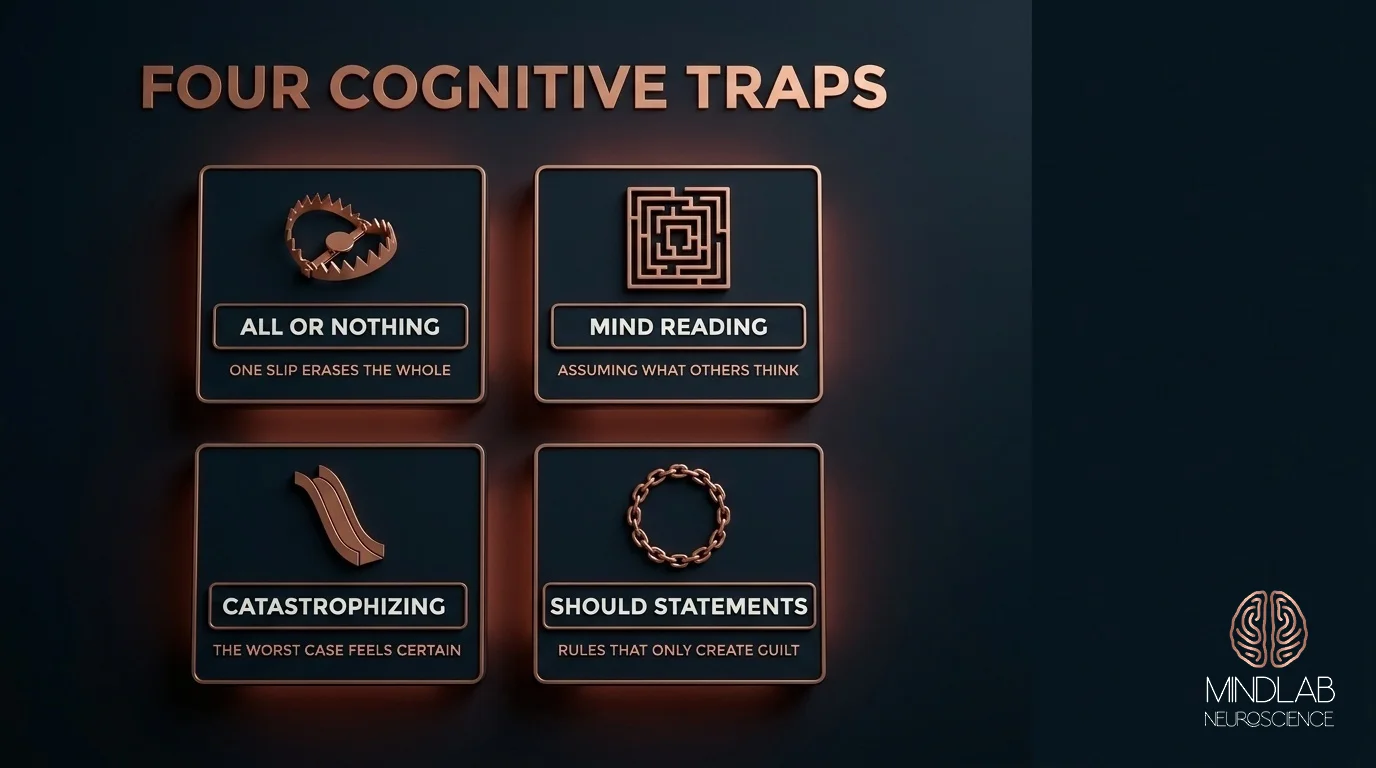
| Mind Trap | Neural Mechanism | How It Sounds in Your Head | The Rewired Version |
|---|---|---|---|
| Confirmation bias | Prefrontal suppression of disconfirming evidence; attention bias toward confirming data | “I knew this would happen: everything proves my point.” | “What evidence would change my mind? Am I looking for it?” |
| Catastrophizing | Amygdala amplification of threat probability; anterior cingulate error-detection overload | “This one mistake will ruin everything.” | “What is the realistic range of outcomes?” |
| All-or-nothing thinking | Reduced prefrontal nuance processing under threat activation | “If I’m not perfect, I’ve failed completely.” | “Where on the spectrum does this actually fall?” |
| Mind reading | Social circuit over-extrapolation from limited facial/vocal data | “They didn’t respond: they must be angry with me.” | “I don’t have enough data to know. What would I need to find out?” |
| Emotional reasoning | Interoceptive signal misattribution: body state read as external reality | “I feel like a failure, so I must be one.” | “This is how I feel right now, not what is factually true.” |
| Negativity bias | Amygdala asymmetric weighting: negative inputs weighted more heavily than positive | “Ten good things happened, but this one bad thing defines the day.” | “Am I giving equal neurological weight to what went right?” |
| Overgeneralization | Hippocampal pattern-matching that applies single-event conclusions to all future events | “This happened once, so it will always happen.” | “Is this actually a pattern, or a single data point?” |
A mind trap does not announce itself. It arrives dressed as a clear-eyed observation, a reasonable conclusion, a justified reaction. The neural automation that makes it a trap is the same automation that makes it feel like insight, which is why identifying mind traps requires a different circuit than the one running them.
Why do mind traps feel like rational thinking when they’re happening?
Mind traps are the output of automated neural circuits, not deliberate reasoning. When the confirmation bias circuit fires, the brain does not experience selective attention: it experiences clear sight. The amygdala’s threat assessment feels like accurate danger detection, not distortion. The prefrontal cortex, which could catch these errors, is often suppressed by the same activation that triggered the mind trap. The net effect is high subjective confidence in objectively distorted responses.
Which mind trap is the hardest to escape?
Confirmation bias is structurally the most difficult to interrupt because it operates at the level of attention allocation: the brain filters incoming information before it reaches conscious processing. Most other mind traps distort information already received, but confirmation bias prevents contradictory data from fully registering. Neuroimaging studies show the prefrontal cortex actively suppresses regions processing disconfirming evidence. Escaping confirmation bias requires deliberately seeking out contradictory information, an action that runs counter to neural efficiency.
Do mind traps get worse under stress?
Stress systematically amplifies every major mind trap. Excessive catecholamine signaling, amplified by elevated cortisol, together with amygdala activation reduces prefrontal cortex bandwidth: the primary inhibitory check on catastrophizing, all-or-nothing thinking, and emotional reasoning. Under low stress, the prefrontal cortex intervenes before distorted patterns produce decisions. Under high stress, that intervention capacity is compromised and mind traps run faster. The stress response physiologically reduces the brain’s capacity to interrupt its own distortions.
Can you durably rewire mind traps?
The underlying circuits producing mind traps do not disappear, but the dominance of those circuits relative to more accurate alternatives can be durably shifted. Neuroplasticity allows frequently activated pathways to strengthen while less-used pathways weaken. Consistently practicing a more accurate response to triggering situations eventually makes that response the brain’s default. The retraining circuit must be engaged during the same conditions that activate the mind trap, not in calm reflection afterward.
Are mind traps the same as cognitive distortions?
The terms overlap significantly. Cognitive distortions is the research term for systematic errors in thinking, first categorized by Aaron Beck during the 1960s. Mind traps is a broader framing that encompasses cognitive distortions but also includes attentional biases, social misattributions, and automated threat responses operating below explicit thought. The practical distinction: distortions suggest errors caught through deliberate reasoning, while traps better capture the automaticity of self-reinforcing patterns.
What are mind traps and how do they keep you stuck in negative thinking?
Mind traps are recurring cognitive patterns where the brain gets locked into loops of rumination, catastrophizing, or black-and-white thinking that feel impossible to escape. These patterns persist because they activate the brain’s default mode network, which reinforces familiar thought paths even when they lead to distress.
Why does the brain create mind traps instead of thinking rationally?
The brain prioritizes energy efficiency and defaults to well-worn neural pathways rather than expending the effort required for fresh, rational analysis of every situation. Mind traps are essentially cognitive shortcuts that once served a protective purpose but now fire automatically in situations where they create more harm than benefit.
What are the most common types of mind traps people experience?
The most prevalent mind traps include catastrophizing, where you assume the worst possible outcome, all-or-nothing thinking that eliminates any middle ground, and personalization, where you blame yourself for events outside your control. Overgeneralization, which turns a single negative event into a never-ending pattern, is another extremely common trap.
How can you break free from a mind trap once you recognize it?
The first step is labeling the specific mind trap by name, which activates the prefrontal cortex and creates cognitive distance from the automatic thought pattern. Then, deliberately generating two or three alternative interpretations of the situation forces the brain out of its default loop and opens up more balanced perspectives.
References
- Kahneman, D. (2011). Thinking, Fast and Slow. Farrar, Straus and Giroux.
- Ochsner, K. N., & Gross, J. J. (2005). The cognitive control of emotion. Trends in Cognitive Sciences, 9(5), 242-249. DOI
- Beck, A. T., Rush, A. J., Shaw, B. F., & Emery, G. (1979). Cognitive Therapy of Depression. Guilford Press.
From Reading to Rewiring
Mind traps are deeply encoded neural schemas, organized belief structures stored in the medial prefrontal cortex and hippocampus, that automatically filter perception and constrain behavioral choices below conscious awareness. Formed through repeated experience, these schemas activate within milliseconds of relevant stimuli, shaping emotional responses and decision patterns long before deliberate reasoning engages.
One hour with Dr. Ceruto