Key Takeaways
- ADHD executive problems come from prefrontal chemistry and reward-pathway differences, not from effort.
- Capable adults mask ADHD with crisis-driven performance until the load outruns the reserve.
- Working memory, initiation, time sense and emotional volume share one regulatory gap.
- Strategies fail because operating them costs the capacity that was short to begin with.
- The premise of the work: the wiring stays plastic, so regulatory circuits can be strengthened.
- ADHD coaching works on habits, therapy on meaning; neuroscience works on the circuitry itself.
If you are capable, driven, and still cannot make yourself start the thing you know matters most, the problem is executive function, not your character. Executive function is the set of prefrontal operations that turn an intention into an action, hold a plan while the world interrupts, feel time passing, and keep emotion at a workable volume. ADHD changes how those operations get their fuel. That is why you can do a week’s work at 11 p.m. the night before a deadline and none of it at 10 a.m. with two weeks to spare.
Coaching works on habits and structure, therapy on meaning and mood, and the work described here on the circuitry underneath both. If you came here looking for an ADHD executive coach, or wondering about ADHD coaching vs therapy, that is the short answer. The prefrontal cortex depends on two chemicals, norepinephrine and dopamine. The working model of ADHD is that they tend to sit outside the range it needs unless something urgent, novel or personally charged pushes them into it. This page explains what is happening in that circuitry, why it looks different in high achievers, and why the usual advice slides off. If you would rather skip to the conversation, the fastest route is an hour by phone with me: schedule a strategy call and we map the pattern together.
What does ADHD do to executive function?
Executive function is the brain’s management layer. It holds a goal in mind, resists the pull of whatever is more interesting, switches approach when the first one fails, and notices when you have drifted. Most of that work runs through the prefrontal cortex and its connections to the striatum, the deep structure that weighs reward and initiates action. ADHD is associated with differences in exactly those circuits. The prefrontal cortex is also unusually sensitive to its chemical environment: it needs optimal levels of norepinephrine and dopamine to regulate attention and behavior. Norepinephrine strengthens the signal you are trying to hold, and dopamine quiets the noise around it. When those levels drift, the management layer thins out.
The condition is not a lifestyle artifact. Twin and family studies put ADHD’s heritability at about 74 percent. That is why the pattern so often runs through a family, and why “just try harder” fails for the same reason it would fail for eyesight.
The most durable model of what ADHD does to executive function starts with inhibition. When the brain cannot reliably pause before responding, four capacities that depend on that pause suffer. They are working memory, the regulation of emotion and motivation, the inner speech that talks you through a task, and the ability to take a problem apart and reassemble it. The table below maps the executive functions people notice most onto what they feel like from the inside; it is a plain-language map, not Barkley’s list.
| Executive function | What ADHD changes | How it shows up |
|---|---|---|
| Working memory | Less capacity, more interference | Losing the thread mid-task, forgetting the instruction you just heard |
| Inhibitory control | A weaker pause between impulse and action | Interrupting, deciding too fast, switching tasks without meaning to |
| Cognitive flexibility | Harder to change approach under stress | Staying stuck in an approach that is not working, all-or-nothing thinking |
| Performance monitoring | Less awareness of drift | Realizing an hour later that you have been somewhere else |
This is a difference in how reliably the management layer gets the chemistry it needs, not a deficit of intelligence, and it is workable.
The gap between what you know you’re capable of and what you can consistently deliver isn’t a character flaw. It’s a mismatch between how your brain processes executive demands and how the world expects those demands to be met. In my 26 years of practice, I’ve observed that the most accomplished clients often struggle the most with this disconnect: their intelligence masks the underlying executive function challenges until the system reaches a breaking point.
In my work with executives, I see how working memory limitations create a cascade of secondary problems. Meetings become stressful because holding all the discussion threads while formulating responses taxes the system. Email becomes overwhelming because each message requires you to remember context, priorities, and previous decisions while crafting appropriate responses. Strategic planning feels impossible because connecting long-term goals to immediate actions requires holding multiple time horizons and variables in mind simultaneously. For the wider map of how attention, memory and motivation fit together, see the ADHD and executive function hub.
Why can you focus for hours on some things and not at all on others?
Because ADHD is not one problem. The best-supported account describes two pathways that can each be affected. One is the executive pathway, the inhibition and planning story above. The other is a motivational pathway, in which the brain’s reward circuits weight immediacy so heavily that waiting itself becomes aversive. The second pathway explains the part of ADHD that baffles people who live with it. The same brain that cannot open a spreadsheet can build a company, write until dawn, or play a game for nine hours without noticing hunger.
The imaging evidence points the same way. In a study of 53 unmedicated adults with ADHD, the dopamine transporters and D2/D3 receptors in the brain’s reward pathway, the nucleus accumbens and midbrain, were less available than in adults without ADHD. The lower the availability, the higher the person’s ratings of inattention. In plain terms, the system that tags a task as worth doing is running with a weaker signal. Ordinary tasks do not clear the bar. Tasks that carry novelty, urgency, competition, or something you love clear it easily, and once they do, the system engages and then keeps going. It locks.
That lock is hyperfocus, and the simplest way to understand it is as the same threshold running in the other direction. The threshold is high, so most things fall below it and the brain looks for an exit. A few things sail over it and the brain cannot let go. People experience these as opposite problems, one about not being able to start and one about not being able to stop. On this model they are one dial. Understanding that stops you from reading your best hours as evidence that you could do this all the time if you tried. It also tells you what the work has to change: the threshold, not the effort.
In my practice, I work with clients who describe feeling like they need constant stimulation or cannot seem to get started on important tasks. One client, a marketing executive, could hyperfocus on designing graphics for hours but could not start writing a simple email. This is not willpower failure. It is the direct expression of how her brain’s dopamine system responds differently to different categories of task. The design work exceeded her activation threshold. The email did not.
In practice, this distinction is transformational. One client, a senior manager who had spent decades believing she lacked discipline, realized that she had never failed to complete anything that genuinely interested her or that carried real stakes. The only things she could not finish were low-urgency, low-interest, long-timeline projects. When we redesigned her work architecture to artificially create urgency and interest through structure rather than waiting for them to occur naturally, her productivity changed within weeks. Not because she tried harder. Because her environment finally met her threshold.
Why does knowing what to do not turn into doing it?
One of the most disorienting features of adult ADHD is the gap between knowing and doing. You know the deadline is today. You know that starting now is the only reasonable move. You intend to begin, clearly and sincerely, and then you watch yourself check your phone, tidy the desk, and find something urgent that turns out not to be. You arrive at the deadline having done none of what you knew you should.
This is an initiation problem, not a motivation problem in the ordinary sense. The bridge between “I should do this” and “I am now doing this” runs through the same reward and prefrontal circuitry described above. For a task that is important but not stimulating, the signal that would fire the bridge is too weak. What makes it exhausting is the self-knowledge. You are not confused about what needs to happen. You are watching yourself not do it, in full awareness, and the self-judgment that follows adds stress, and stress of any kind is what the prefrontal cortex handles worst (Arnsten, 2009). Starting gets harder still. That loop is architectural, and it is the one the work goes after first.
I help clients overcome this by restructuring the initiation conditions rather than demanding more willpower. One client could not start cleaning her apartment. Her first step became placing one item in the sink. In my reading, that tiny action created just enough reward signal to build momentum for the next. The principle is: lower the initiation threshold by making the first step genuinely easy, then use the momentum of completion to generate the dopamine signal for the next step.
Why does ADHD look different in high achievers?
Because success is a very effective disguise. A capable adult with ADHD can reach their thirties or forties, with degrees, promotions and leadership roles, before anyone names the pattern, and when that happens it is not an accident. They have built compensations that hide the executive gap behind measurable output. Three patterns recur.
The first is the crisis-performance cycle. The person learns, usually without noticing, to organize work around urgency. Tight deadlines, emergencies, the project nobody else can rescue: these supply the arousal that brings the prefrontal cortex online, and the work produced under that pressure can be excellent. The belief “I only work well under stress” forms, and it is half true. What it misses is the cost. Running on stress produces a narrow, intense kind of executive function rather than a flexible, sustainable one, and under prolonged load it changes prefrontal wiring physically. Over years, what began as an effective work style becomes the source of burnout.
The second is perfectionist overcompensation. Knowing that executive function is unreliable, the person builds insurance: endless review, over-research, refusing to share anything until it is flawless. The perfectionism protects against the shame of the careless error, and it also creates enormous inefficiency and a reluctance to delegate, because delegation would expose the process behind the polished output.
The third is a split self. At work: organized, decisive, productive. At home: unopened mail, missed renewals, the household running on the partner’s executive function. The cognitive resources spent holding the professional performance together leave almost nothing for the executive demands of a private life, and the people closest to the person read the difference as not caring. It is resource depletion, not indifference, and having it named accurately is itself a relief.
ADHD coaching vs therapy: what each one reaches, and what neuroscience adds
People searching for help with adult ADHD are usually choosing between three things, and the choice is clearer once you know what each one works on.
ADHD coaching works on behavior and structure. A good coach helps you build systems, set up accountability, and practice habits. That is useful, and for some people it is enough. Its limit is structural: every system has to be operated, and operating it costs the same regulatory capacity that was short in the first place. The strategies that are easiest to learn are the hardest to sustain, and when the structure comes off, the pattern tends to come back.
Therapy works on meaning, history and mood. It is the right place for the grief and shame that decades of ADHD can leave behind, and for the anxiety or low mood that often travel with it. It is where relationships bruised by years of dropped threads get repaired. Its limit is that talking about a pattern on Tuesday does not change how the circuitry behaves on Wednesday morning at 9 a.m., when the initiation gap opens.
Medication is a prescriber’s domain, and this work sits alongside it, for those who use it, rather than in place of it.
The work I do is a different category, not a better version of one of those. It operates on the regulatory architecture itself: the strength of the prefrontal systems that decide where attention goes, how long it holds, how reliably it returns when disrupted, and how much emotional volume gets through. When that capacity is stronger, the strategies become executable, the insight from therapy becomes usable, and a deadline stops being the only thing that can switch the brain on. If you have tried coaching and therapy and are wondering what else there is, this is the third category. It starts with an hour by phone: book a strategy call by phone and the first thing we do is map your pattern.
Why does time feel slippery?
Ask an adult with ADHD how long a task took and the estimate can be a long way from the clock. Ask them to start something that is due in two weeks and it will feel identical to something due in two years: not now. The pattern is often called time blindness, and the label fits the experience. Duration is hard to estimate, sequence is hard to hold, and the future does not generate the pull the present does.
The consequences compound. Poor estimates produce overcommitment. Overcommitment produces crises, and crises produce the emergency focus that solves today’s problem while reinforcing the pattern that caused it. People with this pattern describe time “jumping forward”: they start something with plenty of room and look up to find they are late for the next thing. Strategic thinking suffers most, because working backward from a goal to today’s action requires holding several time horizons at once, and holding several things at once is what a strained working memory drops first.
Trying to develop a better internal clock through willpower does not work. What works first is putting time outside the head, where the eyes can see it, and that is where the deeper work gets the room it needs.
A client who managed complex projects consistently missed deadlines despite genuine care and effort. We created external time markers: physical timers, visual schedules, calendar blocking with distinct color coding for task types. By making time visible and concrete, we gave her brain the external structure it needed to compensate for what I read as a dopamine-related timing impairment. External time structures for ADHD brains are not accommodations. They are neurological prosthetics replacing a function the internal system cannot reliably provide.
Why do emotions hit harder?
Emotion dysregulation is so common in ADHD, and so impairing, that some researchers argue it belongs in the definition. It is prevalent across the lifespan (Shaw and colleagues, 2014). The research implicates a network linking the striatum, the amygdala and the medial prefrontal cortex. That is the same regulatory territory attention depends on, so it is reasonable to read it as one gap showing up in a second domain. Frustration spikes faster than the situation warrants, criticism lands harder and stays longer, and excitement can collapse into deflation with no warning at all. The feelings are real; what is missing is the dampening a well-fueled prefrontal system provides.
This matters for performance in a direct way. On a calm, optimistic day the executive system may work beautifully; on a stressed or anxious day the same brain struggles with basic control. The shame that accumulates over years of knowing better and not doing better adds a second layer. Each lapse triggers self-attack, self-attack is itself a stressor, and the person is then asked to regulate emotion with the very system that stress has just strained. Breaking that loop comes before every other executive gain, and the work is built around that order.
A client I work with struggled with angry responses during stressful professional interactions. Through neuroscience-based mapping, we identified what I read as dopamine fluctuations in the late afternoon (when his baseline was lowest) as the primary driver of his emotional escalations. We restructured his schedule to protect high-dopamine morning hours for relational work and low-stakes execution for the afternoon trough. The pattern largely resolved not because he managed it better, but because we stopped placing high-regulation-demand activities in the window when his regulatory capacity was at its lowest.
A client who experienced intense reactivity in professional settings learned to name the emotion internally the moment she noticed it rising. “Frustration at the ambiguity,” or “anxiety about the timeline.” The naming created just enough delay, and just enough prefrontal engagement, for her response to shift from immediate reaction to considered response.
Every client I work with develops a pre-identified set of regulatory strategies that match their own nervous system: physical, sensory, or cognitive. The critical design principle is that these strategies are identified and practiced in a regulated state, not improvised during an escalation. When dopamine is low and emotional intensity is high, the brain does not have the executive resources to generate novel coping strategies. It needs a practiced protocol it can execute without deliberation.
What is ADHD brain fog, and why does it thicken through the day?
People with ADHD describe a particular haze: simple tasks wrapped in cotton, a sentence read three times and not absorbed, a name on the tip of the tongue for an hour. This is different from the fog everyone gets. Situational fog comes from a bad night or a hard week and lifts when the cause does. ADHD fog is the executive gap itself, felt from the inside; people describe it as present to some degree most of the time, and thicker whenever the system is loaded.
In my practice I see the cost of misreading this every week. Capable people spend years convinced they simply aren’t disciplined enough, when what they actually have is a neurochemical supply problem the willpower model cannot touch. Once you understand the root cause, the work changes. Instead of pushing harder against the fog, you build the conditions that let the prefrontal cortex regain its grip on executive function. The fog is not a fixed sentence; it responds to targeted, brain-specific strategy.
Stress is the main thickener. The prefrontal cortex is the brain region most sensitive to stress (Arnsten, 2009): even mild, uncontrollable stress can rapidly degrade prefrontal abilities, and prolonged stress changes prefrontal wiring physically. For an ADHD brain that is already running its management layer on a thin margin, a stressful morning is more than unpleasant. It takes the manager offline. Poor sleep and a day of nonstop input are the other loads people report, and they push the same way, which is why the pattern of clear mornings and useless afternoons is so familiar.
I have seen dramatic functional changes in clients whose primary intervention was sleep optimization. One client had persistent cognitive fog that she attributed to her ADHD. We implemented a structured sleep protocol: lights dimmed 90 minutes before bed, no screens after 9 p.m., consistent sleep and wake times even on weekends. Within two weeks, her focus and emotional regulation improved substantially, not because her ADHD changed, but because her brain finally had the recovery window it needed.
There is a longer loop underneath the daily one. On the account the HPA axis article gives, years of last-minute scrambling teach the stress system that it only needs to mobilize under threat, and the brain learns to wait for the threat before it will work. That loop, and how it can be retrained, is the subject of the article on how stress and the HPA axis interact with ADHD and neuroplasticity.
What does working at the neural level look like?
It starts with precision mapping, because ADHD is not uniform. One person’s pattern is an afternoon collapse under load. Another’s is an initiation gap on anything without a deadline, or emotional volume that wipes out a day, or time blindness that has cost them jobs. The intervention has to match the specific configuration in the brain in front of me, not the label it was given. So the first work is mapping which circuits are carrying the problem and under which conditions they fail.
I worked with a client who had spent years believing she was simply “bad at adulting.” We mapped her specific dopamine regulation pattern: where her threshold sat, which inputs reliably exceeded it, which environments consistently fell below it. Her entire orientation shifted. She stopped pathologizing her preferences and started engineering her environment. Within months, her output, her relationships, and her self-regard improved substantially, not because anything was cured, but because she was finally operating in alignment with how her brain actually works.
From that map, the method is Real-Time Neuroplasticity™: intervening in the live moment when the pattern is running, not in a session reviewing it afterward. The premise of the method is that a pattern is easiest to change while it is running. In practice, this means working with a client when she is in the paralysis of a task initiation failure, not discussing it later. It means identifying the exact neural sequence (the moment the reward system evaluates the task, finds it below threshold, and begins generating the avoidance signal) and intervening at that moment to redirect the circuitry. Over repeated real-time interventions, the evaluation sequence itself changes. The threshold for the specific task category lowers. What required an external structure to initiate eventually becomes internally accessible.
I had a client (a senior professional with a 20-year history of ADHD and a lifetime of failed behavioral interventions) who came to my practice having tried every productivity system available. None had held. The problem was not the systems. It was that all of them required her to implement the correct behavior before her brain had the dopamine signal that would make the correct behavior feel possible. Real-Time Neuroplasticity™ reverses the sequence: the neural work happens in the live moment, at the point of threshold failure, rather than asking willpower to override a system that has not yet changed.
The changes this work aims at are structural: changes in how the system is organized rather than scaffolding bolted onto the outside of it. That is why they are built to hold when the work ends. The aim is that the person who finishes still has the strengths that come with the wiring, and there are real ones, and gains enough regulatory capacity to point them where they choose.
If this is the level you want to work at, the way in is an hour by phone. In that hour I map your pattern, tell you what is driving it, and say whether the work fits, and nothing is decided before then. Schedule a strategy call with me, and bring the thing you have not been able to start.
How do you externalize executive function while the wiring changes?
Structural change takes time, and life does not pause for it, so the second track of the work is environmental design: moving executive demands out of the head and into systems that hold them. It is the correct engineering for this brain, and it frees capacity for the thinking that only a human can do.
Make the first step so small it feels silly. The reward system will not fund “write the report.” It will usually fund “open the document and type the title.” On the threshold model, completing that step supplies the signal that makes the next one reachable. Decompose until the first step produces almost no resistance.
Put working memory on the wall. A task board that shows every open project and its state. A meeting template that lists the preparation steps. A single landing zone for keys, wallet and phone. Each of these is external working memory, and each removes a load the internal system was dropping.
Make time visible. The physical timers, visual schedules and calendar blocking described in the time section above are the first layer. Short, bounded work intervals with a real break between them add frequent, visible completions to work toward.
I worked with a developer who hyperfocused on coding but resisted documentation. We designed his schedule so that coding (his natural hyperfocus domain) was protected during what he and I mapped as his highest-dopamine morning window. Documentation was scheduled in shorter blocks with explicit timer constraints during periods when hyperfocus was less likely to activate. He did not change his hyperfocus. We changed when and where it was deployed.
Use other people’s presence. Working alongside someone, in a room or on a call, with no requirement that they do the same task, is an initiation aid many people with ADHD swear by. Body doubling is the informal name; the effect is well known to anyone who has ever done their taxes only because a friend was in the room.
Protect the basics, and design the resets. Sleep, movement and a proper breakfast count as part of the design here, not as extras. The moments between tasks are where an ADHD brain is most likely to collapse into passive high-stimulation input, scrolling being the obvious example. I had a client who struggled with focus every afternoon. We added a ten-minute walk after lunch. Her concentration improved substantially for the remainder of her workday, not because she relaxed, but because the movement gave her prefrontal cortex the dopamine signal it needed to engage. In my experience the mechanism matters: exercise is not a calming strategy for ADHD. It is a dopamine delivery mechanism.
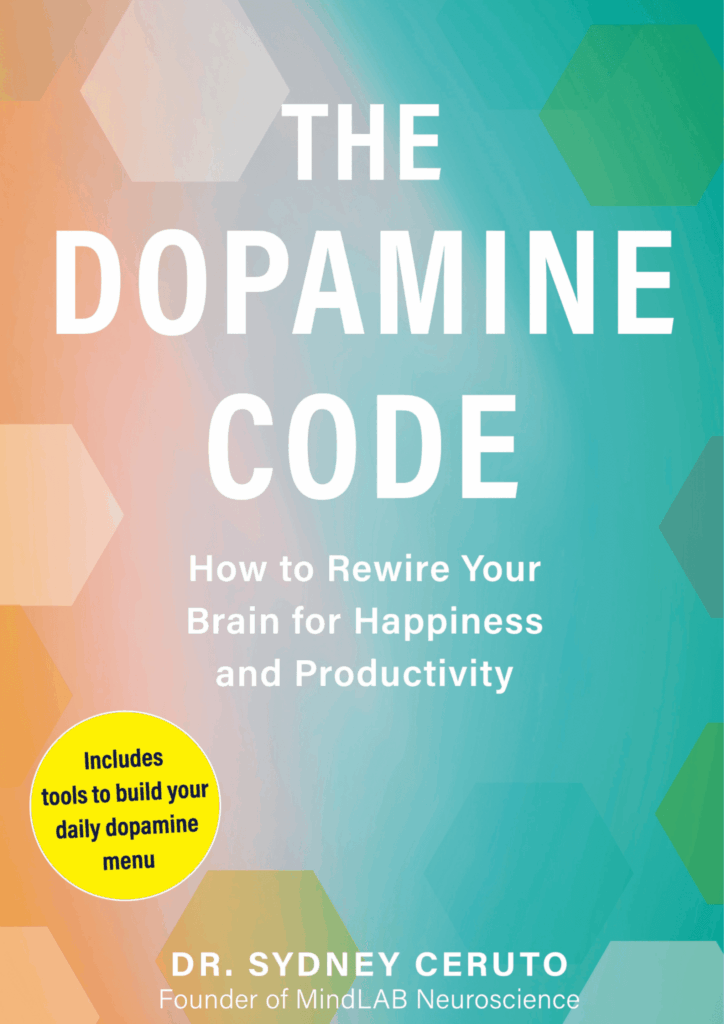
Replacing the scrolling default with planned resets is the idea behind the Dopamine Menu, which I build with every client: a personalized architecture of activities calibrated to their specific dopamine system, in three layers. Micro-Doses are 2 to 5 minute nervous system resets: a song, a brief walk, physical movement. The Sustainable Layer covers 10 to 30 minute effort-linked activities that provide reward through accomplishment: a hobby, focused reading, structured conversation. The Deep Layer contains high-meaning, high-return experiences: creative work, physical challenge, genuine social connection. The Dopamine Menu itself is developed in full in my book, The Dopamine Code (Simon & Schuster, June 2026). The deeper change is the work in the previous section.
The strengths that come with the wiring
Part of what makes ADHD hard to address is that the architecture producing the difficulties also produces real advantages. The reward system’s pull toward novelty and urgency is the engine behind hyperfocus that can lock onto a problem for hours. It is also behind the speed of response when a situation shifts, and the depth of engagement once a task clears the threshold. In roles that supply the conditions the wiring needs, that engine is an asset.
The problem is the gap between those roles and everything else. It runs between the work that switches the system on and the work that does not, and between the performance others see and the effort behind it. The goal of the work is to build enough regulatory capacity that the strengths can be directed, so hyperfocus goes where it is needed rather than only where the dopamine points it. Nothing about that suppresses the strengths.
I worked with a client who spent years believing his ADHD was the reason his career had never reached its potential. When we mapped his actual performance history, the picture that emerged was different: he had consistently produced his best work in high-stakes, high-novelty environments. His career stagnated specifically in roles that required sustained execution of established processes. He was not underperforming. He was in the wrong architecture. Reorienting his career toward roles that matched his neurological strengths, not despite his ADHD but because of it, changed everything.
The most consistent shift I see in clients who understand the dopamine threshold model is the dissolution of shame. When the pattern is a neurological mismatch, not a character failure, the energy that was going into self-criticism becomes available for environmental redesign.
For finance professionals, lawyers, and people who lead
High-load professions are where the ADHD pattern is most likely to look like success and most likely to break. A trading floor or a deal team supplies urgency, novelty and immediate feedback all day, which is the environment this wiring runs best in for a few hours. Then the load of thousands of inputs and dozens of sequential decisions drains the prefrontal reserve faster than it can recover. Judgment at 3 p.m. is not what it was at 9 a.m. The person exercising it is rarely in a position to notice. Leadership roles have the opposite problem: the live parts of the job switch attention on, and the job is mostly the parts in between.
I work with people in these roles from two offices in New York City, on Wall Street and in Midtown Manhattan, from an office in Miami, and by phone from anywhere. ADHD coaching for finance professionals is a phrase people search; what they usually need is the regulatory work described on this page, in the context their environment produces. The city pages describe that context:
- ADHD and executive function on Wall Street
- ADHD and executive function in Midtown Manhattan
- ADHD and executive function in Miami
The mechanism is the same in all three; what differs is the shape the environment gives it.
From understanding to change
Knowing all of this does not, by itself, change anything. The gap between insight and implementation is where most efforts stall, and the reason is now clear: change requires executive capacity, and executive capacity is the thing that is short. So the sequence matters. Build the regulatory strength first, at the level of the circuitry, with the environment engineered to hold what the brain cannot yet. The aim is that the strategies that never held start to hold, one at a time. The premise underneath is that executive skills strengthen through repeated use in real conditions rather than through a burst of intensity, so early on the measure that matters is whether the new pattern ran.
If you recognized yourself in more than one section of this page, the pattern is identifiable and it is addressable at its source. The first step is a strategy call by phone: an hour in which I map what is driving it and tell you whether this work fits.
References
- Arnsten, A. F. T. (2006). Fundamentals of attention-deficit/hyperactivity disorder: circuits and pathways. The Journal of Clinical Psychiatry, 67(Suppl 8), 7-12. https://pubmed.ncbi.nlm.nih.gov/16961424/
- Arnsten, A. F. T. (2009). Stress signalling pathways that impair prefrontal cortex structure and function. Nature Reviews Neuroscience, 10(6), 410-422. https://doi.org/10.1038/nrn2648
- Barkley, R. A. (1997). Behavioral inhibition, sustained attention, and executive functions: constructing a unifying theory of ADHD. Psychological Bulletin, 121(1), 65-94. https://doi.org/10.1037/0033-2909.121.1.65
- Faraone, S. V., and Larsson, H. (2019). Genetics of attention deficit hyperactivity disorder. Molecular Psychiatry, 24(4), 562-575. https://doi.org/10.1038/s41380-018-0070-0
- Shaw, P., Stringaris, A., Nigg, J., and Leibenluft, E. (2014). Emotion dysregulation in attention deficit hyperactivity disorder. The American Journal of Psychiatry, 171(3), 276-293. https://doi.org/10.1176/appi.ajp.2013.13070966
- Sonuga-Barke, E. J. S. (2003). The dual pathway model of AD/HD: an elaboration of neuro-developmental characteristics. Neuroscience and Biobehavioral Reviews, 27(7), 593-604. https://doi.org/10.1016/j.neubiorev.2003.08.005
- Volkow, N. D., Wang, G.-J., Kollins, S. H., Wigal, T. L., Newcorn, J. H., Telang, F., Fowler, J. S., Zhu, W., Logan, J., Ma, Y., Pradhan, K., Wong, C., and Swanson, J. M. (2009). Evaluating dopamine reward pathway in ADHD: clinical implications. JAMA, 302(10), 1084-1091. https://doi.org/10.1001/jama.2009.1308
From Reading to Rewiring
The executive gap described on this page is a description of circuitry, and circuitry can be changed. Work directly with Dr. Sydney Ceruto to map the pattern that is running in your brain and what it will take to rewire it.
What is executive function, and how does ADHD affect it?
Executive function is the set of prefrontal operations that manage attention, working memory, planning and impulse control. In ADHD, the prefrontal cortex and its reward-circuit connections run with less reliable norepinephrine and dopamine signaling. That makes it harder to hold a goal, resist a distraction, start a task that carries no urgency, and notice when you have drifted. The problem is chemical and architectural, not a failure of effort. People searching for ADHD executive function coaching are usually looking for exactly this: work aimed at those circuits rather than at the symptoms.
Why can I work well under pressure and badly without it?
Pressure raises arousal, and arousal is one of the things that moves the prefrontal cortex into its working range (the inverted-U relationship Arnsten describes). In ADHD that range is harder to reach on routine tasks. Urgency, novelty and personal stakes clear the reward threshold; routine tasks do not. The same mechanism that lets you produce a week’s work in a night is what leaves the spreadsheet unopened for two weeks. It is one dial, not two different problems.
How is this different from ADHD coaching or therapy?
Coaching works on behavior and structure; therapy works on meaning, history and mood. Both have their place. This work operates on the regulatory circuitry itself, strengthening the prefrontal systems that decide where attention goes and how much emotional volume gets through. With that capacity in place, the strategies from coaching become executable and the insight from therapy becomes usable. It sits alongside medication, for those who use it, rather than in place of it.
Can executive function improve in an adult brain with ADHD?
Executive function can improve in an adult brain with ADHD; the premise of this work is that the circuits involved stay plastic throughout adult life, and everything in this work rests on it. Two things change together. One is the regulatory capacity of the prefrontal systems, through repeated intervention at the moment the pattern runs; the other is the environment, redesigned to hold what the brain cannot yet. Consistency of conditions matters more than intensity of effort here: the new pattern has to run, repeatedly, in the same stable conditions, before it becomes the default.
Do you work with people in finance and other high-pressure roles?
I work with people in finance and other high-pressure roles from offices on Wall Street, in Midtown Manhattan and in Miami, and by phone from anywhere. Trading floors, deal teams and leadership roles are where this pattern is most often mistaken for talent, and the city pages linked above describe what each environment does to it. Every engagement starts the same way: a strategy call by phone to map the specific pattern.