Borderline Personality Disorder Splitting: The Neural Architecture Behind All-or-Nothing Thinking
Key Takeaways
- Splitting: the orbital prefrontal cortex cannot integrate contradictory feelings about one person, not a choice
- During splitting, the amygdala turns hyperreactive to ambiguous cues, reading neutral faces as threatening
- Reduced orbitofrontal cortex-amygdala connectivity blocks integration of conflicting emotion, forcing binary all-good or all-bad evaluations
- The idealization-to-devaluation cycle is metabolic: prefrontal resources deplete, and the negative representation takes over
- Mentalization-based approaches strengthen the prefrontal-to-amygdala inhibitory pathway
- Splitting’s neural substrate is modifiable: neuroplasticity-based restructuring builds nuanced emotional evaluation
Splitting is a neurological event, not a personality flaw, not a manipulation tactic, and not a conscious decision to see the world in extremes. When someone in a borderline presentation shifts from idealizing another person to devaluing them within hours or even minutes, what has occurred is a measurable failure in the orbital prefrontal cortex to sustain integrated emotional representations under conditions of ambiguity or perceived threat. The amygdala has overridden the prefrontal regulatory system, collapsing nuanced evaluation into rigid binary categories: entirely safe or entirely dangerous, all good or all bad. Neuroimaging research has identified the specific circuits involved, and the same neuroplasticity that makes these circuits vulnerable to disruption also makes them responsive to targeted restructuring. Understanding splitting at the circuit level changes everything, not only about how the pattern is interpreted, but about what can be done to modify it.

What Is Splitting in Borderline Personality Disorder and What Causes It?
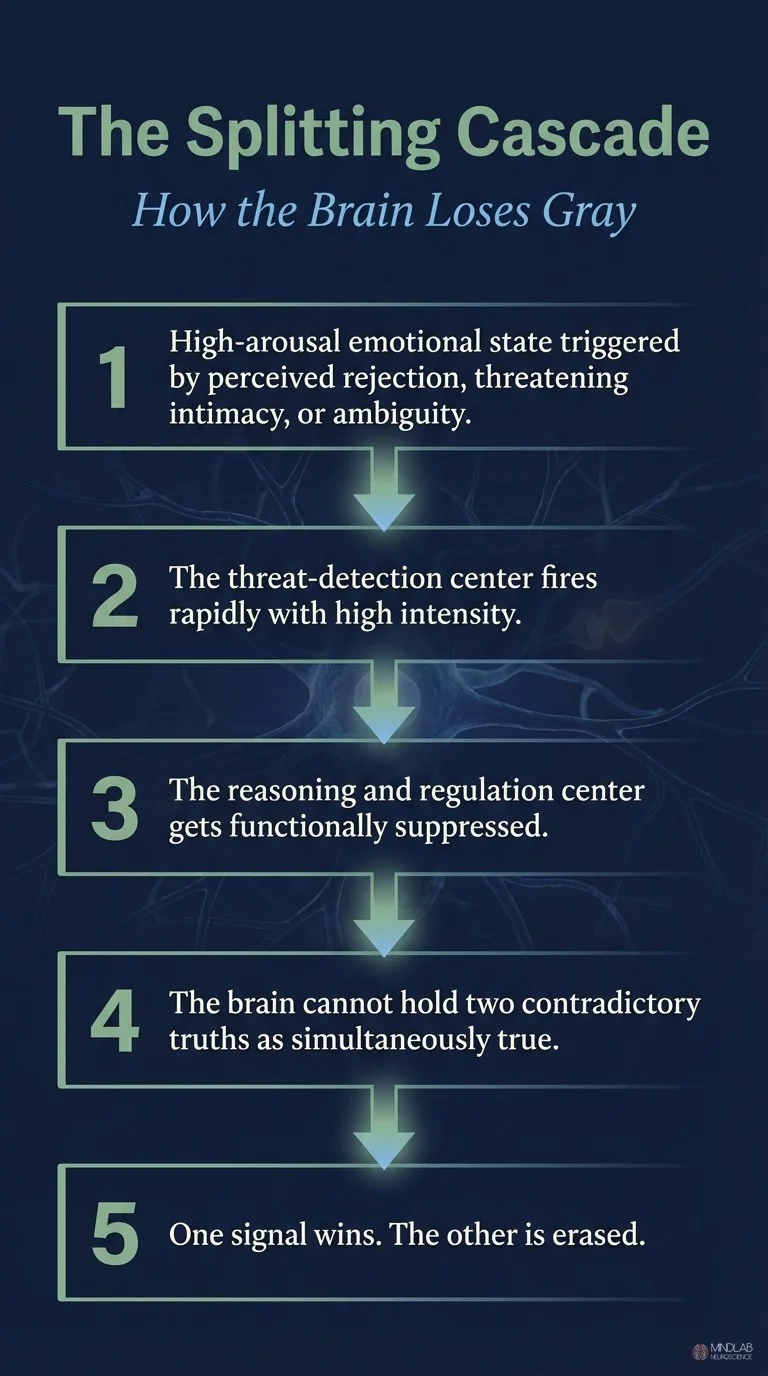
Splitting is a neurological pattern in which the brain loses its capacity to hold contradictory emotional information about the same person simultaneously, defaulting instead to all-or-nothing evaluations that oscillate between idealization and devaluation. It is caused by impaired connectivity between the orbital prefrontal cortex and the amygdala: a circuit disruption that prevents the integration of complex, mixed emotional representations.
Under typical conditions, the prefrontal cortex performs a remarkably sophisticated operation every time you evaluate another person. It holds multiple, often contradictory, pieces of information in parallel (this person was kind yesterday and dismissive today, this person is generally reliable but made a significant mistake) and integrates them into a single, nuanced representation. This integration requires sustained prefrontal activation and robust communication with subcortical structures that assign emotional weight to incoming information.
In borderline presentations, this integration process breaks down. Schmahl and Bremner established through neuroimaging studies that individuals with borderline personality disorder show altered activation patterns across the prefrontal cortex and amygdala during emotional processing tasks, consistent with a structural basis for the splitting phenomenon rather than a purely psychological one. The orbital frontal cortex (the region most directly responsible for evaluating social and emotional information, weighing competing representations, and generating contextually appropriate responses) shows reduced engagement during exactly the moments when integration is most needed.
This means that splitting is not a choice to see someone in black-and-white terms. It is the product of a brain that has temporarily or chronically lost the neural architecture required to hold gray. The person experiencing a splitting episode does not have access to the circuitry that would allow them to simultaneously recognize that someone is both frustrating and valuable, both hurtful and loving. The prefrontal system that performs that synthesis has gone offline, and the amygdala, which operates in binary threat/safety categories by design, is now running the evaluation process without adequate oversight.
How Does the Amygdala Drive Splitting Episodes?
The amygdala drives splitting episodes by assigning disproportionate threat value to ambiguous social cues, overriding the prefrontal cortex’s capacity for nuanced evaluation and forcing the brain into a defensive binary processing mode where every interpersonal signal is categorized as either safe or dangerous.
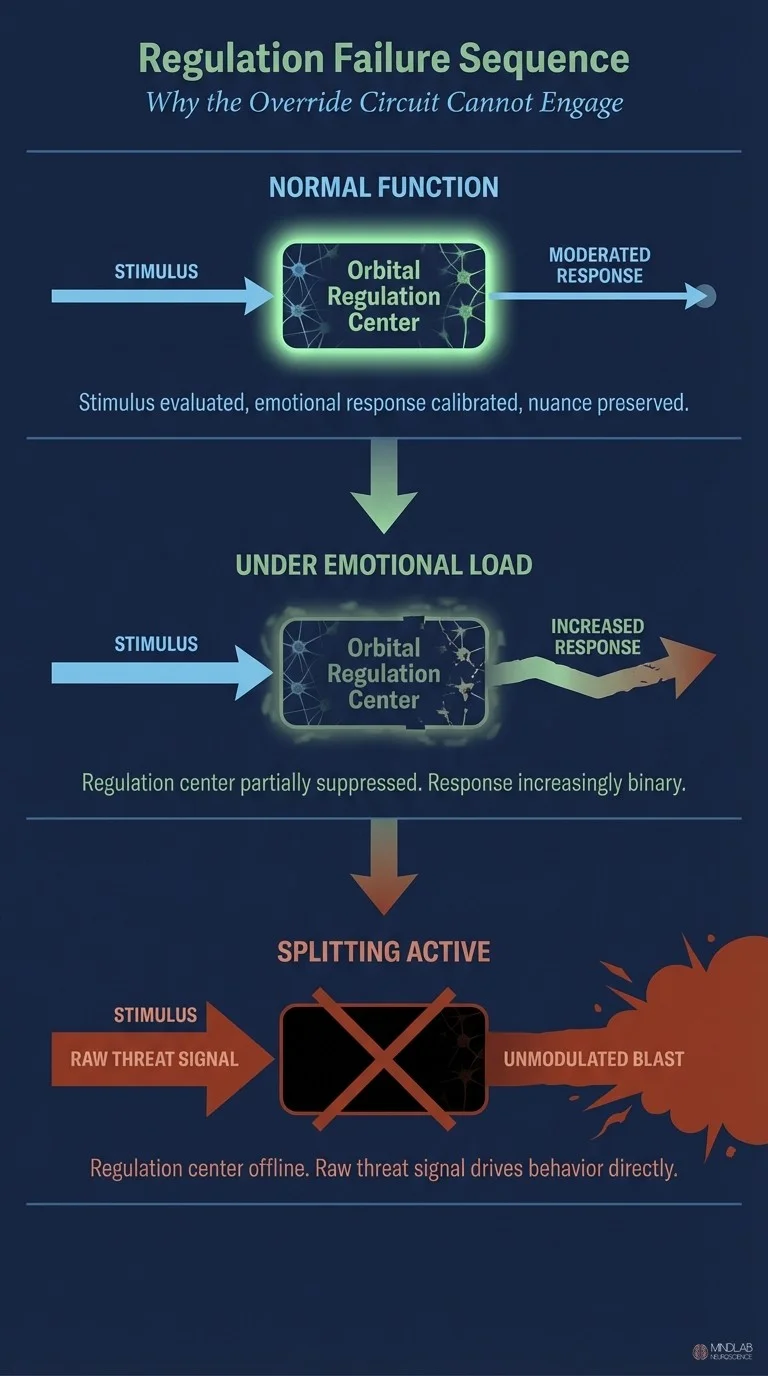
The amygdala was never designed for nuance. It evolved as a rapid threat-detection system, scanning incoming sensory and social information for signals of danger and triggering physiological and behavioral responses before conscious evaluation can complete. In a well-regulated brain, the prefrontal cortex moderates this system, evaluating whether the amygdala’s alarm is proportionate to the actual situation and dampening the response when it is not. In splitting, this moderation fails.
Research published in Biological Psychiatry by Schulze, Schmahl, and Niedtfeld conducted a multimodal meta-analysis demonstrating that individuals with borderline personality disorder show consistent patterns of heightened amygdala activation alongside reduced prefrontal regulatory engagement during emotional processing: a neural signature that maps directly onto the clinical presentation of splitting. The amygdala does not merely overreact; it recruits the brain’s entire threat-response architecture, shifting autonomic nervous system activation, attentional focus, and memory encoding into a mode optimized for danger detection rather than relational evaluation.
This explains why neutral stimuli can trigger splitting episodes. A text message without warmth, a brief pause before responding, a facial expression that carries even slight ambiguity: these register as potential rejection signals in a hyperreactive amygdala system. The threshold for threat detection has been lowered so significantly that stimuli most brains would classify as benign or irrelevant cross the activation threshold and trigger a full defensive cascade. The person is not being oversensitive in any volitional sense. Their amygdala has been calibrated (through developmental experience, relational trauma, or chronic stress) to assign threat value to input that does not warrant it. For the wider science this rests on, see the neuroscience of stress, resilience, and nervous-system regulation.
The asymmetry compounds the problem. Amygdala-to-prefrontal projections outnumber the reverse pathway, which means the threat signal reaches the regulatory system with more force than the regulatory signal can exert over the threat system. When the amygdala fires with sufficient intensity, the prefrontal cortex cannot override it, not because the person lacks willpower, but because the neuroanatomy is weighted toward the alarm rather than the brake.
Splitting is what happens when the brain’s threat-detection system overwhelms the circuitry responsible for holding contradictory truths about the same person: a circuit failure, not a character failure.

Why Does Idealization Suddenly Shift to Devaluation?
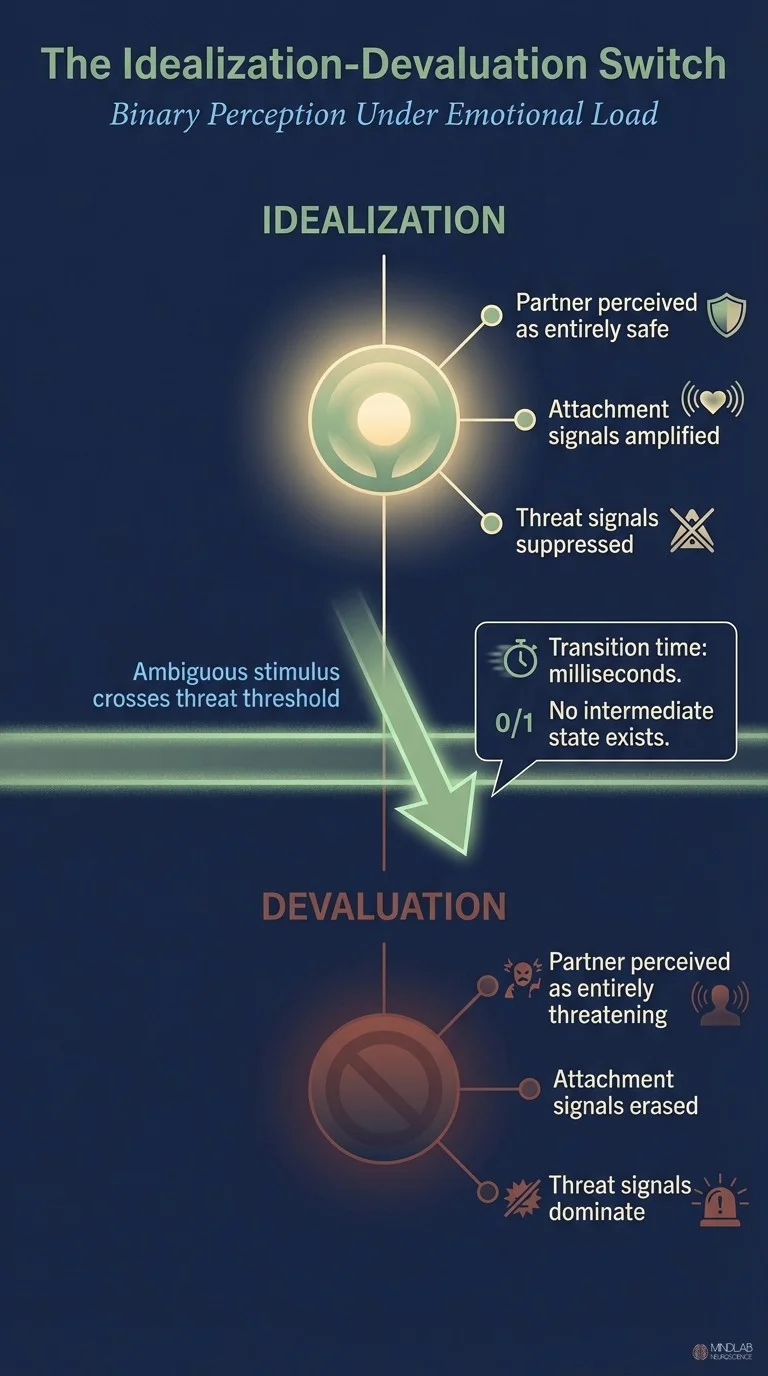
The shift from idealization to devaluation is a metabolic event in the prefrontal cortex: the neural resources required to maintain an all-good evaluation of another person deplete under sustained demand, and when the suppression system fails, the competing negative representation emerges with the full force of a signal that has been actively held back.
Idealization, from a neural perspective, is more expensive than it appears on the surface. Holding an exclusively positive representation of another person requires the prefrontal cortex to actively suppress contradictory information: every slight, every moment of disappointment, every instance where the person did not meet the idealized standard. This suppression is an ongoing metabolic cost. The prefrontal cortex is consuming glucose and oxygen to maintain a representation that does not accurately reflect the full complexity of the relationship.
When that metabolic demand becomes unsustainable (whether through fatigue, stress, an accumulation of suppressed negative information, or an acute triggering event) the suppression collapses. The negative representation does not build gradually. It arrives as a sudden reversal because it was present all along, held below the threshold of conscious evaluation by a prefrontal system that can no longer sustain the effort. This is why the shift feels so abrupt and so total. The devaluation is not new information: it is old information that was being actively suppressed and has now been released.
Chapman described this pattern within the broader framework of emotion dysregulation in borderline personality, identifying that the inability to modulate emotional responses in proportion to the actual situation reflects a fundamental disruption in the regulatory architecture rather than a failure of motivation or insight. The person experiencing the shift does not recognize it as a reversal. From inside the experience, the devaluation feels like a revelation, as though they are finally seeing the truth about someone they had been fooled by. The brain generates a compelling narrative that explains the state change as justified, because the alternative, recognizing that neither the idealization nor the devaluation is accurate, requires integrative prefrontal function that is not currently available.
This cycle is self-reinforcing. Each idealization-devaluation episode further depletes the prefrontal resources needed for integration, while simultaneously strengthening the amygdala’s association between interpersonal engagement and threat. Over time, the threshold for triggering a devaluation drops, and the intensity of each cycle increases, not because the person is choosing escalation, but because the neural architecture supporting balanced evaluation is progressively weakened by repeated episodes of regulatory failure.
What Role Does Mentalization Play in Preventing Splitting?
Mentalization (the brain’s capacity to understand behavior in terms of underlying mental states, both in oneself and in others) provides the cognitive framework that prevents the prefrontal cortex from collapsing into binary evaluation, and deficits in this capacity are among the strongest neural predictors of splitting frequency and severity.
When mentalization is intact, the brain can perform a critical operation during interpersonal ambiguity: it generates hypotheses about why someone behaved the way they did. A canceled plan becomes “they might be overwhelmed” rather than “they do not care about me.” A curt response becomes “they may be stressed” rather than “they have turned against me.” This hypothesis generation is a prefrontal function that requires the capacity to hold uncertainty: to tolerate not knowing the other person’s internal state while maintaining a stable representation of the relationship.
In splitting, this capacity is absent. The brain cannot tolerate the uncertainty, and instead resolves the ambiguity by assigning a definitive emotional category, all good or all bad, that eliminates the discomfort of not knowing but destroys the accuracy of the evaluation in the process. Fonagy and Bateman have extensively documented this relationship between mentalization failure and splitting, establishing that impaired prefrontal regulation of subcortical threat circuits produces the all-or-nothing perceptual pattern that defines the clinical presentation. Their research demonstrates that when mentalization circuits are strengthened through structured intervention, the frequency and intensity of splitting episodes decrease, not because the person learns to control their reactions, but because the neural architecture supporting nuanced evaluation has been rebuilt.
The mentalization system is distributed across the medial prefrontal cortex, the temporoparietal junction, and the superior temporal sulcus: regions collectively responsible for theory of mind, perspective-taking, and social cognition. In individuals who split frequently, these regions show reduced activation during tasks requiring the interpretation of others’ mental states. The brain defaults to simpler, faster processing strategies, primarily amygdala-driven threat/safety categorization, because the more complex mentalization system is either underdeveloped or functionally impaired.
This is why telling someone to “see both sides” during a splitting episode is neurologically futile. The instruction assumes access to prefrontal integration that is currently offline. It is the equivalent of asking someone to run on a broken leg. The architecture required to execute the instruction is the architecture that has failed. Effective intervention targets the architecture itself: rebuilding the neural infrastructure for mentalization through repeated practice under conditions of emotional activation, where the relevant circuits are engaged and modifiable.

How Does the Orbital Prefrontal Cortex Fail During Splitting?
The orbital prefrontal cortex fails during splitting by losing its capacity to weight and integrate competing emotional inputs (specifically, the ability to assign proportional value to both positive and negative information about the same person) resulting in a winner-take-all processing mode where only one emotional valence can be represented at a time.
The orbital prefrontal cortex occupies a unique position in the brain’s emotional processing hierarchy. It sits at the intersection of sensory input, emotional evaluation, and behavioral planning, receiving direct projections from the amygdala while simultaneously maintaining connections with the dorsolateral prefrontal cortex and the anterior cingulate cortex. Its primary function is valuation: determining the relative weight of competing inputs so that the brain’s response reflects the full complexity of the situation rather than the loudest signal.
In splitting, this valuation process collapses into what computational neuroscience describes as a winner-take-all network state. Instead of holding multiple representations with proportional weights (60 percent positive, 40 percent negative, or any other nuanced distribution) the system snaps to an extreme: 100 percent positive (idealization) or 100 percent negative (devaluation). The competing representation is not merely deprioritized; it is functionally suppressed, which is why the person genuinely cannot access positive memories during devaluation or negative memories during idealization.
Koenigsberg and Siever demonstrated through resting-state functional neuroimaging that borderline splitting correlates with reduced connectivity between the orbital frontal cortex and the amygdala, providing direct evidence that the integration failure is structural, not motivational. When these regions cannot communicate effectively, the amygdala’s binary output, safe or threatening, becomes the dominant processing mode because the orbital prefrontal cortex cannot modulate it with more nuanced evaluative information.
This connectivity deficit also explains why splitting generalizes beyond the person who triggered it. During an episode, the orbital prefrontal cortex’s reduced function affects all emotional processing, not just the evaluation of one specific individual. This is why a splitting episode triggered by a partner’s behavior can cascade into irritability, emotional volatility, and black-and-white thinking across every domain: work, friendships, self-evaluation. The circuitry that has failed is domain-general, and its failure produces domain-general consequences.
The orbital prefrontal cortex does not merely regulate emotion: it performs the integration that allows one person to be understood as both imperfect and valuable at the same time. When that integration fails, splitting is the inevitable result.
Can the Neural Architecture That Produces Splitting Be Restructured?
The neural architecture underlying splitting is modifiable through targeted neuroplasticity-based intervention, with research demonstrating measurable changes in prefrontal connectivity and amygdala reactivity within eight to sixteen weeks of structured practice, confirming that the circuits driving all-or-nothing evaluation can be rebuilt rather than merely managed.
The neuroplasticity of the prefrontal-amygdala circuit is well established. Structured emotion-regulation practice can strengthen the functional connectivity between prefrontal regulatory regions and the subcortical threat circuits they modulate, building that capacity through consistent, active engagement over time. These findings apply directly to the circuits involved in splitting, because the same prefrontal-amygdala pathway that governs emotional regulation in general is the pathway that fails during splitting episodes.
What makes restructuring possible is that splitting is not a fixed trait: it is a state that the brain enters when specific circuit conditions are met. If the orbital prefrontal cortex’s connectivity with the amygdala is strengthened, the threshold for entering a splitting state rises. If the mentalization system is reinforced through repeated practice, the brain develops alternative processing routes that can sustain nuanced evaluation even under conditions of interpersonal stress. If the metabolic efficiency of the prefrontal cortex is improved, the suppressive effort required to maintain idealization decreases, reducing the likelihood of the depletion-driven collapse that triggers devaluation.
The critical variable is timing. Neural restructuring is most effective when it occurs during activated states: when the relevant circuits are engaged and biologically primed for modification. This is the principle underlying Real-Time Neuroplasticity™ as practiced at MindLAB Neuroscience: intervening during the live emotional moment, when the prefrontal-amygdala circuit is under actual demand, produces more durable changes than retrospective discussion of splitting episodes after the relevant circuits have disengaged. For the full collection this belongs to, see the neuroscience of emotional resilience.
Dialectical and mentalization-based approaches have both demonstrated the capacity to produce measurable changes in prefrontal connectivity within twelve weeks of structured intervention. The mechanism is consistent across approaches: repeated engagement of the prefrontal-amygdala regulatory pathway under conditions of emotional activation strengthens that pathway through long-term potentiation and synaptic consolidation. Each successful episode of maintained integration, holding the gray instead of collapsing into black or white, reinforces the neural architecture required for the next episode. The brain is literally building the wiring it needs through the act of using it.
Why Do Neutral Stimuli Trigger Splitting Episodes?
Neutral stimuli trigger splitting episodes because a hyperreactive amygdala assigns threat value to ambiguous input that a typically calibrated brain would classify as benign, lowering the activation threshold for defensive binary processing to the point where ordinary interpersonal communication becomes sufficient to overwhelm the prefrontal regulatory system.
The amygdala’s sensitivity is not fixed at birth. It is calibrated by experience: particularly early relational experience, attachment disruptions, and exposure to environments where interpersonal signals were unreliable or dangerous. When someone’s amygdala has been shaped by an environment where neutrality frequently preceded harm (where a calm tone could precede rage, where an absence of warmth signaled imminent rejection) the system learns to treat neutrality itself as a threat signal. This is adaptive in the original environment and maladaptive everywhere else.
Research has documented this phenomenon with precision. Individuals with borderline presentations show heightened amygdala reactivity to neutral facial expressions, interpreting ambiguous or flat affect as negative at rates substantially higher than comparison groups. A text message that lacks an emoji, a conversation where the other person’s tone is merely matter-of-fact, a delayed response that has no significance to the sender: all of these can register as rejection signals in a system that has been calibrated to treat absence of explicit safety as evidence of threat.
This threshold sensitivity means that the frequency of splitting episodes is not determined solely by the severity of interpersonal events. It is determined by the calibration of the amygdala’s threat-detection system and the strength of the prefrontal regulatory pathway available to modulate its output. Someone with a hyperreactive amygdala and impaired prefrontal connectivity can experience splitting in response to stimuli that would not register as significant to most people. The trigger is not the event: it is the mismatch between the amygdala’s calibration and the actual threat level of the input. Restructuring this calibration is possible, but it requires targeted intervention at the level of the circuit itself, not cognitive reframing of the stimulus after the episode has already begun.

What is splitting in borderline personality disorder and what causes it?
Splitting is a neurological event in which the orbital prefrontal cortex loses its capacity to hold contradictory emotional representations of the same person, defaulting to binary all-good or all-bad evaluations driven by amygdala hyperreactivity. It is caused by impaired connectivity between the orbital prefrontal cortex and the amygdala: a circuit disruption that prevents the integration of conflicting emotional information. This is not a personality weakness or a deliberate defense mechanism. It is a measurable failure in the neural architecture responsible for nuanced social evaluation, and it responds to targeted restructuring.
Why does idealization suddenly shift to devaluation in splitting?
The shift from idealization to devaluation is a metabolic event in the prefrontal cortex, not a change of heart or a reaction to new information. Maintaining an all-good representation of another person requires the prefrontal cortex to actively suppress contradictory information: a process that consumes significant neural resources. When those resources deplete through fatigue, stress, or accumulated suppression demands, the competing negative representation emerges abruptly because it was present all along, held below conscious evaluation by a system that can no longer sustain the effort.
Can the brain architecture that produces splitting be changed?
The neural architecture underlying splitting is modifiable through neuroplasticity-based intervention. Research demonstrates measurable changes in prefrontal cortex connectivity and amygdala reactivity within eight to sixteen weeks of structured practice. The mechanism is straightforward: each time the brain successfully maintains an integrated, nuanced evaluation of another person during emotional activation, holding the gray instead of collapsing into black or white, the prefrontal-amygdala regulatory pathway is strengthened through long-term potentiation, making the next episode of successful integration more likely.
Why do minor events trigger splitting episodes?
Minor events trigger splitting because a hyperreactive amygdala assigns disproportionate threat value to ambiguous social cues that a typically calibrated brain would classify as neutral. A delayed text response, a flat tone of voice, or an absence of explicit warmth can register as rejection signals in a system calibrated by early relational environments where neutrality preceded harm. The trigger for splitting is not the severity of the interpersonal event: it is the mismatch between the amygdala’s learned sensitivity threshold and the actual threat level of the incoming stimulus.
Is a person experiencing splitting being intentionally manipulative?
A person in a splitting episode has undergone a genuine neurological state change that neuroscience can now map and measure through functional neuroimaging. The amygdala has overridden the prefrontal cortex, collapsing nuanced evaluation into binary categories: a process that eliminates access to the integrated perspective required for strategic or manipulative behavior. The brain has temporarily lost the circuitry needed to sustain complex, contradictory assessments of another person. Recognizing this as a circuit failure rather than intentional behavior is essential for both the individual experiencing it and those around them.
References
- Schmahl, C. and Bremner, J.D. (2006). Neuroimaging in borderline personality disorder. Journal of Psychiatric Research, 40(5), 419-427. https://pubmed.ncbi.nlm.nih.gov/16239012/
- Schulze, L., Schmahl, C. and Niedtfeld, I. (2016). Neural correlates of disturbed emotion processing in borderline personality disorder: a multimodal meta-analysis. Biological Psychiatry, 79(2), 97-106. https://pubmed.ncbi.nlm.nih.gov/25935068/
- Chapman, A.L. (2019). Borderline personality disorder and emotion dysregulation. Development and Psychopathology, 31(3), 1143-1156. https://pubmed.ncbi.nlm.nih.gov/31169118/
Crisis & mental-health support resources
If you are in crisis or thinking about harming yourself, support is available right now.
- 988 Suicide & Crisis Lifeline: call or text 988 (24/7, free, confidential).
- Crisis Text Line: text HOME to 741741.
- If you are in immediate danger, call 911 or go to your nearest emergency room.
What the First Conversation Looks Like

When someone reaches out to MindLAB Neuroscience about patterns of splitting, the exhausting oscillation between seeing someone as everything and seeing them as nothing, the first conversation cuts directly to the neural architecture producing the pattern. Dr. Sydney Ceruto does not begin with a questionnaire or a symptom inventory. She maps the specific circuit disruption: where the prefrontal-amygdala communication is breaking down, what triggers overwhelm the regulatory system, and why certain relationships activate the pattern while others do not.
From that assessment, the path forward is concrete. Not a promise to help you manage your reactions through willpower or insight, but a structured approach to rebuilding the neural infrastructure that makes nuanced evaluation possible: the architecture that allows one person to be both imperfect and valuable at the same time. That capacity is not something you either have or lack. It is something the brain can build.