When people sit down with me at MindLAB Neuroscience, they rarely say, I want to understand the neuroscience of love. They say things like, “My chest actually hurts when he pulls away,” or, “I feel a physical ache when she is distant.” They apologize for being dramatic, for being too emotional, and for not being stronger. What they do not realize is that the neuroscience of love fully validates what they feel. Their heart is not being overly sensitive; it is responding to very real brain and body signals.
Key Takeaways
- Love is not a feeling — it is a brain state involving coordinated activation of the dopamine reward system (pursuit), the oxytocin bonding system (trust), and the opioid comfort system (safety).
- Heartbreak activates the anterior cingulate cortex and insula — the same regions that process physical pain. The brain does not distinguish between a broken bone and a broken heart.
- Attachment style (secure, anxious, avoidant, disorganized) is a neural calibration that determines how the love circuits activate: who you are attracted to, how quickly you bond, and what happens when the bond is threatened.
- The “falling in love” phase is primarily dopamine-driven and time-limited (6-18 months). Lasting love requires the transition from dopamine (excitement) to oxytocin (safety) — a transition many relationships fail to make.
- The capacity for healthy love is neuroplastic: attachment circuits built in childhood can be modified through corrective adult experiences, allowing earned security at any age.
For more than twenty-five years, I have watched the neuroscience of love play out in real time in my clients’ lives. I have seen powerful executives who can negotiate billion-dollar deals become undone by a two-line text. I have seen brilliant, grounded people lose sleep for weeks because someone they care about feels just out of reach. When we put their stories side by side with the neuroscience of love, everything starts to make sense. Their heart hurts because their brain thinks love is about survival.
In this blog, I want to walk you through what is actually happening inside you when you fall in love, when you worry about losing it, and when your heart breaks. You will see how the neuroscience of love explains that tight chest, the lump in your throat, and the way your thoughts spiral at 3 a.m. Most importantly, you will also see that once you understand the neuroscience of love, you can do something about it. You can train your brain to experience love in a way that feels rich and deep without constantly wrecking your nervous system.

The Neuroscience of Love: Your Brain Perceives Love As Survival
The first thing you need to know about the neuroscience of love is simple and a little unsettling. Your brain does not view love as a mere extra. It regards love as a survival requirement. From an evolutionary standpoint, being attached to other humans kept you alive. So the circuits that handle bonding are tightly connected to circuits that track threat and safety.
When you feel close to someone, your brain releases a mix of chemicals that support the neuroscience of love — chemicals that also underpin sexual attraction at the neural level, where desire and bonding circuits overlap. Dopamine gives you motivation and focus, oxytocin helps you bond and relax, and other systems support warmth and trust. Your body feels softer, more open, and more receptive. This is the warm side of the neuroscience of love, the side you welcome.
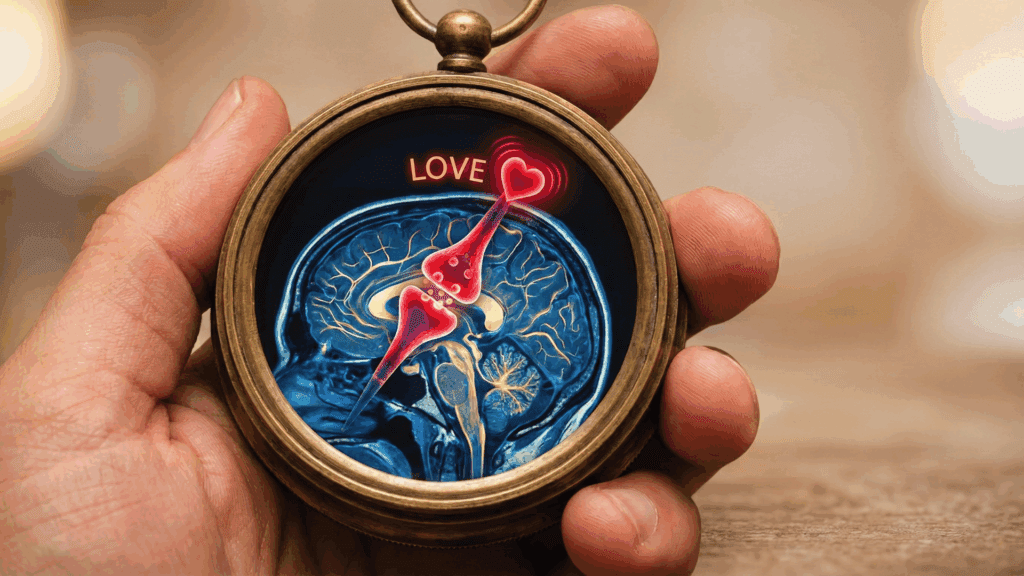
But the same circuits that light up with pleasure also light up with pain when connection feels at risk. Brain regions that track physical pain are involved in the neuroscience of love as well. That means rejection, silence, and emotional distance are not just ideas. Your brain literally registers them as a type of pain signal. This is why your chest tightens when a message is ignored or a partner turns away in bed. The neuroscience of love shows that your body is registering that moment as a threat to your bond and therefore to your safety.
Once you understand that the neuroscience of love links attachment and survival, your reactions stop looking weak or irrational. They start looking like what they really are: your brain doing its best to keep you connected to someone it has decided is essential.

Why A Simple Text Can Feel Like a Life-or-Death Moment
You might wonder how a short message or a missed call could trigger such a big reaction. The neuroscience of love offers a clear answer. Your brain is constantly predicting what will happen next. When someone you care about behaves differently from what you expect, your prediction system lights up. That surprise, even if it looks small from the outside, is coded as a possible threat to connection.
Let’s say you usually get a good morning text, and today there is nothing. The neuroscience of love tells us that your threat system starts asking questions before your logical mind catches up. Did something happen? Are they enraged? Is this the beginning of the end? Your chest may feel heavy, your breathing may speed up, and your mind may loop. This is your nervous system interpreting a change in pattern as a possible danger.
You are not weak for reacting. You are experiencing the neuroscience of love exactly as it was designed, but in a modern world where questions come through glowing screens instead of real-time interactions.

| Love Phase | Dominant Neurochemistry | Duration | Subjective Experience | Relationship Need |
|---|---|---|---|---|
| Attraction | Dopamine + norepinephrine | Days to weeks | Obsession, excitement, can’t eat or sleep | Novelty + uncertainty |
| Infatuation | Dopamine + low serotonin | 3-6 months | Idealization, euphoria, intrusive thinking | Reciprocity + escalation |
| Bonding | Oxytocin + vasopressin | 6-18 months (builds gradually) | Trust, safety, calm presence | Consistency + vulnerability |
| Attachment | Endogenous opioids + oxytocin | Years (deepens with time) | Comfort, security, pain when separated | Reliability + repair after conflict |
| Loss | Dopamine withdrawal + cortisol surge | Weeks to months | Physical pain, craving, grief, identity disruption | Time + corrective neural input |
How Childhood Shapes The Neuroscience of Love In Adulthood
The neuroscience of love does not start with your first kiss or your first serious relationship. It starts in your earliest experiences of comfort and connection. Before you had words, your brain was already measuring how it felt to reach for someone and what happened next. Those early patterns built the foundation for the neuroscience of love that now lives in your adult nervous system.
If, as a child, you reached out and were met most of the time with warmth and consistency, your brain learned, When I need someone, someone comes. The neuroscience of love in that brain tends to support a sense that closeness is generally safe. As an adult, you might still feel upset, angry, or hurt, but deep down you believe repair is possible.
If, on the other hand, you reached out and often felt ignored, dismissed, or shamed, your brain learned a different template. It may have internalized the belief, “When I require support, I risk being harmed,” or “Expressing my emotions causes others to withdraw.”” The neuroscience of love is that the brain wires together the idea of love with a background fear of loss or criticism. As an adult, even small changes in someone’s tone can feel like proof that you are too much, not enough, or about to be abandoned.
I once worked with a client I will call Elena. Growing up, she was told that she was too sensitive and that crying was a sign of weakness. Her caregivers were present physically but distant emotionally. The neuroscience of love in her brain wired closeness together with a quiet dread of being judged. In her romantic relationships, when she felt vulnerable, her heart hurt almost immediately. Her chest would tighten, and she would rush to correct everything before anyone could disapprove. The neuroscience of love explained why. Her brain had decided long ago that showing need was dangerous.
How Early Patterns Show Up In Your Body Today
The neuroscience of love is not just about thoughts and beliefs. It is also about how your body reacts before you even know what you feel. If your early experiences taught you that love is steady, your heart rate may rise a bit during conflict, but it settles quickly. You can have a tough conversation, feel upset, and then return to a baseline sense of safety.
If early experiences taught you that love is unpredictable, the neuroscience of love shows up differently. Your heart might start pounding the second your partner’s tone shifts. Your muscles might tense when someone says, We need to talk. You could notice a lump in your throat any time you want to bring up a concern. Your nervous system is not being dramatic; it is using the old map it has for what love usually feels like.
The beautiful part of the neuroscience of love is that these patterns are not fixed. Your brain can create a new map, but only if you first understand the one it is using now.
Attachment Styles Through The Lens Of The Neuroscience of Love
You have probably heard of terms like “secure,” “anxious,” and “avoidant attachment.” The neuroscience of love helps explain what is actually happening inside these patterns. They are not labels meant to box you in. They are descriptions of how your nervous system has learned to manage the push and pull of intimacy.
In secure attachment, the neuroscience of love looks like a flexible system. You can feel close and enjoy it and still be content when there is space. You can feel upset and want comfort without believing that everything is ruined. Your brain has learned that even when there is tension, the relationship is likely to stay intact.
In a more anxious pattern, the neuroscience of love is wired toward hyperawareness. You notice small details and shifts, sometimes before the other person does. A vague comment, a slightly colder tone, or a period of silence can feel enormous. Your heart hurts quickly because your brain has linked small signals with big risk. Connection feels amazing when it is there and unbearable when it feels shaky.
In a more avoidant pattern, the neuroscience of love has often linked closeness with pressure or loss of freedom. When someone comes toward you emotionally, your nervous system reads it as a possible demand you cannot meet. Your heart can hurt too, but you might feel it more as tightness or irritation rather than obvious sadness. Pulling back becomes a way to calm your system and protect yourself.
When Two Different Love Brains Collide
The neuroscience of love becomes even more interesting when two people with different patterns get together. I worked with a couple where she, whom I will call Michelle, had a more anxious pattern, and he, whom I will call Aaron, had a more avoidant one. Michelle experienced the neuroscience of love as intense closeness, frequent check-ins, and constant reassurance. Aaron experienced the neuroscience of love as needing room to breathe and space to think.
When Michelle felt uncertain, her heart hurt, and she moved closer, texting more and asking questions. When Aaron felt overwhelmed, his heart hurt, and he moved away, staying quiet and turning inward. The neuroscience of love in each of them was trying to protect their bond in the only way it knew how. Unfortunately, their strategies collided. The more she reached, the more he withdrew. The more he withdrew, the more abandoned she felt. Understanding the neuroscience of love finally helped them see that they were not enemies; they were two nervous systems with opposite survival codes.

Why Heartbreak Hurts Like A Physical Injury
You have probably heard people say that heartbreak hurts like a broken bone. The neuroscience of love shows that this is not just poetic language. Many of the same brain regions that light up with physical pain also light up when you experience rejection, loss, or emotional abandonment.
When a relationship ends or changes suddenly, the neuroscience of love tells us that your brain loses a major source of safety signals. Suddenly, the voice you’ve grown accustomed to, the routines you’ve shared, and the person you’ve imagined sharing your future with all disappear. Your nervous system does not know where to place this sudden emptiness. Your heart hurts because your body is responding to a massive drop in expected connection.
I worked with a client I will call Jonah, who was blindsided by a breakup after years together. He told me, It feels like there is a weight on my chest all day. Food tastes different, music sounds off, and my body feels heavy. The neuroscience of love helped him see that his brain was going through withdrawal from a person who had become part of his internal world. The ache in his chest and the fog in his head were not signs that he was unstable; they were signs that his brain was recalibrating after losing a key attachment.
Why You Obsess After Breakups
Another part of the neuroscience of love that confuses people is the way your brain obsesses after a breakup. You replay conversations, analyze messages, study tiny expressions, and imagine different outcomes. You might know, logically, that this is not helpful, yet you feel pulled to do it anyway.
The neuroscience of love offers a clear explanation. Your brain is a prediction machine. It likes to understand cause and effect so it can prevent future pain. When a relationship ends, especially if it ended unexpectedly, your prediction system goes into overdrive. The replaying and analyzing are your brain’s attempt to make a clean story where there actually is confusion and grief.
Your heart hurts because your nervous system is trying to resolve an event that cannot be neatly resolved. Knowing that this obsessive phase is part of the neuroscience of love can help you soften your self-judgment. You are not weak for going over things. Your brain is trying very hard to protect you, even if its method is exhausting.

The Neuroscience of Love In The Age Of Phones And Social Media
The modern world amplifies many parts of the neuroscience of love. Your phone gives you constant access to your partner and constant opportunities to misread signals. You can see when someone is online, when they have read a message, and sometimes when they are active on an app but not responding to you. For a nervous system wired around connection, this is a perfect storm.
The neuroscience of love tells us that uncertainty is one of the most stressful states for the brain. Social media and messaging platforms create endless pockets of uncertainty. You see someone post a story, but they have not replied to your text. You notice a like on someone else’s photo and start to wonder what it means. Your brain fills in the gaps with stories, often negative ones.
I often see clients whose hearts hurt more from what they imagine than from what is actually happening. The neuroscience of love recognizes that your brain is built to complete patterns. If you already fear being ignored or replaced, you will notice anything that seems to confirm that story. Once again, this does not mean you are irrational. It means the neuroscience of love is working with the predictions and memories it already has.
One powerful step is to recognize that your nervous system was not designed for twenty-four-hour digital connection. Giving yourself boundaries, such as not checking read receipts late at night, is not childish. It is a way of respecting the neuroscience of love and the limits of your own brain.
Practical Ways To Work With The Neuroscience of Love
Knowledge without action can feel frustrating, so let me share how I use the neuroscience of love in very practical ways with my clients. The goal is to help your brain and body feel safer in love, without shutting down your capacity to care deeply. You do not need to become detached to protect yourself. You need to become more fluent in your own neuroscience of love.
One powerful practice is learning to notice the first physical signs that your heart hurts instead of waiting until you are overwhelmed. Maybe your shoulders tense, your stomach flips, or your throat tightens. The neuroscience of love tells us that if you can catch the reaction early and work with your body, you can change the way your brain interprets the event. Slow your breathing, keep your exhale a bit longer than your inhale, and gently name what you feel: I am scared, I feel alone, I feel dismissed. This simple act recruits the thinking parts of the brain and softens the threat response.
Another key practice based on the neuroscience of love is reality testing. When a partner is quiet or distant, your brain will automatically offer a painful story. Instead of accepting the first story that comes to mind, ask yourself, “What are three other possible explanations?” Maybe they are tired, focused on a deadline, or in their own emotional state that has nothing to do with you. This is not about denying your feelings. It is about letting the neuroscience of love work with a fuller set of data.
I also guide clients to intentionally collect moments of safety. The neuroscience of love changes through repetition. If you only replay moments of pain, you strengthen those circuits. If you also notice when someone stays, listens, apologizes, or reaches for you, you strengthen circuits that link love with steadiness. Keeping a small record of these moments, even privately, can support your brain in building a more balanced picture.
Finally, I encourage my clients to speak from the body instead of from accusation. The neuroscience of love responds differently when you say, “My chest hurts when we go to bed without talking,” than when you say, “You never listen to me.” One describes your internal state and invites connection. The other lights up defensiveness. When you honor the neuroscience of love in both yourself and the other person, you give the relationship a better chance to repair instead of explode.
Letting The Neuroscience of Love Become Your Compass
The more you understand the neuroscience of love, the less you see your reactions as random or shameful. Your heart hurts for reasons that are deeply rooted in your brain, your body, and your story. You learned early on what love felt like, you gathered evidence in every relationship that came after, and your nervous system built a map that made sense at the time.
The hopeful truth is that the neuroscience of love is not fixed. Your brain never stops changing. With awareness and consistent practice, you can teach your nervous system that love does not have to feel like a constant threat. You can learn to sit with the ache of uncertainty without rushing to self-sabotage or self-sacrifice. You can build relationships where your heart still feels intensely, but not in a way that leaves you shattered every time something shifts.
When I think about the neuroscience of love after all these years, I do not see a cold set of circuits and chemicals. I see a living, responsive system that has been doing its best to keep you safe with the information it had. Now you have more information. You know that your brain perceives love as survival, that childhood shaped your patterns, that heartbreak registers like physical pain, and that modern technology amplifies your triggers.
What you do with this knowledge is where your power lies. You can choose partners and friendships that respect your nervous system. You can reject the idea that you are too sensitive and instead see yourself as finely tuned to connection. You can let the neuroscience of love be your compass, guiding you not toward perfect relationships, since those do not exist, but toward relationships where your heart can be open, your brain can feel safe, and your whole self is allowed to be present.
The next time your chest tightens, your stomach drops, or your mind starts racing, pause for a moment. Remember the neuroscience of love. Remind yourself that your brain is sounding an alarm because something matters deeply, not because you are broken. Then ask, what is the most loving thing I can do for myself in this moment? That simple question shifts you from being at the mercy of your old wiring to becoming an active participant in rewiring your heart and your life.
Real Questions From Real Clients
If love is in my brain, does that mean my feelings are not real?
No, it means your feelings are more real than you think. The neuroscience of love shows that your emotions live in very specific brain and body circuits. When your chest tightens or your stomach drops, that is your nervous system reacting to a change in connection that it thinks is important. Calling it the neuroscience of love does not make your feelings less romantic or less human; it explains why they feel so strong and why they are so difficult to just switch off.
Why does a small thing, like a short text or a cold tone, hurt so much?
Your brain is always scanning for signs of safety and danger in your relationships. The neuroscience of love tells us that your nervous system regards your important relationships as part of your survival plan. When a pattern suddenly changes, such as when you don’t receive a text when you usually do or when the tone is colder than usual, your brain flags this as a possible threat. That is why your heart reacts so quickly. Your brain is not overreacting for fun; it is trying to protect a bond it believes you need.
Can understanding the neuroscience of love actually help me suffer less in relationships?
Yes, because once you know what is happening, you can work with it instead of against it. When you understand the neuroscience of love, you realize that your racing thoughts and aching chest are not random. They are predictable responses from a nervous system that learned certain patterns long ago. This awareness lets you slow your breathing, question your first story, and choose how you want to respond. You can’t stop your brain from reacting, but you can train it to react in ways that don’t ruin your peace.
Is it possible to feel love without it always hurting this much?
It is. The neuroscience of love is not only about pain; it is also about safety, warmth, and deep connection. Your brain can learn that closeness does not always equal danger and that space does not always equal rejection. With repeated experiences of honest conversation, repair after conflict, and steady presence, your nervous system starts to build a new map. Love will probably always feel intense at times, but it does not have to feel like a constant emergency siren.
What is one practical thing I can start doing today to calm my love brain?
Start by catching the very first physical signal that something feels off. Maybe your shoulders tighten or your chest feels heavy. In that moment, instead of jumping into action or sending a long message, pause for ninety seconds. Breathe slowly, lengthen your exhale slightly, and quietly acknowledge what you are feeling; for example, you might say, My heart hurts because I am scared of losing this. The neuroscience of love shows that this simple pause invites your thinking brain back into the conversation, so your next move comes from clarity rather than pure panic.
Your heart does not hurt because you loved wrong. It hurts because your brain built an entire neurochemical architecture around another person — and when that person is gone, the architecture remains, searching for a signal that no longer arrives.
Frequently Asked Questions
Why does heartbreak feel like physical pain?
Neuroimaging confirms that social rejection activates the anterior cingulate cortex and anterior insula — the same regions that process physical pain. The brain uses shared neural infrastructure for both, which is why heartbreak produces chest tightness, stomach pain, and body aches that feel indistinguishable from injury. Additionally, the sudden withdrawal of endogenous opioids (which were elevated during the attachment phase) creates a literal analgesic deficit. The pain is not metaphorical — it is the somatic expression of a bonding system in withdrawal.
Can you be addicted to love?
The neurochemical profile of romantic love overlaps significantly with addiction: dopamine-driven pursuit, tolerance (needing more intensity to achieve the same feeling), withdrawal signals when the source is removed, and continued seeking despite negative consequences. The brain does not distinguish between substance-driven and relationship-driven reward circuit activation. Whether this constitutes “addiction” is debated clinically, but the neural mechanism is functionally identical — which is why love can produce the same compulsive, irrational behavior patterns as substance dependency.
Why do I keep falling for the wrong people?
The attachment system selects for familiarity, not health. The brain’s bonding circuits were calibrated by early attachment experiences — they activate most powerfully in response to patterns that match the original template. If your earliest bonding involved inconsistency, you will feel the strongest “chemistry” with inconsistent partners. If it involved emotional unavailability, available partners will feel neurochemically flat. The “wrong people” feel right because they match the neural template. Choosing healthier partners requires updating the template, not overriding it with willpower.
How long does it take to fall out of love neurologically?
The dopamine-driven infatuation phase naturally subsides within 6-18 months as the brain habituates to the partner’s novelty. If oxytocin bonding developed during this window, the relationship transitions to attachment (which can sustain indefinitely). If oxytocin bonding did not develop, the relationship feels like it has “lost its spark” — the dopamine faded without an attachment foundation to replace it. “Falling out of love” is usually the dopamine phase ending, not the love ending — but without the oxytocin transition, the subjective experience is identical.
Can the brain learn to love more securely?
Yes — this is the concept of “earned security.” The attachment circuits are neuroplastic throughout life. Through sustained corrective experiences — relationships where vulnerability is met with consistency, where repair follows rupture, where safety is reliable — the brain accumulates new evidence that contradicts the original insecure template. This process takes time (typically 1-3 years of sustained corrective input) but produces measurable changes in attachment behavior and neural activation patterns. Earned security is neurologically indistinguishable from original security in brain imaging studies.
From Reading to Rewiring
Understand the neuroscience. Apply it to your life. Work directly with Dr. Ceruto to build a personalized strategy.
Schedule Your Strategy CallRelationships & Dating — MindLAB Locations
References
- Fisher, H. E., et al. (2005). Romantic love: A mammalian brain system for mate choice. Philosophical Transactions of the Royal Society B, 361(1476), 2173-2186. DOI
- Kross, E., et al. (2011). Social rejection shares somatosensory representations with physical pain. PNAS, 108(15), 6270-6275. DOI
- Acevedo, B. P., et al. (2012). Neural correlates of long-term intense romantic love. Social Cognitive and Affective Neuroscience, 7(2), 145-159. DOI
If the pattern described in this article — falling for unavailable partners, love that hurts more than it heals, knowing what you want but choosing what your nervous system recognizes — has become your relational architecture, the attachment circuitry is identifiable and addressable. A strategy call with Dr. Ceruto maps the specific love and bonding circuits driving the pattern.
This article is part of our Intimacy & Bonding collection. Explore the full series for deeper insights into intimacy & bonding.