
ATTUNE Protocol™
The ATTUNE Protocol (Attention Tuning through Unified Neural Engagement) is a neuroscience-based framework developed by Dr. Sydney Ceruto that synchronizes the brain's three competing attention networks (alerting, orienting, and executive) to produce durable concentration without cognitive suppression or stimulant dependence.
What It Is
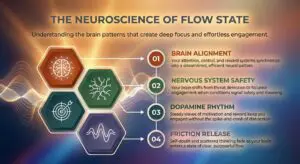
The conventional understanding of focus treats it as a single resource: a tank that fills and depletes. The neuroscience tells a different story. Attention is not one system. It is at least three competing systems, each governed by different neural circuits with different priorities:
The alerting network (brainstem-thalamic circuit) controls arousal and readiness, whether the brain is switched on and receptive. The orienting network (parietal-frontal circuit) controls where attention is directed, selecting targets from the environment. The executive attention network (anterior cingulate-prefrontal circuit) controls what attention is sustained on, holding focus against competing demands.
Most attention problems are not failures of concentration. They are synchronization failures between these three networks. The alerting network may be running too high (hypervigilance) or too low (chronic underarousal). The orienting network may be captured by irrelevant stimuli that the executive network cannot override. Or the executive network may be functional but disconnected from the alerting system, capable of focus but unable to initiate it.
I developed the ATTUNE Protocol because the standard approach to attention (try harder, eliminate distractions, use willpower) treats focus as a discipline problem. It's an engineering problem. The three attention networks need to be tuned to work together, not driven harder individually.
How It Works
The Protocol synchronizes the three attention networks through a tuning process:
Arousal Calibration. The alerting network sets the foundation. If arousal is too low, the brain is not receptive enough to sustain focus regardless of intent. If arousal is too high, the brain is scanning for threats and cannot narrow its aperture to a single target. The Protocol calibrates the arousal system to the optimal window for sustained attention, not the manic alertness of caffeine or stimulants, but the stable, moderate arousal that the thalamic system was designed to maintain.
This is where most clients' attention problems actually originate. They're trying to build focus on a foundation of dysregulated arousal: either chronically underaroused (the brain that needs external stimulation to feel awake) or chronically hyperaroused (the brain that can't stop scanning long enough to settle into a single task). Calibrating this foundation changes everything downstream.
Attentional Orienting Discipline. The orienting network determines what captures your attention, and the modern environment exploits this system relentlessly. Every notification, every movement in your peripheral vision, every social media algorithm is engineered to trigger involuntary orienting responses. The Protocol builds what I call orienting discipline: the capacity to redirect the orienting network from automatic stimulus capture to voluntary target selection.
This is not about willpower. It is about training the parietal-frontal circuit to increase the threshold at which involuntary orienting overrides voluntary focus. The brain that orients to every novel stimulus is not weak. It is uncalibrated. The threshold is too low. The Protocol raises it.
Executive Sustained Engagement. With arousal calibrated and orienting disciplined, the executive attention network can do what it's designed to do: sustain focus on a selected target over time. The Protocol strengthens the anterior cingulate-prefrontal circuit that maintains task engagement, building progressively longer spans of sustained attention through targeted neural engagement exercises.
The key insight: sustained attention is not the absence of distraction. It is the continuous, active selection of the current task over competing stimuli. Every second of focus is a decision the executive network makes. The Protocol builds the circuit that makes that decision faster and more automatic.
Unified Engagement. The final stage is integration: tuning all three networks to operate as a unified system rather than competing subsystems. When the alerting network provides stable arousal, the orienting network selects strategically, and the executive network sustains engagement without interruption, the result is what most people describe as effortless focus. It's not effortless. The effort has been moved from conscious willpower to unconscious circuit-level coordination.
When I Use It
When a client cannot sustain focus despite genuine motivation and effort, and the problem is not ADHD, not distraction, not laziness, but a synchronization failure between attention systems that no amount of willpower can resolve. When someone describes their attention as "scattered" and means it literally: the three networks are pulling in different directions.
When chronic stress or sleep disruption has degraded the alerting network, and the downstream attention systems are building on a destabilized foundation. When digital overstimulation has lowered the orienting threshold to the point where every environmental stimulus captures attention involuntarily. When a professional's focus capacity has declined over years and they've attributed it to aging or stress when the actual cause is progressive network desynchronization.
When the answer to "why can't I focus?" is not one thing but three things happening simultaneously, and no single intervention addresses all three.
If you've tried eliminating distractions, adjusting your environment, and exercising willpower, and focus still won't sustain, the problem may not be discipline. It may be network synchronization. A strategy call is where we assess which of your three attention systems is miscalibrated and what tuning them into alignment would involve.
One hour with Dr. CerutoFrequently Asked Questions
What is the ATTUNE Protocol?
The ATTUNE Protocol (Attention Tuning through Unified Neural Engagement) is a neuroscience-based framework developed by Dr. Sydney Ceruto that synchronizes the brain's three competing attention networks (alerting, orienting, and executive) to produce durable concentration without cognitive suppression or stimulant dependence.
What does ATTUNE stand for?
ATTUNE stands for Attention Tuning through Unified Neural Engagement. The name reflects the Protocol's core mechanism: tuning the three attention networks into unified coordination rather than treating focus as a single resource.
Why can't I focus even when I want to?
Most focus failures are synchronization failures between the brain's three attention networks, not willpower failures. The alerting network may be miscalibrated, the orienting network may be captured by irrelevant stimuli, or the executive network may be disconnected from supporting systems.
Is the ATTUNE Protocol the same as the Cognitive Sovereignty Protocol for ADHD?
They address different problems. The Cognitive Sovereignty Protocol targets ADHD-specific executive function disruption. The ATTUNE Protocol targets synchronization of the three attention networks governing focus quality in any brain. Some ADHD clients benefit from both; most non-ADHD focus problems are ATTUNE cases.
Who developed the ATTUNE Protocol?
Dr. Sydney Ceruto developed the ATTUNE Protocol at MindLAB Neuroscience over 26+ years of applied neuroscience, based on the observation that most focus problems are synchronization failures between competing neural attention systems.