Key Takeaways
- Self-control is a neural prediction about effort-versus-reward, not a fixed trait or depletable resource.
- Dorsolateral prefrontal cortex and ventromedial prefrontal cortex compete: long-term value versus immediate reward.
- Todd Hare‘s Caltech research: self-control needs dlPFC modulating vmPFC; otherwise impulse wins despite intention.
- Environmental architecture determines self-control more reliably than motivation: reducing decision load preserves neural resources.
- Discipline self-sustains when the prefrontal cortex encodes behavior into procedural memory, shifting effortful to automatic.
Why Willpower Fails, And What Actually Drives Self-Control
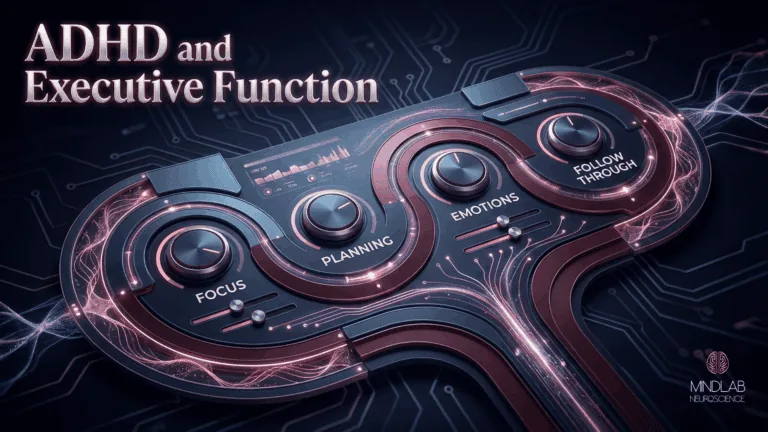
Willpower fails because the prefrontal cortex, not character, governs self-control through real-time cost-benefit computations about effort versus reward. Sleep deprivation reduces prefrontal glucose metabolism, and decision fatigue compounds across hundreds of daily choices. High-performing individuals most often lose self-control not from weak character but from systematically degraded neural resources. This sits within our ADHD and executive function work, and the dopamine-driven effort-versus-reward calculus behind it runs through The Dopamine Code.
The neuroscience of self-control has moved well beyond the willpower-as-muscle metaphor. What the research now shows is that discipline is an architectural problem, not an effort problem. The brain regions that produce self-control are predictable, measurable, and, critically, modifiable. But modification requires understanding the architecture, not simply pushing harder against it. Related reading: the Cognitive Architecture pillar.
This guide approaches self-control as a system rather than a feeling: how the brain calculates effort against reward, and how designing your environment to lower decision load is more reliable than simply trying harder. If you want the moment-to-moment machinery instead, how the brain actually inhibits an impulse in real time and why that capacity fatigues, read our companion piece on the neuroscience of willpower and self-control.
What Happens in the Brain During a Self-Control Decision?
Self-control decisions activate a competition between the prefrontal cortex, which evaluates long-term consequences, and the limbic system, which drives immediate reward-seeking. Neuroimaging studies show this conflict resolves within 200–500 milliseconds, with prefrontal activation predicting successful inhibition on delayed gratification tasks.
Self-control failures are more accurately predicted by prefrontal-striatal connectivity under fatigue conditions than by trait willpower measures, indicating that neural architecture of the circuit, not motivational resolve, is the primary determinant of disciplined behavior. The underlying research is covered in the neural patterns behind compartmentalization for a thriving life.
Individuals who reported high trait self-control primarily succeeded by structuring environments to reduce temptation exposure rather than by exerting inhibitory effort, a finding with direct implications for prefrontal load management.
The ventromedial prefrontal cortex (vmPFC) computes the subjective value of an option: how rewarding it feels right now. It responds to immediate salience: the dessert in front of you, the notification on your screen, the impulse to skip the planned activity. The dorsolateral prefrontal cortex (dlPFC) represents the abstract, future-oriented value: the health goal, the project deadline, the person you are trying to become. Research by Todd Hare and colleagues at the California Institute of Technology, published in Science, demonstrated that successful self-control occurs when the dlPFC modulates vmPFC activity, essentially overriding the immediate-reward signal with a longer-range value signal.
The critical finding is that when the dlPFC fails to engage (due to fatigue, stress, cognitive overload, or insufficient glucose availability) the vmPFC runs unopposed. The impulse wins not because the person lacks discipline, but because the neural system that produces discipline was temporarily offline. This is why self-control failures cluster predictably: late at night, after long decision-intensive days, during periods of sleep deprivation, and under acute stress. These are not coincidences. They are the predictable failure modes of a prefrontal system operating below its functional threshold.
What I observe consistently in my practice is that high-functioning individuals who report self-control problems have not lost the capacity for discipline. They have depleted the specific prefrontal cortex executive function resources that discipline requires, usually long before they encounter the moment where discipline is needed most. The intervention is not more effort. It is architectural: reducing the demand on the dlPFC throughout the day so it retains capacity for the decisions that matter.
Is Self-Control a Limited Resource That Gets Depleted?
The ego depletion model (the idea that self-control draws from a single, finite resource that diminishes with use) dominated the field for two decades after Roy Baumeister proposed it in 1998. The concept felt intuitively right: willpower seems to run out. But the story is more nuanced than a simple fuel tank.
Large-scale replication efforts, including a 2016 multi-lab study involving over 2,000 participants, found weak or inconsistent support for the classic depletion effect. What appears to be happening is not resource depletion but motivational reallocation. Research by Michael Inzlicht at the University of Toronto proposes that after sustained self-control, the brain shifts its motivational priority from “should” goals to “want” goals, not because it has run out of energy, but because it has recalculated the cost-benefit ratio of continued restraint.
This reframing matters enormously for practice. If self-control is a depleting resource, the prescription is conservation: ration your willpower, save it for what matters. If self-control is a motivational shift, the prescription is different: design environments and routines that reduce the need for self-control at low-value decision points, so the brain’s motivational system does not recalculate before the high-value decisions arrive.
The brain does not run out of self-control. It recalculates whether continued restraint is worth the cost, and if the environment has already demanded hundreds of micro-decisions, the calculation shifts against discipline precisely when you need it most.
Why Do Some People Appear to Have More Self-Discipline Than Others?
People who appear more self-disciplined show measurably different brain architecture, not stronger willpower. BJ Casey and colleagues tracked Walter Mischel’s marshmallow test participants across four decades, finding that children who delayed gratification at age four demonstrated greater prefrontal cortex activation and more effective ventral striatal regulation when facing tempting stimuli as adults.
What this means is that people who appear disciplined are not fighting harder battles. They are fighting fewer battles. Their prefrontal systems intervene earlier in the decision chain, often before the impulse reaches conscious awareness. The person who “never eats junk food” is not white-knuckling through every meal: their dlPFC has encoded the food selection as a default behavior that does not require active regulation.
I see this pattern repeatedly in my practice. Clients who struggle with discipline in one domain often exhibit extraordinary discipline in another. A person who cannot maintain a consistent exercise habit may demonstrate remarkable discipline in their professional output. The difference is not willpower capacity: it is which behaviors have been encoded as prefrontal defaults versus which still require active regulation. The neural architecture of self-control is domain-specific, not a general-purpose resource.
How Environment Shapes Self-Control More Than Motivation
Environmental architecture predicts self-control success more reliably than motivation level because the ventromedial prefrontal cortex responds to stimulus salience. When temptations are visible and proximate, the vmPFC generates strong immediate-value signals that the dorsolateral prefrontal cortex must override. When temptations are hidden and effortful to access, vmPFC activation drops sharply, eliminating the need for dlPFC intervention entirely.
Research by Wendy Wood at the University of Southern California has documented that approximately 43% of daily behaviors are performed habitually, without conscious deliberation. This means that nearly half of what people do each day bypasses the self-control system entirely. The implication is that the most effective self-control strategy is not strengthening the dlPFC’s override capacity: it is converting controlled behaviors into automatic ones, so habit formation replaces the need for active regulation. The same a neuroplasticity blueprint for rewiring your brain that allow the brain to encode harmful habits also allow it to encode protective ones: the direction depends entirely on what gets practiced consistently.
| Factor | Increases Self-Control Load | Reduces Self-Control Load |
|---|---|---|
| Environment design | Temptation visible, proximate, easy to access | Temptation invisible, distant, requires effort to access |
| Decision frequency | Hundreds of micro-choices throughout the day | Routines eliminate low-value decisions before they arise |
| Sleep architecture | Chronic 5-6 hours: dlPFC function impaired | Consistent 7-8 hours: full prefrontal function |
| Stress load | Chronic activation shifts resources from dlPFC to limbic system | Regulated arousal maintains prefrontal access |
| Behavioral encoding | Desired behavior requires conscious decision each time | Desired behavior encoded as automatic default |
| Goal structure | Abstract, distant goals with low prediction error | Proximal sub-goals with genuine uncertainty: dopamine engaged |
This architectural approach to self-control explains why the people I work with who have the most consistent discipline are not the ones with the strongest willpower: they are the ones who have most effectively eliminated the need for willpower from their daily routines. They have designed environments, routines, and defaults that convert controlled processes into automatic ones. They are not more disciplined. They have made discipline unnecessary for most of their day, preserving prefrontal capacity for the genuinely difficult decisions.
What Does Building Lasting Self-Discipline Actually Require?
Building lasting self-discipline requires coordinated change across three neurological levels: subcortical impulse regulation, prefrontal cortical override capacity, and habit-circuit consolidation in the basal ganglia. Research consistently shows that interventions targeting only one level produce high relapse rates. Practitioners must address all three systems simultaneously to generate durable behavioral change across health, productivity, and relationship domains.
Level 1: Environmental restructuring. Remove the stimuli that force the dlPFC to engage in low-value override decisions. This is not about willpower. It is about cue architecture: physically restructuring the environment so that the behaviors you want to avoid do not trigger vmPFC activation in the first place. The person who removes social media from their phone is not being weak. They are being neurologically precise: eliminating a cue that would force hundreds of daily self-control micro-decisions that collectively exhaust the system.
Level 2: Default encoding. Convert the desired behaviors from controlled (requiring active dlPFC regulation) to automatic (running as procedural defaults). This requires consistent repetition under stable conditions, not forced repetition under high stress. Research by Phillippa Lally at University College London found that habit formation takes an average of 66 days, but the critical variable is consistency of context, not effort intensity. The behavior must be performed at the same time, in the same place, in the same sequence, until the basal ganglia encode it as procedural rather than deliberative.
Level 3: Prefrontal capacity protection. Once the environment is restructured and key behaviors are encoded as defaults, the remaining self-control budget, the decisions that genuinely require active dlPFC regulation, is protected by managing the inputs that determine prefrontal function: sleep architecture, stress load, blood glucose stability, and emotional regulation practices that preserve cognitive resources. This is where the system becomes self-sustaining: fewer active self-control decisions produce less prefrontal fatigue, which produces better outcomes on the decisions that remain, which reinforces the behavioral defaults, which further reduces the need for active self-control.
This is where optimizing brain patterns with Real-Time Neuroplasticity™ provides what no conventional discipline framework can. The conversion from controlled to automatic does not happen through planning or reflection. It happens in the live moment: when the impulse fires, when the vmPFC generates its immediate-reward signal, and the dlPFC either modulates it or does not. RTN™ engages at precisely that inflection point: the real-time competition between immediate reward and long-range value. Working at the moment of the neural decision, not before or after, is what makes the encoding durable.
The Difference Between Discipline and Punishment
Self-criticism activates the amygdala’s threat response, which redirects neural resources away from the prefrontal cortex toward limbic survival processing: the opposite of what self-discipline requires. Most self-discipline frameworks rely on guilt, shame, or punishment as enforcement mechanisms. This neurological mismatch means punishing a self-control failure actively impairs the brain system responsible for preventing the next one.
Research by Ethan Kross at the University of Michigan has demonstrated that self-distancing, referring to yourself in the third person during moments of difficulty, reduces amygdala reactivity and enhances prefrontal function. This is not a productivity trick. It is a measurable change in neural activation that directly supports the dlPFC’s capacity to regulate impulse.
The most effective discipline I observe across 26 years is not the discipline of force. It is the discipline of architecture: the quiet, systematic restructuring of environment, routine, and neural default so that the behavior the person wants to produce becomes the path of least resistance. Not because they are gritting through it. Because their brain has learned to run it as the automatic program.
That is what genuine discipline looks like from the inside. Not a war with yourself. A redesign of the system that produces the behavior, so the war becomes unnecessary.
Is self-control genetic or learned?
Self-control is both genetic and learned, but environmental factors explain the larger share of variance in adult outcomes. BJ Casey’s longitudinal follow-up of Mischel’s marshmallow test subjects confirmed that prefrontal cortex efficiency carries a heritable component, yet parental modeling, early delayed-gratification practice, and environmental architecture account for the majority of individual differences in self-control capacity.
Why do I have discipline at work but not at home?
Work discipline and home discipline rely on different neural mechanisms. Years of consistent workplace practice encode professional behaviors as procedural defaults in the dlPFC, requiring minimal active regulation. Home environments, typically less structured and more emotionally charged, demand active prefrontal control, but evening decision fatigue depletes that regulatory capacity after hundreds of daytime choices, explaining the asymmetry.
Does sleep affect self-control?
Sleep deprivation directly impairs self-control by reducing dorsolateral prefrontal cortex function, weakening the brain’s ability to override impulse signals from the vmPFC. A single night of restricted sleep lasting 5–6 hours produces measurable declines in impulse regulation the following day, making sleep architecture a more powerful self-control variable than motivation or strategy.
How long does it take to build a new disciplined habit?
Phillippa Lally’s University College London research found new behaviors require an average of 66 days to become automatic, ranging from 18 to 254 days based on complexity. Consistency of context (same time, place, and conditions) drives the basal ganglia’s procedural encoding faster than duration alone. Missing one day does not reset progress.
Can you improve self-control at any age?
Neuroplasticity enables self-control improvement at any age by strengthening dorsolateral prefrontal cortex connectivity through structured behavioral practice. Research confirms that repeated rehearsal under real conditions, not cognitive exercises alone, enhances regulatory capacity across the lifespan. Encoding speed decreases with age, but the brain’s fundamental capacity to build new self-regulatory circuits remains intact.
What brain regions are most responsible for self-control?
The dorsolateral prefrontal cortex and anterior cingulate cortex work together as the primary neural architecture of self-control, managing impulse inhibition and conflict monitoring respectively. The ventromedial prefrontal cortex also plays a crucial role by evaluating the long-term value of choices against immediate gratification signals from the limbic system.
How does chronic stress physically impair self-control capacity?
Chronic stress literally shrinks prefrontal cortex volume while enlarging the amygdala, shifting the brain’s balance of power away from deliberate control and toward reactive impulse. This structural change explains why people under sustained stress consistently make more impulsive decisions regardless of their typical self-control abilities.
Is self-control a finite resource that gets used up throughout the day?
The ego depletion model suggests self-control draws from a limited pool of mental energy, though recent research indicates that beliefs about willpower significantly influence how depleted people actually feel. Whether the limit is purely biological or partly psychological, structuring important decisions for periods of peak mental freshness remains a practical and effective strategy.
What is the relationship between blood glucose levels and self-control performance?
The prefrontal cortex consumes disproportionately large amounts of glucose relative to its size, and drops in blood sugar have been correlated with reduced performance on tasks requiring impulse inhibition. Maintaining stable blood glucose through regular balanced meals, rather than sugar spikes, provides the steady neurological fuel that sustained self-control demands.
References
- Hare, T. A., Camerer, C. F., & Rangel, A. (2009). Self-control in decision-making involves modulation of the vmPFC valuation system. Science, 324(5927), 646-648. https://doi.org/10.1126/science.1168450
- Casey, B. J., Somerville, L. H., Gotlib, I. H., et al. (2011). Behavioral and neural correlates of delay of gratification 40 years later. Proceedings of the National Academy of Sciences, 108(36), 14998-15003. https://doi.org/10.1073/pnas.1108561108
- Inzlicht, M., & Schmeichel, B. J. (2012). What is ego depletion? Toward a mechanistic revision of the resource model of self-control. Perspectives on Psychological Science, 7(5), 450-463. https://doi.org/10.1177/1745691612454134
From Reading to Rewiring
Understand the neuroscience. Apply it to your life. Work directly with Dr. Sydney Ceruto to build a personalized strategy.
Schedule Your Strategy CallStrategy Call
If your self-control pattern is architectural, if you understand what you need to do and consistently fail to do it under specific conditions, a strategy call maps where your prefrontal regulation system is being overloaded and designs the environmental restructuring that makes discipline sustainable rather than exhausting.