The Neuroscience of Anxiety Beyond the Amygdala
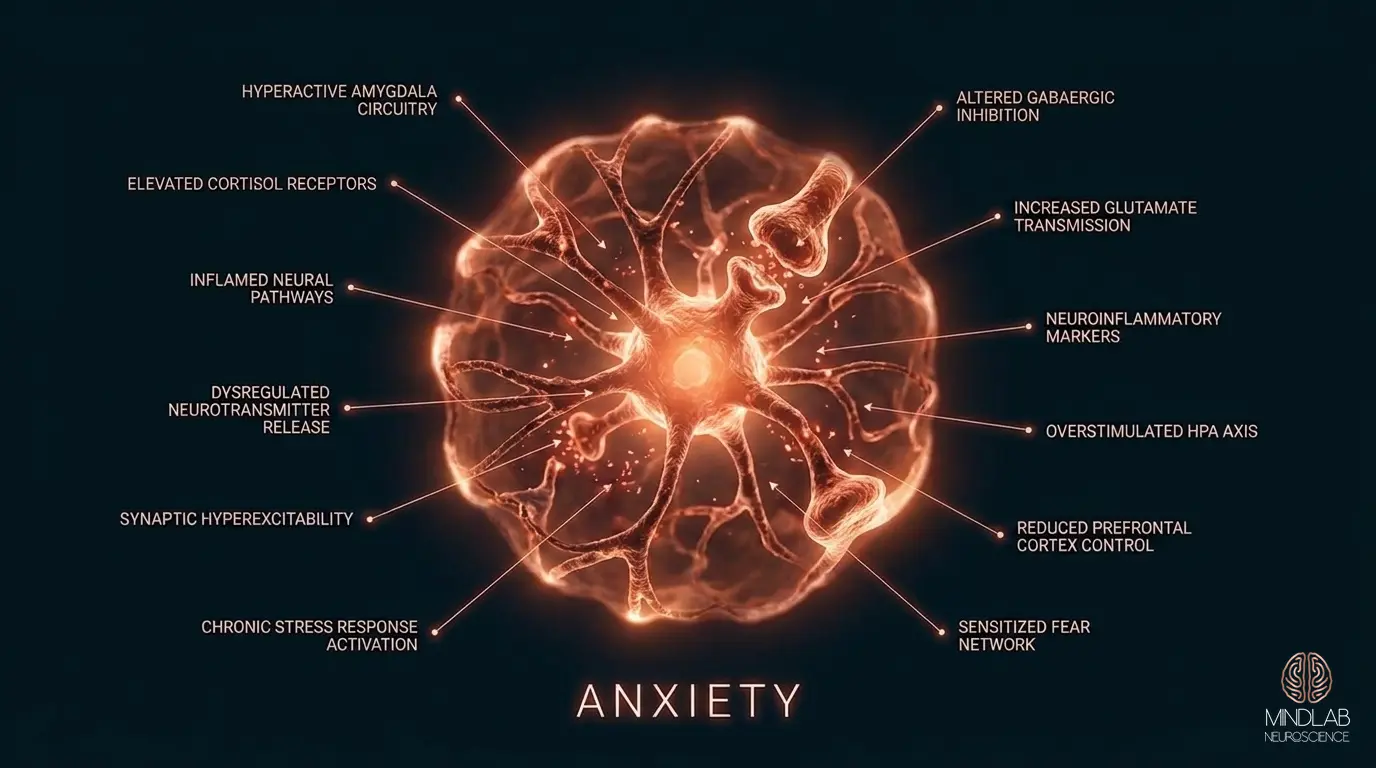
Most conversations about anxiety begin and end with the amygdala: the brain’s alarm system, the structure that fires when threat appears. That framing is not wrong, but it is dangerously incomplete. The neuroscience of anxiety has expanded far beyond the amygdala story, and understanding what else is driving the experience fundamentally changes how change becomes possible.
Anxiety is a whole-brain phenomenon. Three structures in particular have emerged from contemporary neuroscience research as central players that most accounts overlook: the bed nucleus of the stria terminalis, the insular cortex, and the anterior cingulate cortex. Each one shapes anxiety differently, and each represents a distinct intervention target.
The bed nucleus of the stria terminalis, often called the BNST, is the brain structure responsible for sustained, diffuse anxiety. While the amygdala produces acute fear responses tied to specific stimuli, the BNST maintains a state of chronic vigilance even in the absence of identifiable threat. This is why generalized anxiety feels so different from a phobia: it isn’t pointing at anything. It’s a neurobiological holding pattern, a continuous preparedness signal that doesn’t switch off when the danger clears. For individuals living with persistent anxiety, this structure is often the primary driver: not the amygdala reacting to an event, but the BNST sustaining a threat state long after the event is gone.
The insular cortex contributes to anxiety through interoception: the brain’s real-time monitoring of the body’s internal state. When the insula is hyperactive, ordinary physiological sensations become threat signals: a racing heartbeat reads as cardiac emergency, shallow breathing triggers panic, gut tension becomes a harbinger of catastrophe. This is anxiety neuroscience at the body-brain interface: the mechanism by which anxiety lives in the body before it surfaces in thought.
The anterior cingulate cortex (ACC) governs conflict detection and error monitoring. In individuals with elevated anxiety, the ACC becomes hypersensitive to uncertainty: it treats ambiguity as a problem requiring immediate resolution, generating the cognitive restlessness and rumination that characterize anxious thinking. The ACC is not producing fear. It is producing the relentless search for certainty in a world that doesn’t offer it.
Dr. Sydney Ceruto’s work with anxiety takes each of these structures seriously: structures that are mapped in detail within the anxiety and threat calibration hub. Her approach begins where most approaches end: with a neuroscience-based map of which circuits are driving the experience, not a surface-level behavioral description of symptoms.
Anxiety as Miscalibrated Threat Prediction
One of the most important reframes in modern anxiety neuroscience is the shift from viewing anxiety as a reaction to viewing it as a prediction. The brain does not simply respond to the environment. It is a prediction machine, continuously generating models of what will happen next and comparing incoming data against those models. Anxiety, in this framework, is what happens when the prediction system is miscalibrated toward threat.
Neuroscientist Karl Friston’s predictive processing model helps explain why anxiety can persist even when nothing dangerous is happening. The brain’s threat-prediction circuits have been tuned (through experience, through early environment, through repeated activation) to anticipate danger with greater frequency and greater intensity than the actual environment warrants. Every neutral stimulus runs through a filter that adds threat weight. Every ambiguous situation resolves toward the negative outcome. The brain is not broken. It is doing exactly what it was trained to do.
This reframe carries significant implications. It means that anxiety is not a character flaw, not a weakness, and not evidence of mental fragility. It is a neural pattern that was built, often in service of genuine survival needs at an earlier point in a person’s life, and has since overgeneralized. The prediction system calibrated for a more threatening environment is now running in a context that doesn’t require it. The neuroscience makes this clear: the brain can be recalibrated. The question is how.
Dr. Ceruto’s Real-Time Neuroplasticity™ methodology addresses this directly. By intervening during the live moments when the prediction error occurs (not in retrospect, not through discussion, but in real time) she works with the brain’s natural plasticity windows to update the threat model with more accurate data. The prediction system doesn’t need to be dismantled. It needs to be recalibrated with evidence the brain has not yet fully integrated.
Generalized vs. Specific Anxiety at the Neural Level
Not all anxiety is the same neurologically, and treating it as though it were is a central reason why so many interventions produce partial results. The distinction between generalized and specific anxiety maps directly onto different neural circuits, and understanding that distinction changes what recalibration requires.
Specific anxiety (the kind tied to identifiable triggers like social situations, heights, or particular objects) is primarily driven by the lateral amygdala’s conditioned fear responses. A specific stimulus was paired with a threat experience, and the association was encoded. The neuroscience of specific anxiety is relatively well-understood: it involves fear conditioning, stimulus generalization, and the hippocampal memory systems that maintain the association.
Generalized anxiety operates differently. It is less about discrete triggers and more about a globally elevated threat state maintained by the BNST, the hypothalamic-pituitary-adrenal axis, the same stress and nervous system regulation architecture that governs autonomic balance, and a chronically activated sympathetic nervous system. It is diffuse rather than pointed. It is sustained rather than episodic. The neuroscience here involves tonic threat signaling: an ongoing background of neurochemical readiness that doesn’t require a specific stimulus to fire.
This distinction matters enormously for anyone seeking real change. Approaches designed for specific anxiety, those that target discrete stimuli, tend to produce limited improvement for individuals with generalized anxiety, because they’re addressing the wrong neural substrate. The work required is not trigger-by-trigger desensitization. It is a wholesale recalibration of the baseline threat state that the BNST is maintaining.
Dr. Ceruto approaches this differentiation with precision. Her initial assessment identifies which pattern is primary (specific, generalized, or a compound of both) because the neural targets and the intervention architecture differ. This is what separates neuroscience-based work from symptom-management approaches: the map comes first.
The Anxiety-Performance Curve: What Neuroscience Confirms
The relationship between anxiety and performance is not linear: it is an inverted U, and the neuroscience behind this curve explains why so many high-performing individuals are reluctant to fully eliminate their anxiety. The Yerkes-Dodson law, first proposed in 1908 and repeatedly validated by subsequent neuroscience research, demonstrates that arousal (which includes anxiety) enhances performance up to an optimal point, then degrades it sharply beyond that threshold.
At low arousal states, the prefrontal cortex lacks the norepinephrine and dopamine activation needed for focused attention. Performance is sluggish, motivation is flat, and cognitive sharpness is muted. As arousal increases, as anxiety enters the picture, norepinephrine rises, attention sharpens, and performance improves. This is the productive edge of the anxiety curve. Many high-capacity individuals have learned to use pre-performance anxiety as a cognitive fuel source, and they are neurologically correct to do so.
The problem emerges past the optimal point. When anxiety exceeds the threshold, the prefrontal cortex begins to go offline. The hippocampus shifts into threat-detection mode rather than memory consolidation mode. Working memory degrades. The lateral prefrontal cortex, responsible for complex reasoning and executive function, loses bandwidth as subcortical threat circuits consume the brain’s metabolic resources. Performance craters. The very anxiety that was sharpening the edge is now destroying it.
Understanding the anxiety-performance curve through a neuroscience lens reframes the goal. For most high-capacity individuals, the objective is not zero anxiety: it is optimal calibration. The aim is to maintain the productive arousal state, extend the window of peak performance, and prevent the cascade into destructive over-arousal that shuts down the prefrontal systems they depend on. This is a precision neural calibration task, not a wellness exercise.
The Neuroscience of Safety Learning
If the neuroscience of anxiety describes how the brain learns threat, the neuroscience of safety learning describes how the brain unlearns it, and this distinction is critical to understanding why anxiety persists even when circumstances have changed.
Safety learning is an active neural process, not simply the absence of threat learning. The ventromedial prefrontal cortex (vmPFC) plays a central role: it encodes safety signals and modulates amygdala activity when the brain has accumulated sufficient evidence that a previously threatening context is now safe. This is not the erasure of the fear memory. The original threat encoding remains in the lateral amygdala. What safety learning produces is a competing memory: a new neural pattern that the prefrontal cortex can activate to inhibit the threat response in contexts where fear is no longer warranted.
This neuroscience explains why exposure alone is insufficient for lasting change in anxiety. Mere contact with a previously feared stimulus can activate safety learning to some degree, but without the consolidation conditions that allow the vmPFC to build a robust competing memory, the threat pattern remains dominant. Context dependence is another critical factor: safety memories are heavily context-encoded, which is why anxiety can return in a new setting even after significant progress in a familiar one.
Anxiety that returns after apparent improvement is not relapse. It is context mismatch: the brain encountering a novel context and defaulting to the threat pattern because the safety memory hasn’t been generalized across that setting. Understanding this through neuroscience removes the shame from setbacks and clarifies exactly what work remains.
Effective intervention supports the generalization of safety learning across contexts, which requires real-time access to the brain during novel high-stakes moments. This is precisely why Dr. Ceruto’s embedded, real-time model produces the durability that retrospective approaches struggle to achieve.
Dr. Ceruto’s Threat Recalibration Approach
Dr. Sydney Ceruto has spent over two decades refining a neuroscience-based approach to anxiety that starts from a fundamentally different premise than most available options. The question is not “how do we reduce this person’s anxiety symptoms?” The question is: “what is this person’s brain predicting, and what would it take to update that prediction model with more accurate information?”
Her threat recalibration approach begins with identification: mapping which neural circuits are driving the experience, what environments activate them, and what history encoded the original threat model. This is not a questionnaire exercise. It emerges through real conversation, real situations, and the kind of pattern recognition that two decades of neuroscience work in real-world contexts produces.
The recalibration itself happens in real time. This is the cornerstone of Real-Time Neuroplasticity™ and the reason it produces results that other approaches do not: Dr. Ceruto is present during the actual moments when the prediction error occurs, when the threat circuits activate, when the brain is running the old pattern. These are the highest-plasticity windows: the moments when the neural pathway is active and most available for restructuring. Discussing the pattern later, in a neutral environment, accesses a different brain state and a different plasticity window. The neuroscience is clear on this: learning that occurs during the emotional state is retained differently than learning that occurs outside it.
For individuals whose anxiety has organized their professional performance, their relationships, and their decision-making around a miscalibrated threat model, this work is genuinely life-altering, not in the hyperbolic marketing sense, but in the literal neurological sense. The prediction model updates. The threat signal that was firing everywhere begins firing only where it is actually warranted. The brain that was spending enormous metabolic resources maintaining chronic vigilance redirects those resources toward the cognitive tasks the individual actually wants them for.
If you are a high-capacity individual whose anxiety is limiting what you’re able to do (in your career, your relationships, or your own interior experience) a strategy call with Dr. Ceruto is the starting point. She identifies what is actually driving the pattern and maps what recalibration would require for your specific neural architecture. Schedule a strategy call to begin that conversation.
Understanding Anxiety Through a Neuroscience Lens Changes Everything
Anxiety carries enormous cultural weight: decades of stigma, misdiagnosis, and symptom-management frameworks that addressed the surface while leaving the neural substrate unchanged. The neuroscience of anxiety tells a different story: one of specific circuits, specific patterns, and specific conditions under which those patterns can be genuinely revised.
The BNST maintaining a threat state that no longer serves. The insula translating neutral body signals into emergency alerts. The ACC generating rumination in the search for certainty: the same cortisol-driven hypervigilance loop that sustains chronic physiological activation. The prediction system firing at a calibration set for an earlier, more dangerous environment. These are not mysteries. They are mappable neural patterns, and neuroscience research has produced both the explanation for why they persist and the understanding of what changes them.
What that neuroscience requires is a practitioner who can meet the brain where the pattern lives, not in retrospect, not in a retrospective office conversation, but in the live moments when the prediction error is occurring and the neural pathway is available for restructuring. That is the premise of Dr. Ceruto’s work, and it is what distinguishes neuroscience-based intervention from everything the person struggling with anxiety has likely already tried.
Every article in this section approaches anxiety through the lens of the brain: its mechanisms, its plasticity, and its capacity for genuine recalibration. The science is the foundation. The change is the goal.