Rising to the top of your field while crushing ambitious goals should feel triumphant. Yet many high-achieving professionals experience persistent...
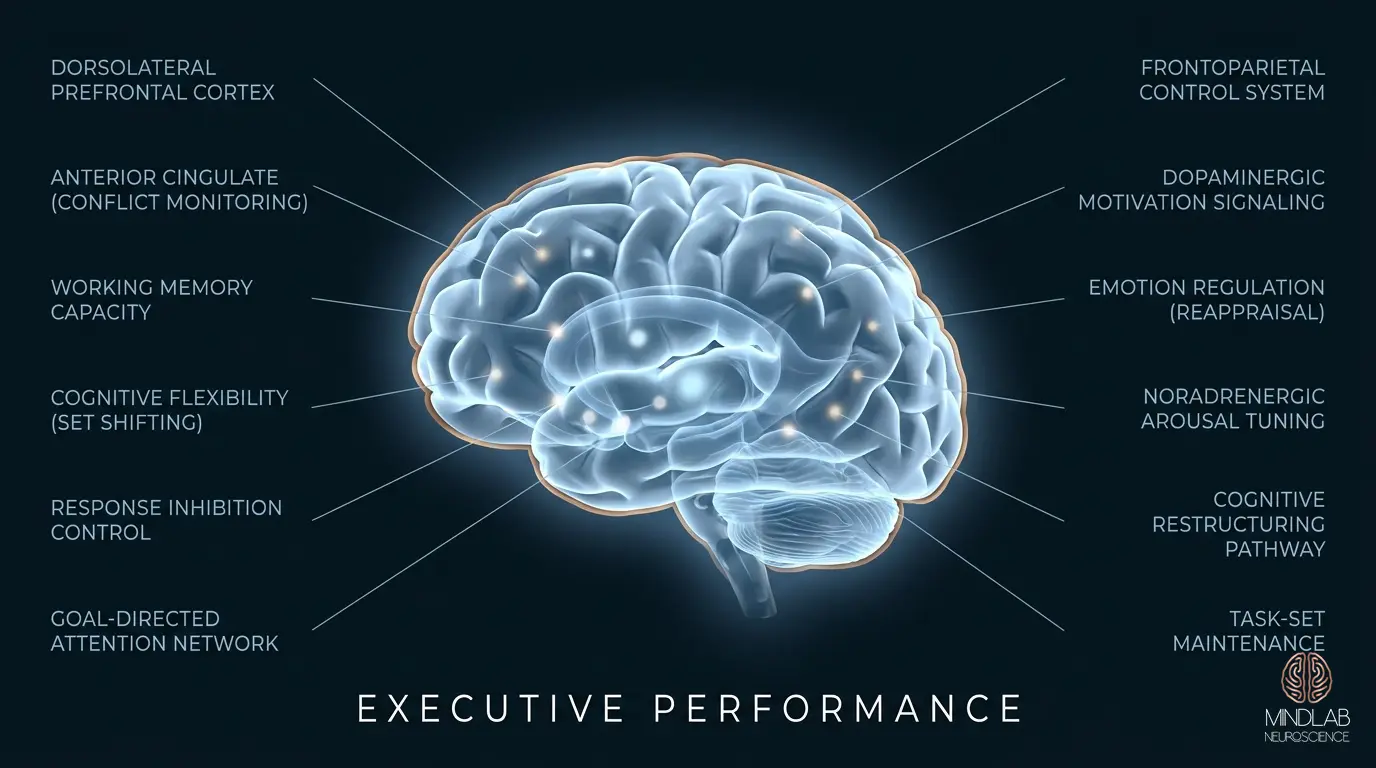
Read article : Anxiety Relief for High Performers: Optimizing Performance and Addressing FearExecutive Performance
The externalization of metacognition. We analyze how coaching acts as a scaffold for executive function, facilitating error correction, blind-spot detection, and the rapid behavioral remodeling required for high-stakes leadership.
24 articlesExternal Metacognition
From a neurobiological standpoint, executive coaching functions as an “externalized Prefrontal Cortex.” The brain is designed to automate behaviors to save energy, which creates “blind spots”—we are often cognitively blind to our own automatic patterns. Coaching provides the metacognitive scaffold necessary to observe these firing patterns from a third-person perspective, moving processing from the automatic Basal Ganglia to the conscious Cortex, where re-evaluation can occur.
Restoring the Error Signal
The brain requires “Prediction Error”—a mismatch between expectation and reality—to trigger neuroplasticity and learning.
-
The CEO Bubble: High-level leaders often suffer from a feedback vacuum; subordinates rarely offer the raw, corrective data the brain needs to adjust.
-
High-Fidelity Feedback: A coach artificially restores this feedback loop. By delivering candid, objective data on performance, they reactivate the brain’s learning machinery, forcing the neural circuits to update their models of social influence and decision-making.
Behavioral Remodeling
Insight alone does not change behavior; it only highlights the need for it. Effective coaching bridges the gap between knowing and doing through “Directed Neuroplasticity.”
-
Override Protocols: Leadership habits (like micromanaging or conflict avoidance) are deeply myelinated neural highways. Changing them requires “Long-Term Depression” (LTD) of the old circuit and “Long-Term Potentiation” (LTP) of the new one.
-
The Implementation Gap: Coaching provides the consistency and accountability required to keep the new, fragile neural pathway active long enough for it to become the default setting.

Latest Articles
Dopamine-aware leadership applies cutting-edge neuroscience to drive team motivation, engagement, and productivity. Learn why dopamine is key for leaders and...
Read article : Dopamine-Aware Leadership: Neuroscience for Motivating TeamsAdaptive leadership isn’t instinct — it’s neurobiology in motion. At MindLAB Neuroscience, the neuroscience of adaptive leadership reveals how the...
Read article : Adaptive Leadership Neuroscience: Leading Through UncertaintyAfter reviewing the blog post at the provided URL, here's a provocative and compelling excerpt written at the recommended reading...
Read article : Is Your Brain Promotion-Ready? Neuroscience Blueprints for Career DominationHow does your brain respond to change?Have you ever asked yourself how "adaptable" you really are? If so, my latest...
Read article : Brain Adaptability: Optimizing Coaching Outcomes Through NeuroscienceDiscover neuroscience-backed strategies to boost your leadership resilience. Learn how to leverage emotional intelligence and brain plasticity to overcome setbacks...
Read article : Exhibiting Leadership Resilience: Overcoming Setbacks with Neuroscience-Backed StrategiesUnlock your leadership potential with coaching. Empower yourself to inspire teams and drive growth. Embrace change and develop a growth...
Read article : The New Standard In Leadership Development: Reaching New Heights Through Neuroscience-Based CoachingIn the fast-paced world of executive leadership, mastering the executive mindset is pivotal. This article delves into the transformative power...
Read article : Unlock Immense Potential with Executive Coaching: Master the Executive Mindset for Success in 90 DaysCognitive distortions impair executive conflict resolution by distorting threat perception, misreading interpersonal intent, and triggering reactive decision-making.
Read article : Decoding the Impact of Cognitive Distortions in Conflict Resolution in Executive LeadershipCognitive distortions in executive decision-making are not errors in judgment — they are systematic patterns wired into the brain's efficiency...
Read article : The Influence of Cognitive Distortions on Executive Decision-MakingDo you often find yourself trapped in a cycle of self-doubt, feeling like an actor waiting for the curtain to...
Read article : From Doubt to Success: How Career Coaching Can Help You Resolve Imposter Syndrome