



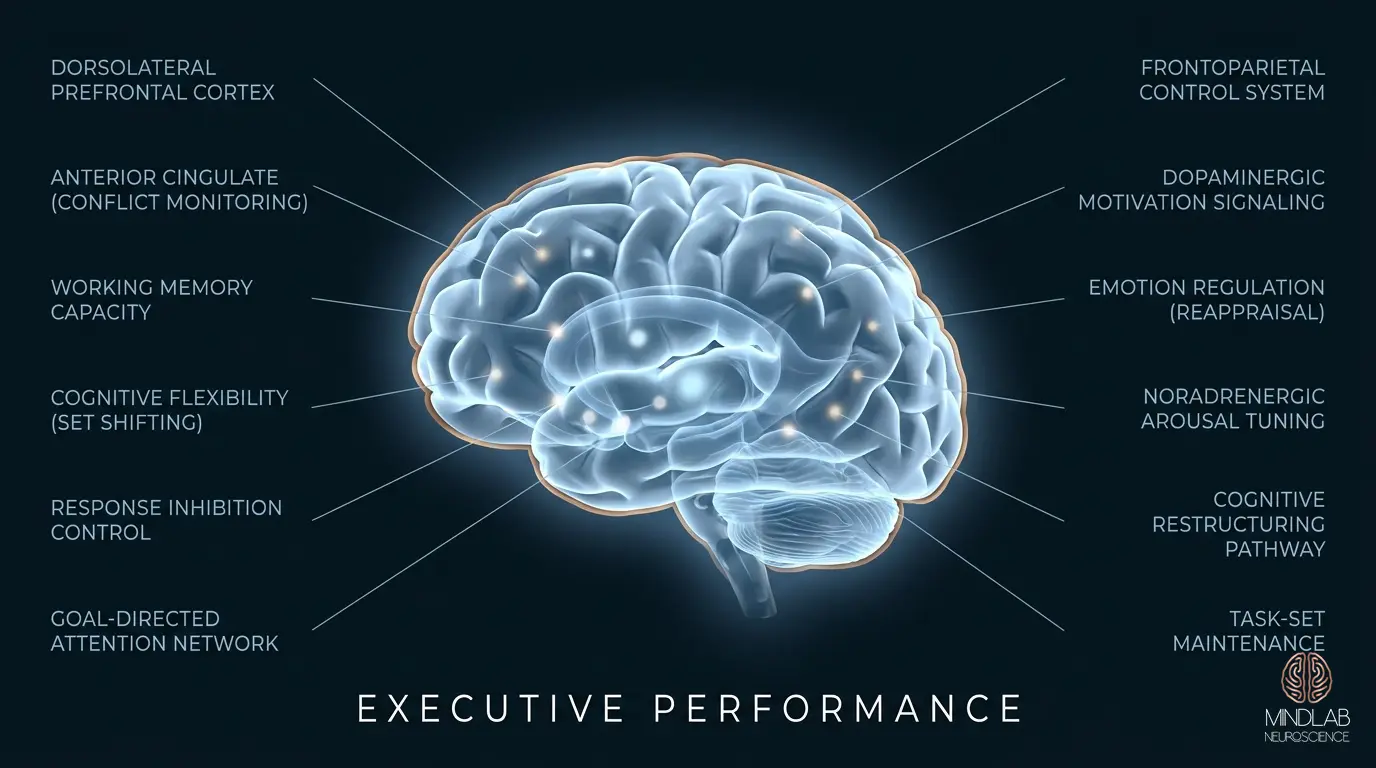
Executive Performance
The externalization of metacognition. We analyze how coaching acts as a scaffold for executive function, facilitating error correction, blind-spot detection, and the rapid behavioral remodeling required for high-stakes leadership.
25 articlesExternal Metacognition
From a neurobiological standpoint, executive coaching functions as an “externalized Prefrontal Cortex.” The brain is designed to automate behaviors to save energy, which creates “blind spots”: we are often cognitively blind to our own automatic patterns. Coaching provides the metacognitive scaffold necessary to observe these firing patterns from a third-person perspective, moving processing from the automatic Basal Ganglia to the conscious Cortex, where re-evaluation can occur.
Restoring the Error Signal
The brain requires “Prediction Error”, a mismatch between expectation and reality, to trigger neuroplasticity and learning.
-
The CEO Bubble: High-level leaders often suffer from a feedback vacuum; subordinates rarely offer the raw, corrective data the brain needs to adjust.
-
High-Fidelity Feedback: A coach artificially restores this feedback loop. By delivering candid, objective data on performance, they reactivate the brain’s learning machinery, forcing the neural circuits to update their models of social influence and decision-making.
Behavioral Remodeling
Insight alone does not change behavior; it only highlights the need for it. Effective coaching bridges the gap between knowing and doing through “Directed Neuroplasticity.”
-
Override Protocols: Leadership habits (like micromanaging or conflict avoidance) are deeply myelinated neural highways. Changing them requires “Long-Term Depression” (LTD) of the old circuit and “Long-Term Potentiation” (LTP) of the new one.
-
The Implementation Gap: Coaching provides the consistency and accountability required to keep the new, fragile neural pathway active long enough for it to become the default setting.
Latest Articles


Dopamine & Motivation
Motivation disappears after success because the brain's dopamine system does not respond to rewards. It responds to the difference between...
Read article : Why Motivation Disappears After Success: The Dopamine Prediction Error
Leadership & Executive Performance
The Neural Authority Protocol™ is my framework for building the neurological infrastructure of executive presence: the prefrontal regulation, vagal tone,...
Read article : The Neural Authority Protocol™
Emotional Intelligence Mastery
Emotional intelligence drives leadership performance through specific brain circuits. Learn the four neural failures that undermine teams and how to...
Read article : Emotional Intelligence and Effective Leadership: The Neuroscience
Leadership & Executive Performance
Overcoming obstacles in leadership requires resilience, adaptability, and a strong mindset. This blog explores neuroscience-backed strategies to help leaders navigate...
Read article : Overcoming Obstacles in Leadership: Resilience; Adaptability; and Growth
Strategic Career Architecture
How neuroscience-based optimization differs from clinical mental health support, and how to know which one fits your current goals.
Read article : Neuroscience vs Therapy: When Each Approach Fits
Dopamine & Motivation
Your genetic blueprint determines how your brain processes dopamine, the neurotransmitter driving motivation, focus, and reward. Understanding dopamine genetics personalized...
Read article : The Dopamine Genetics Connection: Personalized Neuroscience for Optimizing Your Unique Brain
Dopamine & Motivation
Elite executives don't succeed by working harder. They succeed by optimizing dopamine workplace performance. Groundbreaking neuroscience reveals how dopamine, the...
Read article : Dopamine Workplace Performance: Neuroscience Insights
Leadership & Executive Performance
Emotional reactivity in leadership costs executives millions in poor decisions annually. Neuroscience-based coaching rewires your stress response, transforming reactive patterns...
Read article : Emotional Reactivity in Leadership: Executive Coaching for Pressure
Cognitive Flexibility & Thought Patterns
Remote neuroscience coaching is not talk therapy on Zoom. It is real-time brain rewiring in the moments your nervous system...
Read article : Remote Neuroscience Coaching: How It Works and Who It’s For
Leadership & Executive Performance
Most people think perfectionism is “having high standards.” It is not. High standards create clarity and momentum. Perfectionism creates pressure,...
Read article : Perfectionism vs High Standards: The Neuroscience of Knowing the Difference
Leadership & Executive Performance
Decision fatigue in leaders is not a character flaw. It is a predictable brain cost of nonstop choices, context switching,...
Read article : Decision Fatigue Leadership: A Neuroscience-Based Reset Protocol