
Key Takeaways
- Neuroplasticity is location-agnostic: circuit change does not require the practitioner to be physically present.
- Real-Time Neuroplasticity™ works remotely: the target is neural architecture, not proximity; interaction quality drives change.
- Clients report remote sessions reduce social performance activation, giving faster access to authentic neural patterns.
- Assessment depth, session structure, and neuroplasticity methodology transfer to remote format without losing effectiveness.
- Consistency drives neuroplasticity outcomes: remote work raises session frequency by eliminating travel friction.
You can be wildly capable and still feel like your brain is working against you.
You hit the goals. You lead the meetings. You carry the responsibility. And then, in the quiet moments, your nervous system spikes. Your mind loops. You overthink a conversation. You avoid the one decision that matters. You sleep, but you do not recover.
This is exactly where remote neuroscience practice earns its place: a structured MindLAB program built for professionals who cannot put their lives on hold to rewire their brains.
Structural brain changes consistent with skill acquisition are detectable by MRI within weeks of beginning intensive learning, demonstrating that neuroplasticity operates on a timeline accessible within a typical coaching engagement.
Interpersonal neurobiology operates through co-regulation of autonomic states, meaning that the therapeutic relationship itself, including remote formats, functions as a direct mechanism for rewiring the nervous system’s threat-response threshold.
Randomized trials comparing remote video-delivered cognitive behavioral interventions with in-person equivalents found no significant difference in measurable outcomes for anxiety conditions, with remote delivery producing comparable indicator reduction and retention rates.
Mental rehearsal alone, without physical practice, produces cortical motor map reorganization equivalent to that produced by physical training, establishing that significant neural change does not require in-person physical presence.
Remote, neuroscience-informed practice delivered through structured synchronous and asynchronous formats can support meaningful gains in executive function and emotional regulation over sustained, consistent engagement.
Most people assume “remote” means watered down. Dr. Sydney Ceruto has found the opposite. The brain is most receptive to change when stakes and emotions are high, which rarely happens inside a perfectly scheduled, completely calm, once-a-week appointment. The moment happens at 9:07 a.m. before the board meeting. It happens mid-negotiation. This moment occurs in the car after receiving a text that disrupts your nervous system. It happens at 2:00 a.m. when you can’t turn your mind off.
Remote neuroscience practice allows working with the brain where your life actually happens.
Dr. Ceruto built her approach around a simple reality: insight is not the same as rewiring. You can understand your pattern for years and still repeat it in seconds. That is why Dr. Ceruto created Real-Time Neuroplasticity™ Practice™ and why she has refined it across 26+ years of applying neuroscience to real people with real stakes. The method is built for speed, precision, and durability, not for endless processing.
In this guide, This article will walk through how remote neuroscience practice works, what makes it different from traditional practice, what to expect step by step, and who it is truly for.
What remote neuroscience practice actually is
Remote neuroscience practice is a high-touch partnership that uses modern neuroscience and neuroplasticity protocols to change how your brain runs patterns in real time. The brain’s capacity for structural change is not tied to physical location: what matters is the quality and consistency of the experience driving the change.
Remote neuroscience practice is not a motivational pep talk.
It is not “just mindset.”
It is not a weekly venting session.
It is not a medical determination or a replacement for medical or psychiatric care.
Remote neuroscience practice is performance and life change engineered from the brain outward. The method identifies the exact neural loop behind your problem, then retrains it through targeted repetition, emotional regulation, and real-world integration until your default changes.
When you change the default, your results change without constant effort.
Why remote neuroscience practice works so well
Timing is the core reason remote neuroscience practice produces results. The autonomic nervous system requires specific conditions for new learning to take hold: conditions that arise naturally in real-world environments rather than in artificially calm office settings.
When pressure hits, the prefrontal cortex can go offline, and the threat system can take over. You already know what that feels like. You lose access to your best thinking. You go rigid, reactive, avoidant, or compulsive.
Remote neuroscience practice allows rapid access and rapid correction in the exact window where change is easiest. Instead of waiting for the next appointment to “talk about what happened,” the work happens in the moment so the new pathway can be built while your nervous system is still running the old one.
| Dimension | In-Person Session | Remote Session | Neural Impact |
|---|---|---|---|
| Access to neural patterns | Full: verbal, somatic, behavioral cues | Full: verbal, facial, language, pacing cues | No meaningful difference for RTN work |
| Social performance activation | Present: formal setting produces activation | Lower: familiar environment reduces performance state | Remote may enable faster access to authentic patterns |
| Session consistency | Subject to travel and scheduling friction | Higher consistency; lower dropout rate | Consistency is the key neuroplasticity variable |
| Geographic constraint | Limited by commute range | None: worldwide access | No effect on neuroplasticity outcome |
“Distance does not limit neuroplasticity. The brain changes in response to the quality of the interaction and the precision of the work, not the physical coordinates of where it happens.”
Remote work is one delivery channel for the rewiring we explore across cognitive flexibility and thought patterns.
Can genuine brain change work happen remotely?
Yes. The mechanisms driving neuroplasticity (prediction error, new experience, emotional encoding, repeated circuit activation) are not dependent on physical proximity. What matters is the quality of the interaction: the precision of observation, the depth of client engagement, and the consistency of the work. All of these are deliverable in a remote format. The brain does not require the practitioner to be in the same room to update its circuits.
What happens in a remote neuroscience session?
A remote Real-Time Neuroplasticity™ session follows the same structure as an in-person session. Dr. Sydney Ceruto works through detailed observation of language patterns, emotional activation, cognitive architecture, and the specific circuit patterns driving the presenting issue. The same assessment depth and intervention precision apply, through video conversation rather than physical presence.
Is remote neuroscience work as effective as in-person?
For the work that Real-Time Neuroplasticity™ involves, neural pattern identification and precision-targeted intervention, remote format does not reduce effectiveness. Research on remote delivery of neuroscience-informed interventions shows comparable outcomes to in-person for most presentations. In some cases, remote delivery increases effectiveness because individuals work from familiar environments that reduce social performance activation, enabling more authentic pattern disclosure.
Who is remote neuroscience work best suited for?
Remote sessions work well for individuals who travel frequently, live outside major metropolitan areas, or whose schedules make consistent in-person attendance difficult. Consistency is the primary driver of neuroplasticity outcomes: more consistent engagement accelerates circuit change more than format. For individuals where scheduling friction would reduce session frequency, remote work often produces better long-term outcomes than irregular in-person attendance.
Does remote mean working with a less experienced practitioner?
No. Dr. Ceruto delivers both in-person and remote sessions personally. Remote format is not a lower-tier service: it is a delivery modality. The same expertise, the same RTN™ methodology, and the same session structure apply regardless of format. Remote work is not a compromise; it is an expansion of access to the same work.
What is remote neuroscience practice, in one sentence?
Remote neuroscience practice is a high-touch, neuroscience-based partnership that helps you rewire patterns through real-time neuroplasticity protocols in the moments they actually occur.
Do you do Zoom calls?
For strategy calls, Dr. Ceruto uses phone-only for a specific neuroscientific reason: fewer visual distractions help your brain go deeper. Private clients have broader options depending on the engagement.
How fast will results appear?
Many clients notice meaningful change within the first 2 to 3 weeks when they run the protocol consistently. The speed depends on the pattern, the reps, and your environment.
What if the client has a high-pressure schedule?
That is precisely who remote neuroscience practice serves best. The protocol adapts to your schedule and integrates into the life you are already living.
What if the client travels constantly?
Remote work is designed for travel. In select engagements, on-site support can also be deployed at pivotal moments, but the remote backbone keeps your nervous system stable between events.
Do you work with anxiety and panic?
Yes. Dr. Sydney Ceruto targets the neural loop driving the fear response and retrain it through Real-Time Neuroplasticity™ Practice™ tools, including pattern interruption and nervous system regulation.
Do you work with ADHD and neurodivergent brains?
Yes. Dr. Ceruto builds strategies that respect how the brain works and strengthen executive function through targeted practice.
What does “24/7 access” actually mean?
In specific programs, clients can reach Dr. Ceruto through calls, texts, video, and voice notes for real-time recalibration. Access scope is defined in your agreement.
How does a prospective client know if this is worth the investment?
If your current pattern is costing you sleep, health, relationships, decision quality, and performance consistency, the cost is already real. The question is whether you want to keep paying it.
What is the first step?
Consider a Strategy Call, and Dr. Ceruto will map the situation and decide the best path forward together.
References
- Porges, S. W. (2021). Polyvagal theory: a biobehavioral journey to sociality. Comprehensive Psychoneuroendocrinology, 100069.
- Draganski, B., Gaser, C., Busch, V., Schuierer, G., Bogdahn, U. and May, A. (2004). Neuroplasticity: changes in grey matter induced by training. Nature, 427(6972), 311–312.
- Bouchard, S., Paquin, B., Payeur, R., Allard, M., Rivard, V., Renaud, P. and Germain, V. (2004). Delivering cognitive-behaviour treatment for panic disorder with agoraphobia in videoconference. Telemedicine Journal and e-Health, 10(1), 13–25.
- Pascual-Leone, A., Nguyet, D., Cohen, L. G., Brasil-Neto, J. P., Cammarota, A. and Hallett, M. (1995). Modulation of muscle responses evoked by transcranial magnetic stimulation during the acquisition of new fine motor skills. Journal of Neurophysiology, 74(3), 1037–1045.
- Siegel, D. J. (2012). The Developing Mind: How Relationships and the Brain Interact to Shape Who We Are (2nd ed.). Guilford Press.
From Reading to Rewiring
Remote neuroscience practice applies brain-based assessment and structured nervous system protocols through video-based sessions, delivering measurable outcomes without geographic limitation. Remote delivery of brain-based regulation work can produce outcomes comparable to in-person formats, with meaningful behavioral change often emerging within the first weeks of consistent practice.
One hour with Dr. CerutoThe foundation: neuroplasticity in plain language
Neuroplasticity is your brain’s ability to change through repeated experience. This change is not abstract: it is physical, measurable, and directly tied to what you practice in the conditions where you need performance most. That finding is the scientific foundation of everything in this work.
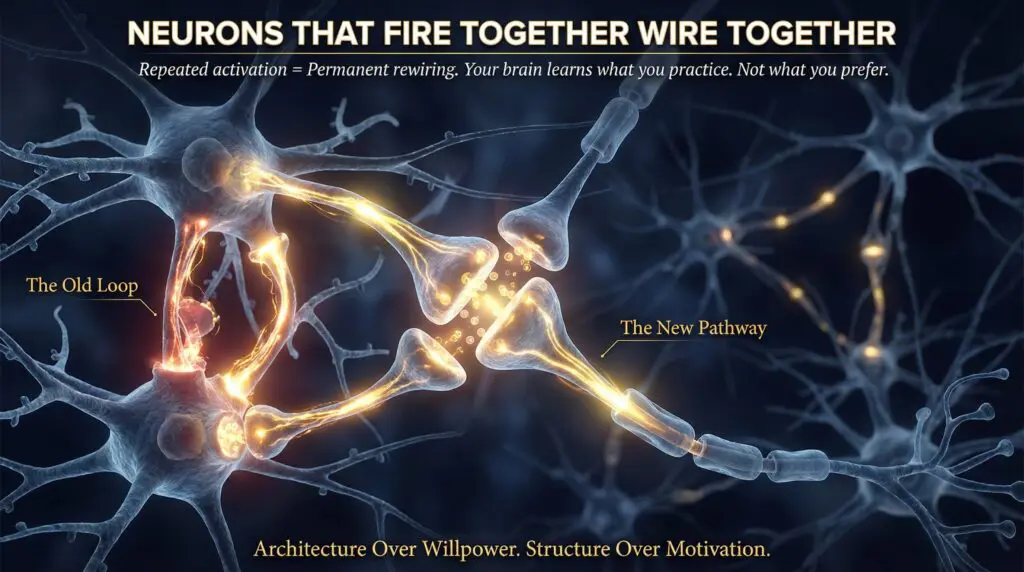
Neurons that fire together wire together. When you repeat a fear response, you strengthen it. When you repeat a regulated response, you strengthen that instead. The brain does not care what you “prefer.” It cares about what you practice.

The difference between a trapped pattern and an engineered default. Remote neuroscience practice doesn’t erase the old loop: it builds a stronger new one.
This is why willpower fails. Willpower tries to force behavior on top of a nervous system pattern. Neuroplasticity work changes the pattern underneath the behavior, so the behavior becomes easier.
Remote neuroscience practice uses this principle in a structured way, so you do not have to rely on motivation. You rely on architecture.
What makes Dr. Sydney Ceruto’s approach different
Dr. Ceruto does not merely discuss your story. She engineers your circuitry.
That line is not a slogan. It is a method.
In many models, you spend months getting insight, then you are sent home to “apply it.” In Dr. Ceruto’s work, applying insights is the primary focus. The sessions use the events of the week as a laboratory for experimentation.
Real-Time Neuroplasticity™ Practice™ focuses on:
- Identifying the specific neural pathway driving your current struggle
- Understanding why that pathway exists and what it is protecting
- Starving the old pathway of reinforcement
- Building and strengthening the new pathway through real-time reps
- Consolidating the change so it stays under stress, not just on a good day
Remote neuroscience practice is the delivery system that makes this possible at the speed your life requires.
Step by step: how remote neuroscience practice works
Step 1: A precision assessment, not a personality test
The process starts by mapping what is actually happening.
What triggers you?
What is your next course of action?
What do you avoid?
What do you over-control?
What you chase when you are stressed.
What your brain uses as a shortcut for safety.
This is not about labels. It is about patterns.
If you are a high performer, your patterns are often adaptive. They helped you win. The cost is that they may now be overworking your nervous system.
Step 2: Mapping your dopamine profile
Motivation is chemistry plus meaning.
Dr. Ceruto maps the client’s dopamine profile to understand how your brain responds to reward, challenge, novelty, and pressure. Then Dr. Ceruto builds a personalized Dopamine Menu that replaces unreliable highs with sustainable drive.
This matters because many high achievers are not lacking discipline. They live in the volatility of dopamine: spikes, crashes, and then self-criticism. Remote neuroscience practice helps stabilize the reward system while keeping your ambition intact.
Step 3: Building stress resilience where it counts
Under pressure, your brain defaults to speed rather than wisdom.
The method retrains the stress response so you can stay online when it matters: negotiations, conflict, public performance, leadership decisions, family moments, and private moments when you are alone with your mind.
This is where real-time work becomes non-negotiable. You do not build resilience by talking about stress. You build resilience by practicing regulation in the presence of stress.
Step 4: Enhancing executive function
When your brain is overloaded, your judgment gets expensive.
Dr. Sydney Ceruto builds the cognitive stamina to think clearly under complexity: attention control, working memory, decision clarity, time perception, deep work capacity, and recovery.

Remote neuroscience practice supports this because executive function is context-dependent. It changes based on sleep, travel, conversations, deadlines, and hormonal and metabolic state. When those inputs shift, your protocol must adjust.
Step 5: The 21-day neural cycle
Dr. Ceruto often uses a focused 21-day neural cycle because repetition plus emotional intensity drives fast change. The process identifies a single primary pattern and run a protocol that builds the new response until it becomes automatic.
Some clients do a 90-day Transformation Arc. Some opt for a longer integration period because life is complex. The timeline is customized, but the principle stays the same: the method creates enough high-quality reps that the brain stops needing the old pattern.
What “remote” looks like in practice
Remote neuroscience practice is not one weekly call and a worksheet.
It is a blend of:
High-fidelity deep dives for neural mapping and strategy
Real-time access for rapid recalibration when your pattern is activated
Short, precise interventions that take minutes
Longer breakthroughs when you are on the edge of a significant shift
Ongoing accountability so that the new pathway consolidates
Depending on the engagement, clients may have access through multiple channels, including calls, texts, voice notes, and scheduled sessions. The goal is simple: your neuroscience strategy is available when pressure, complexity, and consequence are at their peak.
The real-time rewiring loop used inside remote work
When people hear “neuroplasticity,” they often imagine a slow, vague process. In practice, rewiring happens through a repeatable loop you can run in minutes.
Here is the loop Dr. Ceruto uses with clients in Real-Time Neuroplasticity™ Practice™:

- Name the activation
You do not analyze your childhood. You identify what is happening in your body and your attention right now. Tight chest. Tunnel vision. Urge to prove. Urge to flee. Mental spinning. That naming alone recruits higher cortical areas and reduces emotional flooding. - Interrupt the old circuit
Every pattern has a first domino. It might be a sentence you repeat, a posture you take, or a compulsive behavior like checking, rehearsing, or attacking. The process interrupts the domino before the cascade completes. - Regulate the nervous system.
You cannot install a new pattern in a body that feels under threat. The approach downshifts the alarm system and bring the prefrontal cortex back online. Regulation is not “calming down.” It is returning to choice. - Install the new response.
This is where remote work becomes an amplifier. The method involves choosing a new micro-response that is small enough to do in the moment and specific enough to create a new wiring signal. Then the process repeats it. Not for motivation. For biology. - Consolidate through repetition in the real environment
The brain learns what you repeat, not what you agree with. The process runs enough reps in the real context that your default shifts.
Remote neuroscience practice makes this loop usable because you do not have to wait until after the moment has passed. The method trains the brain in the moment, while the plasticity window is open.
What happens between “sessions” is the real session
Traditional models often treat the week as downtime. In Dr. Ceruto’s model, the week is where the work consolidates.
Between deeper sessions, you will have a small set of precise reps. Some are designed to strengthen executive function. Some are designed to stabilize the dopamine system. Some are designed to retrain a stress response. All are designed to be realistic.
This is also why Dr. Ceruto does not use shame-based accountability. If a rep is not happening, the support continues. Dr. Ceruto adjusts the rep until the brain can actually repeat it.
Three examples of remote work in real life
These examples are kept recognizable and straightforward. The names and details are composites, but the neural patterns are real.
Example 1: The boardroom spiral
A senior executive is five minutes from presenting. Their hearts spike. Their mind starts scanning for what could go wrong. They begin over-prepping, rewriting slides, and abandoning their plan. The behavior appears to reflect “high standards.” The nervous system is a threat.
In the moment, the approach runs the loop: name the activation, interrupt the rehearsal spiral, regulate the body, then install one new response. Often, the new response is a single sentence and a single breath pattern. The goal is not to feel “confident.” The goal is to keep the prefrontal cortex online long enough to execute.
Once the meeting is over, the process does not celebrate luck. The process consolidates the rep so the brain learns, “This is how we handle pressure now.”
Example 2: The relationship trigger
A partner says a sentence that hits an old wound. The individual’s nervous system reads it as danger. They go cold, sharp, and defensive, or they collapse into silence. Hours later, they regret it.
Remote support means the recalibration can happen right after the trigger, before the old pathway gets reinforced for another decade. Dr. Ceruto regulates the body, and then scripts a direct, clean repair move. The rep is minor: one message, one boundary, and one honest sentence delivered without threat.
Over time, the pattern changes from “protect at all costs” to “stay connected without losing yourself.”
Credentials and credibility: why this is not a trend for Dr. Ceruto
Remote neuroscience practice is popular now, but Dr. Ceruto did not start this because it was trending. She built it because it works.
Dr. Ceruto holds a PhD in Behavioral and Cognitive Neuroscience and dual Master’s degrees in Clinical Psychology and Business Psychology, and she has lectured in the Executive Development Program at Wharton. Over 26+ years, Dr. Ceruto has worked with thousands of clients across high-stakes domains, including executives, hedge fund managers, performers, and people rebuilding after trauma.
Those credentials matter for one reason: they allow precision. The brain is not a metaphor in Dr. Ceruto’s work. It is the operating system being changed.
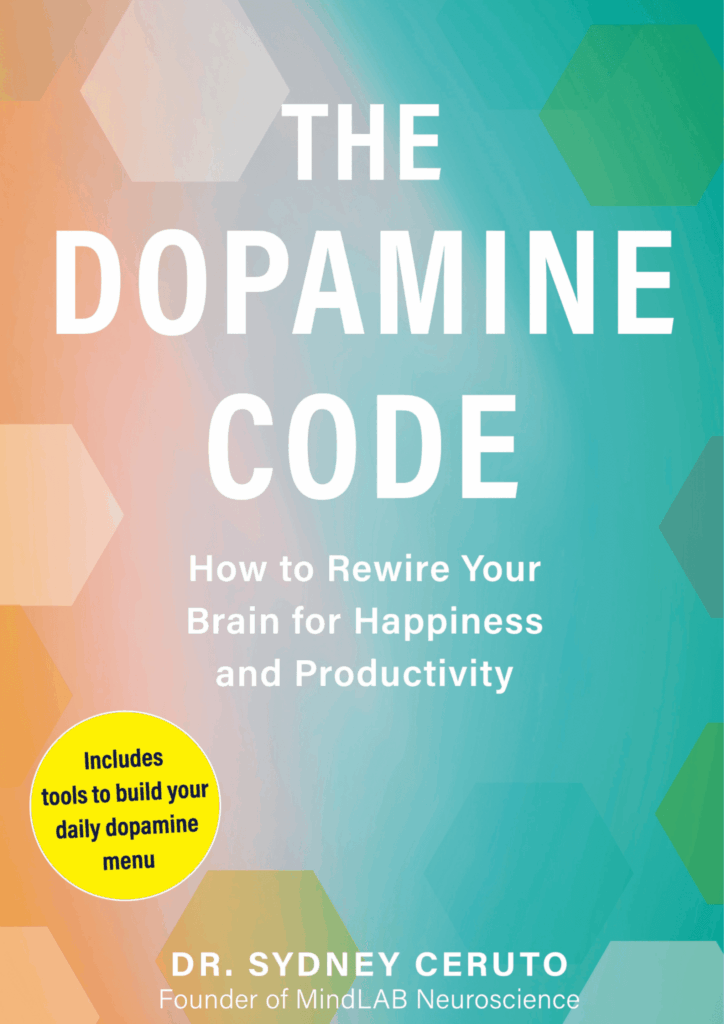
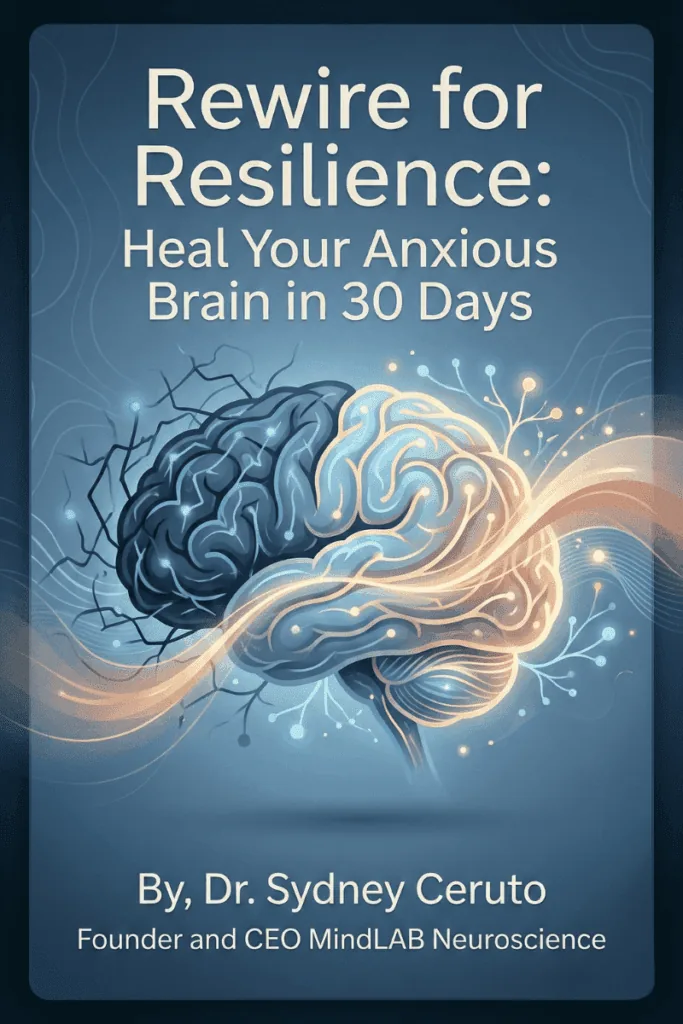
Dr. Ceruto is also the author of The Dopamine Code (Simon & Schuster), out now, and the creator of Rewire for Resilience: Restore Your Anxious Brain in 30 Days, a structured Real-Time Neuroplasticity™ protocol designed for people who need measurable anxiety reduction without endless cycles of trial-and-error.
Choosing your path: levels of support
Not everyone needs the same level of intensity. If you are considering remote neuroscience practice, the best fit depends on the stakes, schedule, and how activated the pattern is.

Self-guided protocol: Rewire for Resilience
If your primary issue is anxiety loops, panic spikes, or chronic overthinking, a structured self-guided protocol can be the right starting point. The advantage is speed and simplicity. You can start immediately and build the habit of real-time regulation.
Targeted transformation: NeuroSync™
NeuroSync™ is a one-on-one Transformation Arc focused on one defining pattern, often completed in about 90 days, with flexibility to integrate over a longer window if needed. It blends deep virtual work with real-time access so the rewiring happens in live environments, not only in reflection. Investment for NeuroSync™ is defined during your Strategy Call.
Embedded partnership: NeuroConcierge™
NeuroConcierge™ is designed for people whose reality spans boardrooms, complex family systems, global travel, and constant high-stakes decision-making. It includes unrestricted multi-channel access and, when appropriate, on-site presence. This engagement is strictly limited and discussed privately after the strategy call.
The through-line is the same at every level: Real-Time Neuroplasticity™ Practice™ applied with precision, so your brain stops repeating expensive defaults.
Who remote neuroscience practice is for
Remote neuroscience practice is for people who are tired of generic advice and are ready for precision.

Remote neuroscience practice is especially effective for:
High-achieving professionals and leaders
You are making decisions that affect teams, money, and outcomes. You cannot afford a brain that collapses under pressure.
Founders and entrepreneurs
Your brain is your operating system. When it is dysregulated, your business pays the price.
Athletes, performers, and public-facing professionals
Your nervous system decides whether you access your skill on demand.
High performers with anxiety, panic, or obsessive loops
You are not weak. Your brain learned a survival strategy and never got updated.
Neurodivergent brains
Many neurodivergent individuals have spent years being told to “just be more disciplined.” The approach works with the brain, not against it.
Couples and relationships under strain
Relational patterns are neural patterns. The method can rewire the loop that keeps you stuck.
If you want the short version: remote neuroscience practice is for people whose life is too real for slow help.
Who it is not for
Remote neuroscience practice is not the right fit if:
You are in an acute psychiatric crisis or need immediate stabilization
You are seeking assessment codes or insurance billing
You want a quick fix without practice
You are unwilling to be coached in real moments, not just in reflection
You want a purely traditional talk-based model
If you are unsure, the right first step is a Strategy Call to assess fit and direction.
What outcomes you can expect
Dr. Ceruto does not promise perfection. She does promise that measurable change is possible when the method is precise.

Common outcomes individuals pursue through remote neuroscience practice include:
More emotional stability under pressure
Less panic, spiraling, and catastrophic thinking
Better sleep quality and faster recovery after stress
Cleaner decision-making and reduced decision fatigue
Improved relationships through reduced reactivity
Sustained motivation without dopamine crashes
More consistent performance in high-stakes environments
The process tracks progress through observable behavior changes and structured check-ins. In some programs, the process uses data-driven assessments to measure cognitive and emotional shifts over time.
Why remote can outperform in-person
In-person work can be powerful. But it often suffers from two issues:
It happens too far from the trigger.
It is too bound by the clock.
Remote neuroscience practice solves both.
The trigger happens in your real life, not in Dr. Ceruto’s office. And your brain does not rewire best when you are calm and explaining what happened. Your brain rewires when it is activated and then guided into a new response. That is why remote neuroscience practice can outperform in-person for high performers. The work happens inside the moment your nervous system is actually running the old program.
In a classic office setting, your brain can look “better” than it really is. You can sound clear, wise, and regulated while sitting in a quiet room. Then you walk back into your real world and the old pattern returns on cue: the email, the meeting, the tone of voice, the deadline, the silence at home, the pressure to perform. Remote neuroscience practice closes that gap. It allows training the brain in the same environment where you need the change to hold.
Remote neuroscience practice is also repetition-friendly. Neuroplasticity is built through reps, not through insight alone. In-person work is often limited to one longer session. Remote neuroscience practice allows shorter, more frequent recalibrations that fit into real days. That frequency matters. A two-minute real-time correction, repeated across a week, often creates more durable rewiring than a single long conversation that stays theoretical.
Here is the simple truth: the brain learns context. If you want your new response to show up in the boardroom, your brain needs reps that feel like the boardroom. If you want your calm to show up in conflict, your brain needs reps that happen right after conflict begins. Remote neuroscience practice gives you that context-based training, so the new pathway is not just “available” when life is easy. It becomes your default when life is demanding.
Remote neuroscience practice also reduces the “clock problem.” Many breakthroughs do not happen on schedule. The window opens when you are activated, not when your calendar says it is time. If you are spiraling at 10:30 p.m. the night before a major presentation, waiting three days for a session can reinforce the old circuit three more times. Remote neuroscience practice uses the window while it is open, which is exactly how Real-Time Neuroplasticity™ Practice™ creates faster consolidation.

There are also practical advantages that matter for real clients:
- Remote neuroscience practice travels with you. If you live on planes, in meetings, and across time zones, the protocol has to move with your life.
- Remote neuroscience practice protects privacy. Some individuals do not want to be seen walking into an office or explaining sensitive issues in person.
- Remote neuroscience practice supports real-world integration. Dr. Ceruto can adjust the protocol based on what is happening this week, not based on what you remember later.
- Remote neuroscience practice reinforces independence. The goal is not that clients need Dr. Ceruto forever. The goal is that your brain learns a new operating system you can run on your own.
For select engagements, Dr. Ceruto also offers on-site, anywhere-in-world availability. But remote neuroscience practice remains the backbone because it covers the moments between the big events. Those in-between moments are where patterns are either reinforced or rewritten. And when you can rewrite them in real time, your results stop depending on willpower and start depending on wiring.
What a typical week looks like
Every engagement is customized, but here is a realistic picture:
One more extended session to map, plan, and build the week’s protocol
Several short calibrations when your pattern activates
Practice reps that are small enough to do, but specific enough to rewire
A review loop to measure progress and refine the plan
Remote neuroscience practice works when the work becomes frictionless enough to repeat and specific enough to change you.
How to evaluate a remote neuroscience practitioner
If you are evaluating options, look for a practitioner who can explain the brain in a way you can use and who runs a clear protocol.
Ask:
- Do they have a repeatable method, not just inspiration?
- Do they work with real-time triggers, not only reflection?
- Do they measure progress in observable ways?
- Do they respect the line between practice and professional neuroscience-based support?
Your brain is not a DIY project when the stakes are high. Choose a practitioner who can apply the science, not just talk about it.
How to start with MindLAB Neuroscience
The gateway is the Strategy Call.
During that call, Dr. Ceruto will:
Identify the core pattern driving your current stuck point
Explore the neuroscience underneath it
Map a clear roadmap for transformation
Determine mutual fit for a private engagement
If the fit is not right, you still leave with usable insights and a clearer direction.