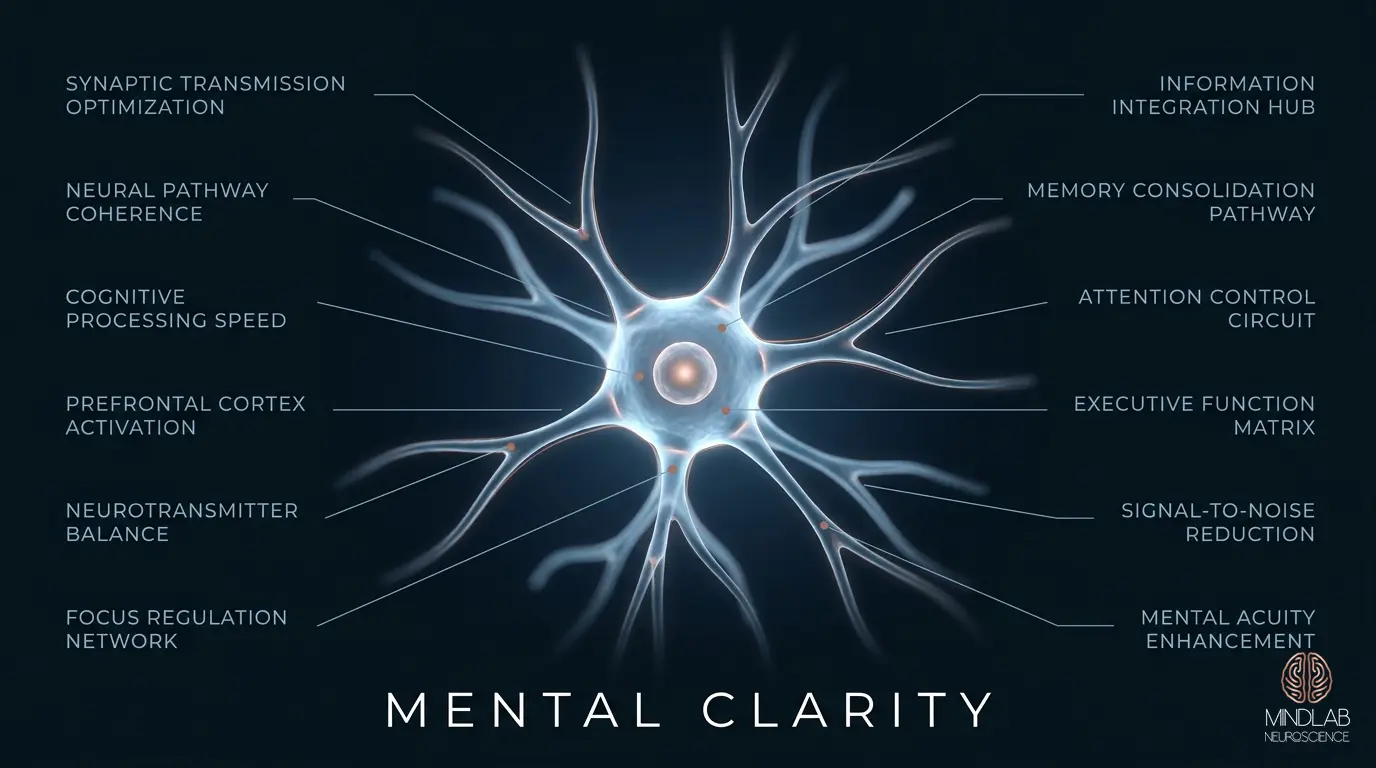
Mental clarity is not a vague aspirational state. It is a measurable configuration of prefrontal network activity. When the dorsolateral prefrontal cortex maintains stable working memory representations, the anterior cingulate cortex efficiently monitors for conflicts and errors, and the frontoparietal attention network suppresses irrelevant information, a person experiences what they describe as “clear thinking.” They can hold multiple variables in mind, process decisions without feeling overwhelmed, sustain focus on a single task, and access the executive functions that sophisticated professional and personal demands require. When any component of this network degrades (through cognitive overload, chronic stress, sleep deprivation, inflammation, or sustained emotional processing) the subjective experience shifts to what people describe as “brain fog,” scattered thinking, or the inability to think straight. The feeling is not imaginary. It reflects a real reduction in prefrontal processing efficiency, measurable in working memory capacity, attentional control, and the speed of executive function.
Dawson and Reid established that sustained wakefulness produces cognitive impairment equivalent to legally significant blood alcohol levels, and Lim and Dinges’ meta-analysis showed which functions go first: simple attention and vigilance degrade fastest, with executive measures following. Diamond’s comprehensive review of executive function identified three core components: inhibition, working memory, and cognitive flexibility, all dependent on prefrontal integrity and all vulnerable to the same set of neurobiological insults: cortisol elevation, inflammatory cytokines, glucose dysregulation, and catecholamine imbalance. Lavie’s perceptual load theory demonstrated that cognitive clarity depends critically on the brain’s capacity to filter irrelevant information: when perceptual or cognitive load exceeds available processing resources, the filtering mechanism degrades and distractors gain access to awareness, producing the experience of mental clutter. Miyake and Friedman’s latent variable analyses confirmed that while the three executive functions are dissociable, they share a common underlying factor, “unity”, that appears to reflect the integrity of prefrontal-subcortical connectivity and is sensitive to individual differences in stress reactivity, neurochemical regulation, and baseline arousal levels.
The popular approach to mental clarity typically involves productivity techniques (time-blocking, digital detox, prioritization matrices) or lifestyle interventions (exercise, meditation, nutrition). These have genuine utility as supporting conditions but do not address the core problem when prefrontal efficiency has been chronically degraded. A person whose dorsolateral prefrontal cortex is underperforming due to sustained cortisol elevation and attentional fragmentation does not need a better to-do list. They need the neural substrate that makes organized thought possible to be restored to functional capacity. Productivity tools assume the cognitive hardware is operational and simply needs better software. When the hardware itself is compromised (when working memory cannot hold enough variables, when the attention system cannot suppress distractors, when cognitive flexibility has been replaced by rigid perseveration) no external organizational framework compensates.
At MindLAB Neuroscience, Dr. Sydney Ceruto treats mental clarity as a neurocognitive output that can be systematically restored. Through Real-Time Neuroplasticity™, she identifies the specific factors degrading an individual’s prefrontal efficiency (whether chronic stress activation, unresolved emotional processing consuming cognitive bandwidth, sleep architecture disruption, or attentional fragmentation from sustained demand overload) and intervenes during the conditions that produce the degradation, when the relevant circuits are active and responsive to reorganization. The goal is not a temporary boost in focus but a durable restoration of the prefrontal processing capacity that makes clear thinking the default state rather than an effortful achievement. Understanding where your clarity breaks down starts with a strategy call to map the specific demands, conditions, and neural patterns that determine when you think well and when you do not. The articles below explore the neuroscience of executive function, cognitive load, attentional control, and the prefrontal architecture that determines whether the mind operates with precision or with noise.