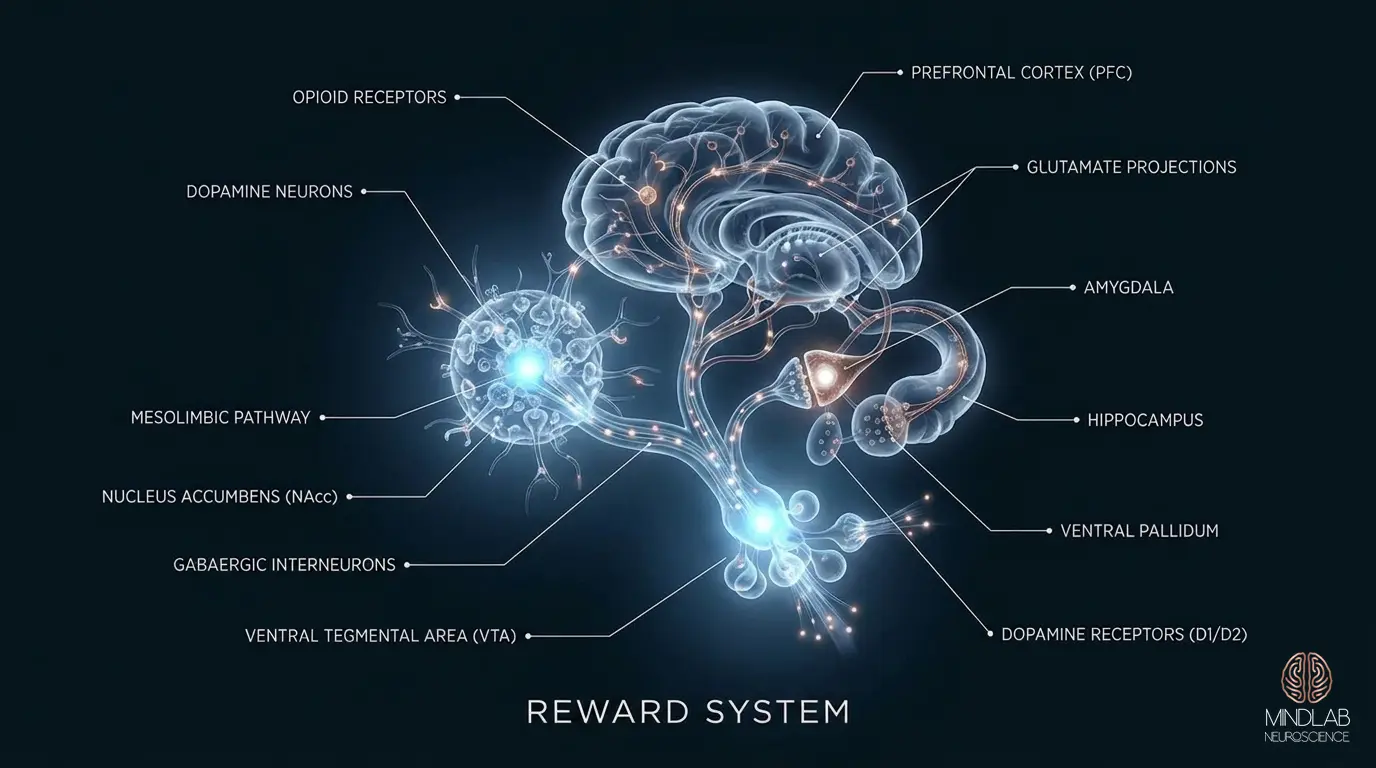
The brain’s reward system does not exist to make a person feel good. It exists to make them repeat what worked. This distinction, between pleasure and reinforcement, is the single most important concept for understanding why people remain locked in behavioral patterns they consciously want to change. The reward circuitry, centered on the ventral tegmental area’s dopaminergic projections to the nucleus accumbens and prefrontal cortex, encodes prediction errors: the gap between what the brain expected and what actually occurred. When an outcome exceeds expectation, dopamine surges. When it meets expectation, dopamine is flat. When it disappoints, dopamine dips below baseline. This signal does not care whether the behavior is adaptive. It only cares whether the outcome surprised the system. The result is a learning architecture that can lock onto destructive patterns with the same tenacity it applies to productive ones.
Schultz’s foundational research on dopamine prediction-error coding established this framework, but subsequent work by Haber and Knutson mapped the full anatomical circuit, revealing that the reward system is not a single pathway but a set of interconnected loops linking the midbrain, ventral striatum, amygdala, hippocampus, and multiple prefrontal regions. Each loop governs a different aspect of motivated behavior: wanting versus liking, habit formation versus goal-directed action, approach versus avoidance. Berridge’s dissection of the “wanting” (dopaminergic) and “liking” (opioidergic) systems showed that these can become decoupled: a person can desperately want something that no longer produces any genuine satisfaction, because the dopamine-driven motivational pull operates independently of the hedonic experience. Volkow’s neuroimaging work with individuals exhibiting compulsive behavioral patterns demonstrated that chronic overstimulation of reward circuits produces measurable downregulation of D2 receptors in the striatum, reducing the system’s sensitivity and creating a state where baseline experience feels flat, driving escalation.
Most interventions target the behavioral endpoint (the substance, the compulsive pattern, the avoidance behavior) while leaving the reward-prediction architecture intact. Willpower-based approaches ask the prefrontal cortex to override a subcortical system that is faster, more automatic, and consuming fewer cognitive resources. This is not a fair contest, and under stress it reliably fails. Incentive-substitution models attempt to redirect reward-seeking toward healthier targets, but if the underlying prediction-error circuitry remains calibrated to the original pattern, the substitution rarely holds. The reward system is not choosing the maladaptive behavior because it is the only option. It is choosing it because the circuitry has encoded it as the highest-value prediction in the repertoire.
At MindLAB Neuroscience, Dr. Sydney Ceruto works directly with the reward-prediction circuitry that sustains entrenched patterns. Her approach through Real-Time Neuroplasticity™ targets the specific dopaminergic prediction loops maintaining the behavior, not in abstracted discussion but during the live moments when the motivational pull is active and the reward system is generating its signals in real time. This is when the circuitry is in its most plastic state and most responsive to reorganization. To understand how your reward system has been trained and what restructuring it requires, begin with a strategy call. The articles that follow explore the neuroscience of motivation, reinforcement, habit formation, and the reward architecture that determines what the brain pursues, and what it cannot let go of.