
Key Takeaways
- Default mode network (medial prefrontal cortex, posterior cingulate cortex, angular gyrus, hippocampal formation): prospective simulation engine.
- Episodic future thinking and visualization share DMN architecture, assembling stored memories into scenarios never experienced.
- Productive DMN engagement strengthens prefrontal-hippocampal connectivity and primes motor and perceptual circuits for anticipated performance.
- Temporal orientation is the distinction: forward-directed imagery produces neural preparation, past-locked rumination reinforces maladaptive circuitry.
- Training the default mode network toward goal-directed prospection converts idle mind-wandering into measurable performance advantage.
When attention turns inward and the external world recedes from focus, the brain does not fall silent. It activates a sprawling network of cortical and subcortical regions that specialize in constructing internal worlds: replaying past events, imagining conversations that have not yet happened, and rehearsing futures that exist only as neural simulations. This network, and the way it supports deliberate visualization, represents one of the most powerful and least understood performance systems the human brain possesses.
The Architecture of the Default Mode Network
The default mode network earned its name from an observation that initially puzzled neuroscientists. When Marcus Raichle and colleagues examined brain activity during rest periods between experimental tasks, they discovered that a consistent set of regions actually increased their metabolic activity when participants stopped performing goal-directed work. Rather than representing neural idleness, these activations revealed a dedicated network that engages most powerfully when attention shifts from external demands to internal processing.
The DMN comprises four core nodes, each contributing a distinct computational function to the network’s collective output. The medial prefrontal cortex anchors self-referential processing: the continuous stream of evaluations, predictions, and judgments the brain generates about one’s own states, traits, and likely futures. The posterior cingulate cortex functions as an integration hub, binding information across memory systems and time frames into coherent internal narratives. The angular gyrus, positioned at the junction of temporal, parietal, and occipital cortices, supports semantic integration and the manipulation of abstract representations. And the hippocampal formation, long recognized for its role in episodic memory encoding, provides the raw experiential material from which new mental scenarios are assembled.
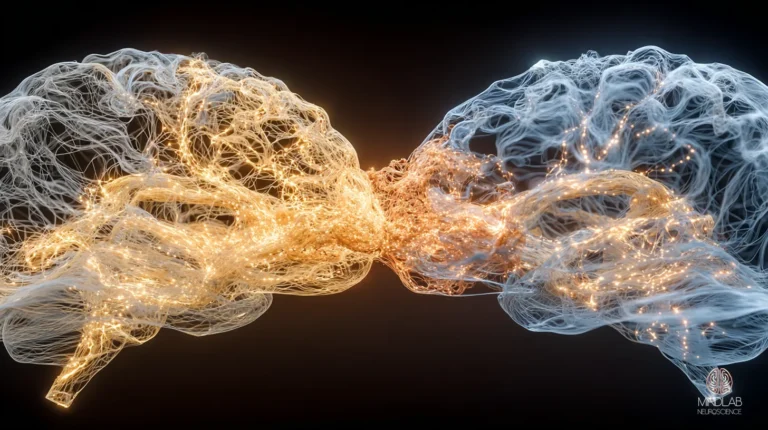
What makes this architecture remarkable is not the individual contributions of each node but the way they coordinate. Functional connectivity analyses reveal that DMN regions synchronize their activity through correlated low-frequency oscillations, creating a unified processing state that is fundamentally different from the fragmented activations seen during externally directed attention. When one node of the network activates, the others follow within milliseconds, producing an integrated computational workspace for internal simulation.
Self-Referential Processing and the Prospective Brain
The default mode network does not merely replay the past. Its most consequential function may be its capacity for prospective simulation: the ability to construct detailed mental models of events that have not yet occurred. Research by Daniel Schacter and Donna Addis demonstrated that episodic memory and episodic future thinking share virtually identical neural substrates, with the hippocampus and medial prefrontal cortex showing overlapping activation patterns whether participants recalled a past birthday or imagined a future one.
This overlap is not coincidental. The constructive episodic simulation hypothesis proposes that the memory system evolved not primarily to preserve faithful records of the past but to provide flexible building materials for constructing future scenarios. The hippocampus extracts spatial, temporal, and contextual elements from stored experiences and recombines them into novel configurations: a process that explains both the power and the fallibility of human memory. Every act of remembering is partly an act of construction, and every act of future imagination draws on the same constructive machinery.
The medial prefrontal cortex adds evaluative processing to these constructions, tagging simulated scenarios with self-relevance assessments: How likely is this outcome? How would it affect my goals? What emotional response would it produce? This prefrontal evaluation transforms raw hippocampal simulation into something functionally useful: a predictive model the brain can use to guide current decisions based on anticipated future consequences.
How Visualization Recruits the Prospection System
Constructive visualization (the deliberate mental rehearsal of future performances, conversations, or outcomes) leverages the DMN’s prospective simulation architecture for goal-directed purposes. When someone mentally rehearses a high-stakes presentation, or an athlete visualizes the precise sequence of movements in a competitive routine, they are engaging the same hippocampal-prefrontal circuitry that the brain uses spontaneously during mind-wandering. The difference is intentionality and specificity.
Neuroimaging studies comparing spontaneous future thinking with directed visualization reveal that deliberate rehearsal produces stronger activation in the dorsolateral prefrontal cortex and supplementary motor areas alongside standard DMN regions. This co-activation pattern suggests that effective visualization does not simply engage the default mode network: it couples the DMN’s constructive simulation capacity with executive control regions that sharpen the simulation’s detail and maintain its goal relevance. The result is a neural rehearsal that bridges imagination and preparation.
The motor system provides particularly compelling evidence for visualization’s neural impact. When a person vividly imagines performing a physical movement, primary motor cortex activation patterns closely mirror those produced during actual execution. Repeated visualization progressively strengthens the synaptic pathways involved, producing measurable improvements in subsequent physical performance without any intervening practice. The brain, in a meaningful neurobiological sense, cannot fully distinguish between a vividly imagined rehearsal and an actual one: both modify the relevant circuitry.
The Hippocampal Construction Engine
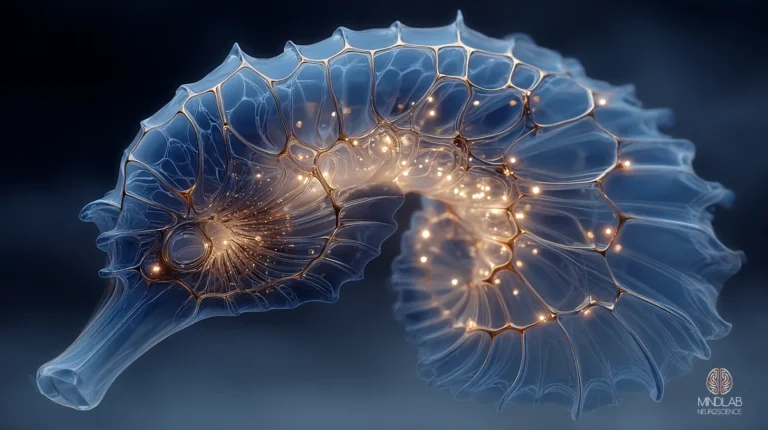
The hippocampus deserves particular attention in understanding why visualization works at a neural level. Rather than functioning as a simple recording device, the hippocampus operates as a relational binding engine: it encodes experiences by creating associations between spatial contexts, temporal sequences, sensory details, and emotional states. When visualization calls upon this system, the hippocampus does not retrieve a single memory. It disassembles stored experiences into their constituent elements and recombines them into a coherent scenario that serves the current imaginative goal.
Research by Schacter and colleagues demonstrated that individuals with hippocampal damage can recall general facts about their past but struggle dramatically to imagine coherent future scenarios, producing fragmented, detail-poor descriptions that lack spatial and temporal structure. This finding confirms that the hippocampus is not optional for prospective simulation: it is the constructive engine that assembles the building blocks of imagined futures from the materials of lived experience.
For visualization practice, this carries a direct implication: the richness of mental rehearsal depends on the richness of the experiential database the hippocampus can draw upon. Individuals with broader, more varied experiential histories can construct more detailed and more flexible mental simulations. And each successful visualization, once encoded, becomes itself a source of experiential material for future constructive simulations: a compounding process that explains why consistent visualization practice produces progressively more vivid and effective rehearsals over time.
The same network that rehearses your fears can rehearse your futures: what changes everything is the direction you aim it.
Productive Versus Counterproductive DMN Activity
The default mode network’s power as a simulation engine carries a corresponding vulnerability. The same architecture that enables constructive visualization also supports rumination: the repetitive, self-focused thought pattern in which the mind cycles through past failures, perceived inadequacies, and anticipated threats without generating actionable insight or forward momentum.
The neuroanatomical distinction between these two modes of DMN engagement is becoming increasingly clear. Productive prospection (visualization, planning, creative problem-solving) shows strong functional connectivity between the hippocampus and the medial prefrontal cortex, with concurrent engagement of dorsolateral prefrontal control regions that maintain the simulation’s goal-directed character. Rumination, by contrast, shows hyperconnectivity between the default mode network and the subgenual anterior cingulate cortex, with reduced prefrontal executive engagement. The simulation engine runs, but without executive steering, it defaults to threat-scanning and self-criticism.
Jonathan Smallwood and colleagues have further demonstrated that the content of mind-wandering, not merely its occurrence, determines its cognitive consequences. Future-oriented, goal-relevant spontaneous thought correlates with better planning performance and greater subjective well-being, while past-oriented, self-critical thought correlates with reduced executive function and increased negative affect. The DMN itself is neither helpful nor harmful. Its output depends entirely on the direction in which its constructive machinery is aimed.
| Dimension | Constructive prospection (visualization) | Rumination |
|---|---|---|
| Temporal orientation | Forward: future scenarios, planning, problem-solving | Backward: past failures and perceived threats |
| Connectivity signature | Strong hippocampus–medial prefrontal coupling, with dorsolateral prefrontal control | DMN hyperconnectivity with the subgenual anterior cingulate; reduced prefrontal control |
| Executive steering | Present: keeps the simulation goal-directed | Absent: defaults to threat-scanning and self-criticism |
| Outcome | Neural preparation, better planning, greater well-being | Reinforced maladaptive circuitry, reduced executive function |
Training the Default Mode Network Toward Constructive Prospection
Understanding that the DMN can operate in either constructive or ruminative modes raises a critical question: can the default mode network be trained to favor prospective simulation over repetitive self-focused analysis? Converging evidence suggests that it can, and that the mechanism involves strengthening prefrontal regulatory connections that steer DMN output toward goal-directed content.
Kalina Christoff and colleagues proposed that creative cognition and effective visualization both depend on a dynamic interplay between the default mode network and the executive control network: a state they term constrained spontaneous thought. In this framework, the DMN generates candidate simulations while executive regions evaluate, refine, and select among them. Skilled visualizers and experienced creative thinkers show stronger functional coupling between these networks, suggesting that the DMN-executive partnership is a trainable capacity rather than a fixed trait.
The practical architecture of effective visualization aligns precisely with this neural model. Structured rehearsal protocols that combine relaxed internal focus with specific goal parameters engage both the DMN’s constructive simulation capacity and the prefrontal executive circuits that maintain simulation quality. Over repeated sessions, this dual engagement progressively strengthens the functional connectivity between default mode and control regions, effectively building a neural infrastructure that makes constructive prospection capacity the brain’s preferred mode of internally directed thought.
From Neural Simulation to Real-World Performance
The default mode network’s role in visualization is not merely an interesting neuroscience finding: it represents a concrete mechanism through which mental rehearsal produces measurable behavioral change. When a person repeatedly visualizes a specific future scenario, the DMN’s constructive simulation process does three things simultaneously: it strengthens the motor and perceptual pathways that will be required during actual performance, it generates anticipatory emotional responses that reduce surprise and reactivity in the real situation, and it creates predictive models that allow faster decision-making when the visualized scenario unfolds.
This triple effect explains why visualization research consistently demonstrates transfer to real-world performance across domains as different as surgery, public speaking, athletic competition, and strategic negotiation. The brain does not require separate preparation systems for each domain. It requires one prospective simulation engine, the default mode network, directed with sufficient precision and repetition to modify the relevant downstream circuits.
For individuals whose default mode network has become entrenched in ruminative patterns, the shift toward constructive prospection represents more than a performance technique. It represents a fundamental reorganization of the brain’s internally directed processing, redirecting the most powerful simulation system in the human nervous system from rehearsing fears to rehearsing futures. The neural architecture for this shift already exists. The question is whether it is being directed with the precision its extraordinary capability deserves.
When the default mode network operates as a disciplined prospection engine rather than an unconstrained worry generator, the results extend beyond any single domain of performance. The brain begins to treat future-oriented constructive thought as its baseline resting state: a transformation with implications for decision-making, emotional regulation, creative output, and the fundamental quality of an individual’s inner life. If this describes the kind of neural recalibration that could change your trajectory, Book a Strategy Call with Dr. Sydney Ceruto to explore how targeted work with your brain’s default mode architecture can redirect its extraordinary simulation power toward the outcomes that matter most.
About the Author
Founder & CEO of MindLAB Neuroscience, Dr. Sydney Ceruto is the pioneer of Real-Time Neuroplasticity™: a proprietary methodology that durably rewires the neural pathways driving behavior, decisions, and emotional responses.
Dr. Ceruto holds a PhD in Behavioral & Cognitive Neuroscience (NYU) and Master’s degrees in Clinical Psychology and Business Psychology (Yale University). Lecturer, Wharton Executive Development Program, University of Pennsylvania.
What is the default mode network?
The default mode network is a set of connected brain regions, medial prefrontal cortex, posterior cingulate cortex, angular gyrus, and the hippocampal formation, that becomes most active during internally directed thought rather than external tasks. Far from neural idling, it is the brain’s prospective simulation engine, constructing memories, imagined conversations, and future scenarios.
How does visualization use the default mode network?
Deliberate visualization harnesses the DMN’s simulation machinery for goal-directed purposes. It draws on the hippocampus to recombine past experiences into novel future scenarios, while the medial prefrontal cortex tags them with self-relevance. Effective rehearsal also couples the DMN with dorsolateral prefrontal control regions that keep the simulation detailed and on-goal.
What is the difference between visualization and rumination?
Both run on the same default mode network, but in opposite directions. Constructive visualization is forward-looking, with strong hippocampal–prefrontal coupling and executive steering. Rumination is past-locked and self-critical, showing hyperconnectivity with the subgenual anterior cingulate and reduced prefrontal control. The machinery is identical; the direction determines the outcome.
Can you train your brain to visualize instead of ruminate?
Evidence suggests yes. The shift depends on strengthening the prefrontal control connections that steer DMN output toward goal-directed content. Structured rehearsal that pairs relaxed internal focus with specific goals engages both the DMN and executive regions, and repeated sessions progressively strengthen their functional coupling: making constructive prospection the brain’s preferred mode.
Why does visualization transfer across so many different skills?
Because the brain uses one prospective simulation engine, not a separate system per domain. Repeated visualization strengthens the motor and perceptual pathways a task will need, generates anticipatory emotional responses that reduce reactivity, and builds predictive models for faster decisions: which is why it aids surgery, public speaking, sport, and negotiation alike.
References
- Raichle, M. E., MacLeod, A. M., Snyder, A. Z., Powers, W. J., Gusnard, D. A., and Shulman, G. L. (2001). A default mode of brain function. Proceedings of the National Academy of Sciences, 98(2), 676-682. https://doi.org/10.1073/pnas.98.2.676
- Buckner, R. L., Andrews-Hanna, J. R., and Schacter, D. L. (2008). The brain’s default network: anatomy, function, and relevance to disease. Annals of the New York Academy of Sciences, 1124(1), 1-38. https://doi.org/10.1196/annals.1440.011
- Schacter, D. L. and Addis, D. R. (2007). The cognitive neuroscience of constructive memory: remembering the past and imagining the future. Philosophical Transactions of the Royal Society B, 362(1481), 773-786. https://doi.org/10.1098/rstb.2007.2087
- Andrews-Hanna, J. R., Smallwood, J., and Spreng, R. N. (2014). The default network and self-generated thought: component processes, dynamic control, and clinical relevance. Annals of the New York Academy of Sciences, 1316(1), 29-52. https://doi.org/10.1111/nyas.12360
- Spreng, R. N., Stevens, W. D., Chamberlain, J. P., Gilmore, A. W., and Schacter, D. L. (2010). Default network activity, coupled with the frontoparietal control network, supports goal-directed cognition. NeuroImage, 53(1), 303-317. https://doi.org/10.1016/j.neuroimage.2010.06.016
- Schacter, D. L., Addis, D. R., Hassabis, D., Martin, V. C., Spreng, R. N., and Szpunar, K. K. (2012). The future of memory: remembering, imagining, and the brain. Neuron, 76(4), 677-694. https://doi.org/10.1016/j.neuron.2012.11.001
- Smallwood, J. and Schooler, J. W. (2015). The science of mind wandering: empirically navigating the stream of consciousness. Annual Review of Psychology, 66, 487-518. https://doi.org/10.1146/annurev-psych-010814-015331
- Christoff, K., Irving, Z. C., Fox, K. C., Spreng, R. N., and Andrews-Hanna, J. R. (2016). Mind-wandering as spontaneous thought: a dynamic framework. Nature Reviews Neuroscience, 17(11), 718-731. https://doi.org/10.1038/nrn.2016.113
Related: mental rehearsal and visualization hub · peak performance systems pillar · how athletes use neural imagery.