Key Takeaways
- Evolution built the brain to read unfamiliarity as threat, even when the change is beneficial.
- The amygdala fires faster than the prefrontal cortex, producing resistance before conscious evaluation.
- Fear of change activates the same circuits as fear of physical harm.
- The brain’s metabolic efficiency preference creates an energy-based bias toward the status quo.
- Overriding fear requires graduated exposure, not willpower.
When your brain rejects change, it can feel confusing and frustrating. Part of you may want to move, grow, leave your job, have a difficult conversation, or finally set a boundary, but another part of you may be resisting these changes. The neuroscience of fear shows that this inner conflict is not laziness or weakness; it is a very old survival system trying to keep you safe in modern society, which looks very different from the environment it evolved in: a dynamic explored throughout relationship intelligence and lasting change.
I am Dr. Sydney Ceruto, founder of MindLAB Neuroscience, and for over twenty-five years I have helped high performers, executives, entrepreneurs, and couples understand why the brain rejects change and how to retrain their nervous system so fear no longer quietly runs their lives. In this article I want to walk you through the neuroscience of fear in clear, human terms so you can recognize what is happening in your own mind and body and begin to work with your brain instead of fighting it.
The brain’s predictive processing architecture assigns high precision weighting to familiar prediction errors, causing the neural system to actively resist updating models when confronted with change stimuli.
Extinction learning, the neural mechanism through which fear of change diminishes, requires repeated prefrontal engagement with the feared stimulus without avoidance, confirming that behavioral exposure is neurologically non-negotiable for change adaptation.
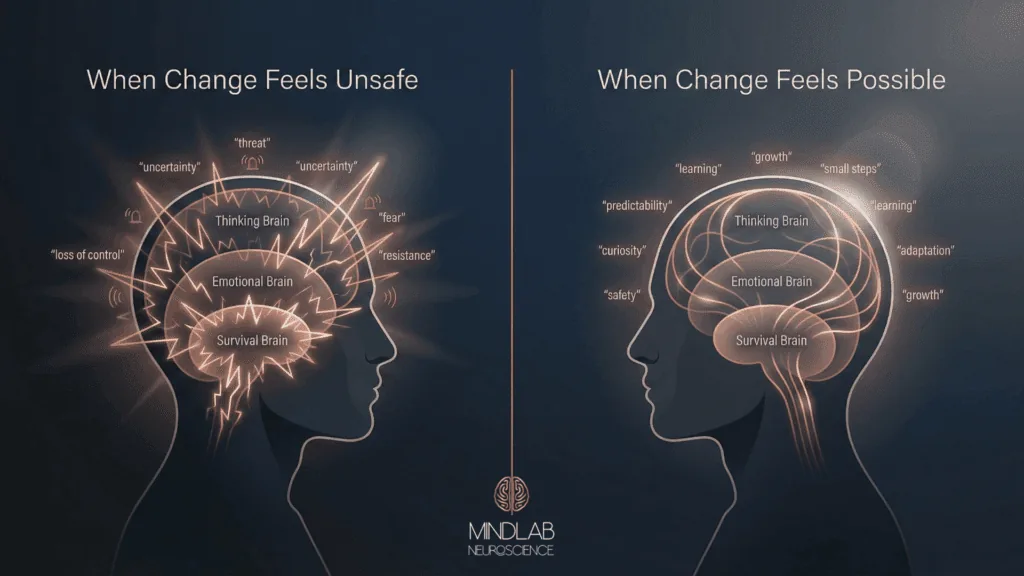
The neuroscience of fear and your built-in alarm system
At the core of the neuroscience of fear is one simple job description: stay alive. Your brain is not designed to make you content first; it is designed to keep you safe first. Change, even positive change, often feels uncertain, and uncertainty is something your threat circuits do not like because they cannot fully predict what will happen next.
Your brain constantly scans your world and asks a quiet question in the background: “Am I safe, or am I in danger?” It does not only look for physical threats like an oncoming car or a loud noise; it also reacts to social and emotional threats like judgment, rejection, failure, or loss of control. The neuroscience of fear shows that your nervous system treats many modern situations, a performance review, a hard conversation, a risky business move, as if they might be life or death.
A key player here is the amygdala, your inner smoke alarm. When it senses something unfamiliar or risky, it sends signals that speed up your heart, tighten your muscles, and narrow your focus. In those moments it does not care if you are stepping into a new job, leaving a relationship, or speaking up in a meeting. It simply labels the situation as uncertain and possibly dangerous. That moment is when your brain rejects change. It pushes you back toward what is known, because the known feels safer to the survival system, even if it does not feel satisfying to you.
Think about a time you wanted to ask for a raise. On Sunday night you might feel clear and confident. You tell yourself that it is time, your performance is strong, and you deserve it. Then you walk into the office on Monday, your boss passes by, and you feel your throat close up. Your heart picks up, your palms get damp, and a voice in your head suddenly says, Not today; it is not the right moment; maybe next month.
Nothing in the room is actually attacking you, yet your built-in alarm system has decided that this change could lead to humiliation or loss. So your brain rejects change, and you stay quiet, not because you are weak, but because your nervous system has stepped in to protect you.
In my work, I see this pattern every day. A client will say, “I know my relationship to work is burning me out. I know I need to do something different,” yet when they stand at the edge of real change, their body reacts as if an alarm just went off. Understanding the neuroscience of fear helps them realize that this is not a personal failure. It is an ancient alarm system doing its job a little too well within a society far more complex than the one it evolved to handle.
Your inner smoke alarm
Deep in the brain sits a small almond-shaped structure called the amygdala. It acts like a smoke alarm. When the amygdala senses a possible threat, it sends rapid signals that raise your heart rate, tighten your muscles, and push you toward fight, flight, or freeze. This response is the most basic expression of the neuroscience of fear.
When your brain rejects change, it is often because the amygdala is reading change as danger. You might be applying for a promotion, ending a draining relationship pattern, or moving to a new city. On paper these shifts make perfect sense. Inside your skull, though, the alarm system is asking a different question. Will this alteration heighten the likelihood of experiencing intense pain, rejection, abandonment, or failure?
Right next to this alarm system you have the hippocampus, which stores memories, and the prefrontal cortex behind your forehead, which helps you plan, reason, and regulate emotion. The neuroscience of fear shows us that when the amygdala is very loud, the prefrontal cortex becomes less effective. In those moments your brain resists change because the thinking part of your mind has been temporarily overruled by the survival part.

| Resistance | Brain System | Feels Like | How to Work With It |
|---|---|---|---|
| Threat detection | Amygdala | Anxiety, dread | Graduated exposure |
| Status quo bias | Basal ganglia | Inertia | Environmental redesign |
| Loss aversion | vmPFC + insula | What I might lose | Reframe: cost of NOT changing |
| Identity protection | Default mode network | “This isn’t me” | Bridge identity: “becoming…” |
| Uncertainty intolerance | Anterior cingulate | Need certainty first | Action before certainty |
How your brain resists change to protect your predictions
There is another layer to why the brain rejects change. Your brain is a prediction machine. Every second it uses past experience to guess what will happen next so it can prepare your body in advance. Familiar routines, even unhealthy ones, are easier to predict. New behaviors are harder to predict, so they often trigger the neuroscience of fear.
The amygdala processes social and professional uncertainty through identical threat-detection circuitry as physical danger, creating neurological resistance to change rooted in evolutionary wiring.
From a prediction point of view, staying in a job you dislike but understand can feel safer than starting a role that stretches you. Remaining in a relationship that is lonely but familiar can feel more stable than opening yourself to the unknown of something healthier. The brain rejects change not because it loves suffering, but because it loves accurate predictions.
Inside your brain, networks that support habits and routines live in regions like the basal ganglia. When you repeat the same behavior over and over, those neural pathways become fast and efficient. This efficiency is one reason it is so common to say you want change while your actions stay the same.
The neuroscience of fear explains that the moment you try to act differently, your prediction and habit systems light up with a kind of internal friction. You feel tension, doubt, or a sudden urge to delay. It can feel like self-sabotage, yet what is really happening is that the brain rejects change to preserve the comfort of what it can already predict.
Evolutionary roots of why the brain rejects change
To really understand why the brain rejects change, we need to step back into our evolutionary past. For most of human history, change in the environment meant possible famine, new predators, loss of shelter, or conflict with another group. Routine and stability were not boring; they were a sign that you might live to see another season.
The neuroscience of fear developed in an environment where slow, cautious responses saved lives. Proximity to threat shifts brain activation from prefrontal planning regions toward midbrain survival circuits. If you suddenly saw new tracks near the river, your brain needed to assume danger first and ask nuanced questions later. The brain rejects change in part because this cautious bias got wired into our nervous system over thousands of generations.
Today, the changes you face are more likely to be digital platforms, new team structures, career shifts, global news cycles, or ending patterns that began in childhood. Yet the same ancient circuits are still in charge. When you feel resistance to change, your nervous system is often responding as if you are about to step into a dark forest filled with unknown threats.
In my work at MindLAB Neuroscience, I see this daily. A client will describe a very modern situation, like restructuring their company or deciding to stop checking their phone every three minutes, yet their body responds as if there is a predator in the room. The neuroscience of fear helps them see that this mismatch is not madness. It is a natural outcome of an ancient brain living in a modern world.

How your brain resists change at work and at home
Because your brain resists change to protect you, it often shows up strongest in the places that matter most: your work and your relationships. Career transitions, difficult conversations with a partner, and boundary-setting with family members all activate the same threat-detection circuitry, even when the change is clearly beneficial.
One of my clients, I will call him Daniel, was a senior executive in a fast-growing tech company. On the surface he was confident and decisive. Privately he felt paralyzed by a restructuring project that he himself had suggested. Every time he sat down to map the new roles and responsibilities, his chest would tighten, his mind would fill with worst-case scenarios, and he would suddenly feel an urgent need to answer emails instead.
From the outside it looked like poor time management. From a neuroscience of fear perspective, his brain rejects change to protect him from imagined failure. The amygdala had linked the restructuring to the risk of losing status, income, and identity. His prediction system was telling him that the safest path was to keep the old structure in place, even if it was inefficient.
At home I see the same pattern in couples every week. Someone will say they want a more honest relationship, yet when it is time to have the real conversation, their throat tightens and they change the subject. The brain rejects change here because deep attachment circuits, shaped in early life, have linked honesty with conflict and conflict with the risk of abandonment. The neuroscience of fear reveals that this person is not lying when they say they want connection; they are simply caught in a nervous system that equates emotional change with danger.
In both settings, the mistake people make is to judge themselves. They call themselves lazy, weak, or broken. In reality, their brain resists change due to its adherence to a traditional belief: it’s better to trust the known you can predict than the unknown you can’t.
When the neuroscience of fear takes over your story
Another quiet way the brain rejects change is by hijacking the story you tell yourself. The neuroscience of fear shows that once the amygdala is activated, it pushes your mind to search for evidence that supports danger. You start to think in all-or-nothing terms, you predict disaster, and you underestimate your ability to adapt.
A client I will call Maya wanted to leave a toxic team and apply for a leadership position in a different division. Every time she opened the application portal, she would suddenly hear thoughts like, “You are not a real leader,” “They will see through you,” “You are too old to start over,” and “If you fail, everyone will know you are a fraud.” This inner narrative was so loud that she would close the laptop and stay exactly where she was.
From a pure logic point of view, her skills, reviews, and mentors all supported the move. Yet her brain rejects change by feeding her a fear-based story. The neuroscience of fear explains that when the threat system is activated, the brain exaggerates possible loss and minimizes possible gain. It does this to stop you from taking risks that, in a different century, might have been deadly.
When clients learn that this voice is not the truth but a protective pattern, something softens. They can begin to see that the brain rejects change because it is overprotective, not because they are incapable.

Practical protocols for a brain that rejects change
The encouraging news is that the same brain that rejects change is also capable of profound rewiring when it feels safe enough. Neuroplasticity, the ability of the brain to form new connections through experience, does not disappear in adulthood. The key is to work with the neuroscience of fear rather than pretend it is not there.
Start with what your body is saying
In my practice at MindLAB Neuroscience, I often start with body-based awareness. Before forcing a new behavior, you learn to notice how your brain rejects change in your body. Maybe your chest tightens when you speak up, or your stomach drops when you imagine saying no. Naming these signals gives your prefrontal cortex more data and dials down the amygdala.
Use micro-experiments to retrain your brain
Next, we design what I call micro experiments. The brain rejects change most strongly when the leap feels huge, so instead of demanding overnight transformation, we ask for small, repeatable shifts that feel safe enough. Your first experiment might be delaying your automatic yes by one hour and noticing that nothing collapses.
These small steps are not random. They are built around the neuroscience of fear. Each time you take a manageable risk and your nervous system discovers that you survived, that experience sends new information back to the prediction system. Over time the brain rejects change less automatically because its model of the world has been updated. Change is no longer coded as a pure threat; it is coded as a stretch that you can handle.
Reward is also important. Dopamine, a key neurochemical in motivation and learning, rises when your brain senses that an action led to a meaningful reward. Many of my clients never celebrate their micro experiments, so the brain rejects change because it does not associate new behavior with any sense of gain. When you pause, name the win, and let yourself feel even a small sense of pride, you literally teach your nervous system that this new path is worth repeating.
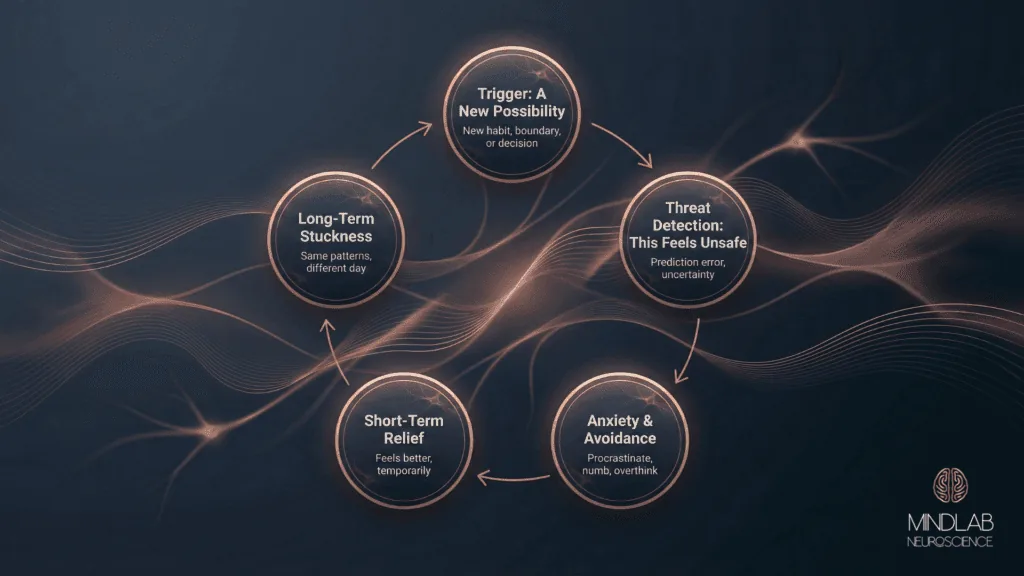
Updating the neuroscience of fear in real time
There is a powerful angle that often gets ignored. The brain rejects change in part because it carries old emotional memories that have not been updated. The first time you spoke up as a child you may have been shamed, or the first time you risked vulnerability, betrayed. Those experiences live in the emotional circuitry shaping your responses today.
In sessions, I guide clients to revisit these older patterns with the tools of neuroscience. You learn to feel a slice of the old fear while anchored in a present moment that is actually safe. You might recall a painful boardroom failure while seated in a calm office, breathing steadily, with me reminding you that this is a memory, not a current threat. In that state the brain can begin to separate past from present. When the prefrontal cortex stays online during the recall of an old fear, the amygdala gradually calms and the memory becomes less triggering.
Over time, this process reduces the likelihood that the brain rejects change due to outdated alarms. The next time you step into a new opportunity, your nervous system has more room to respond to what is actually happening instead of replaying a script from ten or twenty years ago.

Change, relationships, and when your brain rejects change together
The brain rejects change not only inside individuals but also inside systems. When people live or work together, they develop shared habits, roles, and unspoken rules that create a kind of group nervous system. Everyone is aware of who typically initiates conversation, maintains harmony, makes decisions, and steers clear of conflict.
When one person begins to grow or behave differently, that shared pattern gets disrupted, and the whole system can feel unsettled. Even when the shift is healthy, others may instinctively pull things back to the old way, not because they want to hold anyone back, but because the familiar dynamic feels safer and easier to predict.
When groups push back on growth
Families, teams, and partnerships all develop shared patterns. When one person starts to shift, the system often pushes back. From a neuroscience of fear perspective, this reaction makes sense because every member’s prediction system depends on established roles. The group brain is also trying to preserve predictability.
When I work with couples, for example, I might see one partner start to express more needs after years of staying silent. Their brain rejects change at first, then adapts. As they speak up more, the relationship actually becomes healthier. Yet the other partner can feel threatened by this new behavior, even if they asked for more openness. Their brain rejects change because the old dynamic, though painful, was familiar.
The same thing happens in executive teams. A leader decides to stop micromanaging and empower their staff. At first, their own brain rejects change because letting go of control feels risky. Then, as they practice, they settle into a more trusting style. The team, however, may complain, saying they feel abandoned or confused because the old pattern was so deeply wired.
My role is to help everyone understand that the neuroscience of fear is at play in the group. Nobody is bad or wrong. The system simply needs time and repeated safe experiences before the new pattern becomes the new normal.
When people see that even their colleagues and loved ones have brains that reject change, compassion increases. Instead of taking resistance personally, you can frame it as a nervous system response and stay steady as the new pattern settles in.

When your brain rejects change, you can still grow
If there is one message I want you to take from this, it is that when your brain rejects change, you are not broken. You are looking at a nervous system that evolved to protect you, using tools that made perfect sense in a harsher world. The neuroscience of fear explains your resistance; it does not define your future.
With the right understanding and the right experiences, the same brain that rejects change can learn to welcome it. By working with your body signals, by designing micro experiments that feel safe enough, by updating old emotional memories, and by recognizing that the people around you also have brains that reject change, you can create a life where growth feels less like a threat and more like a natural extension of who you already are. There is compelling evidence that cognitive training reshapes neural circuits by strengthening the brain’s ability to encode, retrieve, and adapt to new information.
Throughout my career, I have watched thousands of clients move from paralysis to progress, from looping fear to grounded action. Their stories are living proof that even when the brain rejects change, it can be gently retrained. Change will probably never feel completely comfortable, and that is all right. What matters is that it becomes possible, repeatable, and eventually, deeply rewarding.
Why does the brain resist change, even when it is positive?
When faced with uncertainty, the brain defaults to prediction-based safety mechanisms that overvalue the familiar and undervalue the unknown. This resistance is amplified when stress circuits are chronically active. By activating specific neural pathways, the brain increases a brain chemical that typically wanes under prolonged stress or avoidance, which helps restore cognitive flexibility. Strengthening these pathways makes new experiences feel less threatening and more manageable.
How can cognitive training help someone adapt to change more easily?
Neuroscience shows that strategic mental repetition and novelty-driven learning stimulate neural plasticity. Research shows that cognitive training can boost levels of key neuromodulators involved in attention, learning, and flexible thinking. When these systems strengthen, the brain becomes more efficient at updating outdated predictions, making change feel less like a threat and more like an opportunity.
Why do some people feel “stuck” even when they intellectually want to change?
Feeling stuck is often a neurobiological pattern, not a lack of desire. Underpredicting reward and overpredicting threat is a hallmark of a brain running on outdated survival wiring. This process supports the production of a neurochemical that typically declines with age, one that directly influences motivation, memory accuracy, and cognitive resilience. When that chemical drops, behavior becomes rigid. Rebuilding it helps restore momentum.
How does chronic stress interfere with the brain’s ability to change?
Chronic stress keeps the amygdala and survival circuits in a state of hypervigilance, suppressing the prefrontal regions responsible for planning and adaptability. Over time, stress reduces the availability of brain chemicals that typically support cognitive flexibility and emotional regulation. When this chemical is restored through targeted neural activation, the brain regains the capacity to update old patterns.
Is it possible to train the brain to see change as safe instead of threatening?
Yes. The brain is prediction-based and plastic throughout life. When you regularly introduce new and manageable experiences, along with challenges and some uncertainty, cognitive training can increase the chemicals in the brain that help improve learning and adaptability. Over time, this process fuels the production of a chemical that typically declines, allowing the brain to encode change as safe, expected, and even rewarding.
How long does it take to rewire your brain from negative to positive?
There is no single timeline, but neuroscience gives a realistic range. Consistent, repeated activation of new neural pathways over the course of weeks or months is usually required for meaningful change. Early shifts can appear within a few weeks as the brain begins to form new associations, but deeper rewiring of automatic responses often takes 60 to 90 days of repeated, emotionally relevant experience. Research shows that cognitive training can boost levels of key neuromodulators involved in attention, learning, and flexible thinking, which speeds this process. What matters most is not perfection, but repeated, predictable exposure to new patterns that the brain can learn to trust.
How to stop cognitive decline?
You may not be able to stop every form of cognitive decline, but you can significantly slow and in some cases partially reverse it by targeting the mechanisms that keep the brain plastic. Lifelong learning, complex problem solving, movement that raises heart rate, high-quality sleep, metabolic stability, and emotionally meaningful relationships all protect neural networks. Cognitive training can boost levels of neuromodulators that support attention and learning, which helps the brain maintain efficient signaling. When these systems are engaged regularly, the brain continues to generate and strengthen synaptic connections, making decline slower, later, and less severe than it would be in a chronically stagnant, stressed nervous system.
References
- Mobbs, D., Hagan, C. C., Dalgleish, T., Silston, B., and Prevost, C. (2015). The ecology of human fear: Survival optimization and the nervous system. Frontiers in Neuroscience, 9, 55. https://doi.org/10.3389/fnins.2015.00055
- Quirk, G. J., and Beer, J. S. (2006). Prefrontal involvement in the regulation of emotion: Convergence of rat and human studies. Current Opinion in Neurobiology, 16(6), 723–727. https://doi.org/10.1016/j.conb.2006.07.004
- Graybiel, A. M. (2008). Habits, rituals, and the evaluative brain. Annual Review of Neuroscience, 31, 359–387. https://doi.org/10.1146/annurev.neuro.29.051605.112851
- Barrett, L. F. (2020). Seven and a half lessons about the brain. Houghton Mifflin Harcourt.