Key Takeaways
- Performance anxiety fires the amygdala-driven threat circuit: the brain reads intimacy as evaluation, not pleasure.
- When the threat circuit fires, the sympathetic nervous system redirects resources from arousal toward defense.
- The anterior insula, which processes interoceptive signals, gets hijacked by performance monitoring rather than sensation.
- Cortisol and adrenaline compete with the neurochemistry arousal requires, creating a state will cannot override.
- Recalibration targets circuit-level prediction: what the nervous system predicts intimacy means, not performance behavior.
Sexual Performance Anxiety has a way of making very smart, very capable people feel small. On the outside, your life might look impressive. You make big decisions, carry heavy responsibility, and other people come to you for answers. Yet when it comes to sex, you may feel like you are walking into a test you are doomed to fail.
You might worry that you will not get aroused, that you will lose your erection, that your body will tense and shut down, or that you will not be able to orgasm. You might be terrified that if anything goes “wrong,” your partner will feel rejected, lose attraction, or even leave. When this phenomenon keeps happening, sexual performance anxiety can start to feel like a permanent label rather than a temporary pattern.
The message here is very clear. Sexual performance anxiety is not a sign of weakness, unlovability, or a character flaw. This form of anxiety is a brain-based loop that forms over time. It lives in the way your nervous system links sex with fear, pressure, and high-stakes evaluation. Because that loop is wired, it can be rewired. This is the applied science of stress and nervous system regulation.
The dual control model of sexual arousal proposes that separate excitatory and inhibitory neural systems govern sexual response, meaning anxiety directly activates the inhibitory brake and can override excitatory signals regardless of desire.
Cortisol elevation during performance-threatening situations suppresses hypothalamic activity responsible for initiating arousal, creating a measurable neurochemical barrier between intention and physical response.
Cognitive interference, defined as intrusive self-monitoring thoughts during sexual activity, is the primary driver of arousal dysfunction in both men and women, outweighing hormonal factors in observed populations.
Mindfulness-based interventions targeting the anterior cingulate cortex have been shown to meaningfully reduce performance-related sexual anxiety, with benefits that can persist over the following months.
Genital response and subjective arousal are partially dissociated in women, a finding that reframes sexual performance expectations and reduces the practical utility of applying a single arousal standard across all genders.
For more than twenty-five years in the MindLAB Neuroscience practice, Dr. Ceruto has worked with men and women of all ages who carry sexual performance anxiety in silence, some for decades. Hedge fund managers, surgeons, founders, artists, and stay-at-home parents have all sat across from Dr. Ceruto and whispered the same thing: “This is the one area of my life I cannot figure out.” The reality is that experiencing it actually makes perfect sense once you understand how the brain, body, and sexual wiring interact.
This article will walk you through what sexual performance anxiety really is, how it shows up differently in men and women, why evolution and culture quietly amplify it, and how neuroplasticity allows individuals to retrain the brain in real time. This article will also show exactly how Dr. Ceruto works with clients to abolish sexual performance anxiety so sex becomes a place of safety, playfulness, and connection instead of dread.
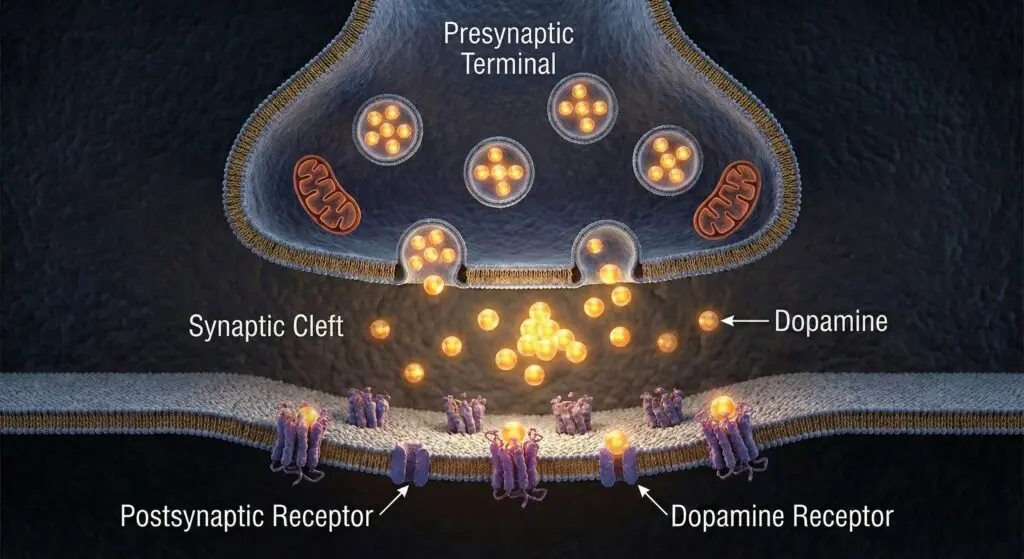
What Sexual Performance Anxiety Actually Is
When people first describe sexual performance anxiety to Dr. Ceruto, they usually talk about the body. They tell her about erections that fade, orgasms that vanish, lubrication that does not show up, or desire that crashes right when they most want it to appear. These details matter, but they are not the full picture.
On the surface, the signals of sexual performance anxiety may look purely physical, like fading erections, lost arousal, or difficulty reaching orgasm, but they actually begin with a rapid shift in your thoughts, attention, and body state in the brain.
Sexual performance anxiety begins in the brain long before anything happens in the body. The somatic markers that encode threat-linked memories create anticipatory body states that precede and shape conscious thought. At its core, sexual performance anxiety stems from the fear of not meeting a real or imagined sexual standard, coupled with the belief that this will reflect negatively on your identity.
The trigger can be almost anything. A look from your partner, a memory of a past night, a comment someone made years ago, a certain setting, or even a simple thought about sex can set off the loop. The brain then runs a fast prediction.
“I will not get hard.”
“I will not get wet.”
“I will take too long.”
“I will finish too fast.”
“I will disappoint them.”
The moment that prediction fires, the brain perceives sex like a threat. Your nervous system moves away from curiosity and pleasure and into protection. Heart rate rises, muscles tense, breathing becomes shallow. Your body is now in self-defense mode in the one place it actually needs to feel safe.
From that state, the sexual system cannot function the way it is designed to. Sexual performance anxiety essentially arises when your brain’s survival network triumphs over your sexual and attachment networks.
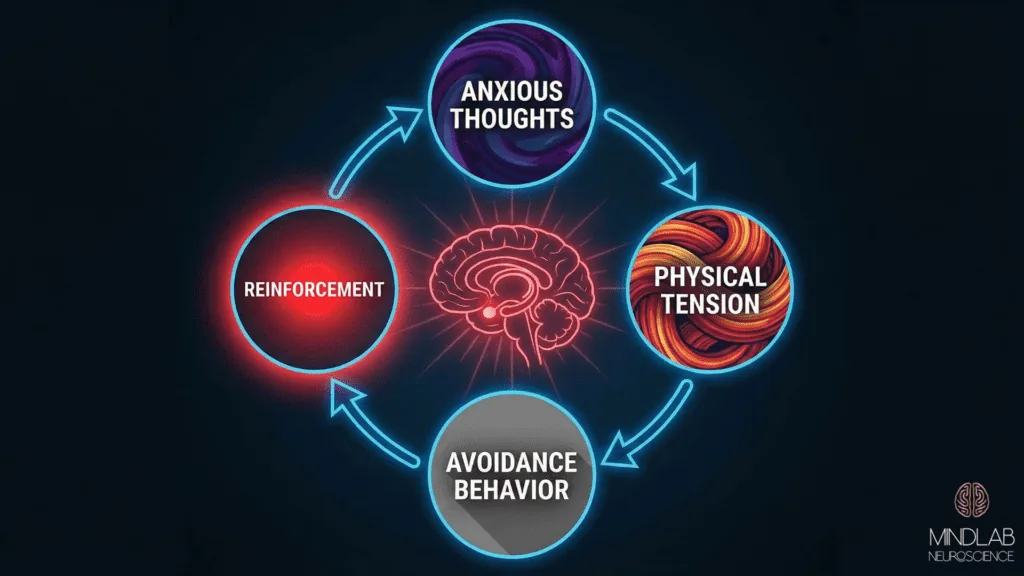
The cruel part is that every “bad” experience then becomes proof. The brain says, “See, I knew it; this is who you are now.” That thought deepens the wiring. Sexual performance anxiety is caused by both your body’s reactions and your self-talk.
This loop is learned, and anything learned can be unlearned. To achieve that, you need to understand how your brain and body create arousal when sexual performance anxiety is not in charge.

How The Brain And Body Create Arousal
Sex is not just a physical act; it is a complex brain event. Several systems talk to each other at once: reward, attachment, body awareness, memory, imagination, and threat detection. When sexual performance anxiety is in the background, the threat system gets too loud and throws the whole network off.
Porges describes how the autonomic nervous system operates across two broad modes. One mode is oriented toward protection, scanning for danger and preparing you to fight, flee, or freeze. The other mode is oriented toward rest, repair, bonding, and play. Healthy sexual function happens when the second mode is dominant, not the first.
In a healthy, relaxed sexual state, the brain sends signals down the spinal cord that increase blood flow to the genitals, soften muscles, and heighten sensitivity to touch. Certain the neurochemicals that rise during sexual arousal and bonding rise and create a sense of interest, pleasure, and bonding. Time feels less linear. You are more in your body than in your head. You are able to track your partner and yourself without trying to control every sensation.
When sexual performance anxiety is present, the brain reverses this process. The survival system begins to watch for signs of failure. “Am I hard enough?” “Am I wet enough?” “Is my face doing something weird?” “Do they notice I am not fully here?” This constant monitoring pulls you out of your body and into mental surveillance.
That surveillance is not neutral. It tells the body, “Something is wrong.” Blood flow shifts, muscles tighten, and it becomes harder to stay in arousal. In other words, the very effort to control your performance makes sexual performance anxiety stronger.
Attention is one of the biggest levers here. Your brain can only spotlight so many things at once. When most of your attention is on judging yourself, there is very little left to feel pleasure. When Dr. Ceruto works with clients, the process teaches the brain how to move attention back into the body, into sensation, and into the actual moment instead of into an imaginary audience in your mind.

An Evolutionary Look At Sex
Sexual performance anxiety can feel like a modern phenomenon amplified by streaming culture, social comparison, and digital pressure, yet evolutionary biology reveals far deeper origins. Long before social media existed, the brain evolved to treat sexual rejection as a survival threat, embedding performance pressure into the neural architecture across hundreds of thousands of years.
From an evolutionary view, sex has always carried weight. For a very long time, sexual behavior was tied to reproduction, lineage, and survival. Being chosen as a mate, staying bonded with a partner, and being seen as a reliable provider or caregiver had real effects on whether your genes moved forward.
In small ancestral groups, reputation was not an abstract idea. It was a daily reality. If you were seen as weak, unreliable, or untrustworthy, you could lose resources and protection. Because of this, the human brain evolved to care deeply about social approval and rejection. Your nervous system registers rejection and humiliation almost like physical pain.
In that context, it makes sense that sexual performance anxiety can feel like a life-or-death test, even though your rational mind knows it is not. Old parts of the brain still regard sex, bonding, and being chosen as high stakes. When you add personal history and cultural messages on top of that, sexual performance anxiety becomes even more understandable.
Anthropology also helps explain why sexual performance anxiety shows up differently for men and women. In many cultures, men have been told that their sexual value comes from performance, stamina, and control, while women have been told that their value lies in beauty, desirability, and the ability to please a partner.
These gendered scripts are not scientific truths, yet they quietly shape expectations. A man who has absorbed the story that “real men are always ready and always strong” will see any change in his erection as a verdict. A woman who has absorbed the story that “good lovers are responsive and orgasm easily” may regard any difficulty with arousal as a personal failure.
Over time, these stories fuse with the nervous system. The brain does not just store facts; it stores meaning. Sexual performance anxiety grows out of a mismatch between your nervous system’s old wiring and your current reality. Wiring can be updated.

Sexual Performance Anxiety In Men
Sexual performance anxiety in men is often more visible because erections and ejaculation are easier to observe from the outside. Beneath that visibility, however, the internal experience is typically hidden and saturated with shame, as societal conditioning leaves most men without language or permission to name what they are carrying.
Many men describe a pattern like this. Things start out fine. There is attraction, some touch, maybe kissing, and playful banter. Then, as sex seems more likely, the mind steps in with questions.
“Will it work?”
“What if I lose it at the worst time?”
“What if I cannot last?”
Those thoughts are the match. The nervous system reads them as danger, even though there is no physical threat in the room. The heart might speed up, breathing may shift, and the body leaves the relaxed state that is needed for arousal. Blood flow to the genitals changes. An erection might not appear at all, or it might fade right before penetration.
For some men, sexual performance anxiety shows up as rapid ejaculation. They feel so tense and so desperate to “get it right” that the nervous system rushes the process. When this happens, men often tell themselves they lack discipline or control, which only deepens sexual performance anxiety the next time.
One client Dr. Ceruto will call Alex came to her in his late thirties. On paper, he was thriving. He led a large team, managed complex projects, and was known for keeping his cool under pressure. In bed, though, he felt like he turned into a frightened teenager. After one difficult night years earlier where he lost his erection, he had never fully relaxed with a partner again.
By the time he reached Dr. Ceruto, sexual performance anxiety had shaped his entire romantic life. He chose casual partners he did not care much about because it felt safer to fail with them. He avoided women he really liked because he could not stand the thought of “messing up” with someone who actually mattered.
When Dr. Ceruto mapped his brain pattern, they saw the same loop each time. A small sensation or shift in his erection triggered a flood of fear, then harsh self-talk, then a full shutdown. Sexual Performance Anxiety had become a learned protective strategy. His brain believed that if it could avoid intimacy, it could avoid humiliation.
With men like Alex, Dr. Ceruto never starts with performance drills. That approach often reinforces sexual performance anxiety. Instead, the work focuses on the nervous system’s sense of safety. The process teaches the brain that sexual situations are not ambushes to survive but experiences to move through with flexibility.

Sexual Performance Anxiety In Women
Sexual performance anxiety in women is just as real, yet many women do not have language for it. They may say they “have low desire,” that sex feels like a chore, or that they “must be broken” because they do not respond the way they think they should. Underneath many of these stories is sexual performance anxiety.
Women with sexual performance anxiety often worry that they will not feel aroused, that they will not lubricate enough, that they will take too long to orgasm, or that they will not orgasm at all. Some fear that sex will hurt. Others fear that they will freeze and go numb inside. Many fear that their partner will feel unwanted or inadequate if their body does not respond on cue.
Because of social conditioning, many women also carry deep shame about their bodies. They worry about how they look, sound, and move. They track every tiny reaction in their partner’s face. Their mind becomes a constant commentator.
“Is my stomach okay?”
“Do I look weird in this position?”
“Are they bored?”
That mental commentary pulls attention away from sensation and into self-surveillance. The nervous system reads this as a sign that something might be wrong, and the body tenses in response. Sexual Performance Anxiety then shows up as lack of arousal, pain, or shutdown.
A client Dr. Ceruto will call Maya, a physician in her thirties, came to see her after years of silent struggle. On the outside, she was poised and confident. Inside, she dreaded sex. She loved her partner deeply yet felt her body betray her again and again. Penetration often hurt, and she rarely felt close to orgasm with someone else present. Sexual performance anxiety told her that she was failing as a partner.
When they worked together, Dr. Ceruto and Maya discovered that her nervous system had learned to brace around intimacy. Past comments about her body and early experiences where her pace was not respected had trained her brain to see sex as a situation where she might be judged or rushed. Sexual performance anxiety was her brain’s attempt to protect her from that.
For women like Maya, the work involves repairing the brain’s map of the body, building safety around touch, and rewriting stories about what makes a good lover. Sexual Performance Anxiety begins to soften when the nervous system learns that she is allowed to be present, allowed to have preferences, and allowed to take up space sexually without being perfect.

The Hidden Double Standard: When Women Can Fake It And Men Cannot
A quiet double standard operates in many bedrooms, one that shapes entirely different emotional worlds for each partner. Women can often simulate an orgasm, while men generally cannot conceal an absent or fading erection, and this fundamental asymmetry drives sharply divergent experiences of shame, concealment, and pressure around sexual performance anxiety.
Many women learn early that they can smooth over awkward moments by pretending they are closer to orgasm than they really are. They might shorten the encounter to escape discomfort, to protect a partner’s ego, or simply to avoid another round of questions about what is “wrong.” On the outside, it looks like everything is fine. On the inside, it can feel lonely, frustrating, and dishonest.
When a woman fakes pleasure, her nervous system does something important. It links sex with acting rather than with authenticity. The brain becomes used to monitoring and performing instead of actually feeling. Over time, an individual can build a quiet layer of sexual performance anxiety, because she starts to worry that if she stopped pretending, her partner would be disappointed or even angry.
Men do not usually have that option. If an erection does not appear or does not stay, it is difficult to hide. A man may wish he could fake his way through intimacy, but the body provides a visible answer. Such an outcome can make sexual performance anxiety feel even more brutal. There is no easy way to cover it up.
Dr. Ceruto sees this dynamic often in her practice. A man sits in front of her, feeling exposed by something he cannot hide. A woman is seated before her, burdened with guilt over a secret she has concealed for many years. Both are carrying sexual performance anxiety, but it shows up in different ways.
From a neuroscience perspective, both faking and failing send powerful signals to the brain. If you fake it, your brain learns that sex is a stage where you must put on a mask. If you feel you are failing, your brain learns that sex is a test where you will be judged. In both cases, the nervous system moves away from safety and into self-protection.
Part of Dr. Ceruto’s work involves helping couples and individuals move out of this acting space and into real experience. When the brain learns that you can be honest, stay present, and still be accepted, sexual performance anxiety begins to loosen. The goal is not to perform better; it is to not have to perform at all.

The Fear Your Partner Is Not Attracted To You
One of the most painful thoughts Dr. Ceruto hears from clients is, “They are just not attracted to me,” or, “If I were better in bed, they would touch me differently.” That belief cuts deeper than any single night of sexual performance anxiety, because it attacks your sense of being wanted at all.
The brain is a meaning-making machine. It does not just notice what your partner does; it explains it. If your partner turns slightly, moves your hand, changes rhythm, goes quiet for a moment, or suggests something different, your mind can jump straight to “They hate this,” or “They are bored,” or “I am doing it wrong again.”
From a neuroscience point of view, this is your threat system and your social radar teaming up. The same circuits that once helped your ancestors read danger in a stranger’s face now scan your lover’s smallest movements for signs of rejection. When you already live with sexual performance anxiety, that radar is turned up so high that almost anything can feel like proof that you are not desirable.
What makes this even harder is that your partner is usually in their own head too. They may be adjusting their body because something cramped, pausing because they got lost in sensation, or changing pace because that is simply how their arousal moves. None of that means they find you unattractive. But if your brain is already primed for sexual performance anxiety, it will not see nuance; it will see danger.
Over time, this fear starts to change how you move. You might stop initiating because you are sure they are only saying yes out of obligation. You might avoid trying new things because you are convinced you will get it “wrong.” You may regard every small correction as evidence that you are failing. The bedroom becomes a minefield instead of a playground.
Dr. Ceruto works with this belief very directly. First, the process slows everything down and look at the story your brain tells. When your partner shifts or sighs or suggests something, what do you make that mean? Most of the time, the meaning you assign is far harsher than anything your partner is actually thinking. Seeing that gap is important, because it shows you that sexual performance anxiety, not reality, is driving your interpretation.
Next, Dr. Ceruto builds real-time skills clients can use in the moment. Instead of freezing or collapsing inside, they practice simple, grounded questions that invite clarity. Phrases like “Show me what you like” or “Do you want softer or firmer?” are not just communication tools; they are nervous system tools. They move you out of guessing and into collaboration.
When you ask instead of mind reading, your brain gets new data. It learns that a partner giving you feedback does not mean they are disgusted or bored; it means they are trying to tune the connection with you. Over time, those new experiences begin to rewrite the old belief that you are unwanted. Sexual performance anxiety loses one of its favorite weapons.
Time and again, Dr. Ceruto has watched a client finally ask their partner, “Are you still attracted to me?” and the partner looks stunned and says, “Of course I am; I thought you were not attracted to me.” Two people suffering in parallel because the brain’s fear stories were louder than the actual relationship.
When the fear that you are fundamentally undesirable is calmed, your body starts to relax. Touch feels less like a test and more like a conversation. That is the kind of environment where sexual performance anxiety cannot keep running the show.
The Fear Of Introducing Sex Toys
Another place performance anxiety loves to hide is around sex toys. Many of Dr. Ceruto’s clients secretly like using toys alone, or they know their partner does, but they fear using them in shared sex. They worry that a sex toy will announce, “You are not enough,” or, “Your body does not work,” or, “Your partner prefers this to you.”
For women, the fear often sounds like this. “If I ask for the toy I love, he will think I cannot orgasm without it,” or “He will feel replaced or unnecessary.” Some women learned early that sex should be “natural,” which their brain interprets as “no tools, no help, no guidance.” So even though a vibrator or other toy might help them feel more relaxed, more aroused, and more present, sexual performance anxiety tells them to hide it in a drawer.
For men, the fear has a slightly different edge. A man might want to use a ring, a toy for his body, or something that adds stimulation for his partner, but his mind screams, “If I need this, it proves I am broken,” or “She will think I am strange or too intense.” When there is already performance anxiety about erections, stamina, or timing, the idea of bringing a toy into the room can feel like putting a spotlight on every insecurity.
From a neuroscience perspective, introducing sex toys is really about novelty, safety, and meaning. The toy itself is just an object. The brain decides whether that object signals play and partnership or failure and replacement. If your nervous system has already linked sex with criticism and pressure, it will naturally view toys through that same lens. Sexual Performance Anxiety then whispers that you must keep your true desires hidden or risk losing your partner. The underlying research is covered in the neural patterns behind rewire your anxious brain.
In Dr. Ceruto’s work, she helps clients change that meaning. The sessions address sex toys as part of a shared toolkit, not a verdict on anyone’s body. When two partners can say, “Let us experiment with this together,” the brain receives a powerful signal. It learns that pleasure is a collaboration, not a solo performance being graded. That shift alone can soften performance anxiety, because you are no longer trying to be the entire answer with just your body.
A simple way to begin is with language that frames toys as curiosity rather than criticism. Phrases like “There is something that really helps my body relax; would you be open to trying it together?” or “I am curious whether this could make things feel even better for both of us” invite collaboration. You are not saying, “You are not enough”; you are saying, “I want to explore more with you.” When a partner responds with openness, your nervous system registers that as safety, and sexual performance anxiety has less room to run the show.
Over time, couples who bring toys into the bedroom in a conscious way often report less pressure, more laughter, and more honest conversations about what actually feels good. The brain begins to associate sex with creativity and teamwork instead of silent tension. That is the opposite environment from the one where sexual performance thrives.
The Shame Loop That Keeps Sexual Performance Anxiety Alive
Sexual performance anxiety is painful enough in the moment, but what unfolds afterward can be even more damaging to the neural architecture of intimacy. The story your nervous system constructs after a difficult sexual experience carries real neurobiological weight: it can either allow the threat circuit to quiet or embed that circuit more deeply into your brain’s predictive framework.
Most people do not walk away from a tough night thinking, “My nervous system was overwhelmed, so of course my body responded that way.” Instead, they think, “This proves I am broken” or “This proves they will never want me again.” Shame floods the system.
Shame is not just an emotion. Shame functions as a full-body state that collapses the nervous system into a rigid, contracted posture. Shoulders may drop, chest collapses, eyes lower, and breathing becomes shallow. The brain shifts into a rigid frame where you feel small, exposed, and unworthy. In that state, sexual performance anxiety thrives.
If you then pull back from your partner, avoid sex, or act as if nothing happened, your nervous system gets even less corrective experience. Sexual Performance Anxiety grows in silence. The brain never gets to see that your partner might respond with warmth, patience, or curiosity. It only hears the internal critic.
One of the most powerful parts of Dr. Ceruto’s work is helping clients separate facts from the story. The fact might be that you did not get an erection last night, that your body did not get aroused, or that you did not orgasm. The story is what you make that mean.
Sexual performance anxiety tells a very specific story: “This will always happen, everyone else is fine, and I am defective.” Neuroscience allows individuals to challenge that story with compassionate accuracy. Dr. Ceruto asks, “What was your nervous system carrying that day? How did your mind talk to you? What would happen if you felt safe enough to stay present next time, even if things did not go perfectly?”
When we change the story, we change the state of the nervous system. When we change the state, the brain becomes more plastic, which means sexual performance anxiety becomes more changeable.

When Repeated Misfires Train The Brain To Expect The Worst
One of the most painful parts of sexual performance anxiety is how it feeds on repetition. The more often you feel you did not perform the way you hoped, the more your brain expects the same result the next time. Expectation turns into prophecy.
Your brain uses your past to guess your future. If you have had several experiences where your body did not respond, your mind begins to walk into every new encounter already braced for another misfire. You may start to think about sex hours before anything happens, spinning stories about what will go wrong.
That anticipation is not neutral. It changes your nervous system even before you are in the room with your partner. Heart rate climbs, muscles tighten, and your mind rehearses escape routes. By the time anything physical happens, your body is already in a defensive state. It is no surprise that arousal then struggles to appear.
Many of Dr. Ceruto’s clients share, “The first time it happened, I was surprised. After a few more times, I was terrified.” That shift from surprise to fear is the moment sexual performance anxiety gets locked in. The brain stops viewing each sexual experience as a fresh event and starts regarding them all as the same story.
Neuroscience helps interrupt this cycle. The work cannot erase the past, but it can change how the brain reads it. When Dr. Ceruto works with clients, she teaches them how to separate single nights from your entire identity and how to create new experiences that do not fit the old pattern.
For example, Dr. Ceruto might design low-pressure moments where physical response is not the goal at all. The brain then has to record a new kind of experience, one where closeness exists without a test attached. Each of these small victories weakens the prediction that everything will go badly.
Over time, real-time neuroplasticity turns those new experiences into new expectations. Instead of walking into the bedroom thinking, “Here comes another failure,” your brain begins to think, “Last time felt different; maybe this will too.” That tiny opening is often all that is needed to start leaving sexual performance anxiety behind.

The Fear Of Being Vulnerable And Talking About It
For many people, the hardest part of sexual performance anxiety has nothing to do with physical function. Vulnerability itself becomes the obstacle: the prospect of looking into a partner’s eyes and admitting, “This is happening to me, and I am genuinely scared,” activates a threat response almost as powerful as the anxiety itself.
Vulnerability is risky for the nervous system. When you tell someone about your deepest fear, you are basically handing them the power to hurt you or to restore you. Your brain knows this. It scans your partner’s face and voice for signs of safety. If you have ever been mocked, dismissed, or ignored in the past, your nervous system may assume that this will happen again.
So you stay silent. You make jokes. You avoid the topic altogether. You pretend you are tired, busy, or not in the mood. You hope that if you ignore sexual performance anxiety long enough, it will somehow fix itself.
The problem is that silence is also a signal. When you hold everything inside, your partner’s brain starts to make its own predictions. They might think you are no longer attracted to them, that you are having an affair, or that you have simply checked out. Their nervous system may now be in a threat state too.
Two nervous systems in threat mode do not create good conditions for sex. Both people feel on edge, yet neither understands why. Sexual performance anxiety grows in that gap.
In Dr. Ceruto’s work with couples and individuals, she approaches vulnerability as a brain skill, not a personality trait. You are not “bad at communication”; your nervous system just has not learned that it is safe to share certain things. She trains that step by step.
Sometimes the first vulnerable act is not a big talk; it is a single sentence. A simple statement such as “Sometimes my body does not match how much I care about you” can initiate a conversation. When a partner responds with kindness, your brain gets new data. It learns, “I can be seen in this, and I am not being thrown away.”
That experience of being met rather than rejected is one of the strongest antidotes to sexual performance anxiety I know. When the relational field feels safe, the body often begins to follow. The survival system quiets. The attachment system lights up. From there, desire and arousal have a real chance to return.
Embarrassment, Self-Blame, And The Brain’s Pain Circuit
Embarrassment and self-recrimination may seem like emotional reactions, but in the brain they behave a lot like physical pain. When you replay a difficult sexual moment and beat yourself up for it, you are not just thinking; you are activating neural circuits that register hurt.
After a night where sexual performance anxiety showed up, many people lie awake and attack themselves.
“Why did I let that happen again?”
“What is wrong with me?”
“They would be better off with someone else.”
Each of these thoughts is like a small electric shock to the nervous system. The more you do it, the more sensitive the system becomes. The brain learns to link sex with humiliation and self-hatred instead of connection and pleasure.
From a neurobiological view, this constant self-blame keeps your stress system switched on. Hormones that are meant to protect you in short bursts now hang around. Muscles stay slightly tense. The mind stays on guard. In that state, sexual performance anxiety is far more likely to appear again, because your body never really leaves the danger zone.
In Dr. Ceruto’s practice, she helps clients notice this inner attack as soon as it starts. The process does not try to replace it with fake positive thinking. Instead, the process uses accurate, grounded language that calms the nervous system.
For example, instead of “I ruined everything,” we might practice, “Tonight did not go the way I hoped, my body was overwhelmed, and I am learning how to handle this differently.” This kind of statement may sound simple, but it changes how the brain encodes the event.
When you speak to yourself with somewhat more fairness, you reduce the pain signal. The next time you are intimate, your nervous system is not dragging as much old hurt into the room. Sexual performance anxiety has less fuel.
Over months of this kind of work, Dr. Ceruto watches people shift from harsh inner critics to more accurate inner coaches. They do not pretend everything is perfect, but they also stop crucifying themselves for every dip in arousal. That change in self-talk is a major part of how Dr. Ceruto abolishes sexual performance anxiety for good.
Neuroplasticity: Rewiring Sexual Performance Anxiety
neuroplasticity exercises for positive brain change, your brain’s capacity to change its wiring through repeated experience, is the mechanism that makes recovery from sexual performance anxiety neurologically possible. Every thought you practice, every emotional state you return to, and every behavior you choose lays down reinforced pathways that reshape your brain’s default predictions around intimacy.
Sexual Performance Anxiety is the result of neuroplasticity that went in an unhelpful direction. Repeated experiences of fear, shutdown, shame, and avoidance taught your nervous system that sex equals threat. That message became a habit. The survival system now jumps in automatically whenever sex is on the horizon.
The beauty of neuroplasticity is that the brain can learn a different pattern. This happens by giving it new experiences, both in and out of the bedroom, that contradict the old map in small, steady ways.
In Dr. Ceruto’s real-time neuroplasticity approach to optimizing brain patterns work, she talks to clients about real-time neuroplasticity. That means the work is not only happening in sessions or during solo practice. It specifically targets the moments when sexual performance anxiety usually takes over and installing a new response there.
For example, if you usually feel Sexual Performance Anxiety spike right before penetration, Dr. Ceruto might build a practice where the client pauses at that exact moment and intentionally shift your state. That could include grounding your attention in your breath, feeling your feet, noticing three sensory details in the room, or sharing a simple phrase with your partner that resets safety, such as, “Let us slow down together.”
The key is not that you never feel the first wave of sexual performance anxiety again. The key is that your brain learns, “When this wave arrives, I am not helpless. I can ride it differently.” Each time you respond in a new way, neuroplasticity strengthens the new pathway and weakens the old one.

How Dr. Ceruto Helps Clients Abolish Sexual Performance Anxiety
Every brain is different, which is why Dr. Ceruto never applies a personalized neuroscience programs for your brain to sexual performance anxiety. Dr. Ceruto’s approach is deeply personal, rigorously neuroscience-based, and informed by more than twenty-five years of neuroscience-based work with high-performing individuals who have often exhausted every standard solution before reaching Dr. Ceruto’s practice.
The process starts with mapping. Dr. Ceruto wants to understand each client’s unique sexual performance anxiety pattern in detail. When does it show up? How does it start in your mind? Where do you feel it in your body? What happens next in your thoughts, emotions, and behavior? How did this pattern begin, and what has kept it alive?
With one client, a senior executive Dr. Ceruto will call James, Sexual Performance Anxiety began after a period of intense work stress and a few nights of poor sleep. One evening he could not maintain an erection with his partner. Instead of seeing it as a tired body reacting normally, he panicked.
He told himself that this meant he was aging badly, that he was no longer desirable, and that his partner would secretly compare him to former lovers. Those thoughts sank deep. Sexual Performance Anxiety was born. Over the next three years, he avoided sex, made jokes to dodge intimacy, and slowly built a wall between himself and the woman he loved.
In the work together, they traced the loop. They saw how quickly his brain jumped from a small physical signal to a global story about his worth. They used targeted exercises that rewire the brain through neuroplasticity to interrupt that jump. He learned to catch the first flicker of sexual performance anxiety and respond with curiosity instead of panic.
Dr. Ceruto also designed new experiences with his partner that were explicitly not performance tests. There were evenings where they agreed there would be no penetration at all, only touch and connection. This took pressure off his nervous system and gave his brain evidence that closeness did not always turn into a pass/fail exam. Over time, erections returned as a side effect of safety, not as the main goal.
With another client, a creative director Dr. Ceruto will call Elena, Sexual Performance Anxiety showed up as a tangle of pain, disconnection, and self-doubt. She could experience pleasure on her own, but with a partner present she felt her body shut down. She described “watching herself from outside” while going through the motions.
Together, they worked on rebuilding her internal sense of safety. They explored early experiences where her boundaries were ignored and where her body was commented on in ways that made her feel like an object rather than a person. The nervous system had learned to regard sex as something that happened to her, not with her.
The work involved slow, carefully paced exercises that reintroduced choice, consent, and body awareness. They shifted focus away from orgasm as a goal and toward feeling each sensation without judgment. As her brain learned that she could stay present and still be safe, sexual performance anxiety lost its grip.
Couples often come to Dr. Ceruto when sexual performance anxiety has created distance that neither person knows how to bridge. Both partners are usually suffering. The one with sexual performance anxiety feels broken and terrified of being a disappointment. The other partner feels confused, unwanted, or shut out.
When Dr. Ceruto works with couples, she almost always begins by educating both people about the neuroscience of sexual performance anxiety. When the partner without the pattern understands that this is not laziness, lack of attraction, or withholding, their nervous system often softens. That softening is powerful data for the brain that the relationship can hold this challenge without collapsing.
From there, they build new agreements. They take intercourse off the table for a while. They create rituals of connection that have nothing to do with sex, so the nervous system stops viewing every affectionate touch as a prelude to a test. As safety grows, sexual experiences are reintroduced in stages that the brain can handle, so sexual performance anxiety does not get reactivated at full force.
In every case, the focus is the same. The goal is not to “fix” the body. The process teaches the brain a different way to relate to sex, to your partner, and to yourself.

Practical Brain-Based Shifts You Can Start Now
While resolving deeply rooted sexual performance anxiety benefits most from expert neuroscience guidance, several evidence-aligned shifts can be initiated independently. Each of the following practices maps directly onto how the brain builds new neural patterns, meaning they create real structural change rather than simply offering temporary relief from performance pressure.
First, change your language. Instead of saying, “I am a failure in bed,” try, “My brain is running a sexual performance anxiety loop right now.” This might sound simple, yet it moves the problem from your identity to your nervous system. You are not broken. You are experiencing a pattern.
Second, slow your timeline. Sexual performance anxiety thrives on a sense of urgency. The moment you feel “on the clock,” your survival system wakes up. Before any intimate moment, give yourself more time than you think you need. Allow space for conversation, eye contact, and touch without rushing toward penetration or orgasm. This tells your brain that sex is not a race.
Third, focus on process, not outcome. If you consider every sexual encounter a success only if certain physical events occur, you train your brain to watch for those events instead of experiencing the moment. See if you can define success differently, for example, “Did I stay present for more of this experience than last time” or “Did I share even one honest sentence about how I felt?”
Fourth, enlist your partner where possible. Sexual performance anxiety loves secrecy. If you have a partner you trust, consider sharing a small piece of your inner world with them. You do not need a dramatic speech. Even a simple phrase like, “Sometimes my body freezes when I care a lot, and I am working on it,” can shift the emotional tone. When partners respond with warmth, your nervous system receives powerful corrective data.
Fifth, create a practice space outside of high-stakes moments. Just like athletes train before the big game, you can train your nervous system outside of the bedroom. That might mean practicing grounding and body awareness during low-stress times, so those skills are available when sexual performance anxiety appears. The more familiar your brain becomes with calm states, the easier it is to return there under pressure.
These steps will not erase sexual performance anxiety overnight, yet each one supports the neuroplastic changes that make deeper work much more effective.

Reclaiming Safety, Pleasure, And Connection
If sexual performance anxiety has been part of your life for a long time, you may have quietly adjusted your entire world around it. You might avoid certain relationships, dodge trips or weekends away, or sabotage promising connections before they get too intimate. You might carry private grief about what you imagine other people enjoy with ease.
This anxiety does not have to be the end of your story. Sexual performance anxiety is a pattern your brain learned under pressure. It is not a fixed truth about you or your future. The same brain that wired Sexual Performance Anxiety in can wire it out.
In the MindLAB Neuroscience practice, Dr. Ceruto has watched clients move from dread to genuine desire, from shutdown to presence, and from shame to a sense of quiet confidence in their sexual lives. Dr. Ceruto has seen couples who went months or years without touch rediscover warmth and playfulness. She has seen people who almost gave up on intimacy realize that their nervous system is far more capable of change than they were ever told.
You deserve a sexual life that feels like an extension of who you truly are, not a constant test you fear failing. You deserve to feel safe in your body, to explore pleasure without performance pressure, and to connect with partners in ways that honor your nervous system rather than crush it.
Sexual Performance Anxiety is loud right now, but it is not the only voice available to you. With the right understanding, the right tools, and the right guidance, your brain can learn a different way. Neuroscience does not just explain why sexual performance anxiety happens. It also shows how to change it, one real moment at a time.
The patterns described in this article were built through thousands of neural repetitions, and they require targeted intervention to rewire. Real-Time Neuroplasticity™ provides the mechanism: intervening during the live moments when the pattern activates, building new neural evidence that a different response is architecturally possible.
| Trigger Pattern | Brain Circuit Activated | Physiological Effect | Recalibration Focus |
|---|---|---|---|
| Anticipating intimacy | Amygdala evaluation threat | Sympathetic pre-activation, cortisol rise | Decouple anticipation from evaluation prediction |
| During intimacy: self-monitoring | Anterior insula switches from sensation to assessment | Interoceptive disconnection, reduced sensation | Redirect attention to sensory input, not performance output |
| Previous difficult experience activated | Hippocampal pattern-match triggers amygdala | Prior memory amplifies present threat signal | Memory reconsolidation through new successful experience |
| Partner reaction monitoring | Social evaluation circuitry (anterior cingulate) | Anxiety spike, focus fragmentation | Build tolerance for uncertainty through graduated exposure |
“The brain cannot distinguish between stage fright and sexual performance anxiety: both are the same amygdala circuit responding to an evaluation signal. The nervous system does not know you are in bed. It knows you are being watched.”
Why does performance anxiety happen during something that should feel pleasurable?
The brain does not categorize intimacy as inherently pleasurable or threatening: it categorizes it based on learned predictions. If past experiences, social conditioning, or self-comparison have attached an evaluation dimension to intimacy, the amygdala treats sexual situations as performance contexts. Once that threat-appraisal circuit fires, it activates the same sympathetic nervous system response that prepares the body for danger: cortisol rises, resources redirect, and the neurochemical environment shifts away from the relaxed, present-state arousal requires.
Is sexual performance anxiety a brain circuit problem or a confidence problem?
Sexual performance anxiety is a brain circuit problem. Confidence is a cognitive state, but the threat circuit operates below cognition. Many people with high general confidence still experience significant performance anxiety in intimate settings because the threat pattern was learned in a specific context that confidence in other domains does not override. The work is at the circuit level, changing what the nervous system predicts about intimate evaluation, not changing beliefs about self-worth.
Why does focusing on sensation rather than performance actually help?
When attention is on performance monitoring, the anterior insula, which processes interoceptive signals from the body, is co-opted for self-assessment rather than sensation. Redirecting attention to sensory input (what you are physically feeling, not how you are performing) activates the insula in its interoceptive function and disengages the self-monitoring circuit. This is not a distraction technique. It is a neurological shift in which part of the brain’s attention system is engaged, which directly affects the physiological arousal state.
Does sexual performance anxiety affect the body physiologically, or is it just psychological?
Both, and the physiology is primary. When the sympathetic nervous system activates in response to a perceived threat, adrenaline and cortisol enter the bloodstream. These neurochemicals directly compete with the vasodilatory and hormonal processes required for physical arousal. The body is responding correctly to a threat signal; the problem is the threat signal itself. Willpower and reassurance frequently fail because they do not address the upstream threat prediction generating that signal.
Can the evaluation circuit around intimacy actually be recalibrated?
Yes. The neural prediction that intimacy equals evaluation is learned and can be updated through new experience that consistently produces a different outcome. The process involves graduated exposure, creating low-threat intimate experiences that provide the brain with new prediction data, combined with work on the specific conditioning events that first established the evaluation link. Over time, the brain’s prediction model updates, and the threat circuit fires with decreasing intensity.
References
- Lupien, S. and colleagues (2009). Effects of stress throughout the lifespan on the brain, behaviour and cognition. Nature Reviews Neuroscience, 10, 434-445. doi.org
- Porges, S. (2009). The polyvagal theory: New insights into adaptive reactions of the autonomic nervous system. Cleveland Clinic Journal of Medicine, 76(Suppl 2), S86-S90. doi.org
- Gross, J. (2015). Emotion regulation: Current status and future prospects. Psychological Inquiry, 26(1), 1-26. doi.org
- Damasio, A. (2010). Self comes to mind: Constructing the conscious brain. Vintage Books.
- Bancroft, J., Graham, C., Janssen, E. and Sanders, S. (2009). The dual control model: Current status and future directions. Journal of Sex Research, 46(2–3), 121–142. doi.org
- Chivers, M. and Bailey, J. (2005). A sex difference in features that elicit genital response. Biological Psychology, 70(2), 115–120. doi.org
From Reading to Rewiring
Sexual performance anxiety is a threat-response cascade initiated by the amygdala that activates the sympathetic nervous system, constricting blood flow and suppressing the parasympathetic arousal state required for sexual function. Cortisol released during this cascade further inhibits hypothalamic signaling. Research shows anticipatory anxiety alone is sufficient to trigger the physiological suppression cycle before any encounter begins.
Book a Strategy Call