Key Takeaways
- Digital exhaustion is prefrontal cortex depletion: judgment, creativity, and self-regulation drain with every notification.
- Task switching leaves “attention residue”: the brain stays partly on the previous task, degrading performance.
- Notification-driven dopamine spikes follow slot machines’ variability-reward pattern, compelling despite the cognitive cost.
- Decision fatigue compounds: by evening the prefrontal cortex makes worse choices than at 9am.
- Analog recovery works because physical engagement restores the prefrontal cortex without re-triggering the depleting pathways.
If it feels harder to focus than it used to, you are not imagining it. You sit down to do meaningful work, open a tab, and your mind drifts. You check a message “for one second” and return ten minutes later with a different mood and a scattered train of thought. You reread the same paragraph, not because you are incapable, but because your attention keeps slipping out from under you.
That experience is a real pattern, and it has a name: digital exhaustion.
Digital exhaustion occurs when your neuroscience approach to cognitive vitality and exhaustion is continuously exposed to rapid switching, persistent alerts, and variable rewards that train the brain to check “just in case.” It is a growing mental health concern among professionals. It is not simply that screen time drains you. It is the way modern input streams shape rewiring the brain for peak optimization, emotion regulation, and the body’s readiness state. It sits squarely in the domain of attention and focus.
In my work as a neuroscientist and practitioner, and in collaboration with neurologists who study these patterns in my work, I see this most often in optimizing performance and addressing fear in high achievers: leaders, entrepreneurs, professionals, and creators who are deeply motivated and extremely capable. They are not failing. They are operating inside an environment that taxes attention the way constant noise taxes hearing. Over time, the cost becomes noticeable. Your focus feels brittle. Your patience drops. Your work takes longer than it should. Your nervous system does not come back to baseline easily.
This article gives you a neuroscience-backed fix you can use immediately: the analog bag reset, sometimes called a stop-scrolling bag. It is a small offline kit paired with a state-shift protocol that helps you interrupt compulsive checking, reduce attention residue, and restore depth without needing a perfect day or a total digital detox. The goal is not to become less modern. The goal is to restore your brain’s functionality in a contemporary world shaped by the infinite workday and constant context switching.
Why does focusing feel harder now?
Many people assume something is wrong with them when they cannot focus. They blame declining motivation, slipping discipline, or worry that a disorder is developing. Most of the time, what is actually happening is environmental, not personal. Chronic overload fundamentally reshapes how the brain allocates attentional resources across competing demands.
Your brain’s attention system is designed to do two primary jobs:
- Hold a goal long enough to complete it
- Scan for important changes in the environment
In earlier eras, those two jobs were easier to integrate. The environment changed at a human pace. The modern environment is changing rapidly, your inbox updates. Your collaboration tools refresh. Your phone vibrates. Your news feed offers constant novelty and threats. Your social channel asks you to evaluate status, tone, and meaning across 100 micro-moments.
The brain can handle that kind of input occasionally. It struggles when that input becomes the default, and the nervous system never fully resets. That is where digital exhaustion develops: the attention system is forced into a chronic “available” posture, even when the task requires depth.
If you want a simple test, ask yourself this question: when you sit down to do one meaningful task, do you feel safe to be unavailable? If the answer is no, your nervous system is not in a focus-friendly context.
Digital exhaustion thrives in the gap between what your work requires and what your environment demands.
The infinite workday and the cost of context switching
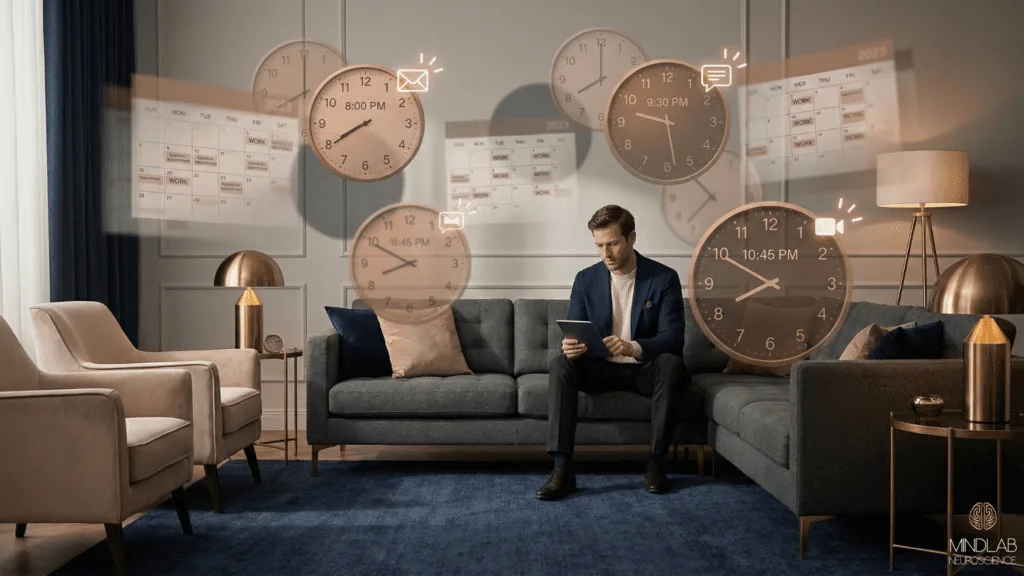
The workday used to end. Now it fades. Messages arrive at night, calendars shift in real time, and collaboration tools keep the social brain continuously engaged. Even when you are “off,” you remain reachable, and your nervous system registers that availability as an ongoing obligation that prevents full restoration.
That is the infinite workday. It is one of the strongest accelerants of attention fatigue and digital burnout, and it fuels neuroscience reset for decision fatigue in leaders.
Notification overload is not only the number of pings you receive. It is what each ping represents to the brain:
- a potential task
- a social cue
- a risk signal
- a demand for response timing and tone
Even if you do not respond, your nervous system registers the possibility. That possibility consumes cognitive resources because your brain cannot fully commit to depth while it is monitoring for interruption.
The mere physical presence of a smartphone on a desk, even when silenced and face-down, reduces available working memory capacity and fluid intelligence, demonstrating that proximity to notification-capable devices impairs cognition independent of active use.
If you are a leader, the cost is higher. Leadership adds social regulation: reading people, managing EQ and neuroscience behind real leadership influence, anticipating conflict, and maintaining emotional steadiness. When notification overload is layered onto leadership, focus is not merely reduced; it is compromised. Presence is reduced. Meetings become noisier. Decisions become more reactive. Minor problems feel bigger.
This is not a moral weakness. It is a predictable output of constant connectivity and an input stream that never resolves.
Digital exhaustion is often the lived experience of never being truly off duty.
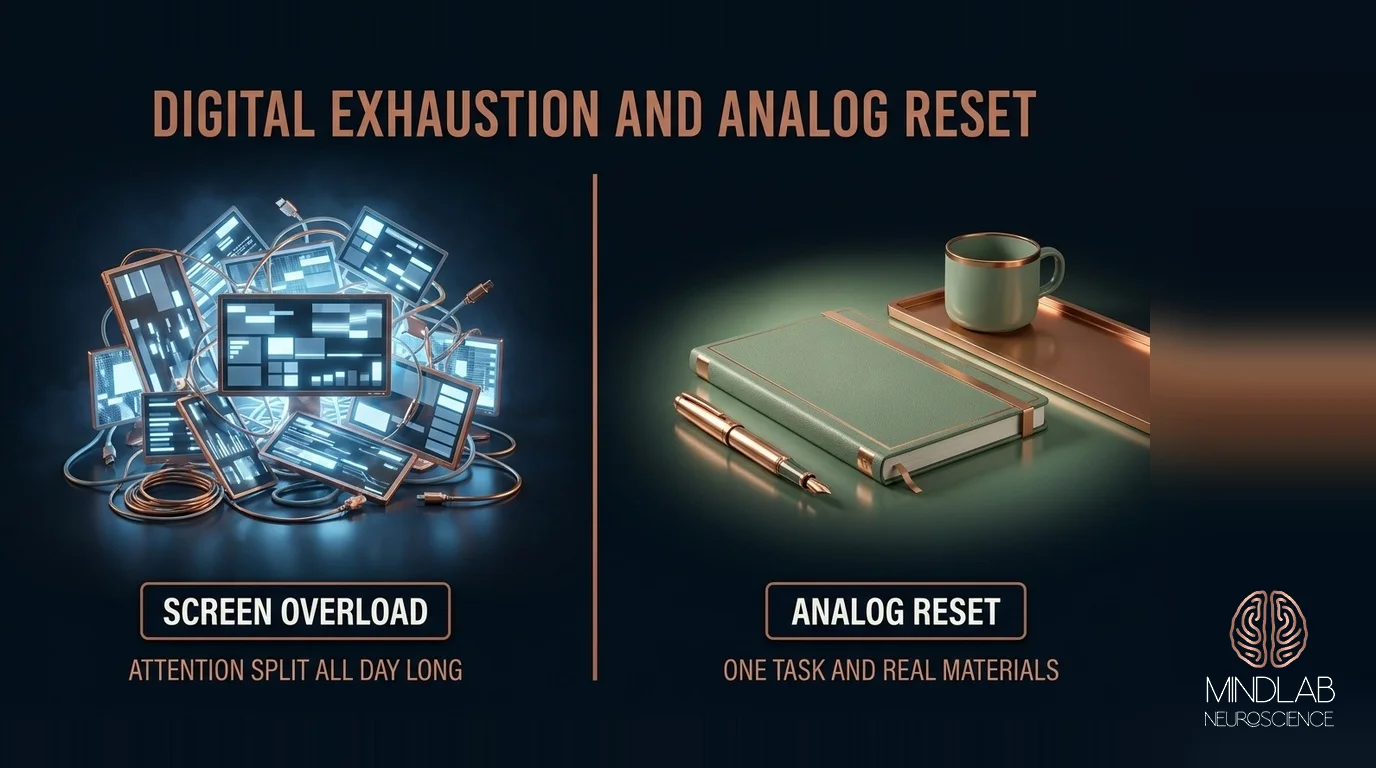
Most people underestimate the true cost of switching tasks. The common assumption is that switching is a time issue, but the deeper problem is cognitive reconfiguration: the brain must disengage from one goal, update working memory, and rebuild a sense of priority from scratch each time.
Ophir and colleagues found that heavy media multitaskers perform significantly worse on tasks requiring filtering of irrelevant environmental stimuli and are measurably more susceptible to attention capture by task-unrelated cues than light media multitaskers.
Every time you switch tasks, your brain must do three things:
- Disengage from the prior goal
- Update working memory with the new goal
- Rebuild a sense of “what matters right now.”
That rebuild is the tax, and the nervous system pays it each time. The more often you switch, the more often you pay the tax. Over a day, those small payments add up to a heavy cognitive bill. You feel busy but not productive. You feel cognitively active but oddly ineffective.
Mark and colleagues have documented how frequently office workers switch between on-screen tasks and how each switch leaves a residue that delays full re-engagement with the primary task.
how working memory stores and loses information is what remains after you switch. A piece of the previous task lingers: the unfinished email, the tense message, the uncertain decision, and the social ambiguity. Residue reduces working memory capacity. It can flatten creativity. It can slow reading comprehension. It makes the next task feel heavier than it should.
This is why a day full of short tasks can feel more exhausting than a day of deep work, your nervous system is paying a compounding cost. You are not doing “more.” You are re-entering more.
If you struggle with attention residue, the fix is not to try harder. The fix is to build transitions that clear residue before you start the next task.
Attention quality improves quickly when you reduce switching frequency and improve switching quality.
Variable reward and compulsive checking
A significant reason digital habits feel sticky is not that you are weak. It is that the reward schedule is engineered to train repetition.
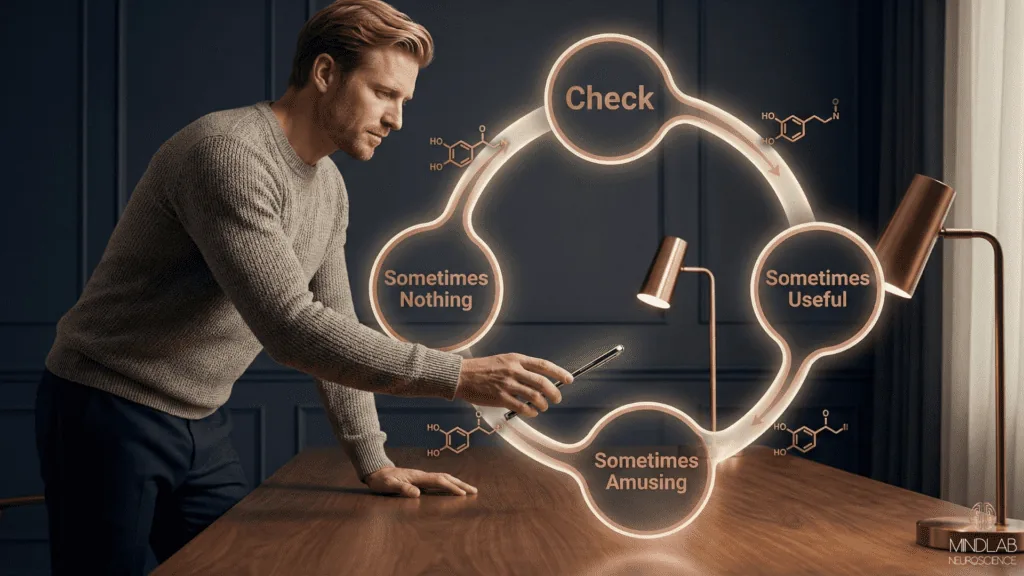
Your brain learns through prediction and outcome. When you check your phone or refresh a feed, the outcome is variable:
- Sometimes you find something useful
- Sometimes you find something amusing
- Sometimes you find something upsetting
- Sometimes you find nothing
That variability is precisely what trains the scrolling habit. The brain keeps checking because the next check might matter. Over time, the checking becomes a self-soothing reflex. You do it when you feel uncertain, bored, depleted, or emotionally activated.
This is how “I just want a break” becomes “I cannot stop checking.”
There is also a second mechanism: low-effort novelty can crowd out high-effort satisfaction. Deep work has a delayed reward. Scrolling has an immediate reward. When your nervous system is tired, it will preferentially reach for the quicker reward.
The solution is not to remove the reward. The solution is to replace it with cleaner rewards and better friction that the nervous system can accept without resistance.
Digital exhaustion is not cured by white-knuckling through cravings. It is reduced by changing the loop, a principle that mental health researchers increasingly recognize as central to sustainable behavioral change.
Doomscrolling and threat scanning
Doomscrolling is how rage bait hijacks your brain’s threat response packaged as content.
Your brain wants closure. It wants certainty. It wants to know what is happening so it can prepare. The problem is that the feed rarely provides closure. It offers more uncertainty. More risk cues. More “watch this” signals.
Habitual doomscrolling keeps the brain’s threat-detection system engaged, which can bias cognition toward vigilance even during low-risk contexts.
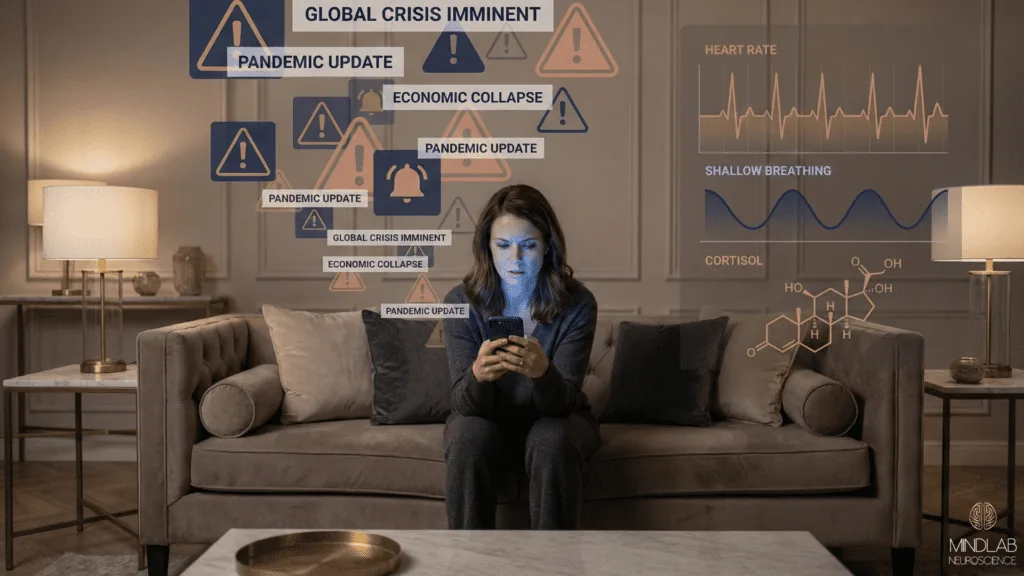
Even if you are not consciously anxious, doomscrolling can keep your body in a subtle state of activation that sustains anxiety below conscious awareness:
- shallow breathing
- tense shoulders
- jaw clenching
- narrowed attention
- increased irritability
This is not only psychological. It is physiological. The nervous system ramps up when it perceives threat signals. That ramp-up can persist after you put the phone down, which is why you can feel unsettled for hours after “just checking the news.”
If you work with high-stakes situations, doomscrolling can also create a cognitive bias. Threat-heavy input narrows perspective and increases urgency. That can lead to reactive decisions, shorter tempers, emotional distress, and diminished tolerance for uncertainty.
If doomscrolling is part of your pattern, focus will not fully recover until your body learns reliable downshifts.
Digital exhaustion often has a threat component, not just a distraction component, and the mental health implications of sustained threat activation are well documented.
Technostress, tool fatigue, and nervous-system regulation
Technostress is the strain of adapting to continuous digital demand: new tools, new norms, new expectations, and an always-on social layer that accelerates digital fatigue.
Digital tool fatigue is the practical expression of that strain. Tools meant to simplify work become an additional cognitive load:
- You manage multiple platforms
- You track multiple threads
- You translate tone across channels
- You monitor response expectations
- You hold unresolved notifications in working memory
You can be excellent at your job and still feel a rising resistance to opening a tool. That resistance is not laziness. It is your brain predicting friction and overload.
Signs of technostress and digital tool fatigue include:
- avoidance of starting because the setup feels heavy
- irritability at minor interface changes
- checking multiple channels compulsively “just to be safe”
- difficulty transitioning into rest because the mind stays online
A core principle here is important: the brain hates unresolved signals. Every unread badge is a micro-open loop. Every open loop pulls attention.
Reducing digital tool fatigue is less about deleting tools and more about consolidating signals, clarifying expectations, and creating firm boundaries between modes.
Digital exhaustion becomes more manageable when tools stop behaving like a second job.
Many people try to solve focus problems cognitively. They tell themselves to concentrate. They try to reason their way into calm. That works sometimes. It often fails when the body is activated.
Nervous system regulation should not be viewed as merely a mindset. It is a state. When the body is in a higher arousal state, attention narrows and becomes reactive. This reactivity leads to more frequent checking, which in turn increases stimulation and maintains high levels of arousal. The autonomic nervous system must shift into a ventral vagal state before sustained attention becomes neurologically accessible. Neurologists emphasize that this shift is not optional, it is a prerequisite for the kind of focused cognition high performers depend on.
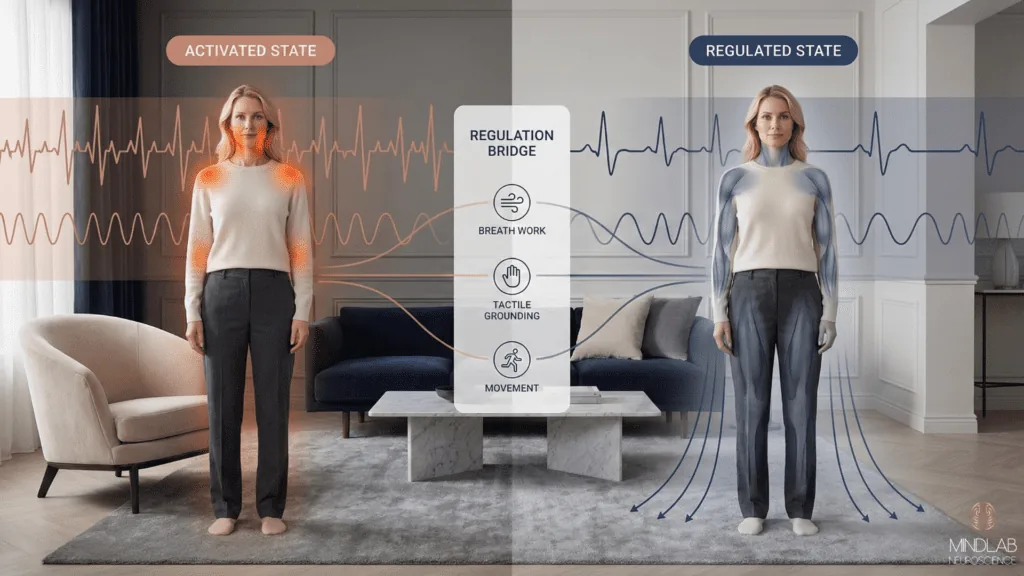
This is why telling yourself to stop scrolling often does not work. Your system is not looking for a lecture. It is looking for a downshift.
A practical definition of nervous system regulation is this: the ability to return to baseline efficiently after activation.
Notice the wording: not ‘never activated,’ but activated sometimes, and able to return to baseline efficiently.
That return is trainable. It improves through nervous system reset protocol for holiday burnout: breath, movement, tactile grounding, and clear following actions. Those downshifts are not trivial. They are how you restore executive attention under pressure.
Digital exhaustion decreases as your body learns it can settle without the phone.
What digital exhaustion looks like in high performers
High performers tend to experience this pattern in specific ways:
- They can focus in bursts, but sustaining is hard
- They can perform in meetings, but re-entry afterward is slow
- They can solve urgent problems, but creative work feels blocked
- They can manage the day, but evenings become compulsive checking
- They can keep output high, but the effort cost keeps increasing
This is the stage where many people become privately worried. They wonder whether they are losing their edge or developing an attention disorder.
What I tell clients is simple: your edge is not gone. This is chronic exhaustion caused by an environment that drains the mechanisms supporting it.

When you restore those mechanisms, the “sharpness” returns. Not because you changed who you are. Because you changed your inputs and your recovery.
Digital exhaustion, and the digital burnout it produces, is reversible when you address it as a systems problem.
The analog bag: an offline reset for compulsive checking
An analog bag is an offline kit designed to interrupt checking loops and provide immediate, regulation-friendly alternatives. Some people call it a stop-scrolling bag. I prefer the term ‘analog bag’ for professional audiences because it emphasizes function rather than moral judgment.
The analog bag works because it aligns with three core principles:
- Friction beats willpower
- Sensory anchoring stabilizes attention
- Replacement behavior prevents rebound
If your phone is within reach, your brain will check it more often. Not because you are undisciplined, but because proximity reduces friction.
If you remove the check without addressing the underlying need, the brain will rebound. It will seek another quick reward, another quick certainty, another quick distraction.
The analog bag gives your system a better move: something tactile, something regulating, something that helps you re-enter your goal.
Digital exhaustion improves when the replacement is easier than scrolling.

Keep the bag small. The goal is repeatable use, not a lifestyle purchase list. Choose 5 to 8 items across the categories below.
Tactile regulation tools
- a smooth stone or textured token
- putty or a small fidget
- an acupressure ball
- finger bands or a small grip tool
Why this works: tactile input provides predictable sensation, which pulls attention back into the body and reduces scanning.
Micro-movement tools
- a compact resistance band
- a stretch strap
- a mini roller for forearms or neck
- a simple “one lap” walking route you can do anywhere
Why this works: movement discharges arousal and improves cognitive flexibility.
Analog attention anchors
- a small notebook and a pen
- sticky notes
- a printed “next three actions” card
- a one-page brain-dump sheet
Why this works: writing externalizes working memory and reduces attention residue.

Clean reward replacements
- sugar-free gum or mints
- tea bags or a calming beverage option
- a scent roller
- a small puzzle card or logic prompt
Why this works: the brain learns through reward. Clean rewards reduce the pull of variable-reward loops without hijacking attention.
Optional: visual calm cues
- a small photo that signals meaning or safety
- a values card with three short reminders
- a short “do this next” script
Why this works: a stable cue helps the brain switch modes without negotiation.
Your bag should live where your phone usually lives. If you hide it, you will not use it. If it is in your working hand’s reach, it becomes your default.
The compulsive loop becomes less sticky when the environment offers an immediate alternative.
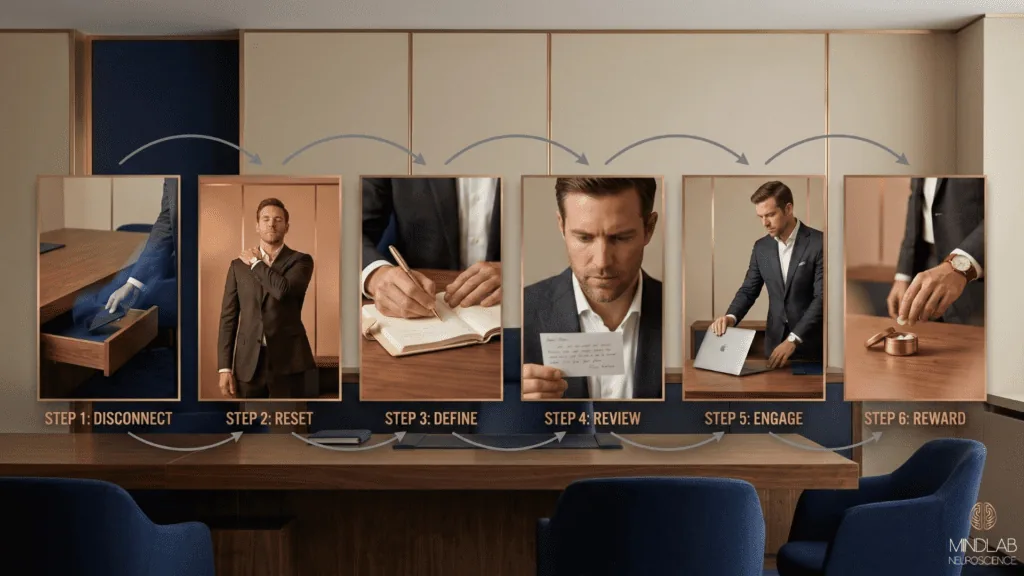
The Analog Bag Protocol
This is a repeatable protocol you can run in minutes. Use it when you notice compulsive checking, feel attention residue, or need to transition into deep work.
Step 1: Interrupt the loop (10 seconds)
Say quietly, “I am switching states.”
Then take one physical action:
- Put your phone out of reach
- Stand up
- Turn your screen face down
- Move one step away from the cue
This matters because the brain needs a boundary marker to break autopilot.
Step 2: Downshift arousal (60 to 120 seconds)
Choose one:
- Six slow breaths with a longer exhale
- 30 seconds of shoulder rolls and jaw release
- A 60-second brisk walk
- Tactile tool in hand while breathing
Your goal is a small downshift, not a state of perfect calm.
Step 3: Clear residue (60 seconds)
Write a quick brain dump:
- What is pulling my attention right now
- What I am afraid I will forget
- What I am avoiding
Do not write a novel. Write three lines. The point is to offload.
Step 4: Rebuild the goal (90 seconds)
Write:
- The one thing I am doing next is
- The first tiny action is
- If I feel pulled, I will do this instead
This restores executive attention by giving it a target.
Step 5: Start anchor (2 minutes)
Do the smallest start:
- Open the document
- Outline three bullets
- Write the first sentence
- Complete one short admin action
Starting is often the most challenging part during overload because the nervous system resists re-engagement. Train starting first.
Step 6: Reward cleanly (30 seconds)
Use a clean reward from your bag: a mint, tea, a scent cue, or a short stretch.
This matters because reinforcement is what makes new loops automatic.
Digital exhaustion improves when you stop relying on self-control and start training state shifts.

Deep work architecture: protect depth without becoming rigid
High performers do not need more productivity hacks. They need a stronger architecture for depth.
Here are the most reliable structural shifts I use with clients:
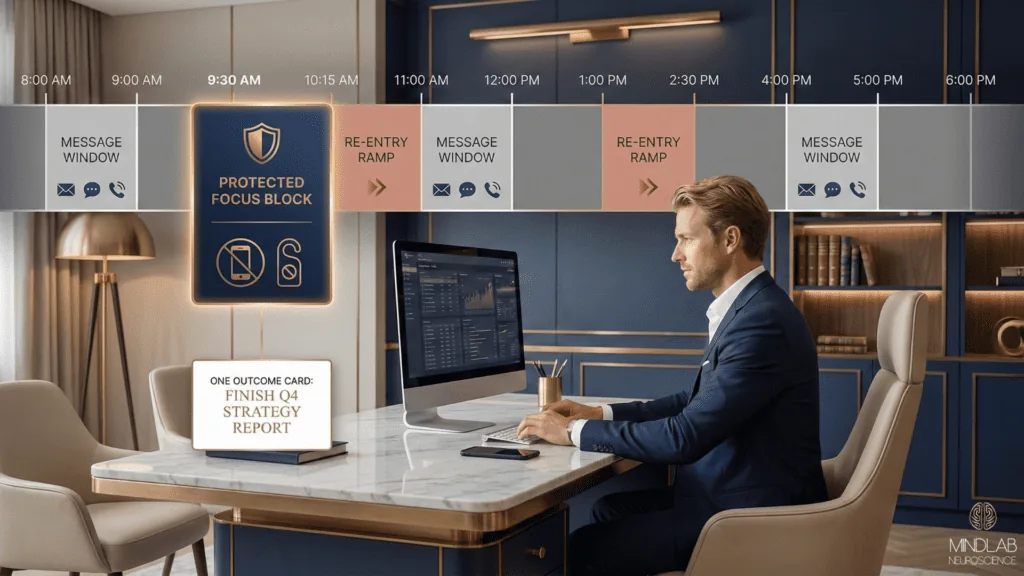
Build one protected focus block per day
Start with 45 minutes. Put it at the same time each day if possible. Consistency reduces negotiation.
During that block:
- phone out of reach
- notifications off
- one task only
If you cannot do 45 minutes, do 25. Depth tolerance builds like conditioning.
Use a re-entry ramp
Keep a card on your desk:
- Today’s one outcome
- The following tiny action
- The distraction I will ignore
When you get pulled, you do not debate. You follow the card.
Batch communication
Choose two or three message windows. Outside those windows, you are not available by default. This disruption reduces the infinite workday effect without requiring perfection.
Reduce channel sprawl
If possible, consolidate updates into one place: a single task system, a single messaging channel for non-urgent items, and a single place for decisions. Each additional tool increases digital tool fatigue.
This is not about being strict. It is about reducing the number of ways your attention can be captured.
Digital exhaustion eases when your day contains fewer mode switches and stronger boundaries.
Leadership and team norms that reduce attention debt
If you lead people, your environment is not just personal. Your culture can reduce or amplify cognitive load.
Here are team norms that reduce context switching and attention residue:
- Define response expectations for non-urgent messages
- Use clear subject lines and decisions in writing
- Avoid “drive-by” pings that lack context
- Batch non-urgent updates into one daily thread
- Create quiet hours for deep work
- Model phone-free meetings when the stakes are high
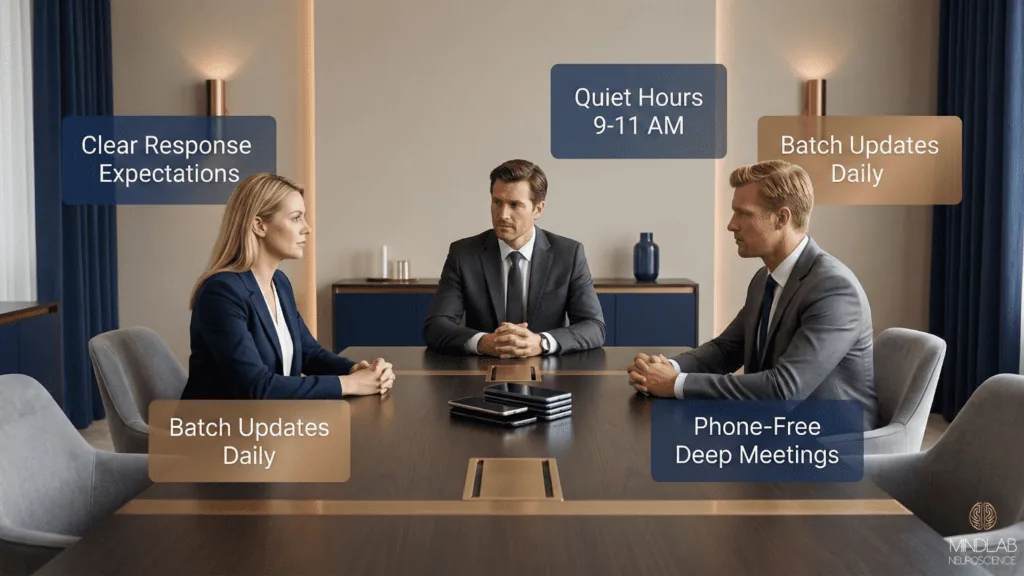
A key leadership truth: your attention becomes the emotional climate. If you are scattered, the team feels it. If you are regulated, the team stabilizes.
The analog bag protocol can be used between meetings to prevent residue from becoming interpersonal reactivity.
Digital exhaustion is not only an individual issue in leadership contexts. It is a systems issue.
Sleep, circadian alignment, and why nighttime scrolling backfires
Sleep is where attention recovers.
If your evenings are filled with doomscrolling and messages, your nervous system does not fully downshift. That can increase optimizing sleep and energy through circadian health, reduce deep sleep quality, and create a foggy morning, leading to more checking.
After extended work periods, people often feel adequately rested while still carrying real cognitive impairment, so subjective energy alone is an unreliable gauge of readiness in high-demand roles.
If nighttime is your hardest window, assume depletion. Do not rely on discipline. Use design.
A simple evening reset
- Phone charging across the room
- Analog bag next to the bed
- Two-minute brain dump: “what my brain is trying to solve.”
- One regulation cue: longer exhales, scent cue, or warm tea
- A low-stimulation activity: reading a paper, stretching, a short shower
The goal is not perfection. The goal is to stop feeding the activation loop just as you need to downshift.
Digital exhaustion often improves dramatically when the first and last hour of the day become more stable.
Movement, nutrition, and baseline reward stability
Many focus issues are framed as purely cognitive, but the body sets the baseline.
When your physiology is depleted, the brain seeks quick reward and quick relief. That increases checking, snacking, and impulsive behavior. You do not need a perfect routine. You need a baseline that reduces craving intensity.
Movement as regulation
Short movement bouts are often more effective than long workouts for immediate regulation:
- a 5-minute walk between tasks
- 30 seconds of resistance band pulls
- 2 minutes of stretching
- brief sunlight exposure when possible
Movement clears arousal, improves mood, and reduces the urge to scan.
Food and hydration
Under-fueling can increase distractibility and irritability. A simple rule:
- protein early in the day
- water visible on your desk
- caffeine earlier, not later
If you tend to crash mid-afternoon, check whether your day contains long gaps without food or hydration. That crash often masquerades as “I can’t focus,” but it is a physiological dip that triggers quick-reward behaviors.
The cognitive drain becomes less intense when baseline physiology is steadier.
Travel and high-noise days: how to stay focused in chaotic environments
Travel days, conference days, and crisis days are perfect storms: high uncertainty, high switching, high alerting.
On these days, do not aim for deep work. Aim for regulation and clean transitions.
A travel-friendly analog bag
- notebook and pen
- mints or gum
- scent roller
- tactile tool
- one small puzzle card
A 3-minute airport reset
- interrupt: phone away
- regulate: longer exhales for 60 seconds
- clear residue: write the following three actions
- start anchor: do one tiny action immediately
The goal is to prevent the day from becoming a continuous loop of checking.
Digital exhaustion is often prevented, more than cured, on high-noise days, and the analog bag helps you do that.
A 7-day plan to restore focus
Day 1: build the bag
Choose your items. Place the bag where your phone usually sits during work.
Day 2: create one friction rule
The phone goes out of reach during one focus block. If you need it, you’ll get it.
Day 3: set message windows
Two windows for email and chat. Outside those windows, use the protocol when pulled.
Day 4: install start anchors
List five two-minute start anchors for your most important tasks.
Day 5: address doomscrolling directly
When you want to scan, regulate first. Then decide if you still need to check.
Day 6: install a shutdown ritual
Write what is done, what is next, and what can wait. Then 30 minutes phone-free.
Day 7: measure recovery
Track recovery time, sleep latency, and irritability from 1 to 10.
You are not chasing perfection. You are retraining baseline and recovery.
Digital exhaustion shifts when recovery improves.
A 30-day plan to make it durable
Week 1: stabilize
Run the Analog Bag Protocol once per day, even when you feel fine. You are training the loop.
Week 2: reduce switching
Consolidate tools where possible, batch communication. Protect one deep work block.
Week 3: build depth tolerance
Do 20 minutes of reading or writing without checking. Expect discomfort. That discomfort is conditioning, not failure.
Week 4: protect mornings and evenings
No phone for the first 20 minutes after waking. No feeds for the last 30 minutes before sleep.
At 30 days, most people notice:
- faster re-entry after interruption
- reduced compulsive checking
- improved emotional steadiness
- stronger capacity for deep work
Digital exhaustion does not vanish overnight. It becomes less dominant as your system learns new defaults.
Troubleshooting common obstacles
“I need my phone for work.”
Separate functions from feeds. Keep communication accessible, but make feeds harder to enter:
- remove social apps from home screen
- log out of high-trigger apps
- turn off badges
- put the analog bag within reach
“Scrolling is how I calm down.”
If scrolling is how you calm down, your body needs regulation, not restriction. Start with:
- Breath or movement for 60 seconds
- Tactile grounding
- Then, choose a deliberate method to soothe yourself, such as tea, music, or stretching

“My brain is neurodivergent or ADHD.”
Shorten the cycle:
- 10-minute focus blocks
- 2-minute resets
- rotating novelty inside the bag
Make the replacement loop enjoyable enough to compete.
“I relapse at night.”
Assume depletion. Use design:
- phone across the room
- bag at bedside
- two-minute brain dump
- longer exhales
“My team keeps interrupting me.”
This is where leadership boundaries matter:
- define response expectations
- create quiet hours
- shift non-urgent items into a daily batch thread
Digital exhaustion is sometimes a cultural problem, not just a personal pattern.
Your next step
If you feel scattered, tired, and quietly worried that your focus is slipping, you are not broken. Your brain is responding to the environment it is in.
What you are experiencing is not a lack of discipline. It is the predictable outcome of living inside notification overload, constant context switching, and an always-on social layer. Your attention system is doing its job: scanning, updating, and preparing. The issue is that it has not been given enough structured downshifts to return to baseline.
Digital exhaustion is reversible when you stop viewing it like a personal flaw and start approaching it like a systems issue. You do not need a dramatic digital detox. You need repeatable friction, clean transitions, and a replacement loop your nervous system can trust.
Here is your simplest next move: build the analog bag today and place it where your phone lives typically. Then run the protocol once, even if you feel “fine.” That first rep matters because it teaches your brain a new default: when the urge to check shows up, you have a better option ready. Tomorrow, rerun it. Your goal is not perfection. Your goal is faster recovery.
As you repeat this, watch the early wins that actually matter: you come back to the task faster after an interruption. You feel less reactive after being online. You start your most important work with less resistance. You end the day with fewer open loops buzzing in your body. Those are the signals that your executive attention is returning and your nervous system is stabilizing.
If you want to accelerate this shift, approach it like training. Choose one protected focus block each day, and defend it the same way you would protect a client session, a board meeting, or a critical decision. The more consistently you create a safe container for depth, the less your brain will need compulsive checking to feel “caught up.”
And if you are realizing you cannot get traction alone, that is not a failure either. An out-of-control environment necessitates a tighter strategy with personalized friction points, leadership boundaries to limit the workday, and regulatory practices tailored to your nervous system. This is precisely the work done with high performers who need their focus and clarity back quickly, without burning their lives down to get it.
Focus is not something you force. It is something you design for.
| Digital Stressor | Neural Mechanism | Cumulative Cost | Analog Reset |
|---|---|---|---|
| Constant task switching | Attention residue between tasks | Degraded focus depth, slower processing | Single-task physical activity for 20+ min |
| Notification interruptions | Dopamine spike, threat check, reorientation | Fragmented attention, cortisol accumulation | Scheduled off-window (no device visible) |
| Infinite scroll / doomscrolling | Variable reward loop, dopamine seeking | Reduced satisfaction threshold, restlessness | Fixed-end analog reading (book, journal) |
| High-volume decision making | PFC glucose and ATP depletion | Impulsive choices, short-term bias | Eliminate low-stakes decisions by noon |
| Always-on availability | Sustained sympathetic activation | Elevated baseline cortisol, poor sleep | Hard stop + physical transition ritual |
“Every notification spike drains the same prefrontal fuel that powers your judgment, creativity, and self-regulation. By the time you feel it, the depletion happened hours ago.”
The patterns described in this article were built through thousands of neural repetitions, and they require targeted intervention to rewire. Real-Time Neuroplasticity™ provides the mechanism: intervening during the live moments when the pattern activates, building new neural evidence that a different response is architecturally possible.
What is digital exhaustion in simple terms?
Digital exhaustion is the fatigue and focus instability that builds when alerts, feeds, and constant switching repeatedly pull your attention. It can show up as brain fog, irritability, and difficulty sustaining deep work.
What is the infinite workday?
The infinite workday is when work communication and updates never truly end. Messages spill into evenings and weekends, which increases alertness, checking, and difficulty transitioning into rest.
What is attention residue?
Attention residue is the cognitive carryover from the previous task after you switch. Cognitive resources remain partially allocated to the prior goal, which consumes working memory and makes the next task feel heavier. Clearing residue through a brief brain dump is one of the fastest ways to restore focus.
How do technostress and digital tool fatigue affect performance?
Technostress is the strain of adapting to constant digital demands. Digital tool fatigue is the day-to-day wear from managing too many platforms, alerts, and threads. Both increase avoidance and compulsive checking.
Does doomscrolling impact nervous system regulation?
Doomscrolling keeps the threat system engaged and can maintain elevated arousal even after you put the device down, which makes it harder to downshift into rest and easier to fall into more checking. Porges identifies this as a failure to access the ventral vagal state needed for recovery.
What should be in an analog bag or stop-scrolling bag?
Include a tactile tool, a notebook, a pen, a micro-movement option, and a clean reward replacement, such as mints or tea. The goal is to regulate the state and create an explicit following action.
What if I keep failing?
Lapses are part of retraining. Each time you notice the loop and run the protocol, you build a new pathway. Count repetitions, not perfect days.
References
- Ophir, E., Nass, C. and Wagner, A. (2009). Cognitive control in media multitaskers. PNAS, 106(37), 15583-15587.
- Mark, G., Iqbal, S., Czerwinski, M. and Johns, P. (2014). Bored Mondays and focused afternoons: The rhythm of attention and online activity in the workplace. Proceedings of the SIGCHI Conference on Human Factors in Computing Systems, 3025-3034.
- Ward, A., Duke, K., Gneezy, A. and Bos, M. (2017). Brain drain: the mere presence of one’s own smartphone reduces available cognitive capacity. Journal of the Association for Consumer Research, 2(2), 140-154.
- Porges, S. W. (2022). Polyvagal theory: A biobehavioral journey to sociality. Comprehensive Psychoneuroendocrinology, 11, 100069.
- Sapolsky, R. M. (2023). Determined: A science of life without free will. Penguin Press.
- Barrett, L. F. (2020). Seven and a half lessons about the brain. Mariner Books.
From Reading to Rewiring
Understand the neuroscience. Apply it to your life. Work directly with Dr. Ceruto to build a personalized strategy.
Book a Strategy Call