Key Takeaways
- Outcome visualization triggers goal completion’s dopaminergic reward signal, a premature “mission accomplished” that collapses drive
- Gabriele Oettingen found positive fantasies lower systolic blood pressure and energization: the body relaxes prematurely
- Mental contrasting (outcome plus obstacles) engages anterior cingulate cortex conflict monitoring, outperforming visualization on commitment
- Process rehearsal activates motor planning circuits; outcome fantasy activates reward circuits suppressing the effort signal
Why visualization doesn’t work comes down to a single neurochemical event most people never learn about. When you vividly imagine achieving a goal (the promotion, the transformed body, the standing ovation) your brain’s dopaminergic reward circuit fires a completion signal before you’ve taken a single step. This reward prediction error, the brain’s mechanism for comparing expected and received outcomes, registers the imagined success as partially achieved. Systolic blood pressure drops. Energization decreases. The motivational drive you need to actually pursue the goal quietly collapses, replaced by the neurochemical equivalent of having already arrived. In my practice, I’ve watched this mechanism undermine some of the most capable people I work with, not because they lack discipline, but because their brains have been trained to treat fantasy as progress.
Why Does Visualization Make Anxiety Worse?
Outcome visualization amplifies anxiety by creating a neurochemical gap between the imagined future and current reality. The dopamine system produces a partial reward signal during vivid positive fantasy: a down payment on success that hasn’t been earned. When the fantasy fades, the anterior cingulate cortex registers the shortfall as a prediction error that feels like something is wrong.
I worked with a young professional who had adopted a daily visualization practice from a popular self-help book. Every morning, she spent twenty minutes imagining a confident, accomplished version of herself delivering presentations and closing deals. Within three months, her anxiety had measurably worsened. The visualization wasn’t motivating her. It was creating a daily experience of falling short: a neurochemically manufactured gap between the person she imagined and the person who showed up at her desk each morning.
How Does the Gap Between Fantasy and Reality Become a Source of Distress?
The mechanism operates through dopamine’s comparison function. Dopamine neurons don’t simply fire in response to reward: they fire in response to the difference between expected and received outcomes. Schultz, Dayan, and Montague demonstrated this in their foundational research on reward prediction error, showing that dopamine neurons decrease firing when an expected reward fails to materialize. Outcome visualization sets the expectation. Reality delivers the shortfall. The resulting dip in dopaminergic signaling produces the subjective experience of disappointment, inadequacy, and anxiety, not because anything has gone wrong in the present, but because the brain has already priced in a future that doesn’t exist yet.
This isn’t a failure of willpower. It’s a predictable neurochemical consequence of training the reward system to expect outcomes it hasn’t earned.
Does Positive Visualization Actually Work?
Positive visualization (specifically, the vivid mental rehearsal of desired outcomes without concrete action planning) does not reliably produce the motivational effects most people expect. Gabriele Oettingen’s two decades of experimental research consistently demonstrate that positive fantasies about the future reduce the energization needed to pursue goals. The more vivid and positive the fantasy, the weaker the subsequent effort signal.
The mechanism is counterintuitive but physiologically precise. When you imagine achieving something you deeply want, the brain generates a partial reward response. This response is measurable.
What Does Blood Pressure Reveal About Positive Fantasy?
Kappes and Oettingen measured systolic blood pressure, a reliable physiological marker of energization, during positive fantasy versus neutral ideation. Participants who vividly imagined positive future outcomes showed significant systolic blood pressure drops compared to participants who engaged in neutral thinking or mental contrasting. The body physiologically relaxed, as if the desired outcome had already occurred.
This finding reframes what happens during visualization at the biological level. The blood pressure drop isn’t relaxation in a useful sense. It’s a premature de-mobilization: the cardiovascular system powering down because the brain’s reward circuit has signaled that the goal-directed effort is no longer necessary. For anyone who has felt mysteriously drained after an intense visualization session, this is the mechanism: the brain treated the fantasy as partial completion and withdrew the energization that would have fueled actual pursuit.
“The most vivid visualization sessions often produce the least action, not because the person lacks commitment, but because the brain’s reward circuit has already registered partial completion.”
What Is Mental Contrasting and Why Is It Better Than Visualization?
Mental contrasting engages the brain’s anterior cingulate cortex, the conflict monitoring center, by pairing a desired outcome with the specific obstacles standing in the way. This dual-focus technique produces higher goal commitment than positive visualization alone because it activates discrepancy-detection and problem-solving circuits rather than triggering the reward circuit’s premature completion signal.
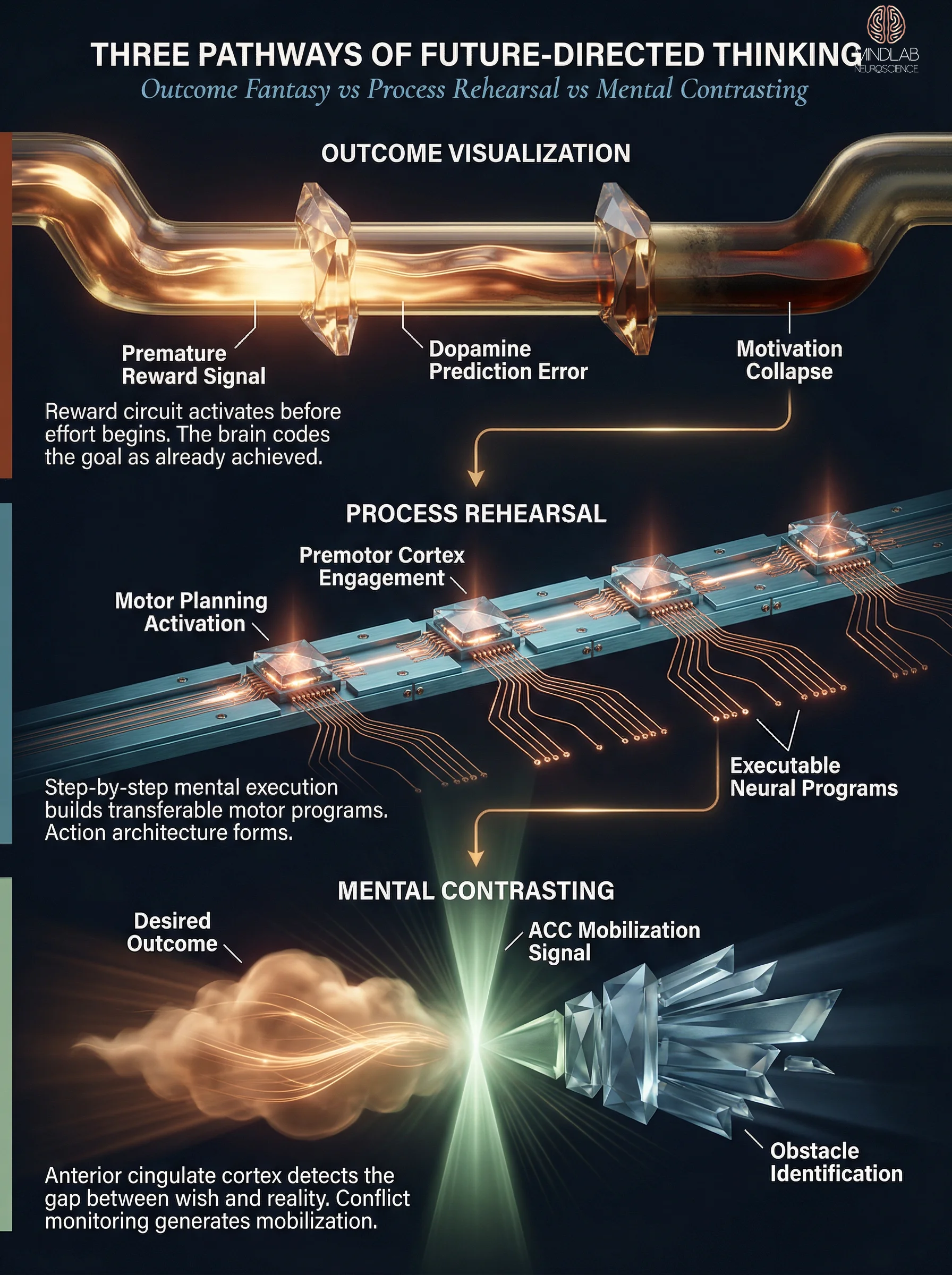
The structured version (WOOP, which stands for Wish, Outcome, Obstacle, Plan) translates Oettingen’s laboratory findings into a repeatable sequence. You identify a wish, imagine the best outcome, name the primary internal obstacle, and form an if-then implementation plan. The critical shift happens at the obstacle step. When the anterior cingulate cortex registers the contrast between desired outcome and concrete barrier, it generates a mobilization signal rather than a satisfaction signal. The brain codes the goal as something requiring effort, not something already achieved.
How Does the WOOP Technique Restructure Mental Rehearsal?
I observed this mechanism clearly with an individual managing three competing domains: family logistics, a nonprofit board, and a partner’s career transition. She had been practicing outcome visualization for “calm”, imagining herself moving through her day with ease and composure. The result was deepening overwhelm, because the calm she imagined each morning made the actual chaos feel like failure by comparison.
We replaced the outcome visualization with mental contrasting. Instead of imagining calm, she identified the specific obstacle: the moment each afternoon when competing demands converged and her prefrontal resources were already depleted. The if-then plan was concrete and executable. Within weeks, her reported overwhelm had decreased, not because she felt calmer, but because she had stopped manufacturing a neurochemical gap between fantasy and reality. The anterior cingulate cortex was now coding the afternoon convergence as a solvable problem rather than evidence that she was falling short of an imagined ideal.

Can Visualization Backfire or Have Negative Effects?
Visualization backfires when the brain’s reward prediction error system registers imagined success as actual achievement, producing the neurochemical signature of completion without the pursuit. The mesolimbic dopamine pathway, the circuit from the ventral tegmental area to the nucleus accumbens, fires the same directional pattern during vivid imagery as during genuine goal attainment.
Why Does the Reward Circuit Treat Imagined Success as Real?
The dopamine system evolved to motivate behavior toward survival-relevant goals. It operates on prediction, not verification. When a vivid mental image activates the reward circuit, the system has no mechanism for distinguishing between “I achieved this” and “I convincingly imagined achieving this.” The reward prediction error signal responds to the expected value of the imagined outcome, not to its ontological status.
This is why the backfire effect scales with vividness. A fleeting thought about success produces minimal dopaminergic response. A deeply immersive twenty-minute visualization, the kind recommended by most self-help protocols, produces a robust reward signal proportional to the perceived value and probability of the imagined outcome. The more effectively you visualize, the more completely the reward circuit codes the goal as achieved, and the less motivational drive remains for actual pursuit.
For a complete framework on understanding and resetting your dopamine reward system, I cover the full science in my book The Dopamine Code (Simon and Schuster, June 2026).
“The brain’s dopamine system responds to the perceived probability of reward, not to whether the reward actually occurred, which means a sufficiently vivid fantasy produces the same motivational shutdown as genuine success.”
What Happens in the Brain During Process Rehearsal vs. Outcome Fantasy?
Process rehearsal activates the brain’s motor planning circuits, the premotor cortex and supplementary motor area, building executable neural programs for specific action sequences. Outcome fantasy activates the reward circuit, producing completion signals that suppress effort mobilization. These two forms of future-directed thinking engage fundamentally different neural systems and produce opposite behavioral effects.
The distinction matters because the popular category “visualization” collapses both forms into a single practice, obscuring the mechanism that determines whether mental rehearsal helps or hinders. Research on motor imagery and neural activation demonstrates that step-by-step mental execution of specific movements produces measurable cortical changes, increased motor map area, elevated cortical excitability, and refined timing patterns, none of which occur during passive outcome imagery.
How Does Step-by-Step Mental Execution Differ From Outcome Imagery?
A competitive musician preparing for an audition illustrates the divergence precisely. Outcome visualization (imagining the applause, the judges’ expressions, the feeling of success) triggers the reward circuit and produces the systolic blood pressure drop Oettingen’s research documents. Process rehearsal (mentally executing each passage, feeling the finger positions, hearing the tonal transitions, recovering from a deliberate mistake) activates the motor planning architecture. The neural substrates engaged during process rehearsal overlap substantially with those engaged during actual performance, creating transferable motor programs.
This is the mechanism that connects to what I work with in Real-Time Neuroplasticity™: the principle that the brain restructures most efficiently during active engagement with specific challenges, not during passive imagination of desired states. The broader implications for mental rehearsal and visualization extend across the full spectrum of elite performance systems, from athletic preparation to high-stakes decision-making. Process rehearsal is, at the neural level, a form of guided pattern installation. The motor planning circuits don’t distinguish between imagined execution and a practitioner-guided walkthrough of the precise cognitive sequence required in a high-stakes moment. Both build executable architecture. Neither resembles the passive reward-circuit activation of outcome fantasy.
In 26 years of practice, I’ve found that the individuals who struggle most with visualization are often the most vivid imaginers. Their capacity for rich mental imagery is precisely what makes outcome fantasy so neurochemically potent, and precisely what makes the transition to process rehearsal so immediately effective.

What the First Conversation Looks Like
When someone reaches out after years of visualization practices that never delivered, the first conversation is often one of relief. I hear some version of the same realization: “I thought I wasn’t doing it right.” You were doing it exactly as instructed. The instruction was the problem. In our initial conversation, I map which form of future-directed thinking your brain defaults to, outcome fantasy or process rehearsal, and where the reward circuit is generating premature completion signals. We identify the specific goals, decisions, or high-stakes moments where structured mental rehearsal would replace the passive imagery that has been quietly undermining your follow-through. It begins with understanding why your brain has been treating imagination as achievement, and what happens when we redirect that capacity toward building executable neural architecture.
Why does visualization increase anxiety instead of reducing it?
Outcome visualization generates a neurochemical gap between the imagined future and present reality. The dopamine system produces a partial reward signal during vivid positive imagery. When the fantasy fades, the brain registers the shortfall between expected and actual states as a prediction error: a negative signal that feels like something is wrong. This mismatch compounds with repeated practice, producing chronic low-grade anxiety. The anterior cingulate cortex treats the gap as ongoing threat data, sustaining baseline arousal even in calm moments.
What is the difference between outcome visualization and process visualization?
Outcome visualization involves imagining the end state of a goal and primarily activates the dopaminergic reward circuit, producing a premature completion signal. Process visualization involves mentally executing the specific steps required and activates motor planning circuits: the premotor cortex and supplementary motor area. Research consistently shows process visualization produces measurable performance improvements while outcome visualization reduces energization. The two engage fundamentally different neural systems with opposite behavioral effects. Elite performers, athletes, surgeons, musicians, rely on process visualization for exactly this reason.
Does the WOOP mental contrasting technique work better than positive thinking?
Mental contrasting using the WOOP framework, Wish, Outcome, Obstacle, Plan, consistently outperforms positive thinking alone in controlled studies. The technique engages the anterior cingulate cortex’s conflict monitoring function when the obstacle step is introduced, generating a mobilization signal rather than the premature satisfaction produced by positive visualization. Oettingen’s research demonstrates significantly higher goal commitment and more immediate action initiation than positive fantasy across academic, health, and professional domains. The obstacle-identification step is what converts passive wishing into actionable pursuit.
Can too much visualization actually make you less motivated?
Excessive outcome visualization reduces motivation through a specific dopaminergic mechanism. The reward prediction error system generates a completion signal proportional to the perceived value of the imagined outcome, reducing systolic blood pressure and physiological energization: the body powers down as if the goal were already achieved. The more frequent and immersive the practice, the stronger this effect becomes, creating a paradox where the most dedicated visualizers experience the greatest motivational collapse. Daily 20-minute visualizers often report exhaustion rather than readiness.
How does dopamine affect visualization and goal pursuit?
Dopamine serves as the brain’s prediction and motivation signal, not simply a pleasure chemical. During outcome visualization, dopamine neurons in the ventral tegmental area fire in response to the anticipated reward value of imagined success, producing a partial signal that mimics actual achievement. This premature signal reduces the dopaminergic drive needed to sustain goal-directed behavior. The mechanism operates through reward prediction error: when expected outcomes exceed actual outcomes, dopamine firing decreases, producing the deflation many people report after intensive visualization.
References
- Kappes, H. B., and Oettingen, G. (2011). Positive fantasies about idealized futures sap energy. Journal of Experimental Social Psychology, 47(4), 719-729. https://doi.org/10.1016/j.jesp.2011.02.003
- Oettingen, G., and Wadden, T. A. (1991). Expectation, fantasy, and weight loss: Is the impact of positive thinking always positive? Cognitive Therapy and Research, 15(2), 167-175. https://doi.org/10.1007/BF01173206
- Pham, L. B., and Taylor, S. E. (1999). From thought to action: Effects of process-versus outcome-based mental simulations on performance. Personality and Social Psychology Bulletin, 25(2), 250-260. https://doi.org/10.1177/0146167299025002010
- Schultz, W., Dayan, P., and Montague, P. R. (1997). A neural substrate of prediction and reward. Science, 275(5306), 1593-1599. https://doi.org/10.1126/science.275.5306.1593
- Berridge, K. C., and Robinson, T. E. (1998). What is the role of dopamine in reward: Hedonic impact, reward learning, or incentive salience? Brain Research Reviews, 28(3), 309-369. https://doi.org/10.1016/S0165-0173(98)00019-8
- Volkow, N. D., Wise, R. A., and Baler, R. (2017). The dopamine motive system: Implications for drug and food addiction. Nature Reviews Neuroscience, 18(12), 741-752. https://doi.org/10.1038/nrn.2017.130