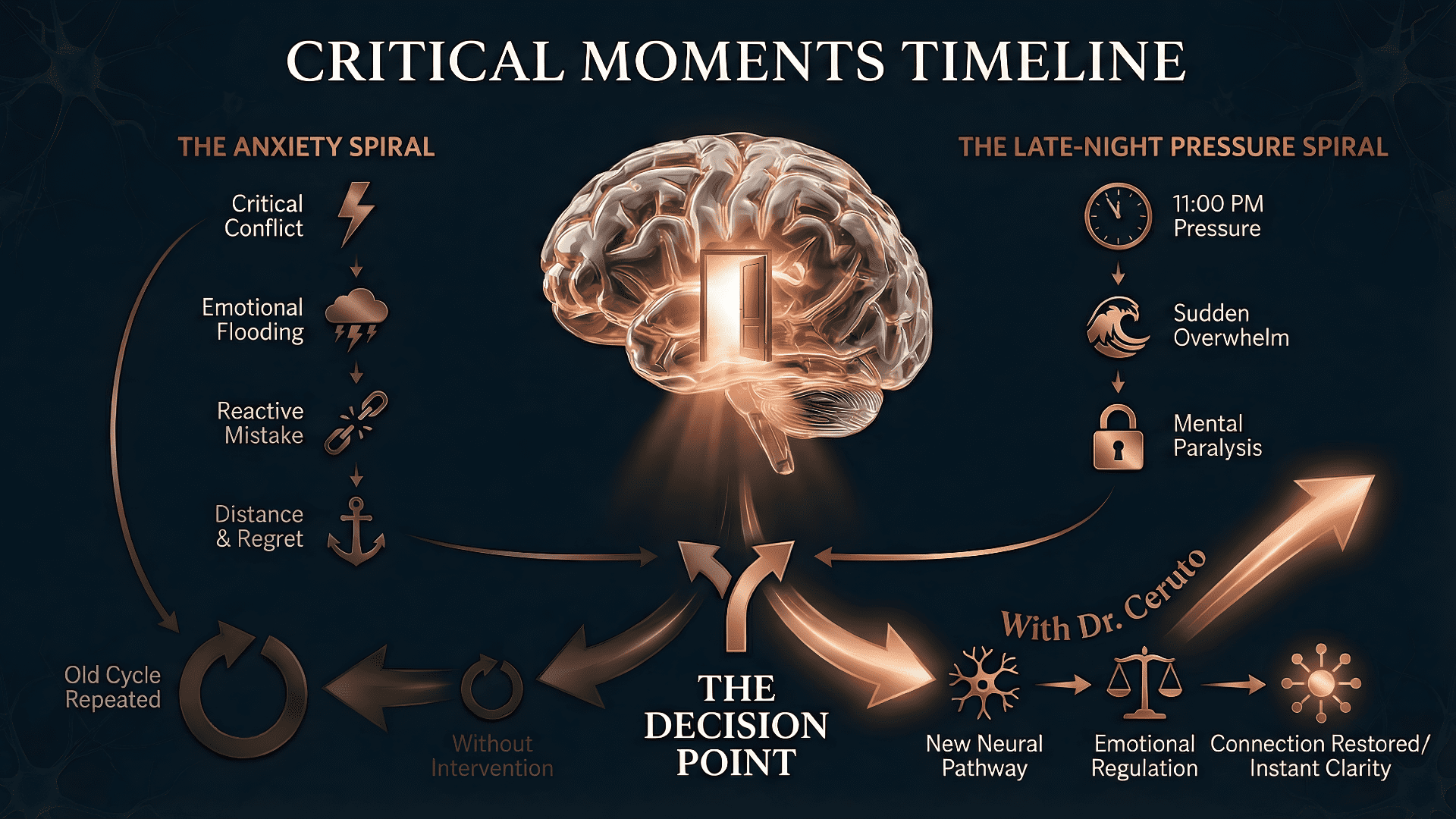
Real-time neuroplasticity is not just a clever phrase; it is the way your brain actually changes when life is happening in front of you. After more than twenty-five years working as a neuroscience-based coach with high achievers, I’ve watched the same pattern repeat. People can understand their story, name their patterns, and even feel inspired in a session, yet the old reactions return the moment stakes are high. They promise themselves they’ll do it differently next time, then next time arrives and the brain snaps back to what is familiar.
Real-time neuroplasticity was born from my frustration with that cycle. Insight without in-the-moment rewiring is not enough. Your brain learns through live experience, especially when emotion and meaning are strong. If coaching and change work don’t meet you inside those real moments, they can’t fully reshape the neural pathways driving your choices, your mood, and your performance. Real-time neuroplasticity is a natural evolution of my science-based work at MindLAB Neuroscience.
In this article, I aim to provide you with a clear, practical understanding of real-time neuroplasticity, its functioning in your brain, and its transformative power when you’re committed to long-lasting change. You’ll learn how this method differs from traditional coaching, how to integrate it into your daily life, and how it can help you perform better and feel more at ease. Most importantly, you’ll see that your brain is not fixed; it’s always listening, and it’s capable of changing in the exact moments that used to feel impossible.

The science behind real-time neuroplasticity
At its core, real-time neuroplasticity rests on a simple truth. Your brain wires itself around whatever you repeat, especially in emotional situations. Each time you respond to a trigger with the same thought, feeling, or behavior, the neurons involved fire together. Over time they form a stronger and stronger pathway. That pathway becomes the default route your brain takes the next time you feel pressure, fear, shame, excitement, or desire.
Real-time neuroplasticity targets those high-stakes moments on purpose. When you’re in a board meeting, sitting across from a partner, or watching a trade move against you, your brain is flooded with information. Emotional centers and executive centers are both engaged. That state of activation is not a problem; it’s an opportunity. The brain is especially plastic when emotion, attention, and meaning are all present. If you apply a new response inside that window, the brain tags it as important and begins to encode it as the new pattern.
We don’t expect you to remember a tool from a session and use it flawlessly on your own in real-time neuroplasticity. We intervene live, during the actual situation or as close to it as possible. That might mean coaching minutes before a crucial negotiation, texting through a conflict at home, or decoding a shame spiral that was triggered earlier in the day. This real-world timing lets us capture the emotional charge and use it to strengthen a new circuit instead of feeding the old one.
Your brain chemistry also shifts when you practice real-time neuroplasticity. When you choose a different behavior in the heat of the moment, you release new patterns of neuromodulators linked to focus, calm, and confidence. Over repeated cycles, your nervous system learns that this new response is safe and effective. The result is less internal noise, fewer crashes after stressful situations, and more access to your highest level thinking when it matters.
When you look at the topic through a microscopic lens, you can imagine tiny branches on your neurons reaching toward one another. Each time you repeat a reaction, those branches grow a little closer, and the signal between them becomes easier to send. Neuroscientists sometimes call this process wiring and firing. The more often a route is used, the more efficient and automatic it becomes. This lesson is why you can tell yourself a thousand times that you’ll stay calm, yet your body still surges with adrenaline when it senses a familiar cue.
Emotion functions as a stimulant on these circuits. Moments that carry shame, excitement, humiliation, pride, or fear are tagged as especially important. Your brain doesn’t judge whether the reaction is helpful; it only notices that it was intense and repeated. Fortunately, you can leverage this same tagging system to your benefit. When you bring a new response into a situation that already feels lit up, your nervous system pays attention. It recognizes that something different just happened in a place that mattered.
Timing is also critical. If you wait until hours after a challenging event to process what happened, your brain has already filed most of the pattern away. You can still learn from it, but the signal is weaker. When you intervene while the body is still activated, you’re standing inside a window where plasticity is naturally higher. That is why this approach focuses so much on live or near-live intervention. We are conversing with your brain precisely when it is primed for change.

Why traditional insight is not enough on its own
Classic insight-based work can be valuable. Understanding your history, your core beliefs, and the meaning you attach to events gives you context. It helps you see that you’re not broken or weak; your brain simply learned to survive using the tools it had at the time. The problem is that insight alone doesn’t automatically rewrite those tools.
Think about a client who knows they overreact in conflict. They can explain exactly why. They grew up in a chaotic home, they learned that conflict meant danger, and their body still responds as if every disagreement will explode. In a calm session they can talk about staying regulated and communicating clearly. Yet when their partner raises their voice, their heart races, their thoughts blur, and they either attack or shut down. The old wiring wins.
Real-time neuroplasticity steps in where that process normally stops. Instead of leaving the client to hope they do better next time, we step into the next conflict with a plan. I might be on call before a difficult conversation, coaching them in real time as their nervous system ramps up. We rehearse specific phrases, breathing patterns, and attentional shifts that fit their brain, not a generic template. We then anchor the new response as their body moves through the actual moment.
In this way, real-time neuroplasticity doesn’t dismiss insight; it amplifies it. You still explore the story of how your brain learned its current patterns, but you don’t stop there. You use that understanding to design real-time interventions that meet your brain exactly where it tends to go offline. Over time, those targeted moments of practice become the foundation for an entirely different way of moving through your life.

How real-time neuroplasticity works in real life
To understand the power of real-time neuroplasticity, it helps to see what it looks like in a typical coaching journey. Every person is different, but certain themes show up again and again among the high performers I work with.
A hedge fund manager might come to me because they know their decision-making collapses when a position moves quickly against them. Intellectually, they understand risk, probability, and strategy. However, when the market surges, the limbic system takes control. They exit too early, double down impulsively, or freeze. Together we begin with a clear map of the neural pattern that takes over in those moments. Then we move into real-time neuroplasticity.
During live trading days, I’m in close contact. We prepare before the opening, we track internal signals as the day unfolds, and we intervene the moment the old panic pattern starts to fire. The portfolio manager learns to recognize the first somatic cues that their brain is slipping into threat mode. In that exact window, we install micro shifts in focus, body posture, and language that bring the prefrontal cortex back online. With repetition, the brain associates volatility with curiosity and precision instead of fear and chaos. That is real-time neuroplasticity in action.
Another client might be a senior executive who feels confident in strategy meetings but unravelled in intimate relationships. Their brain has linked closeness with loss or criticism. When their partner reaches for them emotionally, an old survival pattern surges. They pull away, become defensive, or overexplain. In our work, real-time neuroplasticity means I’m often present virtually before, during, and after key conversations. We rehearse, we adjust in the moment, and we debrief right away. Over a structured series of weeks, their nervous system learns that staying present and vulnerable is not only survivable, it’s rewarding.
In both cases, real-time neuroplasticity respects how a high achiever actually lives. These clients don’t undergo change in isolation. They change inside boardrooms, trading floors, living rooms, and airports. By bringing neuroscience-based coaching into those live settings, we create a continuous feedback loop between brain, body, and environment. That loop is what allows new wiring to stabilize instead of fading as a wonderful idea.
A third pattern I see often involves entrepreneurs who have built successful companies yet still feel like everything will collapse if they’re not pushing every second. Many people’s brains have linked slowing down with danger. Even on vacation, their thoughts race through worst-case scenarios. In sessions, they may understand that this constant vigilance is unsustainable, but their nervous system has not received that memo. To shift this, I’ll often stay closely connected during a planned period of rest or during a week when they delegate more responsibility to their team.
We don’t simply tell them to relax. Together we identify precisely when their body tightens, when their hand reaches for the phone, or when they start rehearsing imaginary disasters. In those micro moments, we insert small, concrete alternatives that we’ve practiced in advance. Occasionally it’s a brief sensory reset; other times it’s a specific sentence they say to themselves or a new behavior, like letting a team member solve a problem without stepping in. Each successful experiment sends a fresh signal to the brain that ease does not equal collapse.
Over time, this founder begins to notice that their company doesn’t fall apart when they step back. They also notice that their best ideas often arrive when their nervous system is not in pure survival mode. Energy that used to feed constant threat monitoring becomes available for strategy, creativity, and connection. This is the kind of shift that can’t be achieved by insight alone. It emerges from repeated experiences in the real environments that once triggered overload, until the brain comes to trust a completely different way of operating.

The 21-day cycle and why repetition matters
One of the most important principles inside real-time neuroplasticity is the role of repetition. The brain doesn’t fully commit to a new pattern after one brave moment. It needs consistent proof that the new pathway is safe and effective. In my work, I often design focused twenty-one-day cycles around a specific target pattern.
For twenty-one days, we identify the key situations that trigger the old response. We plan real-time neuroplasticity interventions for each one. We track what happens, how your body feels, how quickly you recover when you slip, and what adjustments make the new pattern easier to access. This concentrated window gives your brain a clear message. The old route is no longer the only option.
Clients are often surprised by what changes inside those cycles. A leader who thought they were simply an anxious person notices that their baseline settles. A person who always avoided conflict finds themselves speaking clearly without the usual shaking or resentment. This is not magic; it is real-time neuroplasticity doing what the brain is built to do. When you give your nervous system repeated experiences of a new response, especially in meaningful situations, the synapses involved thicken and stabilize.
If you imagine your old pattern as a deep canyon that your thoughts and reactions fall into, real-time neuroplasticity is the process of building an alternate path alongside it. At first the new path feels awkward and slow. You have to remember each step, and it takes effort to stay on track. With twenty-one days of in-the-moment practice, that path becomes smoother, wider, and easier to choose. Eventually, the canyon is still there, but you simply don’t walk into it as often. Your brain has options.

Real-time neuroplasticity as a daily practice
People sometimes assume that real-time neuroplasticity belongs only in dramatic moments, like crises or high-stakes decisions. In reality, it’s just as powerful in the small, quiet spaces of your day. The brain is always learning, and the micro choices you make when no one is watching still shape your emotional landscape.
Morning routines are a perfect example. Many clients start their day in a flood of email, news, and internal criticism. Before they’ve even left the bed, their brain is rehearsing stress and self-doubt. When we apply real-time neuroplasticity here, we don’t simply tell them to think positive. We break down the first thirty minutes of the day, identify tiny leverage points, and install new patterns anchored in how their brain functions. That might look like specific sensory inputs, movement, or focus questions that prime their neural circuits for clarity and steadiness.
Real-time neuroplasticity also transforms how you relate to your own inner voice. Instead of wrestling with negative thoughts long after a situation ends, you begin to work with them in the exact moment they arise. You catch the first subtle narrative that says you’re failing, that you’re not allowed to rest, or that one mistake defines you. In that instant, we practice alternative responses that are both truthful and regulated. The harsh voice fades not because you ignore it, but because your brain rewired the pathway that created it.
The more you treat real-time neuroplasticity as a way of living rather than a technique, the more natural it feels. You start to notice micro shifts in attention, breath, and posture throughout the day. You become curious about your reactions instead of ashamed of them. That curiosity is a sign that your nervous system is moving out of survival and into growth.
Another productive opportunity for this work is during the transition points in your day. The way you move from work to home, from screen time to sleep, or from solitude to social settings can either calm your nervous system or keep it on high alert. Many high achievers treat these transitions as throwaway moments, yet they are actually powerful opportunities to teach your brain new associations. For instance, if you consistently arrive at the office with your mind still in the office, your family will never see you in a regulated state, and your own system will never have a chance to de-energize.
Together, we might design a simple but intentional sequence that marks the end of the workday. It could involve a short walk without your phone, a specific playlist, or a brief reflection on what went well instead of what still needs fixing. The details depend on your brain and lifestyle, but the principle is the same. You’re educating your nervous system about when it’s safe to change course. Over weeks, this tiny ritual becomes a cue. The moment it starts, even before you consciously think about it, your body begins to relax.
Sleep is another domain where small, real-time shifts add up quickly. Instead of lying awake replaying the day, we practice catching the very first loops of worry and redirecting them gently, using tools that are grounded in how your brain and body settle. When you experience, night after night, that you can guide yourself into rest instead of being dragged by old patterns, your confidence grows. That confidence then bleeds into daytime challenges, because you have proof that your brain will listen when you give it new instructions.

Why real-time neuroplasticity is different from generic coaching
There is a reason high-level performers seek neuroscience-based coaching instead of generic motivation. They understand that mindset, emotional regulation, and behavior are biological processes, not vague ideas. Real-time neuroplasticity takes that understanding even further.
Instead of offering one-size-fits-all tools, this work is tailored to the way your specific brain processes information, emotion, and threat. We look at your history, your current environment, your goals, and your nervous system patterns. Then we design real-time neuroplasticity interventions that fit you. That level of customization respects your intelligence and your experience. It also respects the complexity of the human brain.
Another key difference is access. My clients don’t only see me for an hour a week and try to fill the gap alone. Real-time neuroplasticity relies on close connection, whether through calls, messaging, or virtual presence during key moments. This access allows us to identify patterns early, make adjustments in context, and celebrate victories while your brain is still fresh from the experience. It also builds a deep level of trust, which is essential for the vulnerable work of changing long-standing neural patterns.
Finally, real-time neuroplasticity is not about producing a short burst of performance at the cost of your well-being. It’s about integrating high achievement with emotional stability, strong relationships, and a sense of internal grounding. When your brain no longer treats every challenge as a threat, you have more bandwidth for creativity, empathy, and strategic thinking. This is where true excellence lives.
My background matters here as well. After decades immersed in cognitive and behavioral neuroscience, I don’t treat human change as a mystery or as a matter of slogans. I study patterns, I test hypotheses with my clients, and I refine protocols the way a researcher refines an experiment. Over more than twenty five years, that process has led to a method that is both sophisticated and very human. I care as much about your nervous system feeling safe as I do about your quarterly results, because those two outcomes are deeply linked.
People often tell me they’ve tried every mindset tool they could discover online before they arrive in my practice. They’ve repeated affirmations, tracked habits, and consumed endless content. When we look closely, what is usually missing is timing and individualized design. They were trying to force their brain into someone else’s template, often at moments when their system was already overwhelmed. No wonder nothing seemed to stick. When we ground the work in your actual neurobiology and daily life, the picture changes. Suddenly, the tools don’t feel like chores; they feel like relief.
Trust is the final ingredient that makes this kind of coaching different. Clients know that when they’re in a high-stakes moment, I’m not judging them for slipping into old reactions. We expect those slips, and we use them as data. That stance removes a massive layer of shame, which is one of the biggest blockers of plasticity. When you feel safe enough to be honest about what is really happening inside you, your brain stops wasting energy on self-protection and can devote more resources to learning.

Bringing it all together, choosing real-time neuroplasticity
Real-time neuroplasticity is not a quick fix, but it is a direct path. It meets your brain where it actually changes, in the moments that matter most. By combining profound insight with in-the-moment rewiring, it allows old patterns to finally loosen their hold. Your nervous system learns that it no longer has to choose between survival and growth. It can be both.
In my work at MindLAB Neuroscience, I’ve watched real-time neuroplasticity transform the lives of hedge fund managers, founders, physicians, athletes, and high-level leaders in many industries. I’ve also watched it heal patterns in marriages, families, and inner worlds that once felt unchangeable. These results are not the product of willpower alone. They are the natural outcome of working with the brain instead of fighting against it.
If you’re tired of understanding your patterns without being able to shift them in real situations, real-time neuroplasticity offers a different way forward. You don’t have to wait for the perfect moment, the perfect mood, or the perfect plan. You can begin where you are, in the next conversation, the next decision, the next wave of self-doubt. Each of those moments serves as raw material for rewiring.
It’s important to say that nothing about this process turns you into a different person. The goal is not to erase your history or flatten your personality. The goal is to free up the best parts of you that have been buried under outdated survival patterns. When your nervous system is no longer bracing for impact in every meeting, every conversation, or every quiet moment, your natural intelligence has room to breathe. Clients often tell me that they feel more like themselves at forty-five than they did at twenty-five, simply because their brain is no longer locked in old battles.
You deserve that experience too. Change doesn’t have to feel like an endless war with your own mind. It can feel like a series of specific, supported experiments in the places that matter most to you. With the right map, the right timing, and the right partnership, your brain will surprise you. It wants to adapt. It wants to update old conclusions that no longer fit your life. You can build a more peaceful and successful future step by step.
Your brain is already changing all the time. The question is whether that change is being shaped by old fear or by conscious, science-based practice. Real-time neuroplasticity lets you answer that question on purpose. When you do, you don’t just perform better. You feel more like yourself, and that is the kind of success that lasts.
Questions My Clients Frequently Ask
What exactly is real-time neuroplasticity?
Real-time neuroplasticity is the process of rewiring your brain while life is actually happening, not hours or days later in a calm session. We work inside real moments of stress, conflict, performance, and decision-making, so your nervous system learns new patterns in the same conditions where it used to collapse. That is why the change feels both practical and permanent, instead of like a nice idea that fades.
How is this different from regular life coaching or mindset work?
Most life coaching is insight- and motivation-driven. You discuss goals, mindset, and habits, then return to your life to apply them. Real time neuroplasticity is grounded in neuroscience. We monitor how your brain processes threat, emotion, and choice, and we intervene in real-time or near real-time when those neural circuits are activated. You are not handed a script; instead, you are supported in rewiring the actual neural pathways that drive your behavior.
I’ve worked with life coaches who only had short certificates. Why does your background matter so much?
A ten-week life coaching certificate can give someone basic tools and some helpful language, but it does not train them to understand the brain systems they are trying to change. My work is built on decades of formal study and practice, including dual PhDs in cognitive and behavioral neuroscience, multiple advanced degrees, and more than twenty-five years of direct clinical and coaching experience. When you are working with complex nervous systems, high-stakes performance, and deep emotional patterns, that level of training is not a luxury. It is what keeps the work precise, safe, and truly effective.
This sounds intensive. Is it one of those “you get what you pay for” situations?
In a word, yes. Real time neuroplasticity is not a casual, once-in-a-while conversation. It is a highly specialized, high-access partnership built for people whose decisions and emotional patterns carry real weight in their lives, relationships, and businesses. You are investing in a process that improves your brain’s response in critical moments, not just for a few weeks. That level of precision, availability, and expertise has a cost, but it also has a very clear return in performance, stability, and long term well being.
How long does it take before I actually feel a difference?
Most clients begin to notice subtle shifts within the first few weeks, especially when we are running a focused twenty-one-day cycle. That might look like catching a trigger earlier, recovering faster after a conflict, or staying clearer during a stressful meeting. The deeper, more automatic changes build over time as your brain repeats the new patterns in real situations. This is not an overnight miracle, but it also does not take years of talking to feel movement. You can usually feel the system beginning to tilt in a new direction relatively quickly.
Is real time neuroplasticity only for hedge fund managers and executives?
Many of my clients are hedge fund managers, executives, founders, and other high performers because their work and stress loads demand this level of support. But the underlying method is about human brains, not job titles. Patterns around conflict, avoidance, perfectionism, overwork, or emotional shutdown show up in marriages, parenting, and creative work just as much as in trading floors and boardrooms. If your nervous system keeps pulling you back into responses that no longer fit your life, real time neuroplasticity is relevant.
What if I’ve already tried therapy, coaching, and self-help, and nothing has really stuck?
That is actually a very common starting point. Most people who find me are intelligent, self-aware, and well-read. They are not lacking insight or motivation. What has been missing is timing and design. They were trying to apply generic tools at moments when their nervous system was already overwhelmed. Real time neuroplasticity respects that reality. We work with your brain in the specific windows when it usually goes offline, and we build protocols that fit your nervous system, not a template from a book.
Will I always need this level of support, or does my brain eventually “hold” the change?
The goal is never to keep you dependent on constant support. The goal is to build enough repetition, safety, and success into your real-life moments that your brain begins to hold the new patterns on its own. As your nervous system stabilizes and your new responses become automatic, the intensity and frequency of real time work can taper. You move from needing close intervention to simply using the tools as part of how you live. At that point, real time neuroplasticity is no longer something you are doing; it is the way your brain now operates.
#RealTimeNeuroplasticity #NeuroscienceCoaching #BrainRewiring #HighPerformance #Neuroplasticity #MindLABNeuroscience